Suvarṇaprabhāsottamasūtra: Das Goldglanz-Sūtra (Nobel 1937)
From Bodhicitta
< Books
(Redirected from Suvarṇaprabhāsottamasūtra: Das Goldglanz-Sūtra (1937))Books/Suvarṇaprabhāsottamasūtra: Das Goldglanz-Sūtra (Nobel 1937)
| 🤓 Admin Zone 🛠️ hidden to non-admins | |
Suvarṇaprabhāsottamasūtra: Das Goldglanz-Sūtra - ein Sanskrittext des Mahāyāna-Buddhismus - nach den handschriften und mit hilfe der tibetischen und chinesischen übertragungen
Book
- A Revised Edition of the Laṅkāvatāra-Sūtra, Kṣaṇika-Parivarta
- A Revised Edition of the Laṅkāvatāra-sūtra, "Kṣaṇika-parivarta" (in Collected Papers)
- Akṣayamatinirdeśasūtra, Vol. 1 (Braarvig, J.)
- Akṣayamatinirdeśasūtra, Vol. 2 (Braarvig, J.)
- Amida Dhāraṇī Sūtra and Jñānagarbha's Commentary
- Ashṭasāhasrikā: A Collection of Discourses on the Metaphysics of the Mahāyāna School of the Buddhists
- Aṣṭa-sāhasrikā prajñāparamitā: A Sanskrit Manuscript from Nepal
- Aṣṭasāhasrikā Prajñāpāramitā, with Haribhadra's Commentary called Ālokā
- Bhaisajya-guru-sutra: Original Sanskrit Text with Introduction and Commentary
- Bhaiṣajyaguruvaidūryaprabharājasūtram (Dutt, N.)
- Bhaiṣajyaguruvaidūryaprabharājasūtram (Vaidya, P. L.)
- Bhaiṣajyaguruvaiḍūryaprabharājasūtra (Vira and Chandra)
- Bodhisatvapiṭaka (Bibliotheca Polyglotta)
- Bouddhisme: Notes et Bibliographie
- Buddhist Wisdom Books Containing the Diamond Sutra and the Heart Sutra (1972)
- Catalogue of Buddhist Sanskrit Manuscripts in the Possession of the Royal Asiatic Society (Hodgson Collection)
- Caturdharmikasūtra (Tseng, V.)
- Cuṇḍīdevīdhāraṇī (Zieme, P.)
- Das Gilgit-Fragment Or. 11878A im Britischen Museum zu London
- Daśabhūmikasūtra (Rahder, J.)
- Daśabhūmikasūtra et Bodhisattvabhūmi
- Daśabhūmikasūtram
- Daśabhūmīśvaro nāma Mahāyānasūtraṃ
- Dharma-Samuccaya: Compendium de la Loi, Vol. 1
- Dharma-Samuccaya: Compendium de la Loi, Vol. 2
- Dharma-Samuccaya: Compendium de la Loi, Vol. 3
- Die Bhadracari, eine probe buddhistisch-religiöser lyrik
- Die Überlieferung vom Lebensende des Buddha, Part 1
- Gaṇḍavyūhasūtra (Vaidya, P. L.)
- Gilgit Manuscripts, Vol. 2 (Part 1)
- Gilgit Manuscripts, Vol. 2 (Part 2)
- Gilgit Manuscripts, Vol. 2 (Part 3)
- Lalita Vistara: Leben und Lehre des Çâkya-Buddha, Erster Teil: Text
- Lalita-Vistara (Vaidya, P. L.)
- Lankavatara-Sutra (Das, Sarat Chandra)
- Laṅkāvatāra-sūtra: Sanskrit Manuscript from Nepal
- Mahā-megha-sūtra
- Mārīcīdhāraṇī (Zieme, P.)
- Narayanapariprccha: Sanskrit and Tibetan Texts
- Rāṣṭrapālaparipṛcchā (Vaidya, P. L.)
- Rāṣṭrapālaparipṛcchā: Sūtra du Mahāyāna (1901)
- Saddharma-Puṇḍarīka-Sūtra: Kashgar Manuscript
- Saddharmalankavatarasutram (Vaidya, P. L.)
- Saddharmapuṇḍarīka (1908)
- Saddharmapuṇḍarīka-sūtram (Wogihara and Tsuchida)
- Saddharmapuṇḍarīkanāmamahāyānasūtram (Kawaguchi and Ikeda)
- Saddharmapuṇḍarīkasūtra (Vaidya, P. L.)
- Saddharmapuṇḍarīkasūtram (Dutt, N.)
- Samantabhadracaryā-praṇidhānarāja (Devi)
- Samādhirāja-Sūtram (Das, Sarat)
- Samādhirājasūtra (Vaidya, P. L.)
- Samādhirājasūtra (Vira and Chandra)
- Sarvadharmāpravṛttinirdeśa (Braarvig, J.)
- Saṃgharakshita (Cowell and Neil)
- Saṃgharakṣitāvadāna (Bibliotheca Polyglotta)
- Saṃgharakṣitāvadānam (Vaidya, P. L.)
- Siṃhaparipṛcchāsūtra (Tseng, V.)
- Studies in the Divyāvadāna: I. Sūkarikāvadāna
- Studies in the Literature of the Great Vehicle
- Suvarna Prabhā
- Suvarṇaprabhāsasūtram (Bagchi, S.)
- Suvarṇaprabhāsottamasūtra: Das Goldglanz-Sūtra (Nobel 1937)
- Sūkarikāvadāna (Cowell and Neil)
- Sūkarikāvadānam (Vaidya, P. L.)
- Sūtra of Aṅgulimālika
- The Acceptance of Evil Acts in the Śīla-paṭala of the Yogācārabhūmi
- The Bhaiṣajyaguru-Sūtra and the Buddhism of Gilgit
- The Final Leaves of the Pravrajyāvastu Portion of the Vinayavastu Manuscript Found Near Gilgit: Part 1 Saṃgharakṣitāvadāna
- The Gandavyuha Sutra (1949)
- The Gilgit Text of the Vajracchedikā
- The Gāthās of the Daśabhūmika-Sūtra (1–5)
- The Gāthās of the Daśabhūmika-Sūtra (6–10)
- The Hymn of the Life and Vows of Samantabhadra
- The Khotanese Bhadracaryādeśanā
- The Khotanese Śūraṅgamasamādhisūtra
- The Lalita-Vistara, or Memoirs of the Early Life of Śákya Siñha (Sanskrit)
- The Laṅkāvatāra Sūtra (Bunyu)
- The Laṅkāvatāra-ratna-sūtram: Sarva-buddha-pravacana-hṛdayam
- The Manuscript of the Vajracchedikā Found at Gilgit
- The Perfection of Wisdom (Schopen)
- The Ratnarāśisūtra Quoted in the Śikṣāsamuccaya
- The Saddharma Laṅkāvatārasūtra (Vaipulya Sūtra)
- The Samādhi Lists of the Akṣayamatinirdeśasūtra and the Mahāvyutpatti
- The Story of Saṅgharakṣita (Stories 23–25)
- The Suvarṇaprabhāsa Sūtra (Nanjio and Idzumi)
- The Suvarṇaprabhāsa Sūtra: A Mahayana Text called "The Golden Splendour"
- The Tathāgatagarbha Sūtra
- The Śālistamba Sūtra
- Two Sanskrit Manuscripts of the Daśabhūmikasūtra
- Unique Sanskrit Fragments of the "Sūtra of the Golden Light" in the Manuscript Collection of the St. Petersburg Branch of the Institute of Oriental Studies (Russian Academy of Sciences)
- Vajracchedikā Prajñāpāramitā (Conze)
- Vajracchedikā Prajñāpāramitā (Dutt)
- Vajracchedikā Prajñāpāramitā (Sanskrit)
- Vajracchedikā Prajñāpāramitāsūtra (Joshi, L.)
- Vajracchedikā in the Original Sanskrit
- Vajracchedikā nāma Triśatikā Prajñāpāramitā
- Vimalakīrtinirdeśa: A Sanskrit Edition Based upon the Manuscript Newly Found at the Potala Palace
- Vimalakīrtinirdeśa: Transliterated Sanskrit Text Collated with Tibetan and Chinese Translations
- Vimalakīrtinirdeśasūtra (Joshi and Prāsādika)
- Vinayaviniścaya Upāliparipṛcchā (Dutt, N.)
- Çatasāhasrikā-Prajñā-Pāramitā: A Theological and Philosophical Discourse of Buddha with His Disciples (in a Hundred-Thousand Stanzas), Vol. 1
- Çatasāhasrikā-Prajñā-Pāramitā: A Theological and Philosophical Discourse of Buddha with His Disciples (in a Hundred-Thousand Stanzas), Vol. 2
- Ārya Śrīaṣṭasāhasrikāprajñāpāramitāsūtram (Vajrācārya, H.)
- Ārya Śālistamba Sūtra (Sastri, N.)
- Āryaśrīdaśabhūmikasūtram (Herākājī Vajrācārya)
Please note that many items in our library are simply pages that represent a detailed library catalog entry and citation of someone else's work, presentation, or performance. Read our General Disclaimer for more information.
Description
A critical Sanskrit edition of the Suvarṇaprabhāsottamasūtrendrarājasūtra, edited by Johannes Nobel. In Sanskrit (Roman), Tibetan (Roman), and Chinese; introductory matter and critical apparatus in German.
Interconnections
1 Recension of

There are three translations of this text included in the Tibetan canon:
- Suvarṇaprabhāsottamasūtrendrarājasūtra (RKTSK 550) translated from the Chinese by Gö Chödrub.
- Suvarṇaprabhāsottamasūtrendrarājasūtra (RKTSK 551) translated from the Sanskrit by Jinamitra, Śīlendrabodhi, and Ye shes sde.
- Suvarṇaprabhāsottamasūtrendrarājasūtra (RKTSK 552). Translator not listed.
1 Scholarship on
There are three translations of this text included in the Tibetan canon:
- Suvarṇaprabhāsottamasūtrendrarājasūtra (RKTSK 550) translated from the Chinese by Gö Chödrub.
- Suvarṇaprabhāsottamasūtrendrarājasūtra (RKTSK 551) translated from the Sanskrit by Jinamitra, Śīlendrabodhi, and Ye shes sde.
- Suvarṇaprabhāsottamasūtrendrarājasūtra (RKTSK 552). Translator not listed.
3 Related

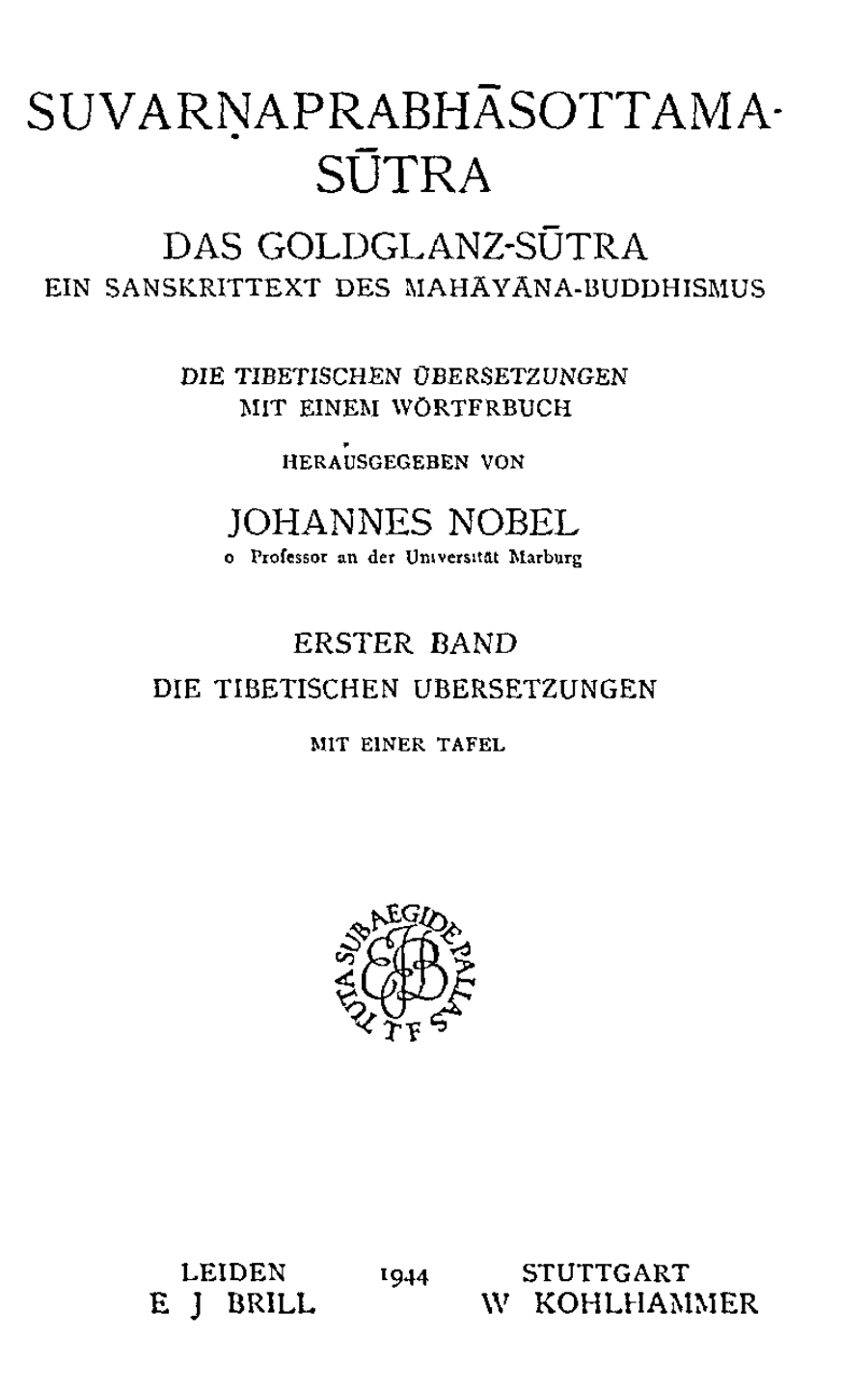
Suvarṇaprabhāsottama-Sūtra: Das Goldglanz-Sūtra—Erster Band: Die tibetischen Übersetzungen mit einem Wörterbuch (Leiden: E. J. Brill / Stuttgart: W. Kohlhammer, 1944) is Volume 1 of Johannes Nobel's critical edition of the Tibetan translations of the Suvarṇaprabhāsottamasūtra, presented alongside a dictionary (with the companion Tibetan-German-Sanskrit glossary following as Volume 2 in 1950). It forms the second phase of Nobel's larger three-part edition of the sūtra, preceded by his 1937 edition of the Sanskrit text (Leipzig: Harrassowitz) and followed by his 1958 edition of I-tsing's Chinese version with its Tibetan translation (Leiden: Brill). Together these volumes became the standard modern critical basis for the text, underlying R. E. Emmerick's widely used English translation, The Sutra of Golden Light.

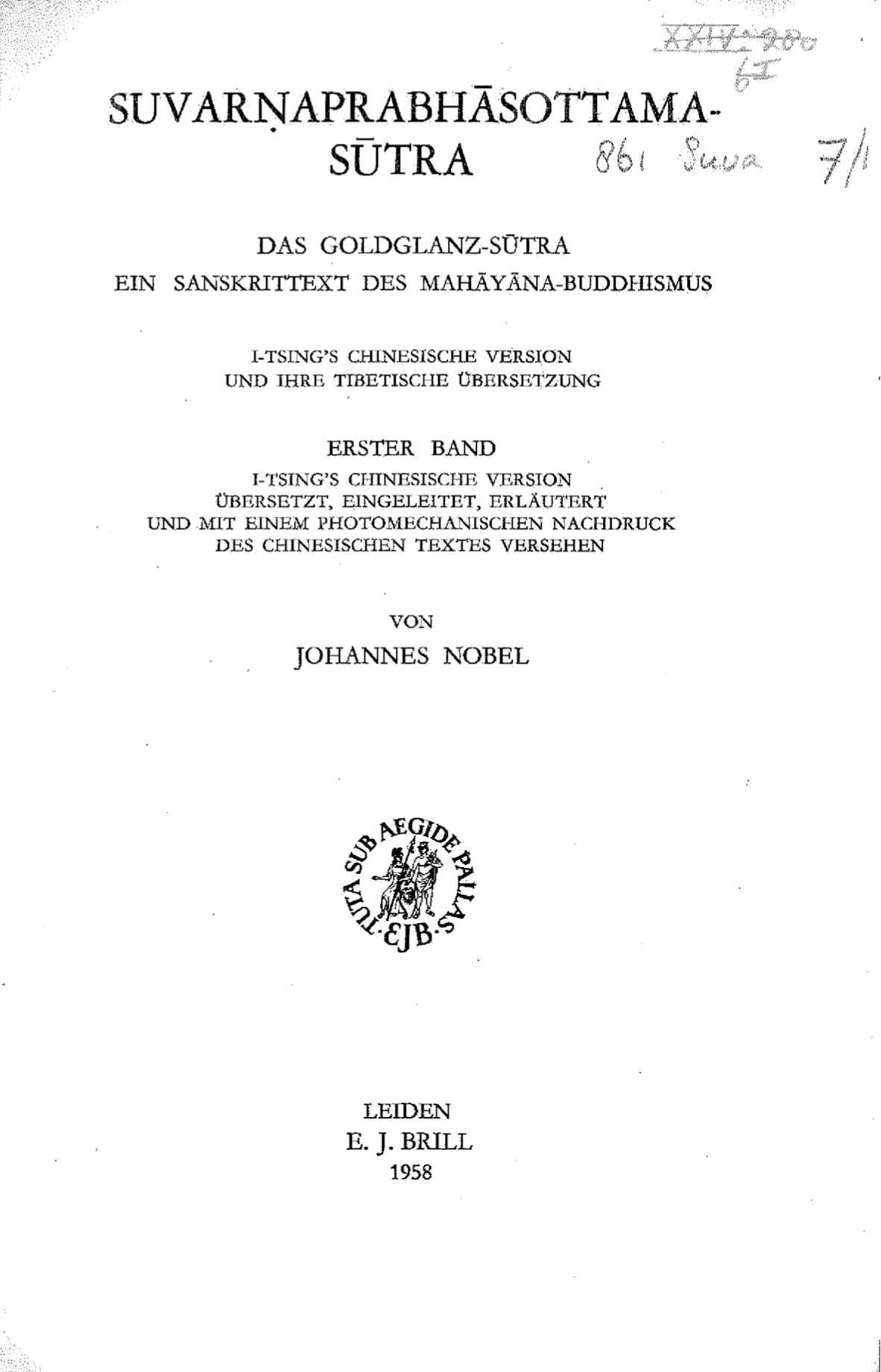
This is work represents vol. 1 (of 2). The first volume contains Yijing's Chinese version, transl., introduced, annotated and provided with a photomechanical reprint of the Chinese text by J. Nobel. The second volume contains the Tibetan translation edited with critical notes. (Source Accessed Aug 24, 2023)

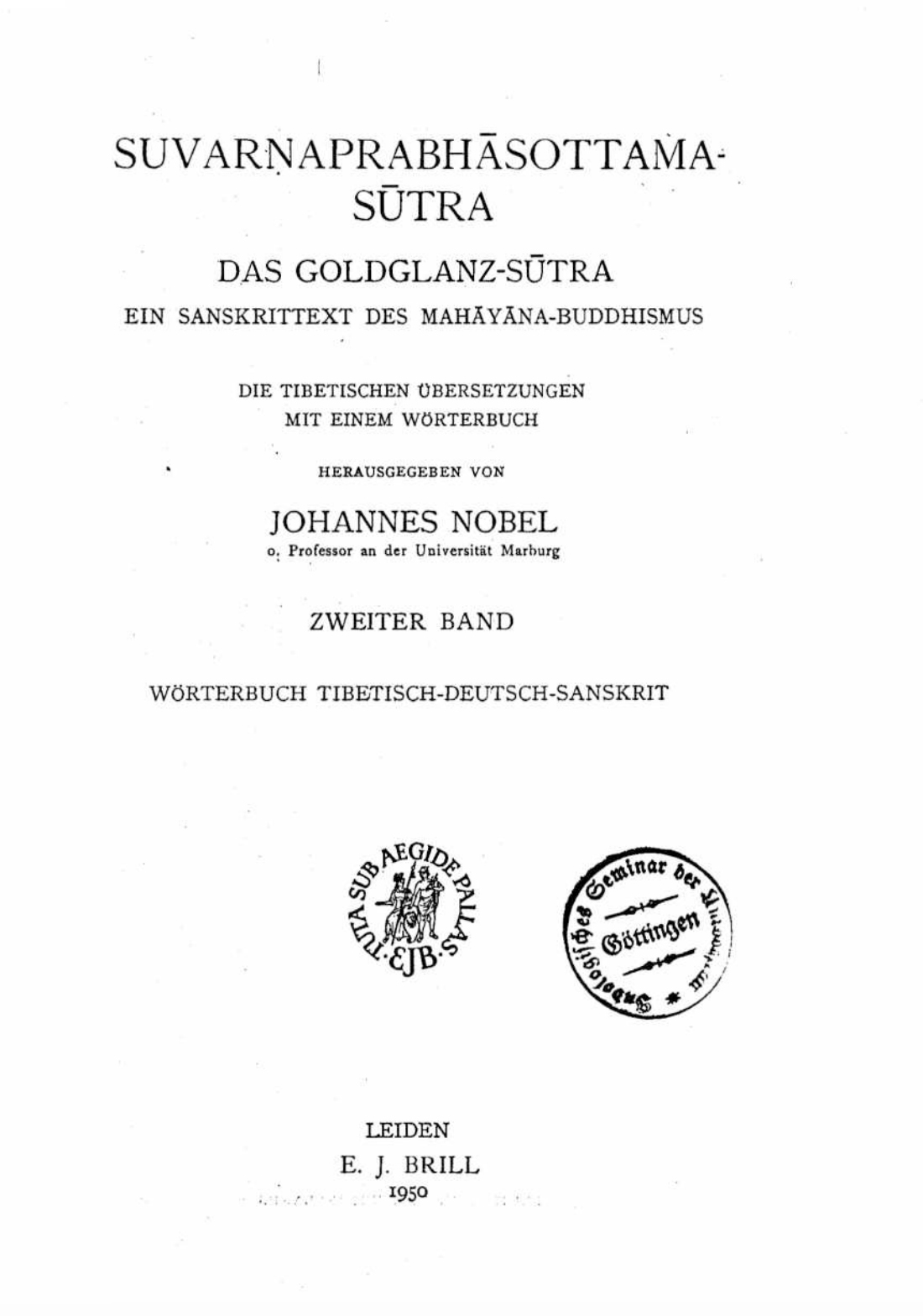
This is Volume 2 of Johannes Nobel's landmark critical edition of the Suvarṇaprabhāsottamasūtra ("Sūtra of Golden Light" / Gser 'od dam pa), one of the most influential Mahāyāna sūtras, especially in East Asian state-protection Buddhism. It comprises a Tibetan–German–Sanskrit dictionary/glossary, serving as the companion reference volume to Nobel's edition of the Tibetan translation of the sūtra published as Volume 1 in 1944.
This pairing (1944 Tibetan text + 1950 dictionary) formed the second phase of Nobel's larger three-part critical edition project on the sūtra:
1937 — critical edition of the Sanskrit text (Leipzig: Harrassowitz)
1944/1950 — the Tibetan translation with accompanying dictionary (this volume)