Suvarṇaprabhāsottamasūtrendrarājasūtra
| 🤓 Admin Zone 🛠️ hidden to non-admins | |


Description
- Suvarṇaprabhāsottamasūtrendrarājasūtra (RKTSK 550) translated from the Chinese by Gö Chödrub.
- Suvarṇaprabhāsottamasūtrendrarājasūtra (RKTSK 551) translated from the Sanskrit by Jinamitra, Śīlendrabodhi, and Ye shes sde.
- Suvarṇaprabhāsottamasūtrendrarājasūtra (RKTSK 552). Translator not listed.
Suvarṇaprabhāsottamasūtra. (T. Gser ’od dam pai mdo; C. Jinguangming zuishengwang jing; J. Konkōmyō saishōōkyō; K. Kǔmgwangmyǒng ch’oesǔngwang kyǒng). In Sanskrit, "Sūtra of Supreme Golden Light," an influential Mahāyāna sūtra, especially in East Asia. Scholars speculate that the text originated in India in the fourth century and was gradually augmented. It was translated into Chinese by Yijing in 703. The sūtra contains many dhāraṇī and is considered by some to be a proto-tantric text; in some editions of the Tibetan canon it is classified as a tantra. It is important in East Asian Buddhism for two main reasons. First was the role the sūtra played in conceptualizing state-protection Buddhism (huguo fojiao). The sūtra declares that deities will protect the lands of rulers who worship and uphold the sūtra, bringing peace and prosperity, but will abandon the lands of rulers who do not, such that all manner of catastrophe will befall their kingdoms. The sūtra was thus central to "state protection" practices in East Asia, together with the Saddharmapuṇḍarikasūtra and the Renwang jing. Second, the sūtra provides the locus classicus for the "water and land ceremony" (shuilu hui), a ritual intended for universal salvation, but especially of living creatures who inhabit the most painful domains of saṃsāra; the ceremony was also performed for a variety of this-worldly purposes, including state protection and rain-making. According to the sūtra, in a previous life, the Buddha was a merchant s son named Jalavāhana, who one day encountered a dried-up pond in the forest, filled with thousands of dying fish. Summoning twenty elephants, he carried bags of water from a river into the forest and replenished the pond, saving the fish. He then sent for food with which to feed them. Finally, recalling that anyone who hears the name of the buddha Ratnaśikhin will be reborn in the heavens, he waded into the pond and pronounced the Buddha's name, followed by an exposition of dependent origination. When the fish died, they were reborn in the Trāyastriṃśa heaven. Recalling the reason for their happy fate, they visited the world of humans, where each offered a pearl necklace to Jalavāhana's head, foot, right side, and left side. The sūtra also tells the story of Prince Mahāsattva who sees a starving tigress and her cubs. He throws himself off a cliff to commit suicide so that the tiger might eat his body (see Namo Buddha). This is one of the most famous cases of dehadāna, or gift of the body. (Source: "Suvarṇaprabhāsottamasūtra." In The Princeton Dictionary of Buddhism, 877. Princeton University Press, 2014. http://www.jstor.org/stable/j.ctt46n41q.27.)
Recensions
| Sanskrit | सुवर्णप्रभासोत्तमसूत्रेन्द्रराजसूत्र, Suvarṇaprabhāsottamasūtrendrarājasūtra.
|
|---|---|
| Tibetan | འཕགས་པ་གསེར་འོད་དམ་པ་མདོ་སྡེའི་དབང་པོའི་རྒྱལ་པོ་ཞེས་བྱ་བ་ཐེག་པ་ཆེན་པོའི་མདོ། ('phags pa gser 'od dam pa mdo sde'i dbang po'i rgyal po zhes bya ba theg pa chen po'i mdo). rKTs (Resources for Kanjur and Tanjur Studies) Link: https://www.istb.univie.ac.at/kanjur/rktsneu/verif/verif2.php?id=551.
|
| Chinese |
|

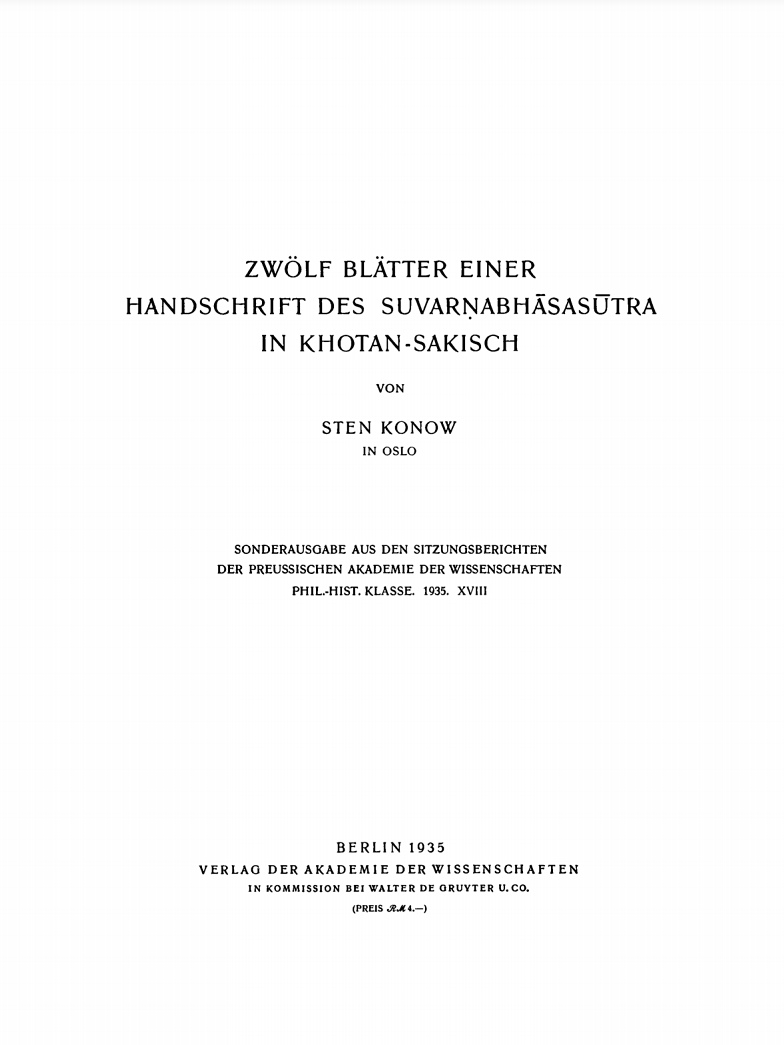
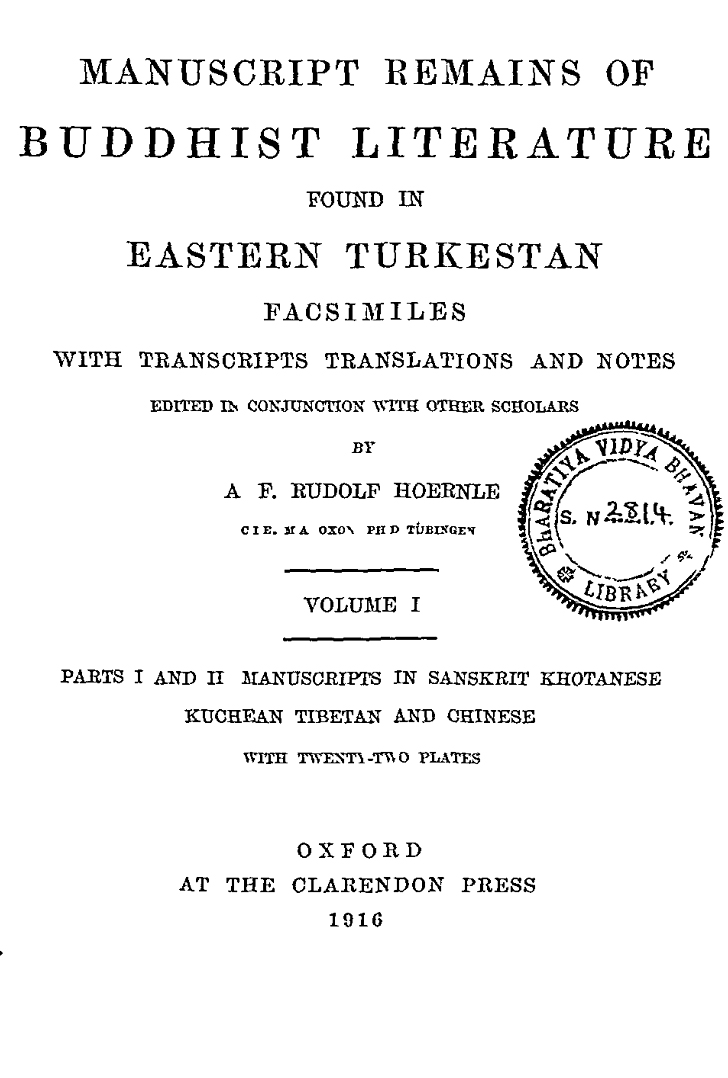
Fragments 1–2 are small, irregularly shaped pieces too damaged to yield a coherent sense or textual identification; Fragment 1 is tentatively judged the oldest of the set on paleographic grounds.
Fragment 3 is rhomboid, in a slanting Gupta script, and represents a discourse between the Buddha and Kāśyapa on the four classes of "false ascetics" (duḥśīlaśīlavatpratirūpakāḥ), correlated with dhūtaguṇa lists in the Dharmasaṃgraha and Mahāvyutpatti.
Fragment 4 is a complete leaf, badly damaged, containing a metrical portion (verses 8–16) dealing with bodhisattvas adorned with the four dharmas, with a partial parallel noted in Mahāvastu II; the prose section on the reverse could not be matched to a known text.
Fragment 5 is identified as a portion of the Saddharmapuṇḍarīka, corresponding to the printed text pp. 40¹⁶–41¹⁴, with the fragment's readings differing only slightly from the edition.
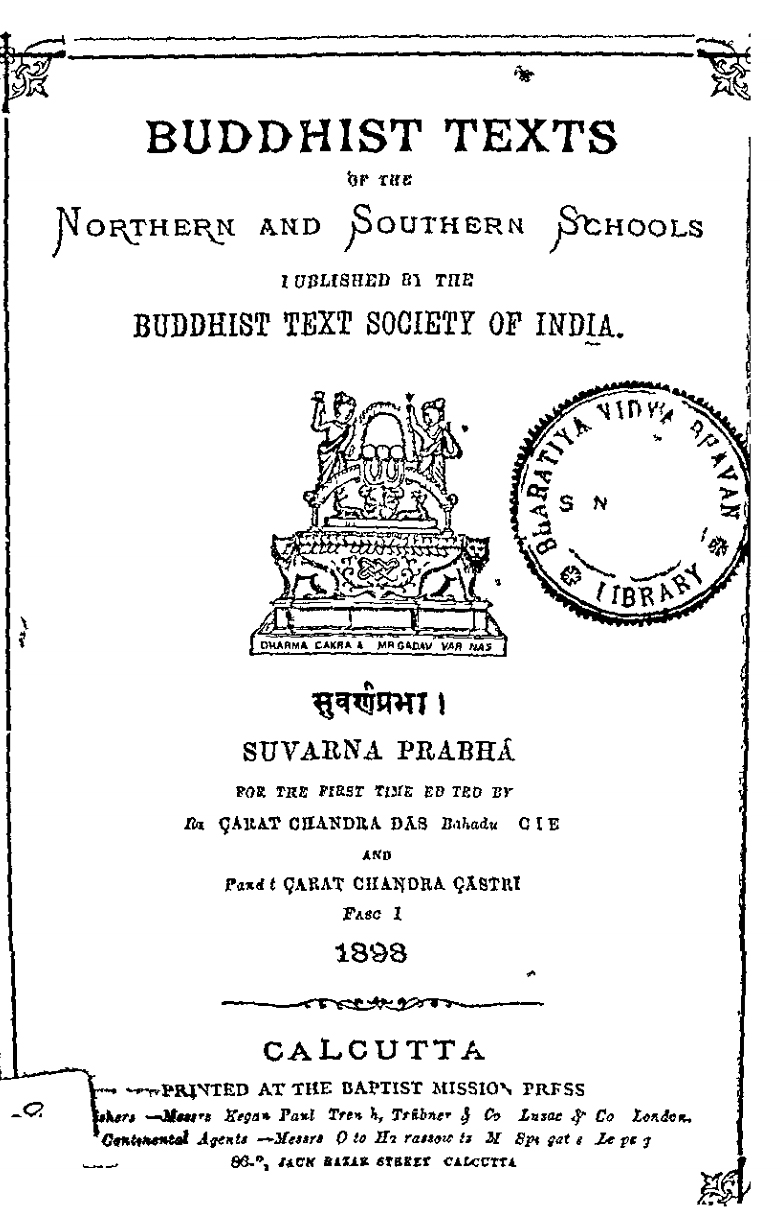
Fragment 6 (Plates III–IV) is identified as a portion of the Suvarṇaprabhāsa, corresponding to parivarta 14 and to p. 68⁹ ff. of Rai Sarat Chandra Śāstri's 1898 edition (Buddhist Texts Society of India, Calcutta). Reuter transcribes and restores the fragment's stanzas (numbered 27–32 in the source), comparing its readings against Śāstri's printed edition line by line and noting divergences in wording, meter, and vocabulary.
Fragment 7 (Plate V) corresponds to a passage in the Śatasāhasrikāprajñāpāramitā, 11th parivarta, but the fragment distributes the same text over two differently-numbered parivartas and shows enough divergence from the printed edition to suggest it belongs to a different manuscript recension, possibly related to Fragment 8.
Fragment 8 (Plate VI) is a complete leaf (numbered 147) closely allied to the Śatasāhasrikāprajñāpāramitā, opening with the bodhisattva Subhūti's questions to the Buddha on the "dream-like" and "illusion-like" nature of phenomena, and possibly forming part of the same textual tradition as Fragment 7, though not the same manuscript.
Fragment 9 (Plate VII) could not be identified with any known text; its general argument concerns the invincibility of an irreversible (avaivartika) bodhisattva's mind against the hosts of Māra, illustrated by the simile of a lapis lazuli gem placed amid glass beads, whose luster the glass cannot eclipse.
Fragment 10 (Plate I) is a small, bilingual Sanskrit-Khotanese piece, difficult to read, containing scattered decipherable words in both languages.
Fragment 11 (Plates VIII–IX) is a Khotanese-language piece naming the otherwise rare bodhisattva Bhaiṣajasena, offering philological comparanda with other known Khotanese Buddhist manuscripts (the Stein collection and the Godfrey manuscripts), and providing material for Reuter's discussion of Khotanese numerals, loanwords from Sanskrit, and verb morphology.


Salguero argues that despite the chapter's canonical status in Buddhist tradition, it should not be read as evidence of a distinct "Buddhist medicine": the narrative—in which the future Buddha, reborn as the physician's son Jalavāhana, learns and practices medicine out of compassion during an epidemic—never attributes his medical knowledge to a Buddhist source. The doctrinal content is standard Indian medicine framed in a Buddhist narrative. He notes this does not diminish the text's value, however, since Dharmakṣema and Yijing preserved the material with minimal Chinese doctrinal interpolation, making it a useful, relatively unobstructed source for the history of Indian medicine itself.
The translated content covers seasonal fluctuations of the bodily Elements and doṣas, flavor- and diet-based treatments, the "Eight Arts" of medicine, diagnosis of constitutional type, prognostic death-signs, and universal remedies (myrobalan, ghee, honey, sugar), closing with an injunction to practice medicine from compassion rather than profit.
In this sūtra, the bodhisattva Ruciraketu has a dream in which a prayer of confession emanates from a shining golden drum. He relates the prayer to the Buddha, and a number of deities then vow to protect it and its adherents. The ruler’s devotion to the sūtra is emphasized as important if the nation is to benefit. Toward the end of the sūtra are two well-known narratives of the Buddha’s previous lives: the account of the physician Jalavāhana, who saves and blesses numerous fish, and that of Prince Mahāsattva, who gives his body to a hungry tigress and her cubs.
This is the longest version of The Sūtra of the Sublime Golden Light preserved in the Kangyur. It comprises thirty-one chapters and was translated into Tibetan primarily from Yijing’s Chinese translation in the early ninth century. (Source: 84000)
In this sūtra, the bodhisattva Ruciraketu has a dream in which a prayer of confession emanates from a shining golden drum. He relates the prayer to the Buddha, and a number of deities then vow to protect it and its adherents. The ruler’s devotion to the sūtra is emphasized as important if the nation is to benefit. Toward the end of the sūtra are two well-known narratives of the Buddha’s previous lives: the account of the physician Jalavāhana, who saves and blesses numerous fish, and that of Prince Mahāsattva, who gives his body to a hungry tigress and her cubs.
This is the second-longest version of The Sūtra of the Sublime Golden Light preserved in the Kangyur. It comprises twenty-nine chapters and was translated into Tibetan primarily from Sanskrit. (Source: 84000)In this sūtra, the bodhisattva Ruciraketu has a dream in which a prayer of confession emanates from a shining golden drum. He relates the prayer to the Buddha, and a number of deities then vow to protect it and its adherents. The ruler’s devotion to the sūtra is emphasized as important if the nation is to benefit. Toward the end of the sūtra are two well-known narratives of the Buddha’s previous lives: the account of the physician Jalavāhana, who saves and blesses numerous fish, and that of Prince Mahāsattva, who gives his body to a hungry tigress and her cubs.
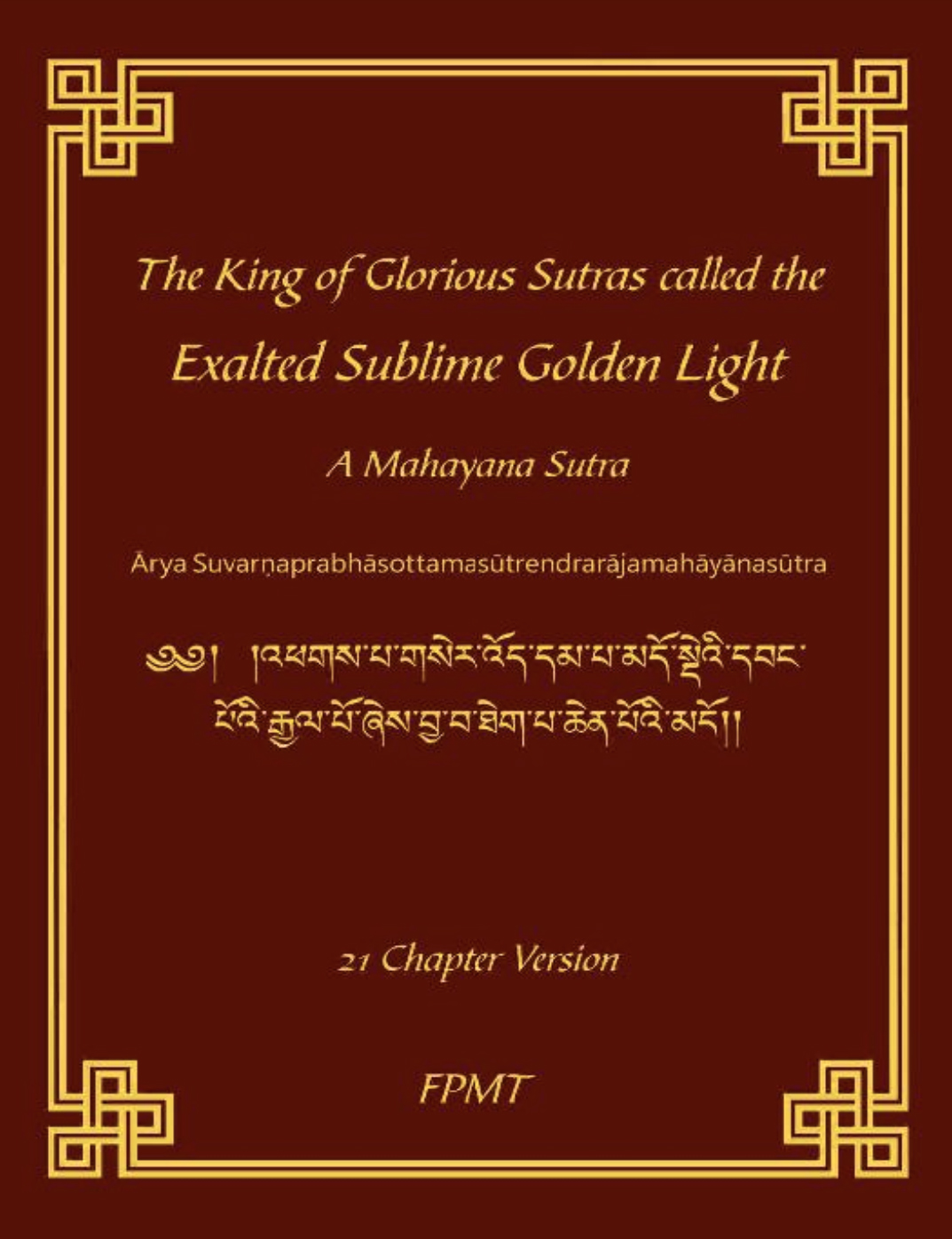
This is the shortest version of The Sūtra of the Sublime Golden Light preserved in the Kangyur. It comprises twenty-one chapters, was translated into Tibetan primarily from Sanskrit, and is the only version for which a complete Sanskrit manuscript survives. (Source: 84000)
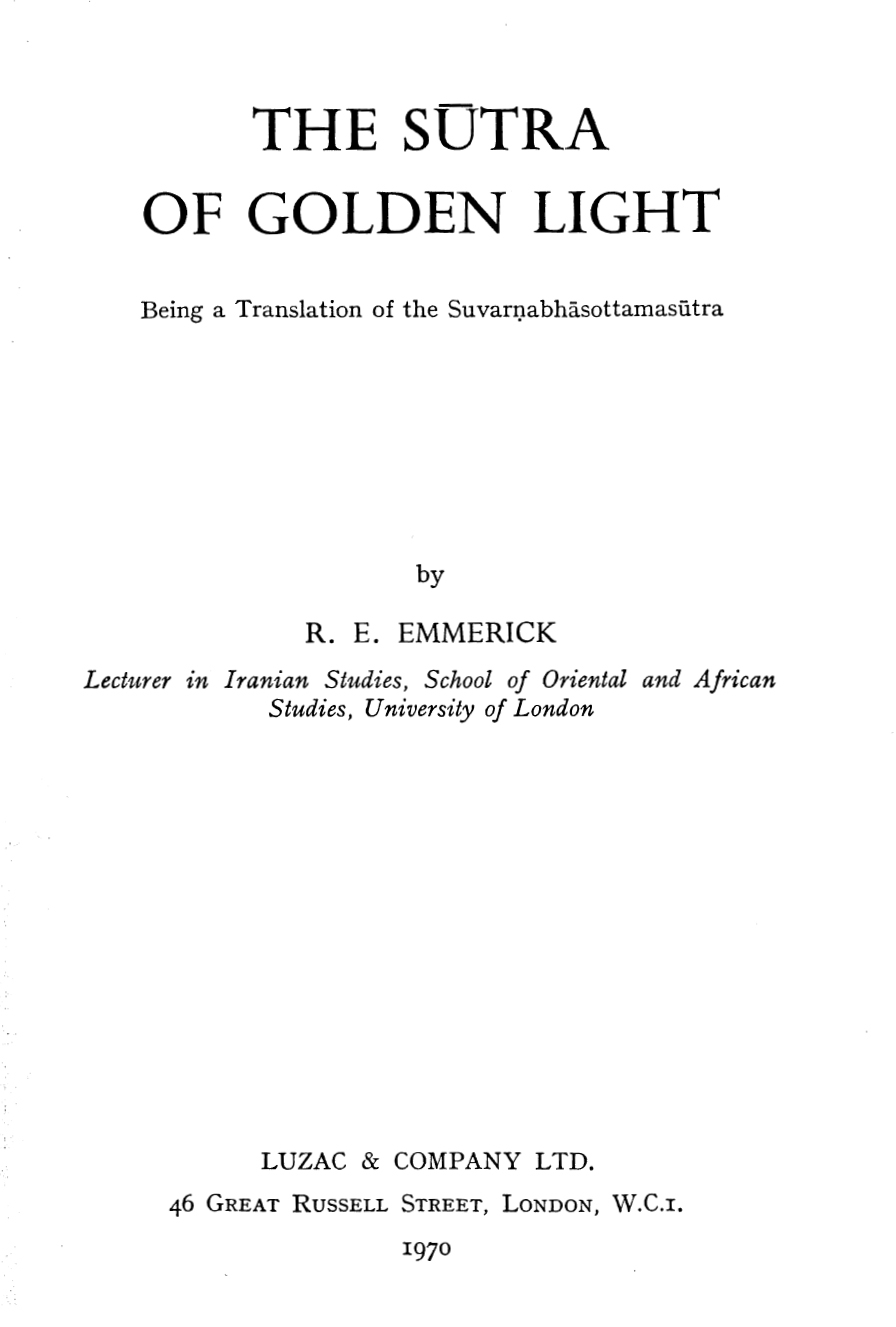
The dissertation explores the complex relationships among the sūtra, the Buddha, and the dharmabhānaka (the orator), as well as the synesthetic representation of the oral/aural sūtra as a potent substance (especially as a rasa, a savory liquid that is also an aesthetic quality) that enters and transforms its audience and their world. The categories of analysis employed in this close reading are derived from the Suvarna(pra)bhāsottamasūtra itself: the relationships between the form and the content of the sūtra, and between the sūtra and its auditors and orators. The words of the sūtra are about the potency of the words of the sūtra; this involuted relationship between form and content is critical to the articulation of the sūtra's potency. The sūtra also asserts the critical dependence of its value and transformative capacity upon its being uttered by an eloquent orator and heard by a receptive audience—a scenario that is intricately mirrored in the narrative content and form of the sūtra. The role of these relationships in the articulation of the sūtra's potency informs the methodology of this study.
While the Sanskrit text is the primary focus of the study, Chinese, Tibetan, and Khotanese translations of the Suvarna(pra)bhāsottamasūtra are also considered. Translation, as an interpretive process, provides a crucial glimpse of the different ways in which potency has been interpreted and re-created in varied Buddhist communities, thereby both confirming and complicating the reading of the Sanskrit text presented in this study. (Source Accessed Aug 5, 2026)

Fragments 1–2 are small, irregularly shaped pieces too damaged to yield a coherent sense or textual identification; Fragment 1 is tentatively judged the oldest of the set on paleographic grounds.
Fragment 3 is rhomboid, in a slanting Gupta script, and represents a discourse between the Buddha and Kāśyapa on the four classes of "false ascetics" (duḥśīlaśīlavatpratirūpakāḥ), correlated with dhūtaguṇa lists in the Dharmasaṃgraha and Mahāvyutpatti.
Fragment 4 is a complete leaf, badly damaged, containing a metrical portion (verses 8–16) dealing with bodhisattvas adorned with the four dharmas, with a partial parallel noted in Mahāvastu II; the prose section on the reverse could not be matched to a known text.
Fragment 5 is identified as a portion of the Saddharmapuṇḍarīka, corresponding to the printed text pp. 40¹⁶–41¹⁴, with the fragment's readings differing only slightly from the edition.
Fragment 6 (Plates III–IV) is identified as a portion of the Suvarṇaprabhāsa, corresponding to parivarta 14 and to p. 68⁹ ff. of Rai Sarat Chandra Śāstri's 1898 edition (Buddhist Texts Society of India, Calcutta). Reuter transcribes and restores the fragment's stanzas (numbered 27–32 in the source), comparing its readings against Śāstri's printed edition line by line and noting divergences in wording, meter, and vocabulary.
Fragment 7 (Plate V) corresponds to a passage in the Śatasāhasrikāprajñāpāramitā, 11th parivarta, but the fragment distributes the same text over two differently-numbered parivartas and shows enough divergence from the printed edition to suggest it belongs to a different manuscript recension, possibly related to Fragment 8.
Fragment 8 (Plate VI) is a complete leaf (numbered 147) closely allied to the Śatasāhasrikāprajñāpāramitā, opening with the bodhisattva Subhūti's questions to the Buddha on the "dream-like" and "illusion-like" nature of phenomena, and possibly forming part of the same textual tradition as Fragment 7, though not the same manuscript.
Fragment 9 (Plate VII) could not be identified with any known text; its general argument concerns the invincibility of an irreversible (avaivartika) bodhisattva's mind against the hosts of Māra, illustrated by the simile of a lapis lazuli gem placed amid glass beads, whose luster the glass cannot eclipse.
Fragment 10 (Plate I) is a small, bilingual Sanskrit-Khotanese piece, difficult to read, containing scattered decipherable words in both languages.
Fragment 11 (Plates VIII–IX) is a Khotanese-language piece naming the otherwise rare bodhisattva Bhaiṣajasena, offering philological comparanda with other known Khotanese Buddhist manuscripts (the Stein collection and the Godfrey manuscripts), and providing material for Reuter's discussion of Khotanese numerals, loanwords from Sanskrit, and verb morphology.

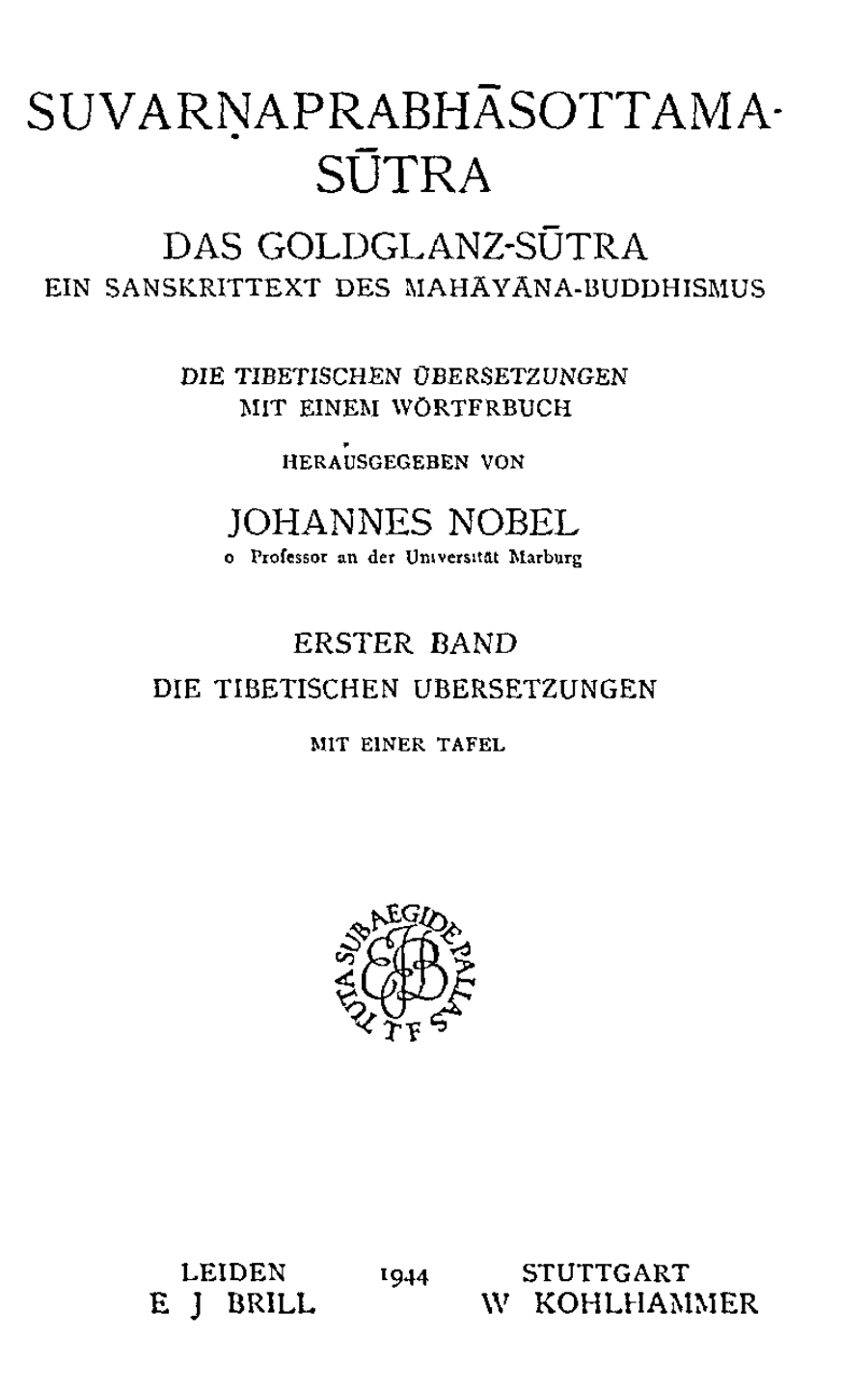
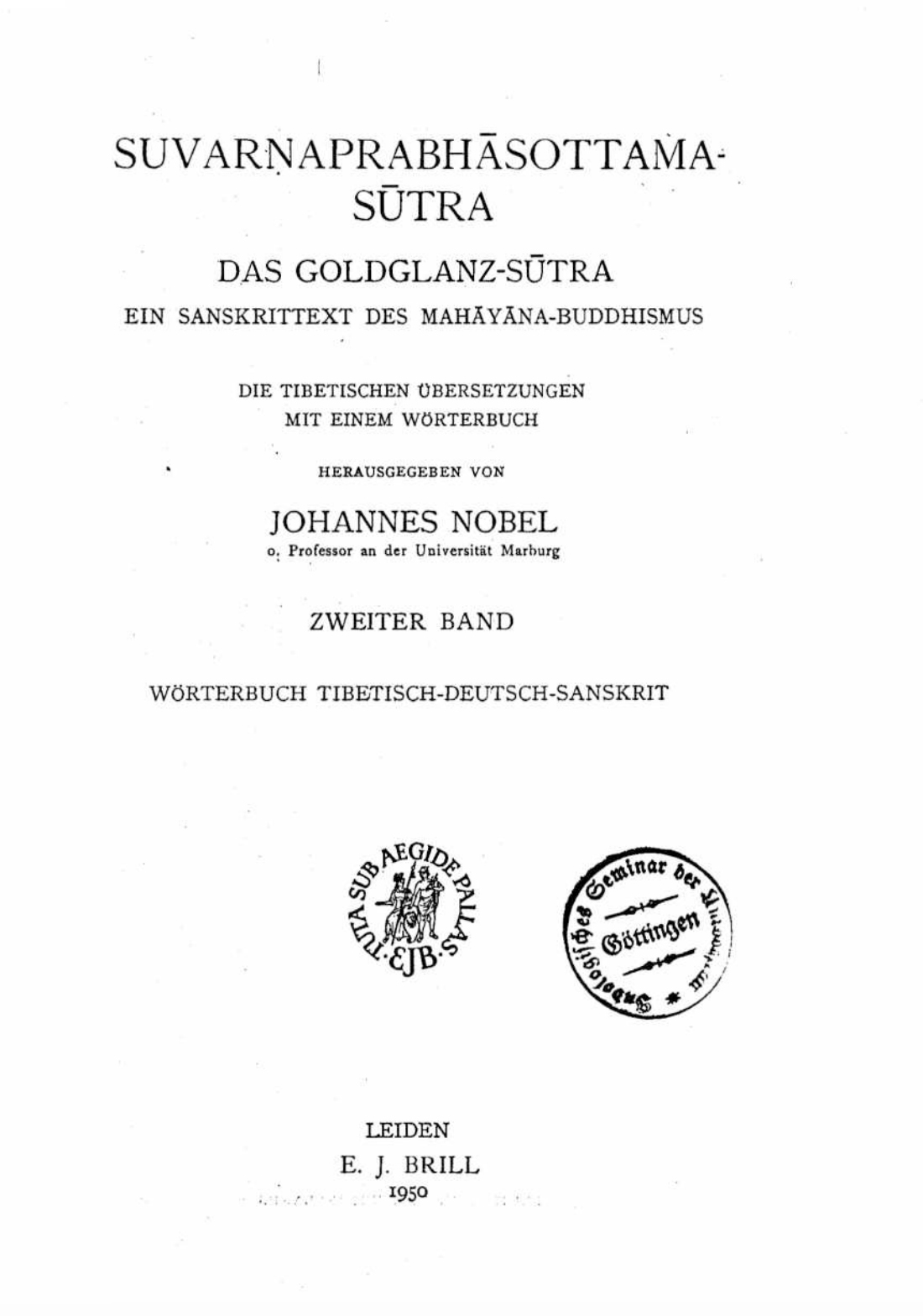
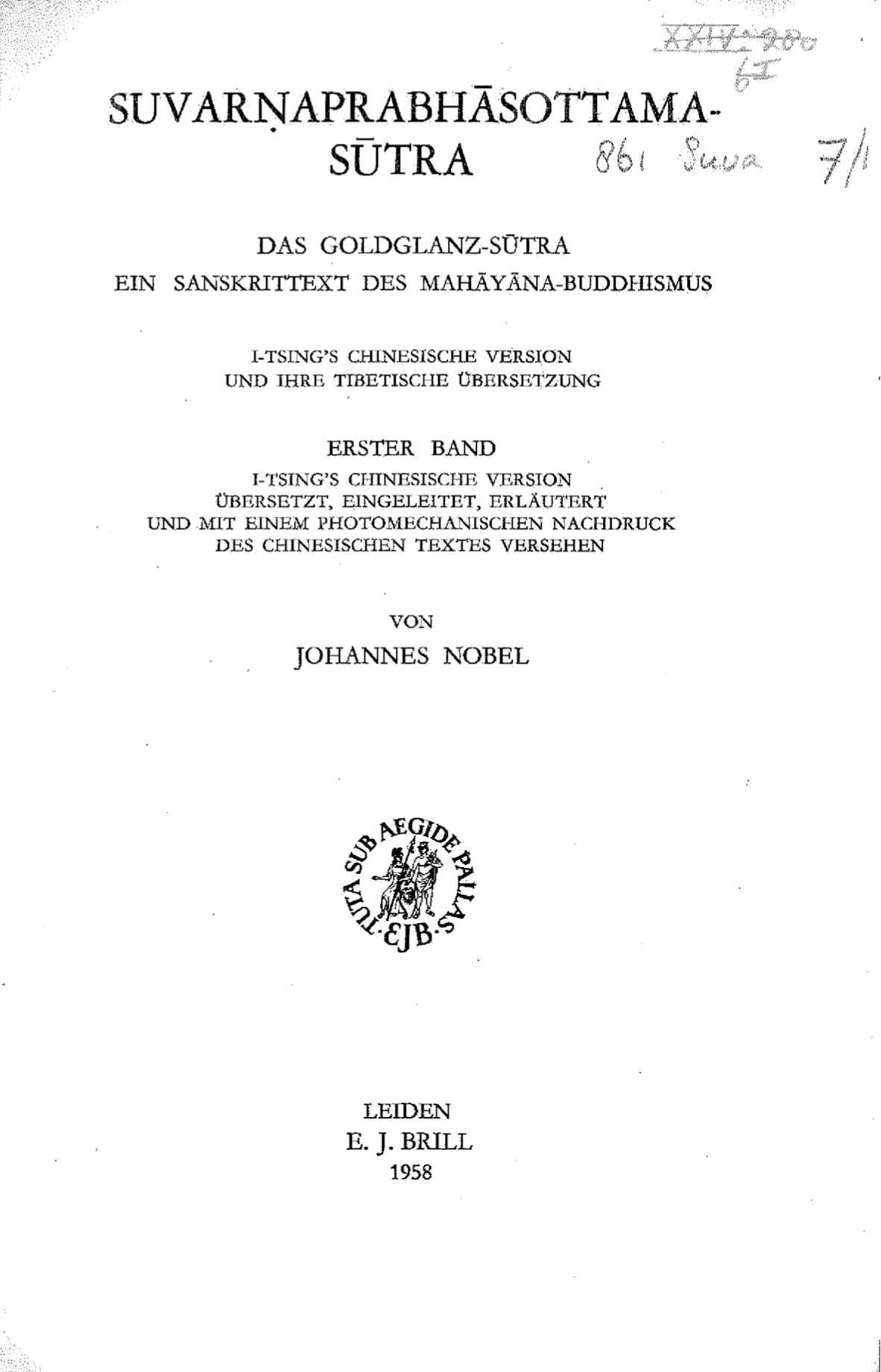
This pairing (1944 Tibetan text + 1950 dictionary) formed the second phase of Nobel's larger three-part critical edition project on the sūtra:
1937 — critical edition of the Sanskrit text (Leipzig: Harrassowitz)
1944/1950 — the Tibetan translation with accompanying dictionary (this volume)
Salguero argues that despite the chapter's canonical status in Buddhist tradition, it should not be read as evidence of a distinct "Buddhist medicine": the narrative—in which the future Buddha, reborn as the physician's son Jalavāhana, learns and practices medicine out of compassion during an epidemic—never attributes his medical knowledge to a Buddhist source. The doctrinal content is standard Indian medicine framed in a Buddhist narrative. He notes this does not diminish the text's value, however, since Dharmakṣema and Yijing preserved the material with minimal Chinese doctrinal interpolation, making it a useful, relatively unobstructed source for the history of Indian medicine itself.
The translated content covers seasonal fluctuations of the bodily Elements and doṣas, flavor- and diet-based treatments, the "Eight Arts" of medicine, diagnosis of constitutional type, prognostic death-signs, and universal remedies (myrobalan, ghee, honey, sugar), closing with an injunction to practice medicine from compassion rather than profit.The dissertation explores the complex relationships among the sūtra, the Buddha, and the dharmabhānaka (the orator), as well as the synesthetic representation of the oral/aural sūtra as a potent substance (especially as a rasa, a savory liquid that is also an aesthetic quality) that enters and transforms its audience and their world. The categories of analysis employed in this close reading are derived from the Suvarna(pra)bhāsottamasūtra itself: the relationships between the form and the content of the sūtra, and between the sūtra and its auditors and orators. The words of the sūtra are about the potency of the words of the sūtra; this involuted relationship between form and content is critical to the articulation of the sūtra's potency. The sūtra also asserts the critical dependence of its value and transformative capacity upon its being uttered by an eloquent orator and heard by a receptive audience—a scenario that is intricately mirrored in the narrative content and form of the sūtra. The role of these relationships in the articulation of the sūtra's potency informs the methodology of this study.
While the Sanskrit text is the primary focus of the study, Chinese, Tibetan, and Khotanese translations of the Suvarna(pra)bhāsottamasūtra are also considered. Translation, as an interpretive process, provides a crucial glimpse of the different ways in which potency has been interpreted and re-created in varied Buddhist communities, thereby both confirming and complicating the reading of the Sanskrit text presented in this study. (Source Accessed Aug 5, 2026)Fragments 1–2 are small, irregularly shaped pieces too damaged to yield a coherent sense or textual identification; Fragment 1 is tentatively judged the oldest of the set on paleographic grounds.
Fragment 3 is rhomboid, in a slanting Gupta script, and represents a discourse between the Buddha and Kāśyapa on the four classes of "false ascetics" (duḥśīlaśīlavatpratirūpakāḥ), correlated with dhūtaguṇa lists in the Dharmasaṃgraha and Mahāvyutpatti.
Fragment 4 is a complete leaf, badly damaged, containing a metrical portion (verses 8–16) dealing with bodhisattvas adorned with the four dharmas, with a partial parallel noted in Mahāvastu II; the prose section on the reverse could not be matched to a known text.
Fragment 5 is identified as a portion of the Saddharmapuṇḍarīka, corresponding to the printed text pp. 40¹⁶–41¹⁴, with the fragment's readings differing only slightly from the edition.
Fragment 6 (Plates III–IV) is identified as a portion of the Suvarṇaprabhāsa, corresponding to parivarta 14 and to p. 68⁹ ff. of Rai Sarat Chandra Śāstri's 1898 edition (Buddhist Texts Society of India, Calcutta). Reuter transcribes and restores the fragment's stanzas (numbered 27–32 in the source), comparing its readings against Śāstri's printed edition line by line and noting divergences in wording, meter, and vocabulary.
Fragment 7 (Plate V) corresponds to a passage in the Śatasāhasrikāprajñāpāramitā, 11th parivarta, but the fragment distributes the same text over two differently-numbered parivartas and shows enough divergence from the printed edition to suggest it belongs to a different manuscript recension, possibly related to Fragment 8.
Fragment 8 (Plate VI) is a complete leaf (numbered 147) closely allied to the Śatasāhasrikāprajñāpāramitā, opening with the bodhisattva Subhūti's questions to the Buddha on the "dream-like" and "illusion-like" nature of phenomena, and possibly forming part of the same textual tradition as Fragment 7, though not the same manuscript.
Fragment 9 (Plate VII) could not be identified with any known text; its general argument concerns the invincibility of an irreversible (avaivartika) bodhisattva's mind against the hosts of Māra, illustrated by the simile of a lapis lazuli gem placed amid glass beads, whose luster the glass cannot eclipse.
Fragment 10 (Plate I) is a small, bilingual Sanskrit-Khotanese piece, difficult to read, containing scattered decipherable words in both languages.
Fragment 11 (Plates VIII–IX) is a Khotanese-language piece naming the otherwise rare bodhisattva Bhaiṣajasena, offering philological comparanda with other known Khotanese Buddhist manuscripts (the Stein collection and the Godfrey manuscripts), and providing material for Reuter's discussion of Khotanese numerals, loanwords from Sanskrit, and verb morphology.
This pairing (1944 Tibetan text + 1950 dictionary) formed the second phase of Nobel's larger three-part critical edition project on the sūtra:
1937 — critical edition of the Sanskrit text (Leipzig: Harrassowitz)
1944/1950 — the Tibetan translation with accompanying dictionary (this volume)
Salguero argues that despite the chapter's canonical status in Buddhist tradition, it should not be read as evidence of a distinct "Buddhist medicine": the narrative—in which the future Buddha, reborn as the physician's son Jalavāhana, learns and practices medicine out of compassion during an epidemic—never attributes his medical knowledge to a Buddhist source. The doctrinal content is standard Indian medicine framed in a Buddhist narrative. He notes this does not diminish the text's value, however, since Dharmakṣema and Yijing preserved the material with minimal Chinese doctrinal interpolation, making it a useful, relatively unobstructed source for the history of Indian medicine itself.
The translated content covers seasonal fluctuations of the bodily Elements and doṣas, flavor- and diet-based treatments, the "Eight Arts" of medicine, diagnosis of constitutional type, prognostic death-signs, and universal remedies (myrobalan, ghee, honey, sugar), closing with an injunction to practice medicine from compassion rather than profit.