There are three translations of this text included in the Tibetan canon:
- Suvarṇaprabhāsottamasūtrendrarājasūtra (RKTSK 550) translated from the Chinese by Gö Chödrub.
- Suvarṇaprabhāsottamasūtrendrarājasūtra (RKTSK 551) translated from the Sanskrit by Jinamitra, Śīlendrabodhi, and Ye shes sde.
- Suvarṇaprabhāsottamasūtrendrarājasūtra (RKTSK 552). Translator not listed.
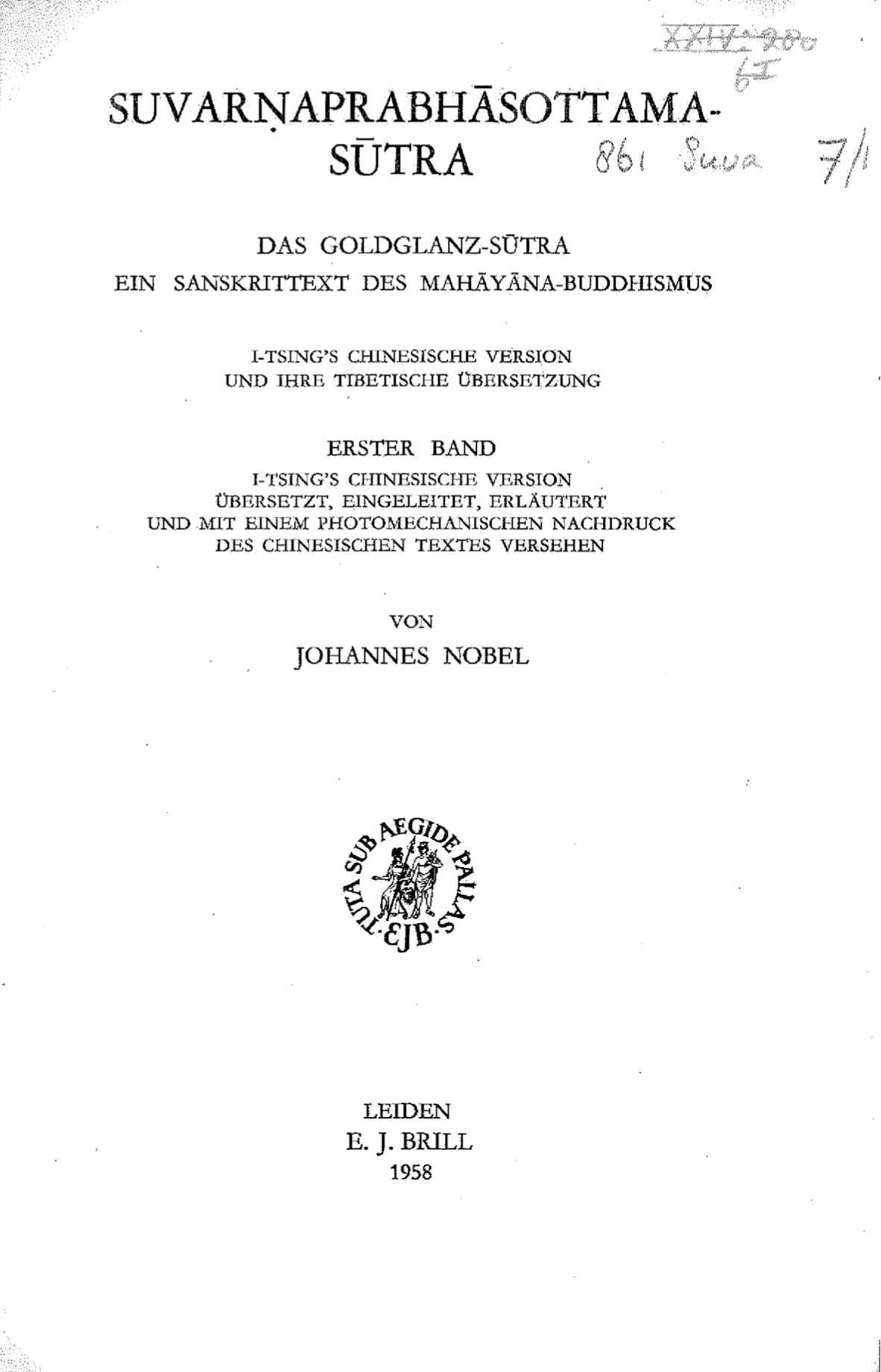
Suvarṇaprabhāsottamasūtra. (T. Gser ’od dam pai mdo; C. Jinguangming zuishengwang jing; J. Konkōmyō saishōōkyō; K. Kǔmgwangmyǒng ch’oesǔngwang kyǒng). In Sanskrit, "Sūtra of Supreme Golden Light," an influential
Mahāyāna sūtra, especially in East Asia. Scholars speculate that the text originated in India in the fourth century and was gradually augmented. It was translated into Chinese by Yijing in 703. The sūtra contains many dhāraṇī and is considered by some to be a proto-tantric text; in some editions of the Tibetan canon it is classified as a
tantra. It is important in East Asian Buddhism for two main reasons. First was the role the sūtra played in conceptualizing state-protection Buddhism (huguo fojiao). The sūtra declares that deities will protect the lands of rulers who worship and uphold the sūtra, bringing peace and prosperity, but will abandon the lands of rulers who do not, such that all manner of catastrophe will befall their kingdoms. The sūtra was thus central to "state protection" practices in East Asia, together with the
Saddharmapuṇḍarikasūtra and the
Renwang jing. Second, the sūtra provides the locus classicus for the "water and land ceremony" (shuilu hui), a ritual intended for universal salvation, but especially of living creatures who inhabit the most painful domains of saṃsāra; the ceremony was also performed for a variety of this-worldly purposes, including state protection and rain-making. According to the sūtra, in a previous life, the Buddha was a merchant s son named Jalavāhana, who one day encountered a dried-up pond in the forest, filled with thousands of dying fish. Summoning twenty elephants, he carried bags of water from a river into the forest and replenished the pond, saving the fish. He then sent for food with which to feed them. Finally, recalling that anyone who hears the name of the buddha Ratnaśikhin will be reborn in the heavens, he waded into the pond and pronounced the Buddha's name, followed by an exposition of dependent origination. When the fish died, they were reborn in the Trāyastriṃśa heaven. Recalling the reason for their happy fate, they visited the world of humans, where each offered a pearl necklace to Jalavāhana's head, foot, right side, and left side. The sūtra also tells the story of Prince Mahāsattva who sees a starving tigress and her cubs. He throws himself off a cliff to commit suicide so that the tiger might eat his body (see Namo Buddha). This is one of the most famous cases of
dehadāna, or gift of the body. (Source: "Suvarṇaprabhāsottamasūtra." In
The Princeton Dictionary of Buddhism, 877. Princeton University Press, 2014.
http://www.jstor.org/stable/j.ctt46n41q.27.)