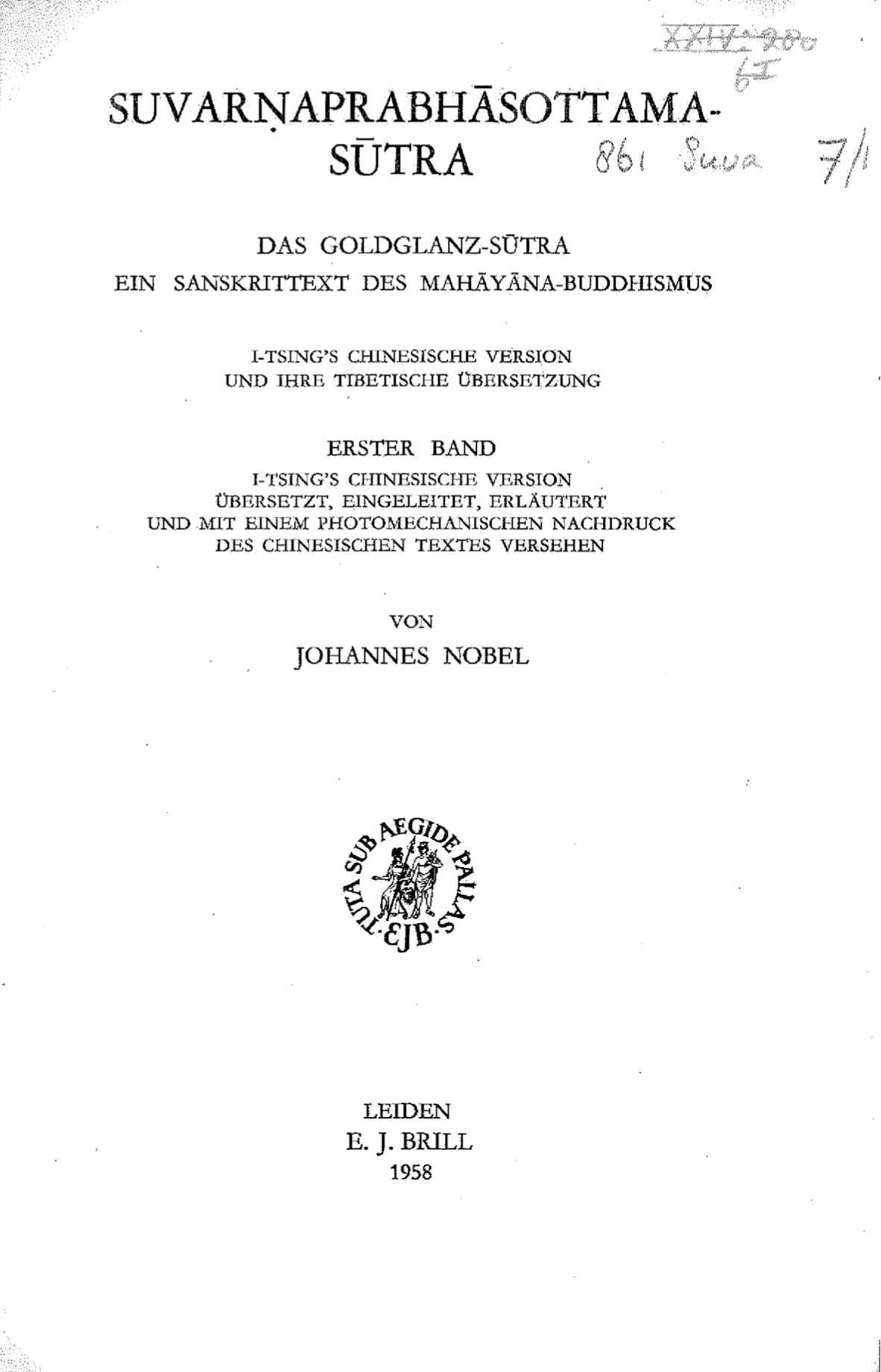
Suvarṇaprabhāsottama-Sūtra: Das Goldglanz-Sūtra - Vol. 1 (Nobel 1958)
| 🤓 Admin Zone 🛠️ hidden to non-admins | |

Description
- Vorwortvii-viii
- Photokopie der Vorrede zu einer Teilabschrift aus den Grotten von Tun-huangxi
- Einleitungxiii
- Inhaltsangabexxxvii
- Literaturangabenlviii
- Abkürzungenlxiii
- Deutsche Übersetzung von I-tsing’s Text3-366
- Kap.
- 1. Einleitung3-15
- 2. Die Lebensdauer des Tathāgata15-40
- 3. Die Lehre von den drei Körpern41-79
- 4. Das Traumgesicht des reuevollen Bekenntnisses80-94
- 5. Die Beseitigung der Hindernisse der Tat 95-123
- 6. Die dhāraṇī des ganz reinen Landes124-156
- 7. Der Lobpreis nach dem Bilde des Lotus157-163
- 8. Die dhāraṇī Goldsieg163-167
- 9. Die Erklärung des Wesens der Leerheit167-173
- 10. Die Erfüllung der Wünsche auf der Grundlage der Leerheit174-185
- 11. Das Hinschauen der vier Himmelskönige auf die Götter und Menschen186-188
- 12. Die Beschützung des Landes durch die vier Himmelskönige189-218
- 13. Die dhāraṇī Nichtanhaftung219-221
- 14. Der Wunschedelstein221-227
- 15. Die grosse Göttin Sarasvatī227-266
- 16. Die grosse Göttin Sri266-268
- 17. Die Mehrung der Schätze durch die grosse Göttin Sri268-272
- 18. Dṛdhā, die Gottheit der Erde273-279
- 19. Saṃjñāya, der grosse Heerführer der Yakṣas279-283
- 20. Die rechte Lehrunterweisung im Königs-dharma283-293
- 21. König Susaṃbhava294-298
- 22. Der Schutz der Götter und Yakṣas298-309
- 23. Die Prophezeiung309-312
- 24. Die Heilung der Krankheiten312-323
- 25. Jalavāhana, der Sohn des Gildemeisters323-332
- 26. Die Hingabe des Körpers333-351
- 27. Der Lobpreis der Bodhisattvas der zehn Himmels gegenden352-354
- 28. Der Lobpreis des Bodhisattva Ruciraketu354-356
- 29. Der Lobpreis der Gottheit des bodhi-Baumes356-358
- 30. Der Lobpreis der grossen Göttin Sarasvatī358-361
- 31. Die Überantwortung361-366
- Chinesischer Text. Photomechanischer Nachdruck von I-tsing’s Version nach der Ausgabe des Taishō Issaikyō,
Band 16, Seite 403-456367-422
- Chinesischer Text. Photomechanischer Nachdruck von I-tsing’s Version nach der Ausgabe des Taishō Issaikyō,

In this sūtra, the bodhisattva Ruciraketu has a dream in which a prayer of confession emanates from a shining golden drum. He relates the prayer to the Buddha, and a number of deities then vow to protect it and its adherents. The ruler’s devotion to the sūtra is emphasized as important if the nation is to benefit. Toward the end of the sūtra are two well-known narratives of the Buddha’s previous lives: the account of the physician Jalavāhana, who saves and blesses numerous fish, and that of Prince Mahāsattva, who gives his body to a hungry tigress and her cubs.
This is the longest version of The Sūtra of the Sublime Golden Light preserved in the Kangyur. It comprises thirty-one chapters and was translated into Tibetan primarily from Yijing’s Chinese translation in the early ninth century. (Source: 84000)In this sūtra, the bodhisattva Ruciraketu has a dream in which a prayer of confession emanates from a shining golden drum. He relates the prayer to the Buddha, and a number of deities then vow to protect it and its adherents. The ruler’s devotion to the sūtra is emphasized as important if the nation is to benefit. Toward the end of the sūtra are two well-known narratives of the Buddha’s previous lives: the account of the physician Jalavāhana, who saves and blesses numerous fish, and that of Prince Mahāsattva, who gives his body to a hungry tigress and her cubs.
This is the longest version of The Sūtra of the Sublime Golden Light preserved in the Kangyur. It comprises thirty-one chapters and was translated into Tibetan primarily from Yijing’s Chinese translation in the early ninth century. (Source: 84000)