Saddharmapuṇḍarīkasūtra

From Bodhicitta
< Texts(Redirected from Saddharmapuṇḍarīka Sūtra)
Texts/Saddharmapuṇḍarīkasūtra

🤓 Admin Zone 🛠️ hidden to non-admins
सद्धर्मपुण्डरीकसूत्र
Saddharmapuṇḍarīkasūtra
དམ་པའི་ཆོས་པད་མ་དཀར་པོ་ཞེས་བྱ་བ་ཐེག་པ་ཆེན་པོའི་མདོ།
dam pa'i chos pad ma dkar po zhes bya ba theg pa chen po'i mdo
The Mahāyāna Sūtra "The White Lotus of the Good Dharma" (84000)
Text


Please note that many items in our library are simply pages that represent a detailed library catalog entry and citation of someone else's work, presentation, or performance. Read our General Disclaimer for more information.

Description

The White Lotus of the Good Dharma, popularly known as the Lotus Sūtra, is taught by Buddha Śākyamuni on Vulture Peak to an audience that includes bodhisattvas from countless realms, as well as bodhisattvas who emerge from under the ground, from the space below this world. Buddha Prabhūtaratna, who has long since passed into nirvāṇa, appears within a floating stūpa to hear the sūtra, and Śākyamuni enters the stūpa and sits beside him. The Lotus Sūtra is celebrated, particularly in East Asia, for its presentation of crucial elements of the Mahāyāna tradition, such as the doctrine that there is only one yāna, or "vehicle"; the distinction between expedient and definite teachings; and the notion that the Buddha's life, enlightenment, and parinirvāṇa were simply manifestations of his transcendent buddhahood, while he continues to teach eternally. A recurring theme in the sūtra is its own significance in teaching these points during past and future eons, with many passages in which the Buddha and bodhisattvas such as Samantabhadra describe the great benefits that come from devotion to it, the history of its past devotees, and how it is the Buddha's ultimate teaching, supreme over all other sūtras. (Source: 84000)
Quoted in the aligned translations
Reference
Saddharmapuṇḍarīkasūtra [सद्धर्मपुण्डरीकसूत्र]. dam pa'i chos pad ma dkar po zhes bya ba theg pa chen po'i mdo [དམ་པའི་ཆོས་པད་མ་དཀར་པོ་ཞེས་བྱ་བ་ཐེག་པ་ཆེན་པོའི་མདོ།]. [The Mahāyāna Sūtra "The White Lotus of the Good Dharma" (84000)]. Translated by Surendrabodhi, Ye shes sde, Kumārajīva, Dharmarakṣa, Dharmakṣema, Jñānagupta, Dharmagupta. Kangyur, RKTSK 113 http://www.rkts.org/cat.php?id=113&typ=1.
Interconnections
All 91Books 73Articles 11Classical Works 6Dissertations 1
8 Recensions
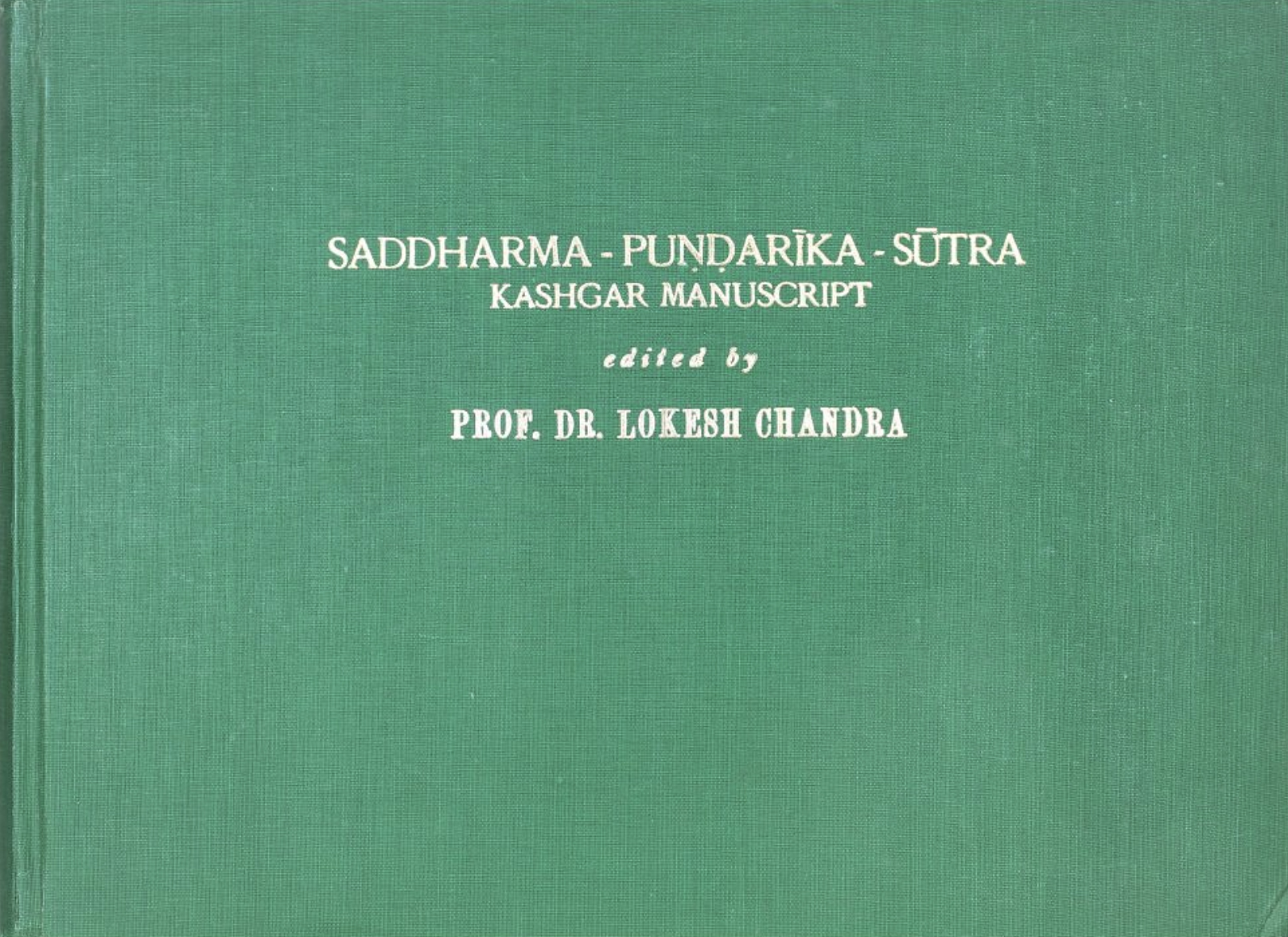
Saddharma-Pundarika-Sutra Kashgar Manuscript Chandra-front.jpg
Books1976About this item
A facsimile edition of the Saddharmapuṇḍarīkasūtra from a Kashgar manuscript, edited by Lokesh Chandra, with a foreword by Heinz Bechert.
Saddharmapundarika 1908-front.jpg
Books1908–1912About this item
A critical Sanskrit edition of the Saddharmapuṇḍarīkasūtra, edited by H. Kern and Bunyiu Nanjio, 1908-1912.
Saddharmapundarika MLBD 1992-front.jpg
Books1992About this item
A critical Sanskrit edition of the Saddharmapuṇḍarīkasūtra. This is a reprint of the first Indian edition, published in 1965 by Motilal Banarsidass.
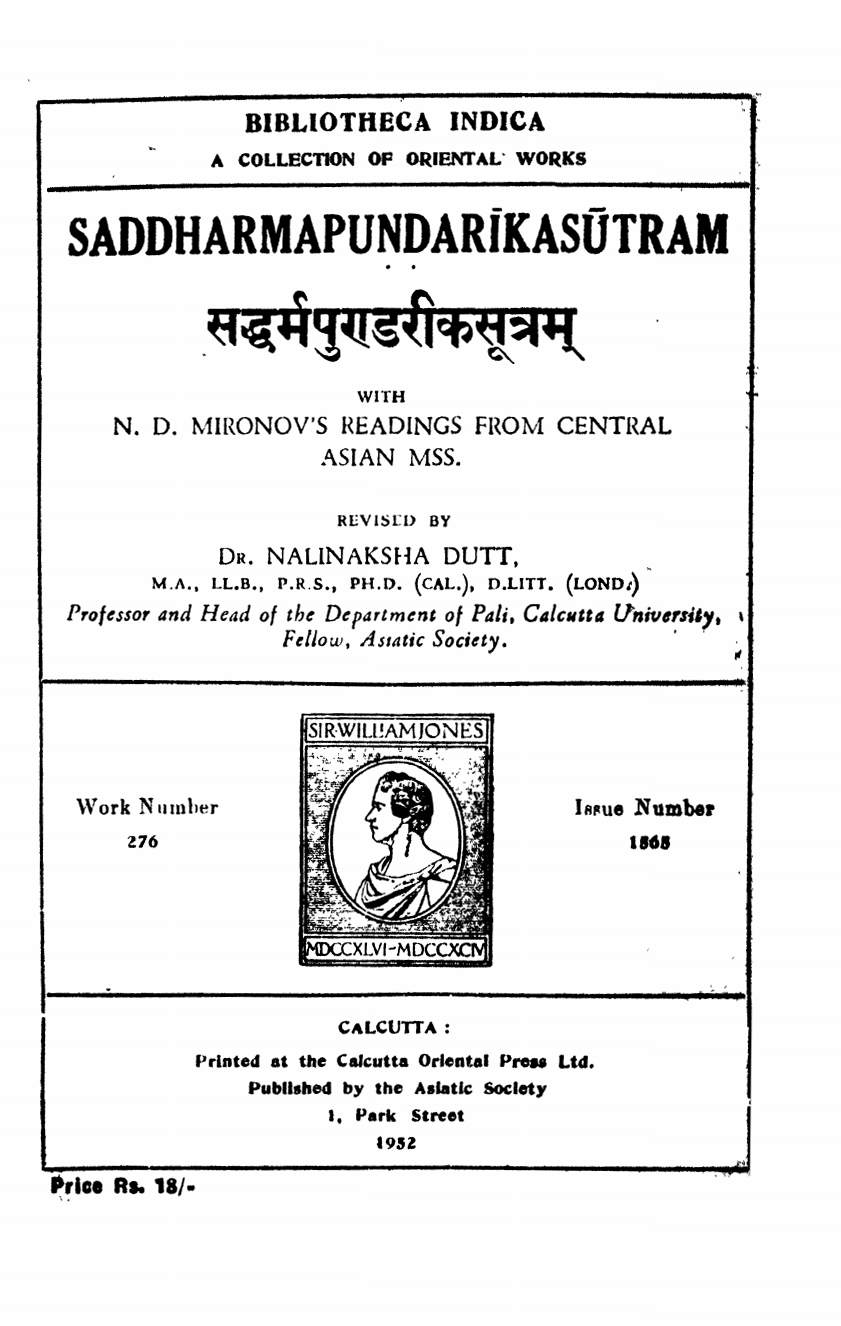
Chris-lawton-zvKx6ixUhWQ-unsplash.jpg
Books1934–1935About this item
A romanized and revised text of the Bibliotheca Buddhica publication of the Saddharmapuṇḍarīkasūtra based upon a Skt. MS. and Tibetan and Chinese translations.
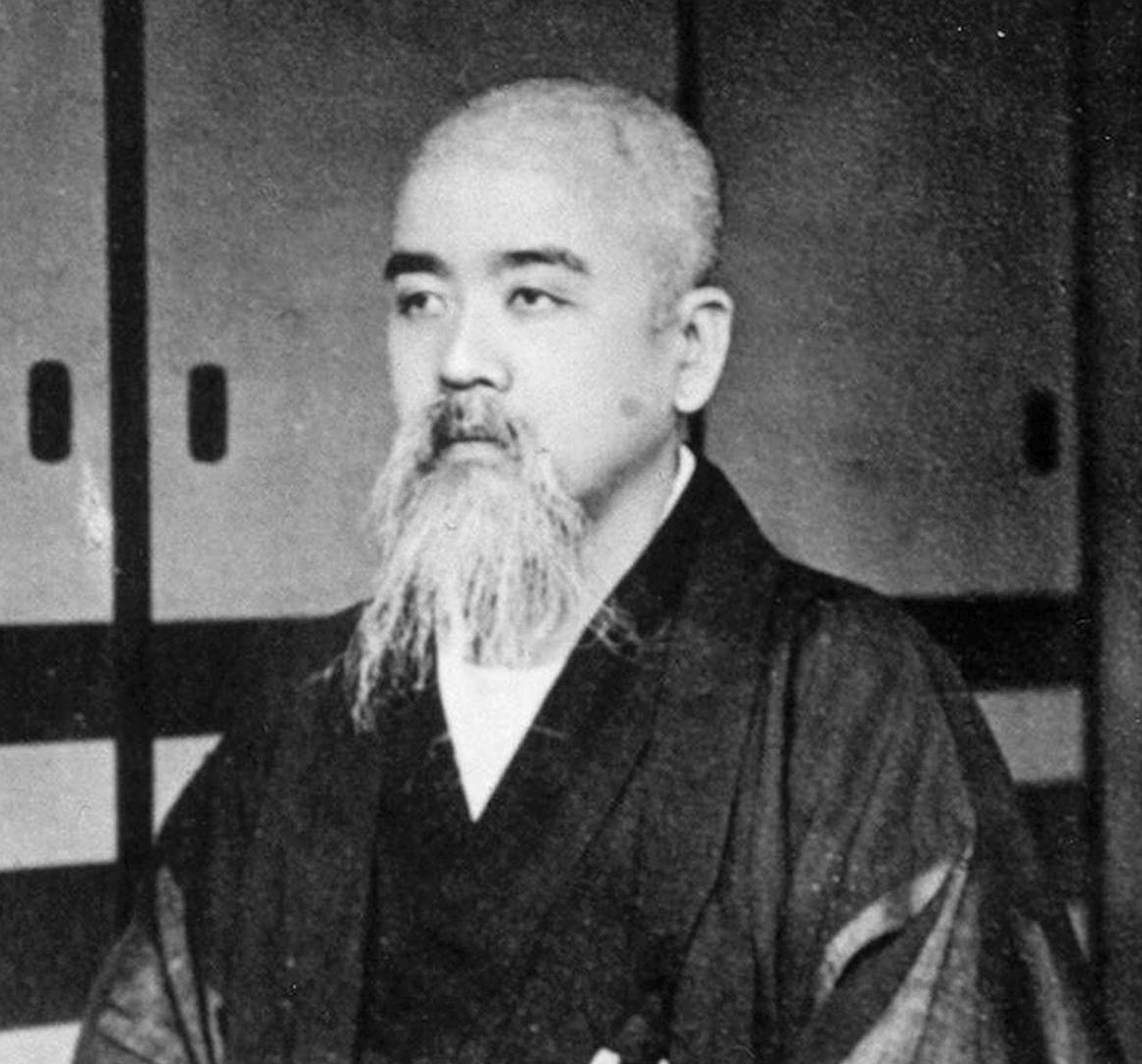
Kawaguchi Ekai.jpg
Books1926About this item
A Sanskrit edition of the Saddharmapūṇḍarīkasūtra, photographically duplicated by Ekai Kawaguchi and Chotatsu Ikeda. In Sanskrit; introduction in English and Japanese.
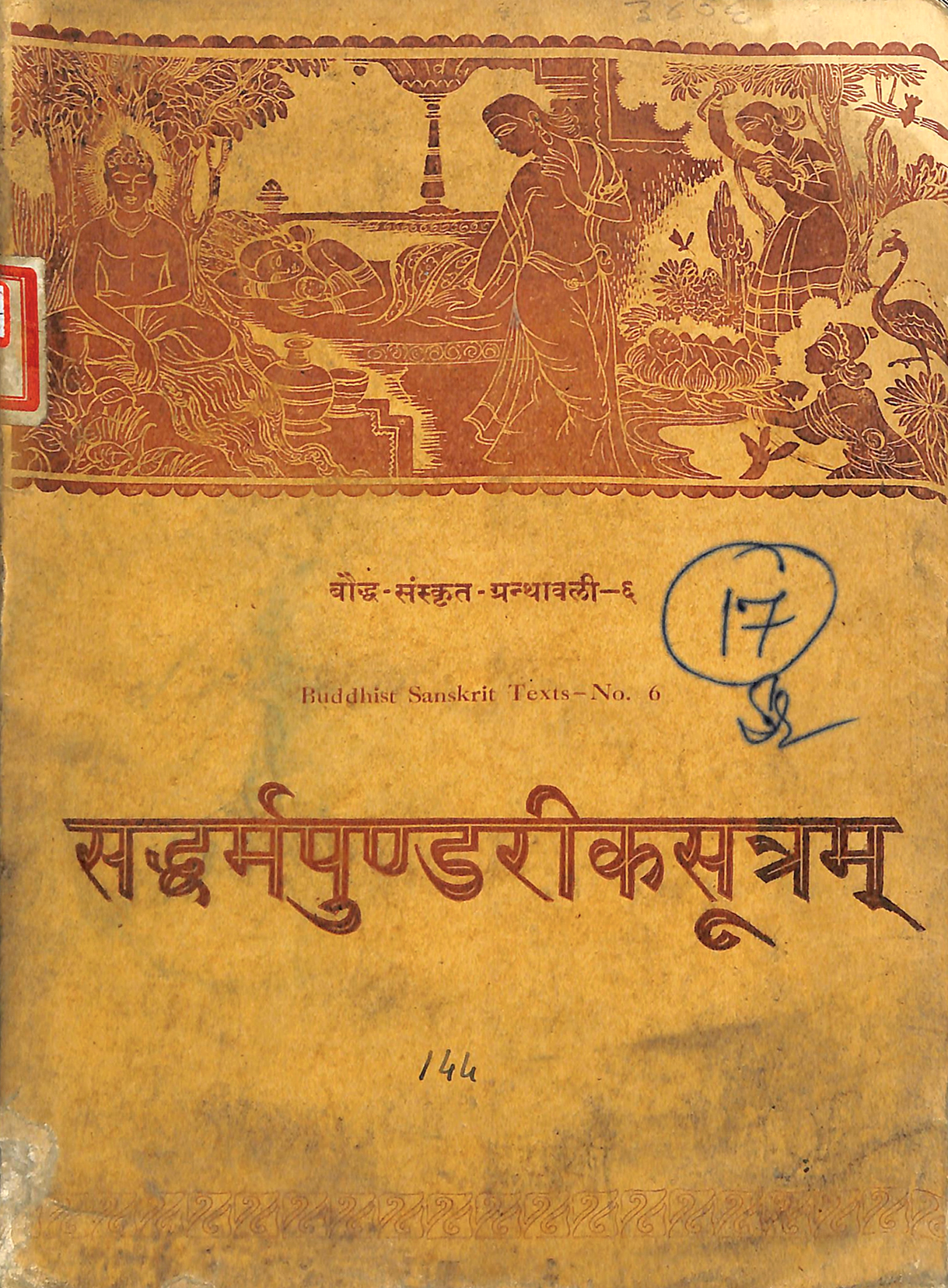
Saddharmapundarikasutra Vaidya-front.jpg
Books1960About this item
A critical Sanskrit edition of the Saddharmapuṇḍarīkasūtra, with an introduction in English and Hindi. Edited by P. L. Vaidya. Published by The Mithila Institute, 1960.
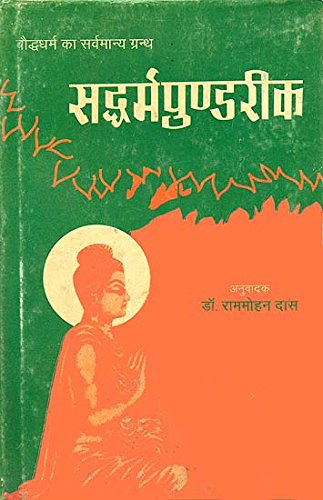
Saddarmapundarikasutram Ram Mohan Das-front.jpg
Books1966About this item
A Hindi translation of the Saddharmapuṇḍarīkasūtra, with Sanskrit text, introductory matter in Hindi and some notes in English. Translated by Ram Mohan Das, 1966.
16 Full translations
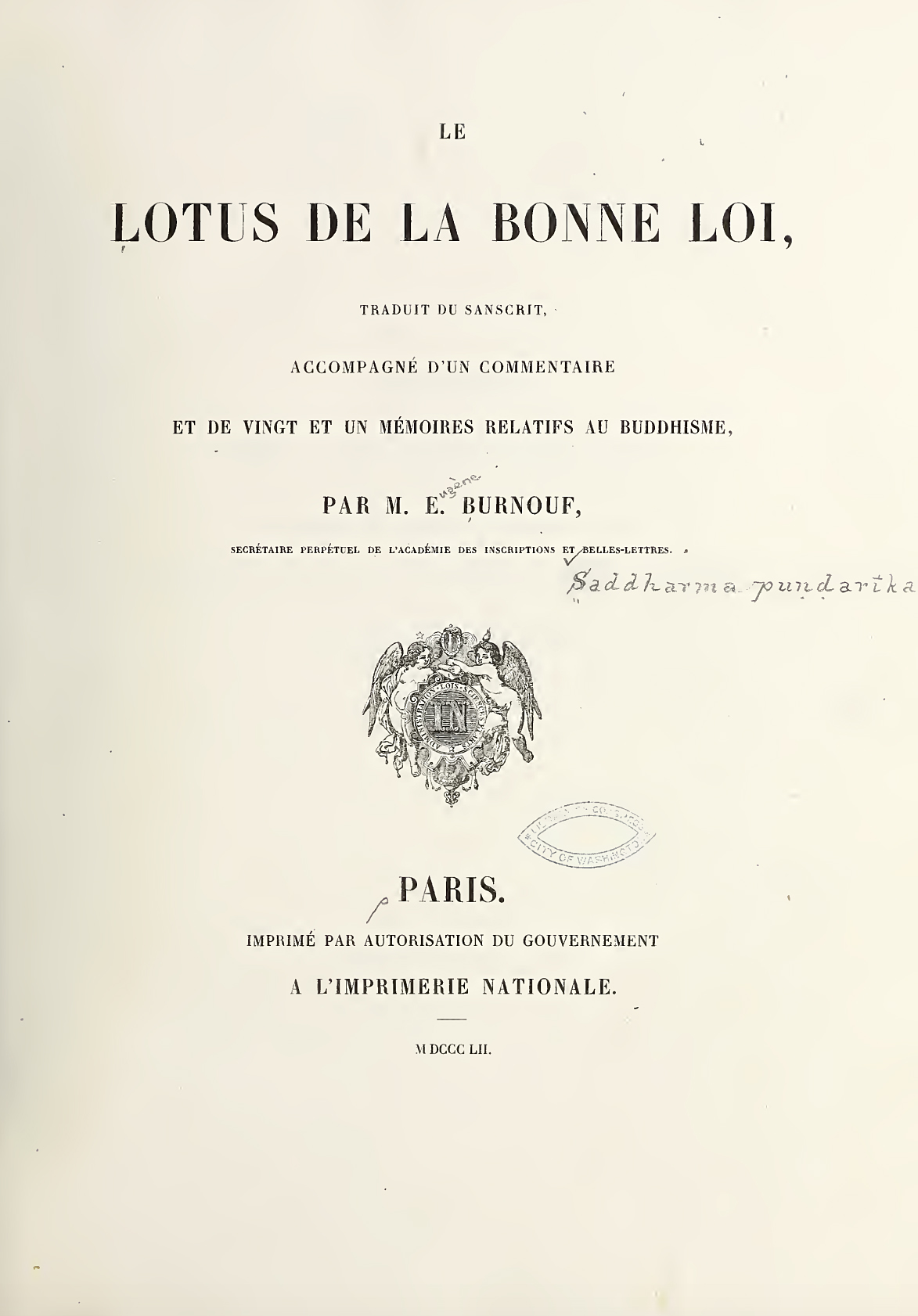
Lotus de la bonne loi-front.jpg
Books1852About this item
A French translation of the Saddharmapuṇḍarīkasūtra by Eugène Burnouf from the manuscript, Société Asiatique, Paris, no. 2, which had been sent to Paris in 1837 by Hodgson.
Le sūtra du lotus blanc de la loi merveilleuse 1998-front.jpg
Books1998About this item
A French translation of the Saddharmapuṇḍarīkasūtra. Adapted from the Chinese version, introduced and annotated by André Chédel.
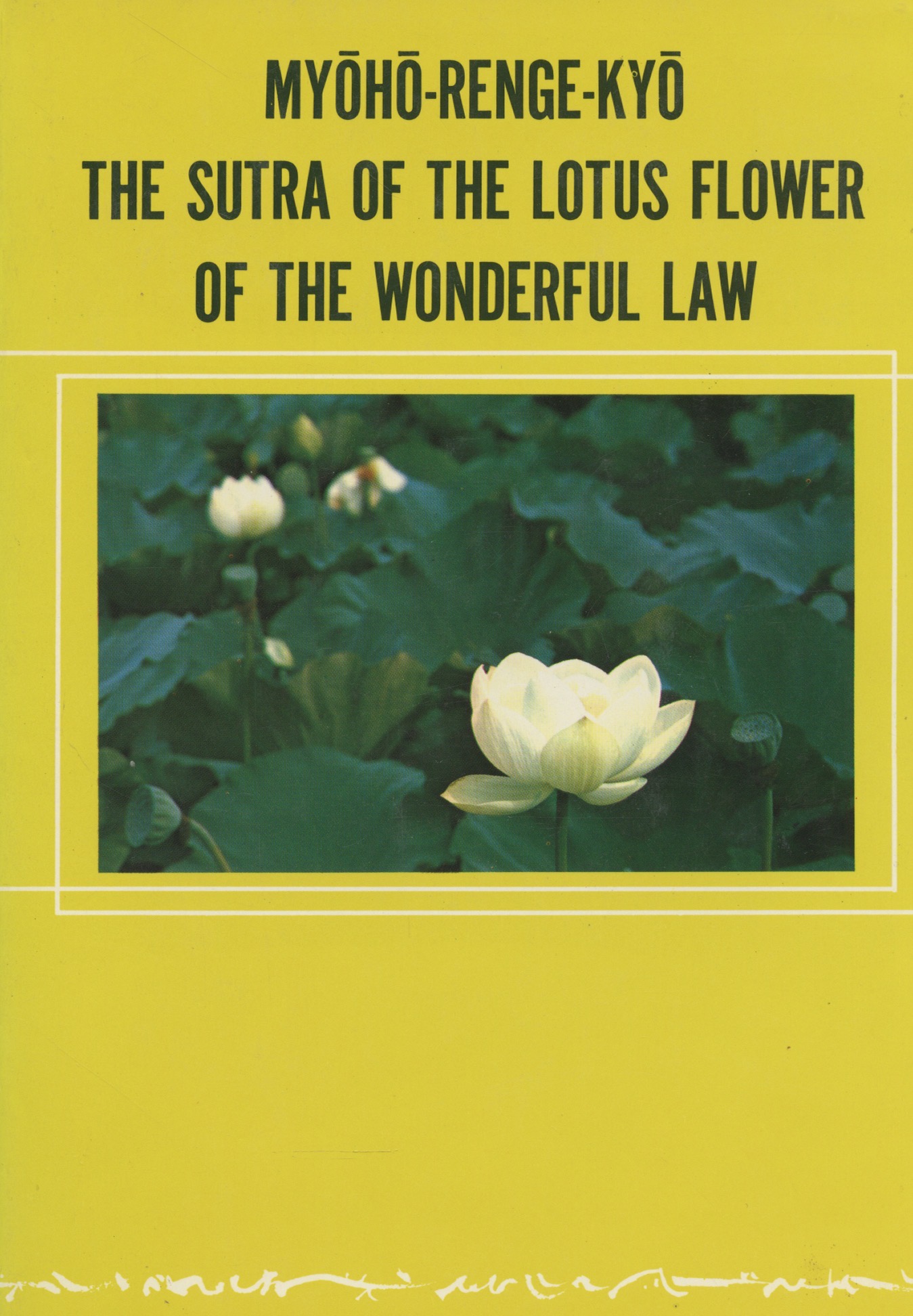
The Sutra of the Lotus Flower of the Wonderful Law-front.jpg
Books1971About this item
Translation of the Saddharmapuṇḍarīkasūtra by the late Reverend Bunnō Katō, priest-scholar of the Nichiren Sect of Japanese Buddhism, with the help of Rev. William Soothill.
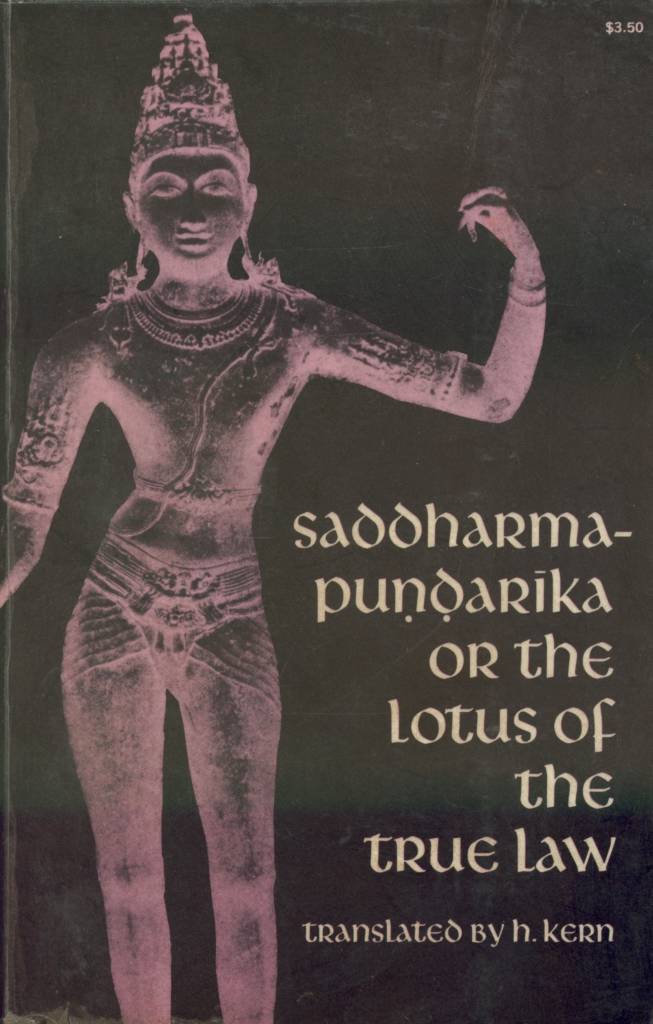
Saddharma-Puṇḍarīka or the Lotus of the True Law-front.jpeg
Books1963About this item
The Lotus Sutra, one of the most significant texts of Mahayana Buddhism, is presented here complete, in the authoritative translation of H. Kern.
Saddarmapundarikasutram Ram Mohan Das-front.jpg
Books1966About this item
A Hindi translation of the Saddharmapuṇḍarīkasūtra, with Sanskrit text, introductory matter in Hindi and some notes in English. Translated by Ram Mohan Das, 1966.
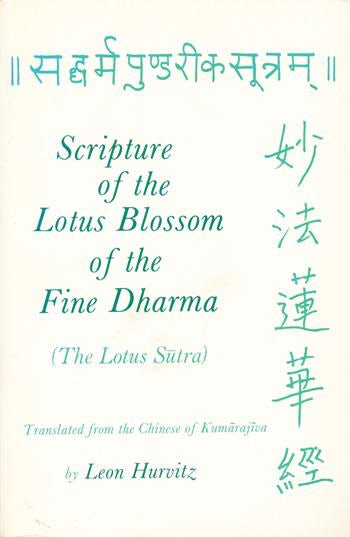
Scripture of the Lotus Blossom of the Fine Dharma-front.jpg
Books1976About this item
A translation of the Lotus Sūtra by Leon Hurvitz based on the Chinese translation by Kumārajīva, published in 1976.
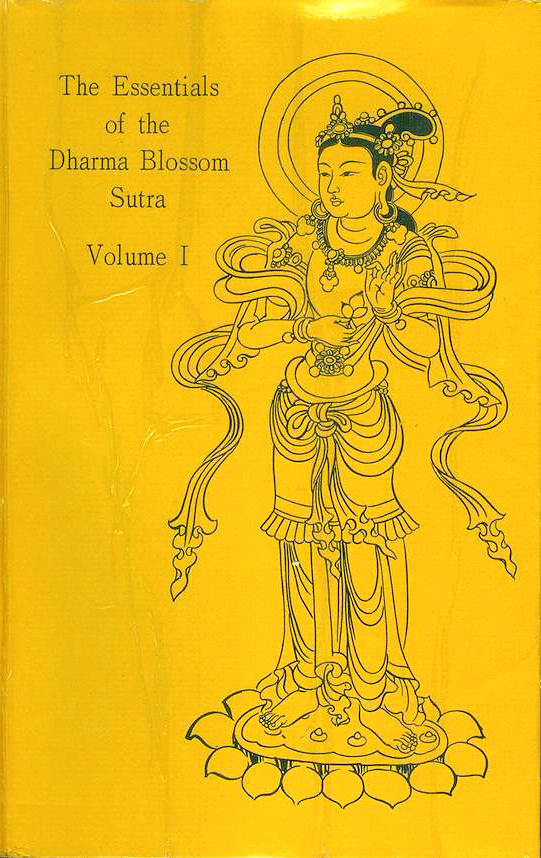
The Essentials of the Dharma Blossom Sutra-front.jpg
Books1974About this item
An English translation of a commentary on the Lotus Sūtra by Hsuan Hua originally delivered as lectures in San Francisco, 1968-70. Translated by Heng Ch'ien.
The Lotus Sutra BDK-front.jpg
Books2016About this item
An English translation of the Lotus Sutra from the Chinese of Kumārajiva by Tsugunari Kubo and Akira Yuyama. Published by BDK America, 2016.
The Lotus Sutra A Contemporary Translation of a Buddhist Classic-front.jpg
Books2008About this item
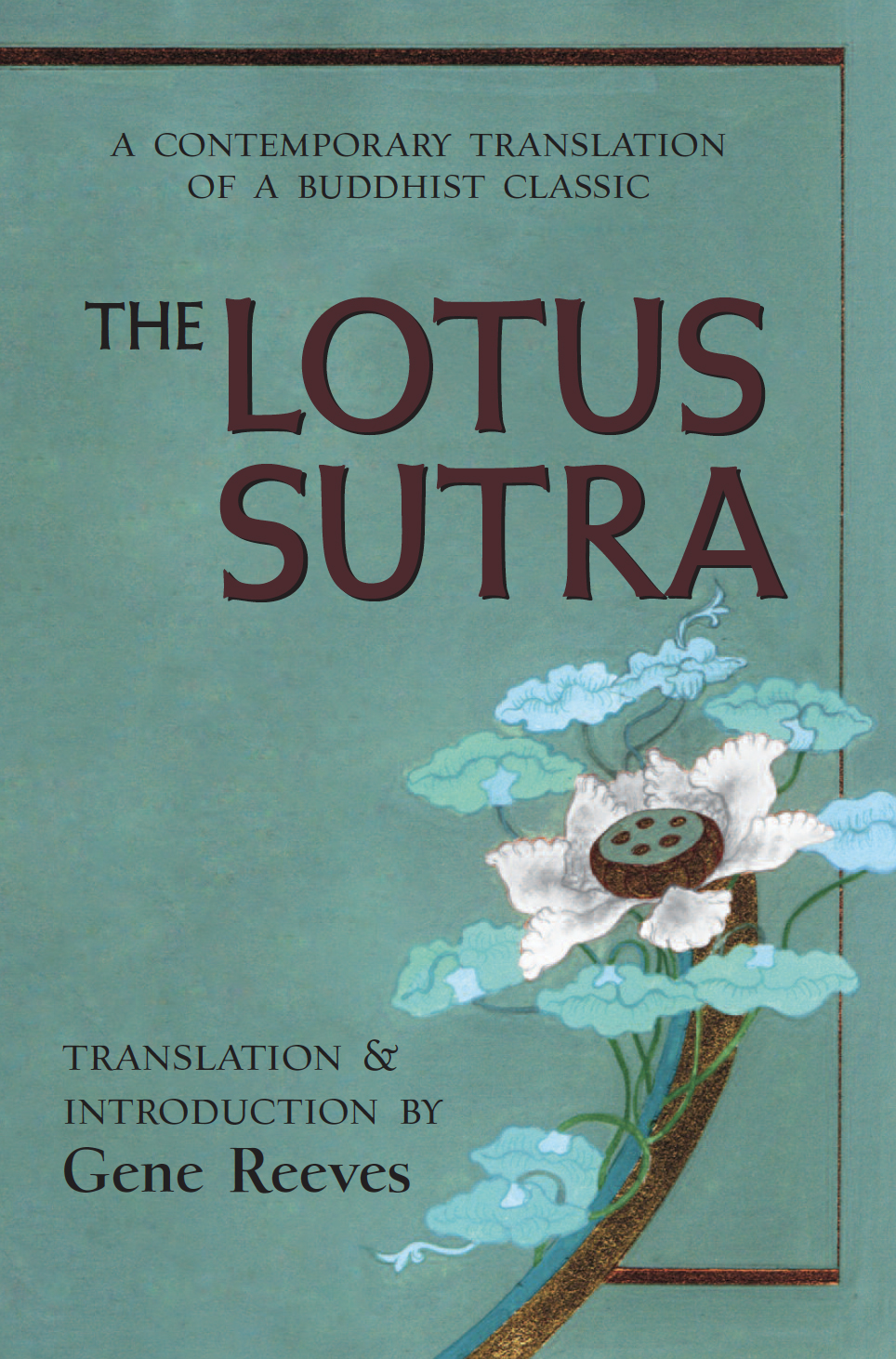
A translation of the Lotus Sūtra by Gene Reeves that appeals to readers with little or no familiarity with technical Buddhist vocabulary, as well as long-time practitioners.
The Lotus of the Wonderful Law or The Lotus Gospel 1975-front.jpg
Books1975About this item
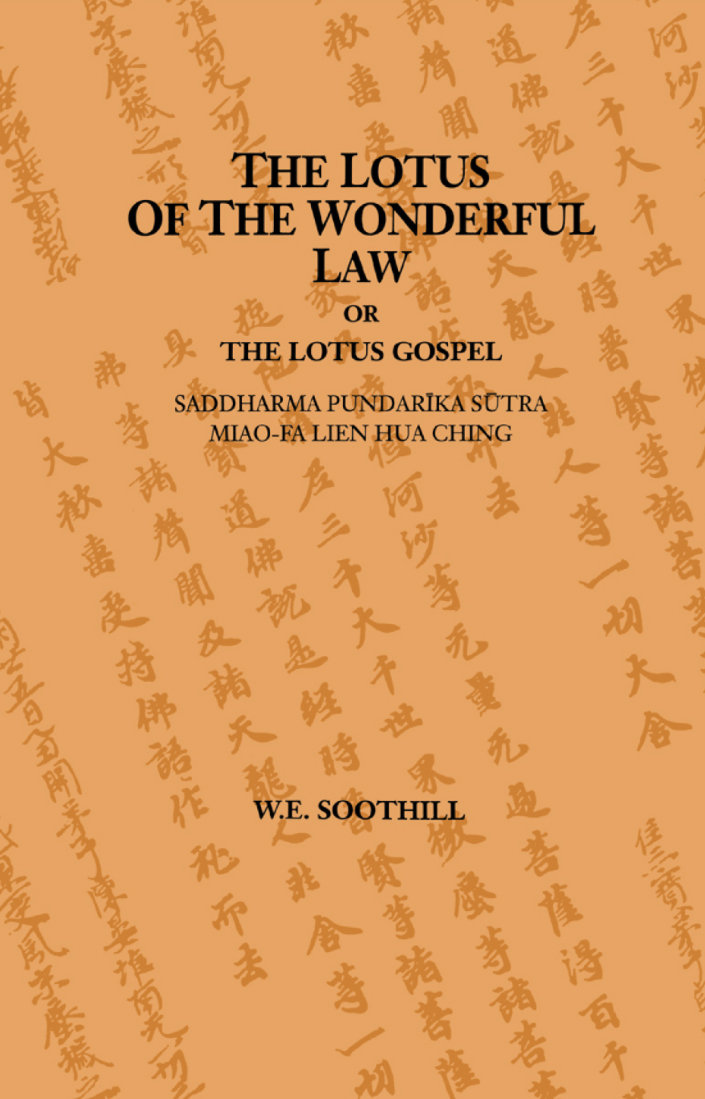
The "Lotus of the Wonderful (or Mystic) Law" is the most important religious book of the Far East, and has been described as "The Gospel of Half Asia". It is also the chief scripture of Buddhism in China, and therefore the chief source of consolation of the many millions of Buddhists in East Asia. It is justifiable to consider it as one of the greatest and most formative books of the world, and the text is here translated for the use of the Western student whilst an endeavour is made to reveal the contour of the most spiritual drama known in the Far East. (Source: Routledge)
The Lotus of the Wonderful Law-front.jpg
Books2005About this item
An English translation of the Lotus Sūtra from the Chinese of Kumārajīva by William Edward Soothill.
Saddharma-Pundarikasutra or The Lotus of the True Law-Kern 1884-front.jpg
Books1884About this item
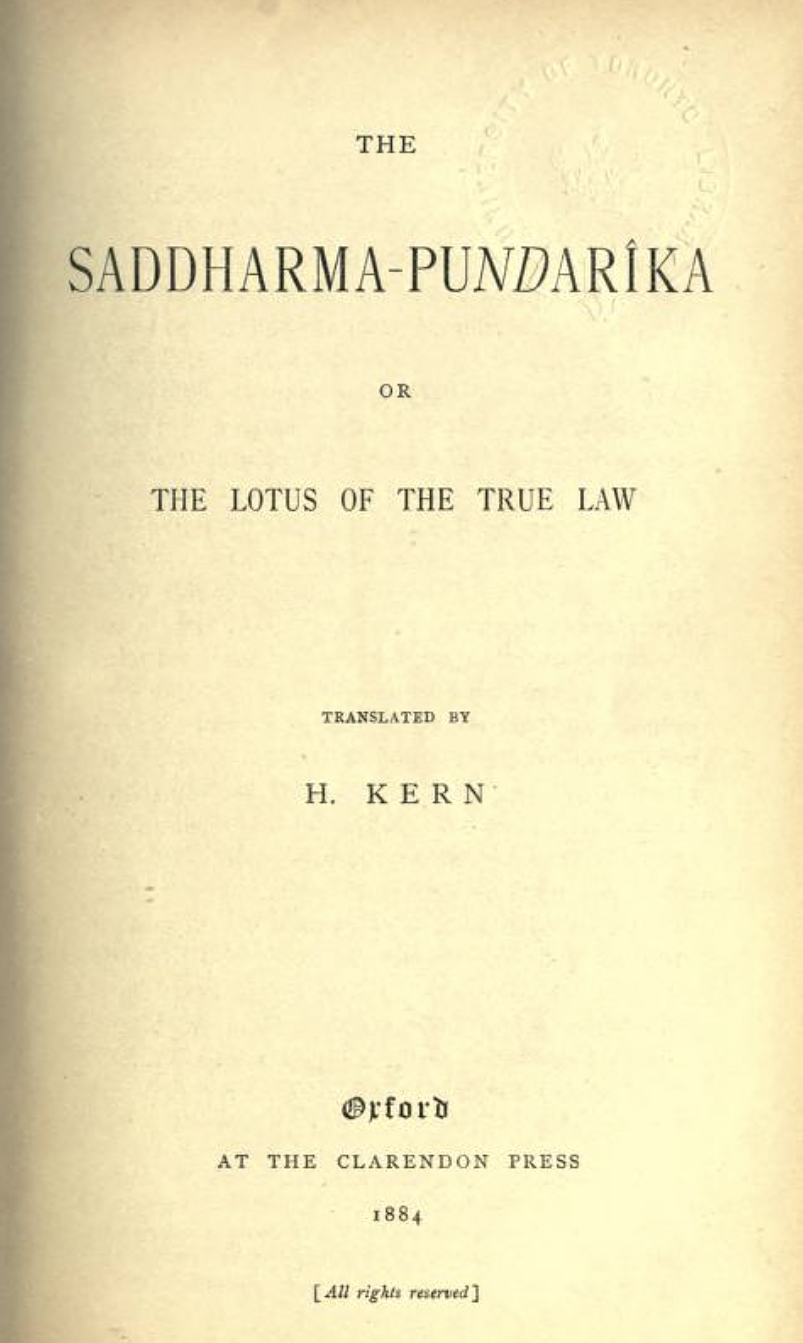
An English translation of the Saddharmapuṇḍarīkasūtra by H. Kern. Published by the Clarendon Press in 1884 as vol. 21 of the The Sacred Books of the East series.
The Threefold Lotus Sutra-front.jpg
Books1995About this item
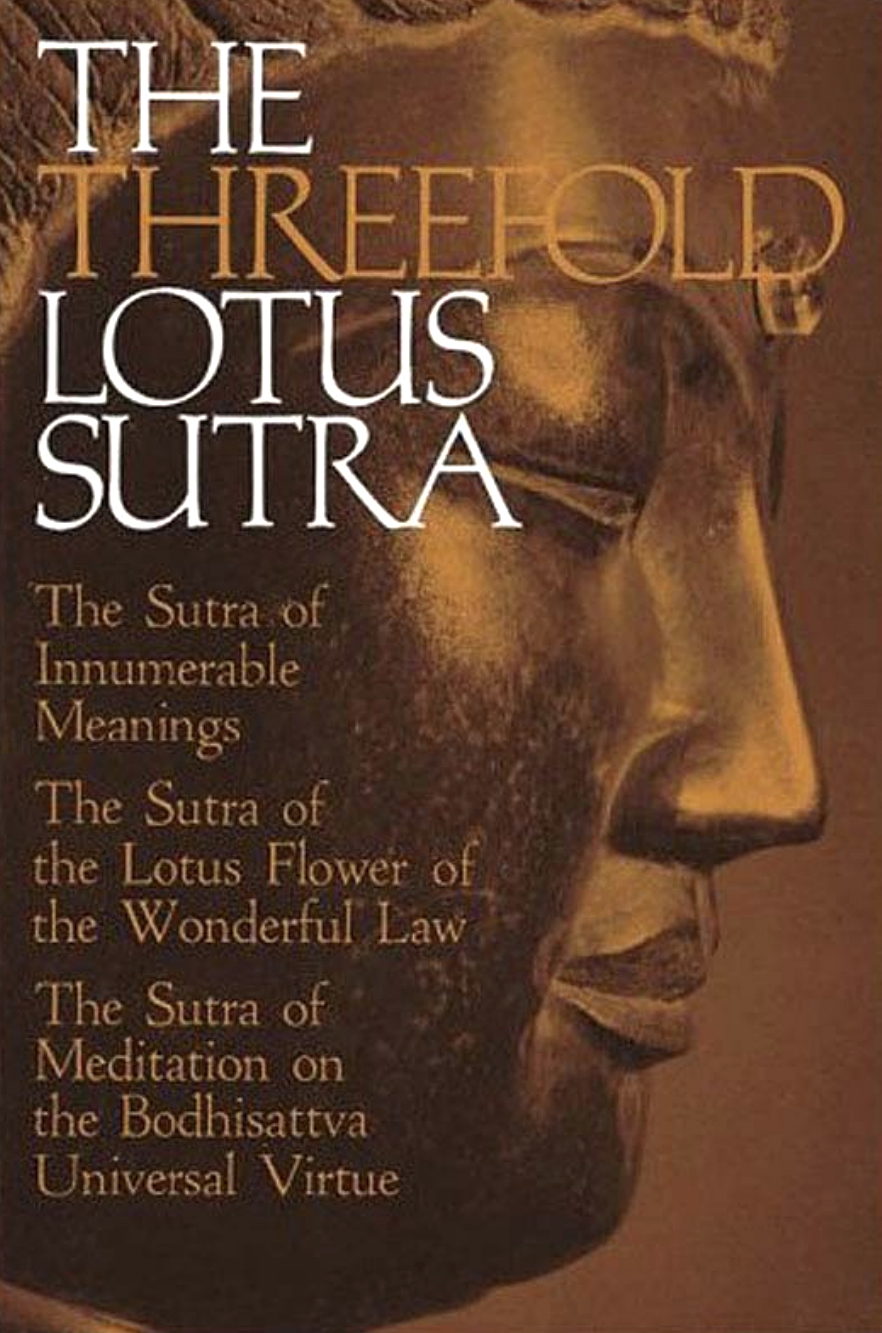
An English translation of the Lotus Sūtra together with the two shorter sūtras that traditionally accompany it: Innumerable Meanings and Meditation on the Bodhisattva Universal Virtue.
The White Lotus of the Good Dharma Saddharmapuṇḍarīkasūtra Roberts-front.jpg
Books2022About this item
This is an English translation of the Saddharmapuṇḍarīkasūtra by Peter Alan Roberts. Edited by Emily Bower. Published by 84000: Translating the Words of the Buddha.
3 Classical commentaries
Daosheng-Wikipedia.png
Classical WorksAbout this item
In Chinese, “A Brief Commentary on the 'Lotus Sūtra,'" the earliest extant Chinese commentary on the Saddharmapuṇḍarīkasūtra, though there is considerable controversy regarding its authenticity. The text is attributed to Dao sheng from the Liu-Song period (420-479), who was one of the direct disciples of the Kuchean translator Kumārajīva. Daosheng claimed that the treatise combined the famous translator's lectures notes on the Saddharmapuṇḍarīkasūtra with Daosheng's own insights. If authentic, this commentary would be Daosheng's only surviving work, offering a rare perspective into the way the Saddharmapuṇḍarīkasūtra was understood and interpreted by Kumārajīva and his circle of adherents. Employing expressions found in the Chinese "Book of Changes" (Yijing), this commentary discusses the notions of "consummate perfection" (yuan) and a peculiar Mahāyāna definition of the "middle way" (C. zhongdao, madhyamapratipad), notions that were further elaborated by subsequent Tiantai and Huayan exegetes. (Source: "Fahua jing lüeshu." In The Princeton Dictionary of Buddhism, 289–90. Princeton University Press, 2014. http://www.jstor.org/stable/j.ctt46n41q.27.)
Sutra portrait.jpg
Classical WorksAbout this item
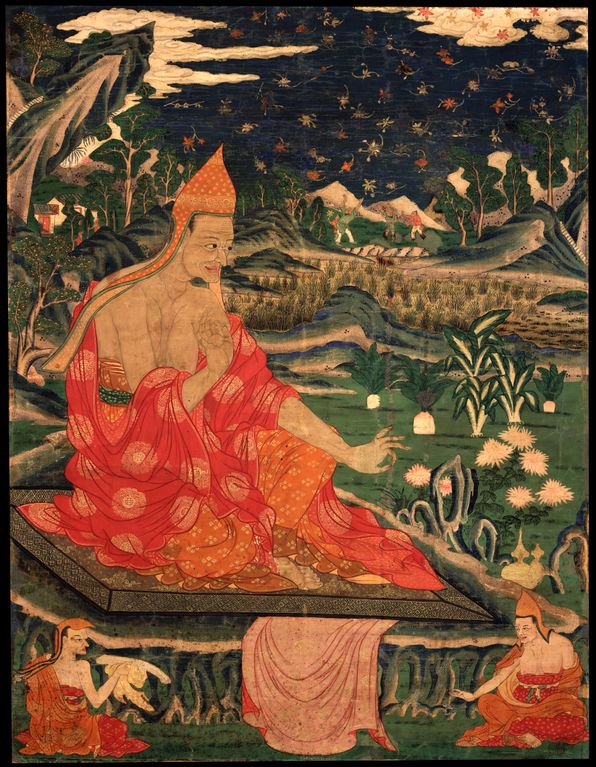
Commentary on the Saddharmapuṇḍarīkasūtra (Lotus Sūtra), attributed by its colophon to Ācārya Pṛthivībandhu (Tib. Sa'i rtsa lag) of Siṃhala (Sri Lanka). It is one of only three sūtra commentaries—out of eight listed as translated from Chinese in the Denkarma catalogue—that survive in the Tengyur (the others being commentaries on the Saṃdhinirmocanasūtra and the Laṅkāvatārasūtra). Some scholars (e.g., Ernst Steinkellner) have argued that the text may actually be of Chinese rather than Sinhalese origin, despite its colophon's attribution.
Vasubandhu-Thangka.jpg
Classical WorksAbout this item
*Saddharmapuṇḍarīkopadeśa (Upadeśa on the Lotus Sūtra of the Wondrous Dharma; Chin. Fahua lun 法華論), attributed to Vasubandhu, is a commentary on the Lotus Sūtra that survives only in Chinese, in two translations made in Luoyang during the Northern Wei: the Miaofa lianhua jing youbotishe 妙法蓮華經憂波提舍 (T 1519) by Bodhiruci with Tanlin, and the Miaofa lianhua jing lun youbotishe 妙法蓮華經論優波提舍 (T 1520) by Ratnamati with Sengliang. Bodhiruci and Ratnamati arrived in China around 508 and produced their versions independently. The text does not comment on the sūtra line by line. It explains selected themes, beginning with the sūtra's opening chapter, which it analyzes in terms of seven kinds of accomplishment. As the only Indian commentary on the sūtra preserved in Chinese, it was highly influential in East Asian Lotus exegesis. No Sanskrit original or Tibetan translation is known.
3 Partial translations
Kuan-si-im Pusar-front.jpg
Books1992About this item
Radlov, Vasily V., ed. and trans. Kuan-ši-im Pusar (Saddharmapuṇḍarīka). Bibliotheca Buddhica 14. Delhi: Motilal Banarsidass Publishers, 1992.
Kuan-si-im Pusar 1911-front.jpg
Books1911About this item
Kuan-ši-im Pusar: A Turkish (or Uighur?) Translation of the 25th chapter of the Chinese edition of the Saddharmapuṇḍarīkasūtra. Translated into German with the original Old Uighur text.
The Sound that Perceives the World-front.jpg
Books2025About this item
Musings and autobiographically informed commentary on the human condition through the lens of the Kannon-gyo—chapter 25 of the Lotus Sutra—connecting Zen and Pure Land Buddhism through the practice of venerating and chanting the names of buddhas and bodhisattvas.

The Kannon-gyo is chapter 25 of the Lotus Sutra, and its focus is the bodhisattva of compassion, Avalokiteshvara, known in China as Guanyin, and in Japan as Kannon or Kanzeon. The text describes the many ways in which calling out the bodhisattva’s name—Namu Kanzeon Bosatsu—can relieve suffering.

Most schools of Zen Buddhism, and especially the Soto school, eschew such practices as chanting the names of buddhas and bodhisattvas, along with venerating such figures.

The eminent Soto Zen master Kosho Uchiyama Roshi, however, while doing hard physical labor early in his career, could not practice zazen—that is, formal sitting meditation. He came to appreciate the Kannon-gyo and the practices related to it. In particular, he took to reciting Kannon’s name, as recommended in the text of the Kannon-gyo.

Later in life, Uchiyama Roshi suffered from illness that again prevented him from practicing formal Zen, so he returned to the Kannon-gyo and the practice of chanting. He went so far as to assert that chanting Kannon’s name is completely equivalent to zazen, that the two practices are simply two sides of the same coin—a revolutionary idea seemingly at odds with Zen.

Chanting practice is especially accessible, as it can be done while working, traveling, or suffering from illness, and other activities that would ordinarily get in the way of formal Zen practice.

With these practices, the Kannon-gyo, and Kannon herself as a backdrop, Uchiyama Roshi muses about the purposes of religion, the goals of religious practice, and the meaning of enlightenment—and their relation to suffering itself. (Source: Wisdom Publications)
18 Scholarship
Corless Roger ParagonHouse.jpg
Articles1990About this item
Roger Gregory-Tashi Corless, in his essay "Lying to Tell the Truth", explores the use of intentional vagueness and obscurity in the texts of Clement of Alexandria and Origen, and relates this to the intentional use of falsehood (or, perhaps better, nontruth) in the Saddharmapuṇḍarīkasūtra. Both in second century Alexandria and in third century India, he suggests, one finds a self-conscious use of graded, hierarchically ordered sets of "false truths" as pedagogical devices. For the Lotus, Corless suggests, the "true truth" is that all living beings are in fact possessors of Buddha Nature; it is this toward which the pedagogically useful though partial truths (upāya) found in other assertions point. This position is illustrated with extensive quotations from Kūkai, and is compared with positions taken by a series of Christian thinkers from Nicholas of Cusa to John Henry Newman. (Griffiths and Keenan, introduction to Buddha Nature, 3–4)
Mahāyāna Buddhism The Doctrinal Foundations 2nd ed -front.jpg
Books2009About this item
Originating in India, Mahayana Buddhism spread across Asia, becoming the prevalent form of Buddhism in Tibet and East Asia. Over the last twenty-five years Western interest in Mahayana has increased considerably, reflected both in the quantity of scholarly material produced and in the attraction of Westerners towards Tibetan Buddhism and Zen. Paul Williams’ Mahayana Buddhism is widely regarded as the standard introduction to the field, used internationally for teaching and research and has been translated into several European and Asian languages. This new edition has been fully revised throughout in the light of the wealth of new studies and focuses on the religion’s diversity and richness. It includes much more material on China and Japan, with appropriate reference to Nepal, and for students who wish to carry their study further there is a much-expanded bibliography and extensive footnotes and cross-referencing. Everyone studying this important tradition will find Williams’ book the ideal companion to their studies. (Source: Routledge)
Saddharma-Pundarika-Sutra Kashgar Manuscript Chandra-front.jpg
Books1976About this item
A facsimile edition of the Saddharmapuṇḍarīkasūtra from a Kashgar manuscript, edited by Lokesh Chandra, with a foreword by Heinz Bechert.
Saddharmapundarika 1908-front.jpg
Books1908–1912About this item
A critical Sanskrit edition of the Saddharmapuṇḍarīkasūtra, edited by H. Kern and Bunyiu Nanjio, 1908-1912.
Saddharmapundarika MLBD 1992-front.jpg
Books1992About this item
A critical Sanskrit edition of the Saddharmapuṇḍarīkasūtra. This is a reprint of the first Indian edition, published in 1965 by Motilal Banarsidass.
Chris-lawton-zvKx6ixUhWQ-unsplash.jpg
Books1934–1935About this item
A romanized and revised text of the Bibliotheca Buddhica publication of the Saddharmapuṇḍarīkasūtra based upon a Skt. MS. and Tibetan and Chinese translations.
Kawaguchi Ekai.jpg
Books1926About this item
A Sanskrit edition of the Saddharmapūṇḍarīkasūtra, photographically duplicated by Ekai Kawaguchi and Chotatsu Ikeda. In Sanskrit; introduction in English and Japanese.
Saddharmapundarikasutra Vaidya-front.jpg
Books1960About this item
A critical Sanskrit edition of the Saddharmapuṇḍarīkasūtra, with an introduction in English and Hindi. Edited by P. L. Vaidya. Published by The Mithila Institute, 1960.
Articles.jpeg
Articles1913–1918About this item
This article presents the editio princeps of eleven Buddhist manuscript fragments (the "Mannerheim fragments") collected during Baron Gustaf Mannerheim's 1906–1908 expedition through Central Asia, sent to the Finno-Ugrian Society in Helsinki. Nine fragments are in Sanskrit, one in Khotanese, and one is bilingual Sanskrit-Khotanese. Reuter transcribes, restores where possible, and philologically annotates each piece, identifying textual affiliations and discussing orthographic, dialectal, and grammatical peculiarities (Prakritisms, Buddhist Hybrid Sanskrit forms, scribal errors) throughout.

Fragments 1–2 are small, irregularly shaped pieces too damaged to yield a coherent sense or textual identification; Fragment 1 is tentatively judged the oldest of the set on paleographic grounds.

Fragment 3 is rhomboid, in a slanting Gupta script, and represents a discourse between the Buddha and Kāśyapa on the four classes of "false ascetics" (duḥśīlaśīlavatpratirūpakāḥ), correlated with dhūtaguṇa lists in the Dharmasaṃgraha and Mahāvyutpatti.

Fragment 4 is a complete leaf, badly damaged, containing a metrical portion (verses 8–16) dealing with bodhisattvas adorned with the four dharmas, with a partial parallel noted in Mahāvastu II; the prose section on the reverse could not be matched to a known text.

Fragment 5 is identified as a portion of the Saddharmapuṇḍarīka, corresponding to the printed text pp. 40¹⁶–41¹⁴, with the fragment's readings differing only slightly from the edition.

Fragment 6 (Plates III–IV) is identified as a portion of the Suvarṇaprabhāsa, corresponding to parivarta 14 and to p. 68⁹ ff. of Rai Sarat Chandra Śāstri's 1898 edition (Buddhist Texts Society of India, Calcutta). Reuter transcribes and restores the fragment's stanzas (numbered 27–32 in the source), comparing its readings against Śāstri's printed edition line by line and noting divergences in wording, meter, and vocabulary.

Fragment 7 (Plate V) corresponds to a passage in the Śatasāhasrikāprajñāpāramitā, 11th parivarta, but the fragment distributes the same text over two differently-numbered parivartas and shows enough divergence from the printed edition to suggest it belongs to a different manuscript recension, possibly related to Fragment 8.

Fragment 8 (Plate VI) is a complete leaf (numbered 147) closely allied to the Śatasāhasrikāprajñāpāramitā, opening with the bodhisattva Subhūti's questions to the Buddha on the "dream-like" and "illusion-like" nature of phenomena, and possibly forming part of the same textual tradition as Fragment 7, though not the same manuscript.

Fragment 9 (Plate VII) could not be identified with any known text; its general argument concerns the invincibility of an irreversible (avaivartika) bodhisattva's mind against the hosts of Māra, illustrated by the simile of a lapis lazuli gem placed amid glass beads, whose luster the glass cannot eclipse.

Fragment 10 (Plate I) is a small, bilingual Sanskrit-Khotanese piece, difficult to read, containing scattered decipherable words in both languages.

Fragment 11 (Plates VIII–IX) is a Khotanese-language piece naming the otherwise rare bodhisattva Bhaiṣajasena, offering philological comparanda with other known Khotanese Buddhist manuscripts (the Stein collection and the Godfrey manuscripts), and providing material for Reuter's discussion of Khotanese numerals, loanwords from Sanskrit, and verb morphology.
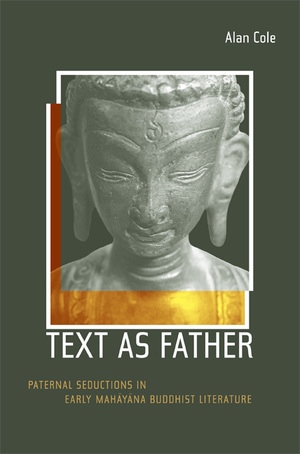
Text as Father-front.jpg
Books2005About this item
This beautifully written work sheds new light on the origins and nature of Mahayana Buddhism with close readings of four well-known texts—the Lotus Sutra, Diamond Sutra, Tathagatagarbha Sutra, and Vimalakirtinirdesa. Treating these sutras as literary works rather than as straightforward philosophic or doctrinal treatises, Alan Cole argues that these writings were carefully sculpted to undermine traditional monastic Buddhism and to gain legitimacy and authority for Mahayana Buddhism as it was veering away from Buddhism’s older oral and institutional forms. His sophisticated and sustained analysis of the narrative structures and seductive literary strategies used in these sutras suggests that they were specifically written to encourage devotion to the written word instead of other forms of authority, be they human, institutional, or iconic. (Source: University of California Press)
Articles.jpeg
Articles2025About this item
This study examines the development and transformation of the bodhisattva concept through comparative analysis of canonical Pāli texts and early Mahāyāna literature. Drawing upon philological evidence from the Jātaka tales, Buddhavaṃsa, and foundational Mahāyāna sūtras including the Lotus Sūtra and Perfection of Wisdom literature, this research traces the evolution from the historical Buddha's preenlightenment journey to the fully developed bodhisattva doctrine. The investigation employs textual criticism and doctrinal comparison to demonstrate how the bodhisattva ideal underwent significant conceptual expansion, shifting from describing the Buddha’s past lives to establishing a universal path of compassionate awakening. Findings reveal that while the Pāli tradition presents the bodhisattva path as exceptional and primarily retrospective, early Mahāyāna sources reconceptualize it as the supreme spiritual ideal accessible to all practitioners. This transformation reflects broader soteriological developments within Buddhist thought, particularly regarding the tension between individual liberation and universal salvation. The study contributes to understanding how fundamental Buddhist concepts evolved across different textual traditions and geographical contexts. Keywords: bodhisattva, Pāli Canon, Mahāyāna Buddhism, comparative Buddhism, Buddhist soteriology.
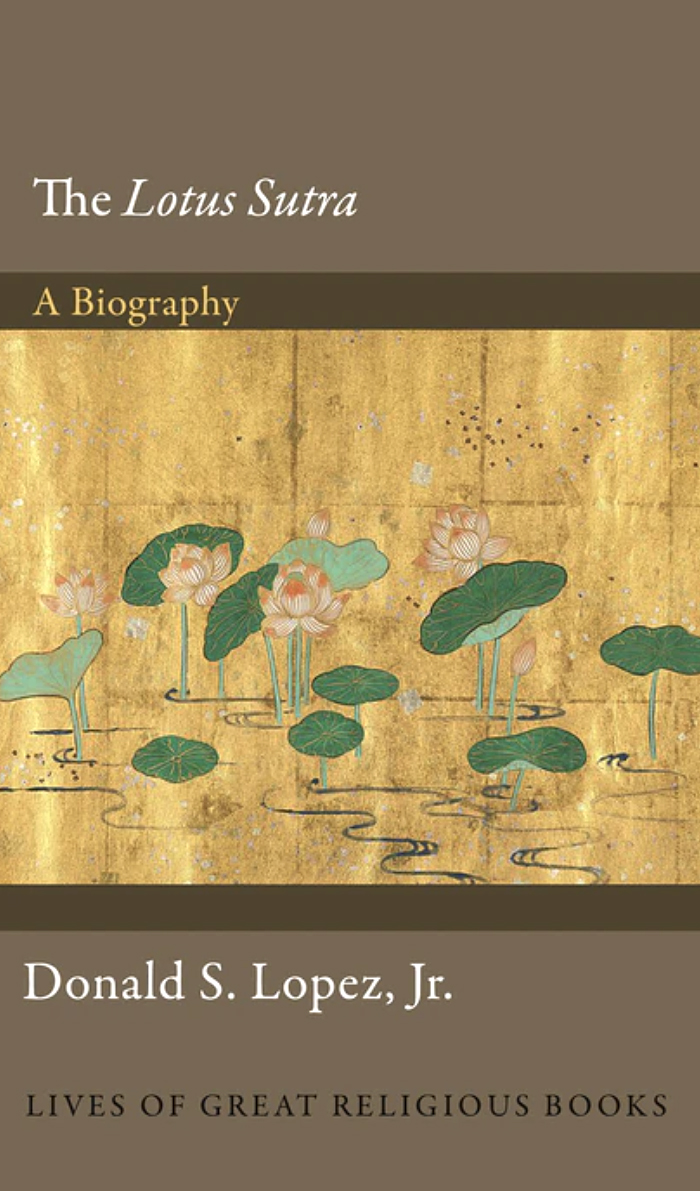
The Lotus Sutra A Biography-front.jpg
Books2016About this item
The Lotus Sutra is arguably the most famous of all Buddhist scriptures. Composed in India in the first centuries of the Common Era, it is renowned for its inspiring message that all beings are destined for supreme enlightenment. Here, Donald Lopez provides an engaging and accessible biography of this enduring classic.

Lopez traces the many roles the Lotus Sutra has played in its travels through Asia, Europe, and across the seas to America. The story begins in India, where it was one of the early Mahayana sutras, which sought to redefine the Buddhist path. In the centuries that followed, the text would have a profound influence in China and Japan, and would go on to play a central role in the European discovery of Buddhism. It was the first Buddhist sutra to be translated from Sanskrit into a Western language—into French in 1844 by the eminent scholar Eugène Burnouf. That same year, portions of the Lotus Sutra appeared in English in The Dial, the journal of New England's Transcendentalists. Lopez provides a balanced account of the many controversies surrounding the text and its teachings, and describes how the book has helped to shape the popular image of the Buddha today. He explores how it was read by major literary figures such as Henry David Thoreau and Gustave Flaubert, and how it was used to justify self-immolation in China and political extremism in Japan.

Concise and authoritative, this is the essential introduction to the life and afterlife of a timeless masterpiece. (Source: Princeton University Press)
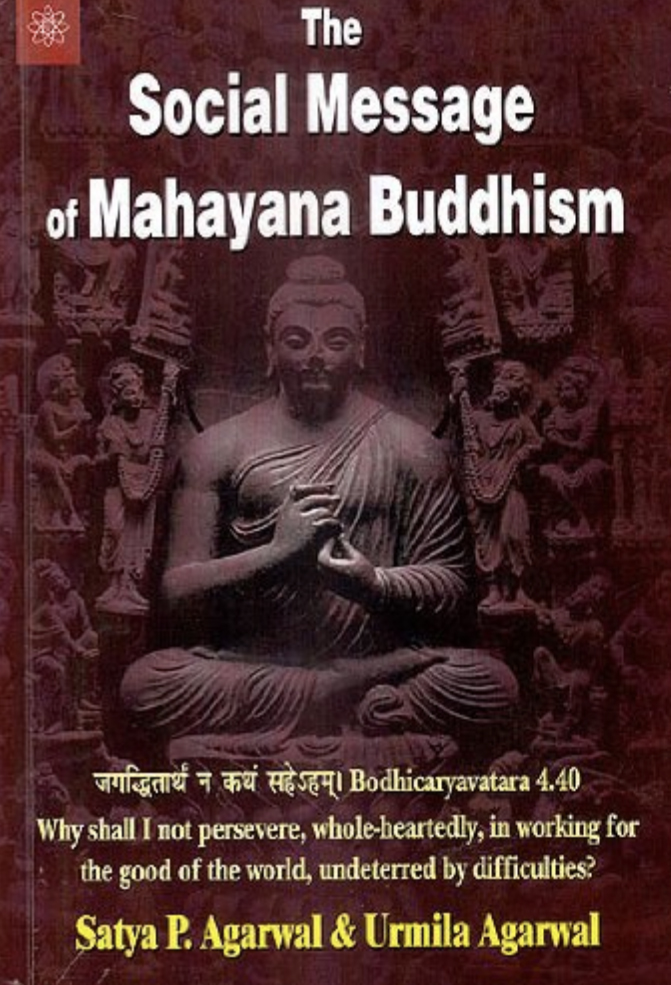
The Social Message of Mahayana Buddhism-front.jpg
Books2012About this item
This book examines topics relating to "engaged Buddhism" viz. The Lotus Sūtra and the Bodhicaryāvatāra. Contains portions of the Sanskrit texts along with their simple meaning in English.
Zimmermann-Hamburg-Copyright Unknown.jpg
Articles1999About this item
No abstract given. Here are the first relevant paragraphs:

In his comprehensive study of the development of the tathāgatagarbha teaching, J. Takasaki also deals with the sūtra which bears the name of this Mahāyāna philosophical current.[1] The Tathāgatagarbhasūtra (TGS) has generally been referred to as the earliest expression of this doctrine and the term tathāgatagarbha itself seems to have been coined by this very sūtra. In this paper I intend to introduce the textual history and doctrinal content of the TGS and offer some speculations concerning the possible motivations lying behind its compilation. By pointing out some interesting parallels concerning the structure and formulations in the Saddharmapuṇḍarīkasūtra (SP), I shall then suggest that the SP and the TGS carry a similar compositional line. Finally, I shall determine the position and role of the TGS in Mahāyāna Buddhism as a sūtra presupposing the doctrine of the SP and providing its metaphysical foundation. (Zimmermann, introductory remarks, 143–44)

Notes
  1. Jikidō Takasaki 高崎直道, Nyoraizō shisō no keisei (Formation of the Tathāgatagarbha Theory), Tokyo 1974 (Shunjū-sha): pp. 40–68.
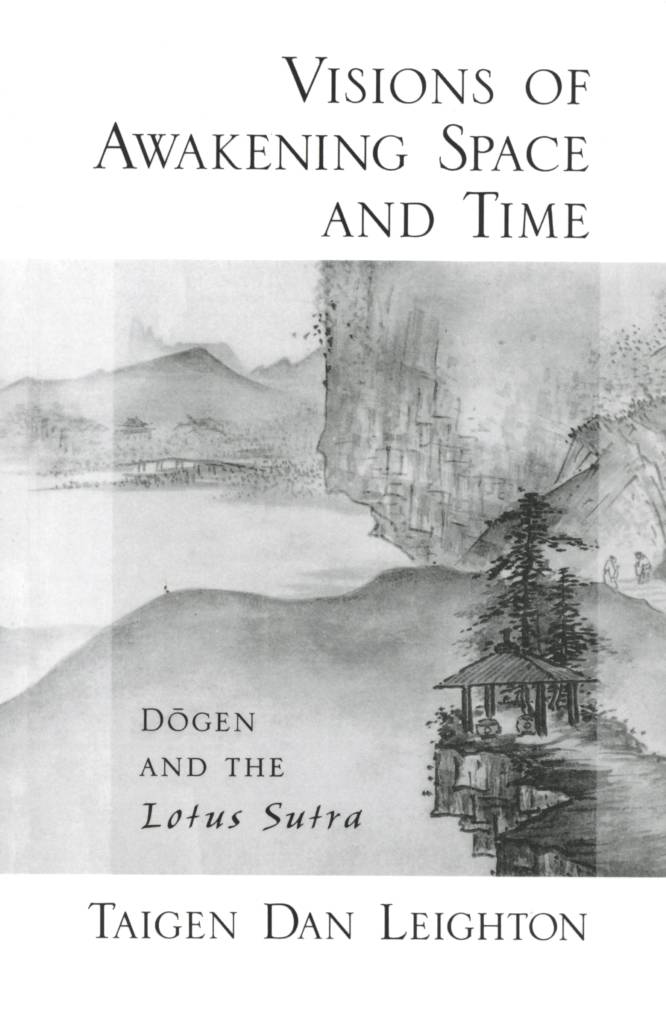
Visions of Awakening Space and Time-front.jpg
Books2007About this item
As a religion concerned with universal liberation, Zen grew out of a Buddhist worldview very different from the currently prevalent scientific materialism. Indeed, says Taigen Dan Leighton, Zen cannot be fully understood outside of a worldview that sees reality itself as a vital, dynamic agent of awareness and healing. In this book, Leighton explicates that worldview through the writings of the Zen master Eihei Dōgen (1200-1253), considered the founder of the Japanese Sōtō Zen tradition, which currently enjoys increasing popularity in the West.

The Lotus Sutra, arguably the most important Buddhist scripture in East Asia, contains a famous story about bodhisattvas (enlightening beings) who emerge from under the earth to preserve and expound the Lotus teaching in the distant future. The story reveals that the Buddha only appears to pass away, but actually has been practicing, and will continue to do so, over an inconceivably long life span.

Leighton traces commentaries on the Lotus Sutra from a range of key East Asian Buddhist thinkers, including Daosheng, Zhiyi, Zhanran, Saigyo, Myōe, Nichiren, Hakuin, and Ryōkan. But his main focus is Eihei Dōgen, the 13th century Japanese Sōtō Zen founder who imported Zen from China, and whose profuse, provocative, and poetic writings are important to the modern expansion of Buddhism to the West.

Dōgen's use of this sutra expresses the critical role of Mahayana vision and imagination as the context of Zen teaching, and his interpretations of this story furthermore reveal his dynamic worldview of the earth, space, and time themselves as vital agents of spiritual awakening.

Leighton argues that Dōgen uses the images and metaphors in this story to express his own religious worldview, in which earth, space, and time are lively agents in the bodhisattva project. Broader awareness of Dōgen's worldview and its implications, says Leighton, can illuminate the possibilities for contemporary approaches to primary Mahayana concepts and practices. (Source: Oxford University Press)
Zapart Jarowslaw Jagiellonian.jpg
Articles2012About this item
This article aims at providing an outlook on the possible origin of tathāgatagarbha theory with a special reference to its relation to the soteriological and formal solutions found in the Saddharmapuṇḍarīka-sūtra and Avataṃsaka-sūtra. Through comparative textual analysis, the first work of this tradition, Tathāgatagarbha-sūtra, is shown as a text providing a metaphysical foundation for the postulate of universal Buddhahood posited by the Lotus Sutra. The realization of this postulate was possible through the implementation of 'Buddha-wisdom' (tathāgatajñāna) — a quality intrinsic to all living beings, which comes from the Tathāgata's all-encompassing compassion — taken from the "Manifestation of the Tathāgata" chapter of Avataṃsaka. By combining these influences the Tathāgatagarbha-sūtra is presented as a culmination of an important soteriological trend of the early Mahāyāna, and at the same time the starting point for an influential 'buddha-nature' tradition. (Source accessed June 26, 2020)
43 A topic of
Kuan-si-im Pusar-front.jpg
Books1992About this item
Radlov, Vasily V., ed. and trans. Kuan-ši-im Pusar (Saddharmapuṇḍarīka). Bibliotheca Buddhica 14. Delhi: Motilal Banarsidass Publishers, 1992.
Kuan-si-im Pusar 1911-front.jpg
Books1911About this item
Kuan-ši-im Pusar: A Turkish (or Uighur?) Translation of the 25th chapter of the Chinese edition of the Saddharmapuṇḍarīkasūtra. Translated into German with the original Old Uighur text.
Lotus de la bonne loi-front.jpg
Books1852About this item
A French translation of the Saddharmapuṇḍarīkasūtra by Eugène Burnouf from the manuscript, Société Asiatique, Paris, no. 2, which had been sent to Paris in 1837 by Hodgson.
Le sūtra du lotus blanc de la loi merveilleuse 1998-front.jpg
Books1998About this item
A French translation of the Saddharmapuṇḍarīkasūtra. Adapted from the Chinese version, introduced and annotated by André Chédel.
Corless Roger ParagonHouse.jpg
Articles1990About this item
Roger Gregory-Tashi Corless, in his essay "Lying to Tell the Truth", explores the use of intentional vagueness and obscurity in the texts of Clement of Alexandria and Origen, and relates this to the intentional use of falsehood (or, perhaps better, nontruth) in the Saddharmapuṇḍarīkasūtra. Both in second century Alexandria and in third century India, he suggests, one finds a self-conscious use of graded, hierarchically ordered sets of "false truths" as pedagogical devices. For the Lotus, Corless suggests, the "true truth" is that all living beings are in fact possessors of Buddha Nature; it is this toward which the pedagogically useful though partial truths (upāya) found in other assertions point. This position is illustrated with extensive quotations from Kūkai, and is compared with positions taken by a series of Christian thinkers from Nicholas of Cusa to John Henry Newman. (Griffiths and Keenan, introduction to Buddha Nature, 3–4)
Mahāyāna Buddhism The Doctrinal Foundations 2nd ed -front.jpg
Books2009About this item
Originating in India, Mahayana Buddhism spread across Asia, becoming the prevalent form of Buddhism in Tibet and East Asia. Over the last twenty-five years Western interest in Mahayana has increased considerably, reflected both in the quantity of scholarly material produced and in the attraction of Westerners towards Tibetan Buddhism and Zen. Paul Williams’ Mahayana Buddhism is widely regarded as the standard introduction to the field, used internationally for teaching and research and has been translated into several European and Asian languages. This new edition has been fully revised throughout in the light of the wealth of new studies and focuses on the religion’s diversity and richness. It includes much more material on China and Japan, with appropriate reference to Nepal, and for students who wish to carry their study further there is a much-expanded bibliography and extensive footnotes and cross-referencing. Everyone studying this important tradition will find Williams’ book the ideal companion to their studies. (Source: Routledge)
Daosheng-Wikipedia.png
Classical WorksAbout this item
In Chinese, “A Brief Commentary on the 'Lotus Sūtra,'" the earliest extant Chinese commentary on the Saddharmapuṇḍarīkasūtra, though there is considerable controversy regarding its authenticity. The text is attributed to Dao sheng from the Liu-Song period (420-479), who was one of the direct disciples of the Kuchean translator Kumārajīva. Daosheng claimed that the treatise combined the famous translator's lectures notes on the Saddharmapuṇḍarīkasūtra with Daosheng's own insights. If authentic, this commentary would be Daosheng's only surviving work, offering a rare perspective into the way the Saddharmapuṇḍarīkasūtra was understood and interpreted by Kumārajīva and his circle of adherents. Employing expressions found in the Chinese "Book of Changes" (Yijing), this commentary discusses the notions of "consummate perfection" (yuan) and a peculiar Mahāyāna definition of the "middle way" (C. zhongdao, madhyamapratipad), notions that were further elaborated by subsequent Tiantai and Huayan exegetes. (Source: "Fahua jing lüeshu." In The Princeton Dictionary of Buddhism, 289–90. Princeton University Press, 2014. http://www.jstor.org/stable/j.ctt46n41q.27.)
The Sutra of the Lotus Flower of the Wonderful Law-front.jpg
Books1971About this item
Translation of the Saddharmapuṇḍarīkasūtra by the late Reverend Bunnō Katō, priest-scholar of the Nichiren Sect of Japanese Buddhism, with the help of Rev. William Soothill.
Saddharma-Puṇḍarīka or the Lotus of the True Law-front.jpeg
Books1963About this item
The Lotus Sutra, one of the most significant texts of Mahayana Buddhism, is presented here complete, in the authoritative translation of H. Kern.
Saddharma-Pundarika-Sutra Kashgar Manuscript Chandra-front.jpg
Books1976About this item
A facsimile edition of the Saddharmapuṇḍarīkasūtra from a Kashgar manuscript, edited by Lokesh Chandra, with a foreword by Heinz Bechert.
Saddharmapundarika 1908-front.jpg
Books1908–1912About this item
A critical Sanskrit edition of the Saddharmapuṇḍarīkasūtra, edited by H. Kern and Bunyiu Nanjio, 1908-1912.
Saddharmapundarika MLBD 1992-front.jpg
Books1992About this item
A critical Sanskrit edition of the Saddharmapuṇḍarīkasūtra. This is a reprint of the first Indian edition, published in 1965 by Motilal Banarsidass.
Chris-lawton-zvKx6ixUhWQ-unsplash.jpg
Books1934–1935About this item
A romanized and revised text of the Bibliotheca Buddhica publication of the Saddharmapuṇḍarīkasūtra based upon a Skt. MS. and Tibetan and Chinese translations.
Kawaguchi Ekai.jpg
Books1926About this item
A Sanskrit edition of the Saddharmapūṇḍarīkasūtra, photographically duplicated by Ekai Kawaguchi and Chotatsu Ikeda. In Sanskrit; introduction in English and Japanese.
Saddharmapundarikasutra Vaidya-front.jpg
Books1960About this item
A critical Sanskrit edition of the Saddharmapuṇḍarīkasūtra, with an introduction in English and Hindi. Edited by P. L. Vaidya. Published by The Mithila Institute, 1960.
Saddarmapundarikasutram Ram Mohan Das-front.jpg
Books1966About this item
A Hindi translation of the Saddharmapuṇḍarīkasūtra, with Sanskrit text, introductory matter in Hindi and some notes in English. Translated by Ram Mohan Das, 1966.
Sutra portrait.jpg
Classical WorksAbout this item
Commentary on the Saddharmapuṇḍarīkasūtra (Lotus Sūtra), attributed by its colophon to Ācārya Pṛthivībandhu (Tib. Sa'i rtsa lag) of Siṃhala (Sri Lanka). It is one of only three sūtra commentaries—out of eight listed as translated from Chinese in the Denkarma catalogue—that survive in the Tengyur (the others being commentaries on the Saṃdhinirmocanasūtra and the Laṅkāvatārasūtra). Some scholars (e.g., Ernst Steinkellner) have argued that the text may actually be of Chinese rather than Sinhalese origin, despite its colophon's attribution.
Vasubandhu-Thangka.jpg
Classical WorksAbout this item
*Saddharmapuṇḍarīkopadeśa (Upadeśa on the Lotus Sūtra of the Wondrous Dharma; Chin. Fahua lun 法華論), attributed to Vasubandhu, is a commentary on the Lotus Sūtra that survives only in Chinese, in two translations made in Luoyang during the Northern Wei: the Miaofa lianhua jing youbotishe 妙法蓮華經憂波提舍 (T 1519) by Bodhiruci with Tanlin, and the Miaofa lianhua jing lun youbotishe 妙法蓮華經論優波提舍 (T 1520) by Ratnamati with Sengliang. Bodhiruci and Ratnamati arrived in China around 508 and produced their versions independently. The text does not comment on the sūtra line by line. It explains selected themes, beginning with the sūtra's opening chapter, which it analyzes in terms of seven kinds of accomplishment. As the only Indian commentary on the sūtra preserved in Chinese, it was highly influential in East Asian Lotus exegesis. No Sanskrit original or Tibetan translation is known.
Scripture of the Lotus Blossom of the Fine Dharma-front.jpg
Books1976About this item
A translation of the Lotus Sūtra by Leon Hurvitz based on the Chinese translation by Kumārajīva, published in 1976.
Articles.jpeg
Articles1913–1918About this item
This article presents the editio princeps of eleven Buddhist manuscript fragments (the "Mannerheim fragments") collected during Baron Gustaf Mannerheim's 1906–1908 expedition through Central Asia, sent to the Finno-Ugrian Society in Helsinki. Nine fragments are in Sanskrit, one in Khotanese, and one is bilingual Sanskrit-Khotanese. Reuter transcribes, restores where possible, and philologically annotates each piece, identifying textual affiliations and discussing orthographic, dialectal, and grammatical peculiarities (Prakritisms, Buddhist Hybrid Sanskrit forms, scribal errors) throughout.

Fragments 1–2 are small, irregularly shaped pieces too damaged to yield a coherent sense or textual identification; Fragment 1 is tentatively judged the oldest of the set on paleographic grounds.

Fragment 3 is rhomboid, in a slanting Gupta script, and represents a discourse between the Buddha and Kāśyapa on the four classes of "false ascetics" (duḥśīlaśīlavatpratirūpakāḥ), correlated with dhūtaguṇa lists in the Dharmasaṃgraha and Mahāvyutpatti.

Fragment 4 is a complete leaf, badly damaged, containing a metrical portion (verses 8–16) dealing with bodhisattvas adorned with the four dharmas, with a partial parallel noted in Mahāvastu II; the prose section on the reverse could not be matched to a known text.

Fragment 5 is identified as a portion of the Saddharmapuṇḍarīka, corresponding to the printed text pp. 40¹⁶–41¹⁴, with the fragment's readings differing only slightly from the edition.

Fragment 6 (Plates III–IV) is identified as a portion of the Suvarṇaprabhāsa, corresponding to parivarta 14 and to p. 68⁹ ff. of Rai Sarat Chandra Śāstri's 1898 edition (Buddhist Texts Society of India, Calcutta). Reuter transcribes and restores the fragment's stanzas (numbered 27–32 in the source), comparing its readings against Śāstri's printed edition line by line and noting divergences in wording, meter, and vocabulary.

Fragment 7 (Plate V) corresponds to a passage in the Śatasāhasrikāprajñāpāramitā, 11th parivarta, but the fragment distributes the same text over two differently-numbered parivartas and shows enough divergence from the printed edition to suggest it belongs to a different manuscript recension, possibly related to Fragment 8.

Fragment 8 (Plate VI) is a complete leaf (numbered 147) closely allied to the Śatasāhasrikāprajñāpāramitā, opening with the bodhisattva Subhūti's questions to the Buddha on the "dream-like" and "illusion-like" nature of phenomena, and possibly forming part of the same textual tradition as Fragment 7, though not the same manuscript.

Fragment 9 (Plate VII) could not be identified with any known text; its general argument concerns the invincibility of an irreversible (avaivartika) bodhisattva's mind against the hosts of Māra, illustrated by the simile of a lapis lazuli gem placed amid glass beads, whose luster the glass cannot eclipse.

Fragment 10 (Plate I) is a small, bilingual Sanskrit-Khotanese piece, difficult to read, containing scattered decipherable words in both languages.

Fragment 11 (Plates VIII–IX) is a Khotanese-language piece naming the otherwise rare bodhisattva Bhaiṣajasena, offering philological comparanda with other known Khotanese Buddhist manuscripts (the Stein collection and the Godfrey manuscripts), and providing material for Reuter's discussion of Khotanese numerals, loanwords from Sanskrit, and verb morphology.
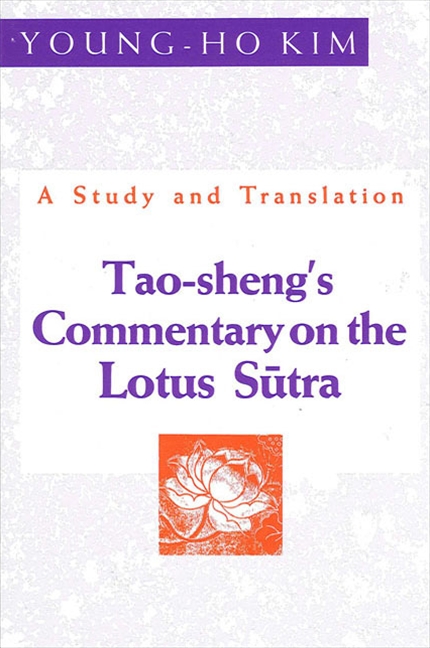
Tao-Sheng's Commentary on the Lotus Sūtra-front.jpg
Books1990About this item
(Chu) Tao-sheng stands out in history as a unique and preeminent thinker whose paradigmatic, original ideas paved the way for the advent of Chinese Buddhism. The universality of Buddha-nature, which Tao-sheng championed at the cost of excommunication, was to become a cornerstone of the Chinese Buddhist ideology. This book presents a comprehensive study of the only complete document by Tao-sheng still in existence. (Source: SUNY Press)
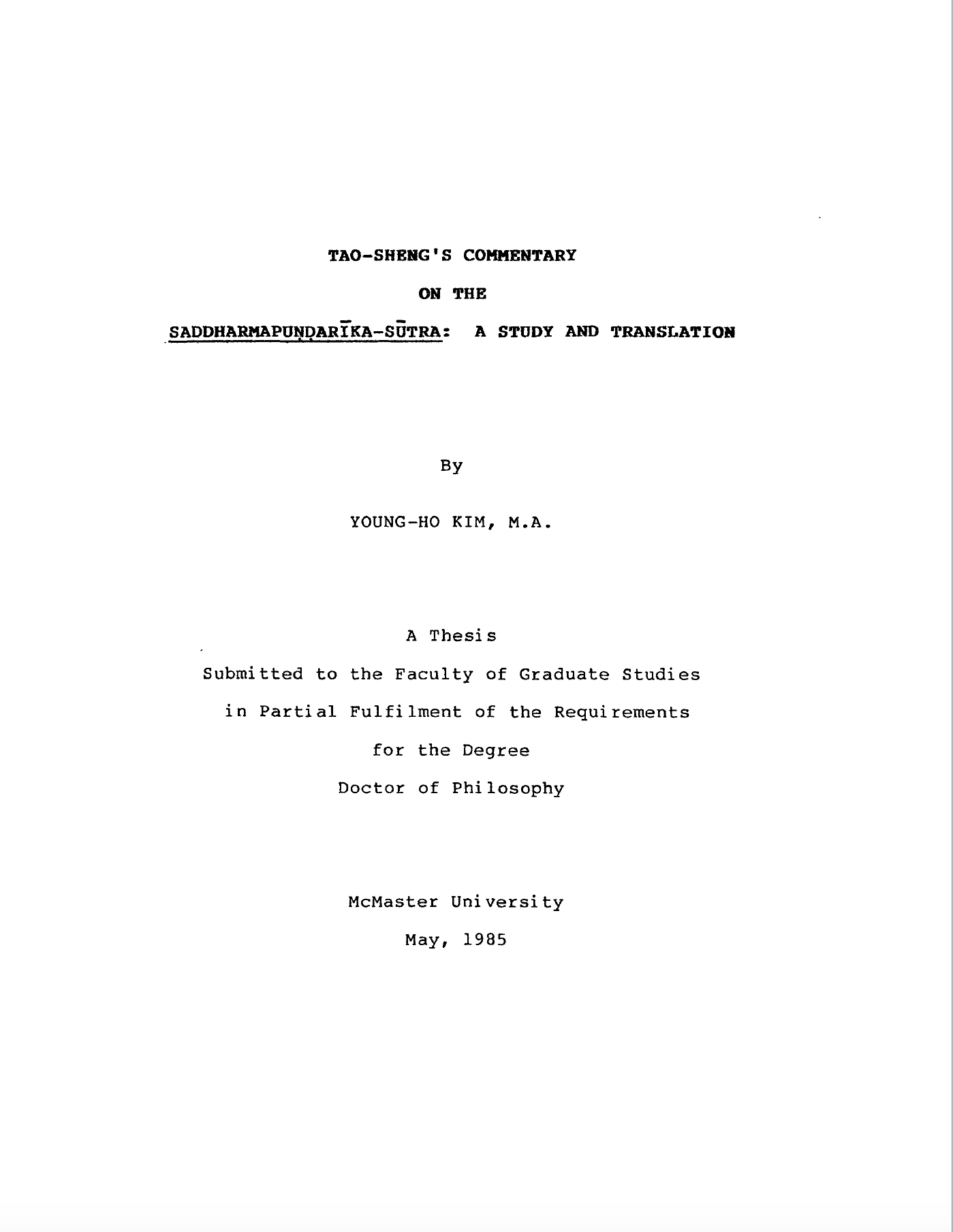
Tao-sheng's Commentary on the Saddharmapuṇḍarīka-Sūtra-front.jpg
Dissertations1985About this item
Abstract

This dissertation provides a comprehensive study and complete translation of Tao-sheng's Commentary on the Saddharmapuṇḍarīka-sūtra (CSPS). This document occupies an important place in Chinese Buddhist literature. Its significance in the study of Chinese Buddhism can be described in two ways. Firstly, the CSPS was the first commentary ever written on the Lotus Sūtra, which was to become a scripture of fundamental importance on the Far Eastern Buddhist scene, especially for the later Chinese Buddhist schools. Furthermore, it was the first commentary on any Buddhist scripture that was written in Chinese and structured in fully developed commentarial form. The CSPS set a pattern in many ways for later Buddhists to follow in terms of both structure and ideology.
      Secondly, the CSPS is a rich source of Tao-sheng's seminal ideas. Tao-sheng (ca. 360-434) has been regarded, both in his time and subsequently, as a uniquely creative and prophetic thinker. The CSPS, the only writing of Tao-sheng preserved in complete form, is essential to any study of Tao-sheng's own original thought. Most of his theses and arguments, which were controversial in his day, were originally propounded in his other writings, but the commentary may provide at least the general structure of Tao-sheng's thought.
      The thesis is composed of two main portions: "Study" (Part I-IV) and "Translation" (Part V). Part I sets out and clarifies the problems involved in the study of Tao-sheng, the aims and method of the present study. Part II as the introductory step to the main task involving the CSPS extensively examines Tao-sheng as a whole as reflected in other sources, in terms of his background, historical and biographical, his works, his doctrines, and his influence. Part III is devoted to a critical examination of the CSPS proper. Here I undertake an in-depth analysis in several different ways in respect with both form and content, or language and ideology. The analysis focuses on how Tao-sheng renders, successfully or otherwise, the ancient Indian system of religious thought into the current Chinese language, which was already laden with indigenous philosophical connotations. Here I also trace and reconstruct Tao-sheng's thought incorporated in the commentary in accordance with his distinct themes. Part IV reviews the findings and significance of the study conducted. In brief, the thesis is the first full-scale study of Tao-sheng and the commentary.
      Finally, a complete translation of the text is presented along with detailed annotations including the classical sources of Chinese philosophical terms used and numerous corruptions of the text. In light of the significance of Tao-sheng and the CSPS, the translation answers the need for a complete translation of the text into a modern language and will serve as a basis for further study.
Text as Father-front.jpg
Books2005About this item
This beautifully written work sheds new light on the origins and nature of Mahayana Buddhism with close readings of four well-known texts—the Lotus Sutra, Diamond Sutra, Tathagatagarbha Sutra, and Vimalakirtinirdesa. Treating these sutras as literary works rather than as straightforward philosophic or doctrinal treatises, Alan Cole argues that these writings were carefully sculpted to undermine traditional monastic Buddhism and to gain legitimacy and authority for Mahayana Buddhism as it was veering away from Buddhism’s older oral and institutional forms. His sophisticated and sustained analysis of the narrative structures and seductive literary strategies used in these sutras suggests that they were specifically written to encourage devotion to the written word instead of other forms of authority, be they human, institutional, or iconic. (Source: University of California Press)
The Essentials of the Dharma Blossom Sutra-front.jpg
Books1974About this item
An English translation of a commentary on the Lotus Sūtra by Hsuan Hua originally delivered as lectures in San Francisco, 1968-70. Translated by Heng Ch'ien.
Articles.jpeg
Articles2025About this item
This study examines the development and transformation of the bodhisattva concept through comparative analysis of canonical Pāli texts and early Mahāyāna literature. Drawing upon philological evidence from the Jātaka tales, Buddhavaṃsa, and foundational Mahāyāna sūtras including the Lotus Sūtra and Perfection of Wisdom literature, this research traces the evolution from the historical Buddha's preenlightenment journey to the fully developed bodhisattva doctrine. The investigation employs textual criticism and doctrinal comparison to demonstrate how the bodhisattva ideal underwent significant conceptual expansion, shifting from describing the Buddha’s past lives to establishing a universal path of compassionate awakening. Findings reveal that while the Pāli tradition presents the bodhisattva path as exceptional and primarily retrospective, early Mahāyāna sources reconceptualize it as the supreme spiritual ideal accessible to all practitioners. This transformation reflects broader soteriological developments within Buddhist thought, particularly regarding the tension between individual liberation and universal salvation. The study contributes to understanding how fundamental Buddhist concepts evolved across different textual traditions and geographical contexts. Keywords: bodhisattva, Pāli Canon, Mahāyāna Buddhism, comparative Buddhism, Buddhist soteriology.
The Lotus Sutra BDK-front.jpg
Books2016About this item
An English translation of the Lotus Sutra from the Chinese of Kumārajiva by Tsugunari Kubo and Akira Yuyama. Published by BDK America, 2016.
The Lotus Sutra A Contemporary Translation of a Buddhist Classic-front.jpg
Books2008About this item
A translation of the Lotus Sūtra by Gene Reeves that appeals to readers with little or no familiarity with technical Buddhist vocabulary, as well as long-time practitioners.
The Lotus Sutra A Biography-front.jpg
Books2016About this item
The Lotus Sutra is arguably the most famous of all Buddhist scriptures. Composed in India in the first centuries of the Common Era, it is renowned for its inspiring message that all beings are destined for supreme enlightenment. Here, Donald Lopez provides an engaging and accessible biography of this enduring classic.

Lopez traces the many roles the Lotus Sutra has played in its travels through Asia, Europe, and across the seas to America. The story begins in India, where it was one of the early Mahayana sutras, which sought to redefine the Buddhist path. In the centuries that followed, the text would have a profound influence in China and Japan, and would go on to play a central role in the European discovery of Buddhism. It was the first Buddhist sutra to be translated from Sanskrit into a Western language—into French in 1844 by the eminent scholar Eugène Burnouf. That same year, portions of the Lotus Sutra appeared in English in The Dial, the journal of New England's Transcendentalists. Lopez provides a balanced account of the many controversies surrounding the text and its teachings, and describes how the book has helped to shape the popular image of the Buddha today. He explores how it was read by major literary figures such as Henry David Thoreau and Gustave Flaubert, and how it was used to justify self-immolation in China and political extremism in Japan.

Concise and authoritative, this is the essential introduction to the life and afterlife of a timeless masterpiece. (Source: Princeton University Press)
The Lotus of the Wonderful Law or The Lotus Gospel 1975-front.jpg
Books1975About this item
The "Lotus of the Wonderful (or Mystic) Law" is the most important religious book of the Far East, and has been described as "The Gospel of Half Asia". It is also the chief scripture of Buddhism in China, and therefore the chief source of consolation of the many millions of Buddhists in East Asia. It is justifiable to consider it as one of the greatest and most formative books of the world, and the text is here translated for the use of the Western student whilst an endeavour is made to reveal the contour of the most spiritual drama known in the Far East. (Source: Routledge)
The Lotus of the Wonderful Law-front.jpg
Books2005About this item
An English translation of the Lotus Sūtra from the Chinese of Kumārajīva by William Edward Soothill.
Forgues-Gregory-Darthmouth-2026.png
Articles2025About this item
Bodhicitta, the "mind of awakening," constitutes the foundational principle of Mahāyāna Buddhism. This essay traces the concept's historical and doctrinal genesis from its pre-Mahāyāna antecedents to its full articulation in the Indian and Tibetan traditions. It explores the main scriptural and scholastic sources in India, the two great Indian lineages of practice—the "Profound View" of Nāgārjuna and the "Vast Conduct" of Asaṅga—and the pivotal role of Atiśa Dīpaṃkara Śrījñāna in transmitting and systematizing these teachings in Tibet. The article further details how Atiśa's Kadam school and its core mind training (lojong) teachings influenced the subsequent development of bodhicitta cultivation in the Nyingma, Kagyu, Sakya, and Geluk schools. Bodhicitta is not a static concept but a dynamic, multifaceted principle that functions as the soteriological core of the Mahāyāna path, embodying the indivisible union of universal compassion and the profound wisdom that realizes emptiness.
Saddharma-Pundarikasutra or The Lotus of the True Law-Kern 1884-front.jpg
Books1884About this item
An English translation of the Saddharmapuṇḍarīkasūtra by H. Kern. Published by the Clarendon Press in 1884 as vol. 21 of the The Sacred Books of the East series.
The Social Message of Mahayana Buddhism-front.jpg
Books2012About this item
This book examines topics relating to "engaged Buddhism" viz. The Lotus Sūtra and the Bodhicaryāvatāra. Contains portions of the Sanskrit texts along with their simple meaning in English.
The Sound that Perceives the World-front.jpg
Books2025About this item
Musings and autobiographically informed commentary on the human condition through the lens of the Kannon-gyo—chapter 25 of the Lotus Sutra—connecting Zen and Pure Land Buddhism through the practice of venerating and chanting the names of buddhas and bodhisattvas.

The Kannon-gyo is chapter 25 of the Lotus Sutra, and its focus is the bodhisattva of compassion, Avalokiteshvara, known in China as Guanyin, and in Japan as Kannon or Kanzeon. The text describes the many ways in which calling out the bodhisattva’s name—Namu Kanzeon Bosatsu—can relieve suffering.

Most schools of Zen Buddhism, and especially the Soto school, eschew such practices as chanting the names of buddhas and bodhisattvas, along with venerating such figures.

The eminent Soto Zen master Kosho Uchiyama Roshi, however, while doing hard physical labor early in his career, could not practice zazen—that is, formal sitting meditation. He came to appreciate the Kannon-gyo and the practices related to it. In particular, he took to reciting Kannon’s name, as recommended in the text of the Kannon-gyo.

Later in life, Uchiyama Roshi suffered from illness that again prevented him from practicing formal Zen, so he returned to the Kannon-gyo and the practice of chanting. He went so far as to assert that chanting Kannon’s name is completely equivalent to zazen, that the two practices are simply two sides of the same coin—a revolutionary idea seemingly at odds with Zen.

Chanting practice is especially accessible, as it can be done while working, traveling, or suffering from illness, and other activities that would ordinarily get in the way of formal Zen practice.

With these practices, the Kannon-gyo, and Kannon herself as a backdrop, Uchiyama Roshi muses about the purposes of religion, the goals of religious practice, and the meaning of enlightenment—and their relation to suffering itself. (Source: Wisdom Publications)
Zimmermann-Hamburg-Copyright Unknown.jpg
Articles1999About this item
No abstract given. Here are the first relevant paragraphs:

In his comprehensive study of the development of the tathāgatagarbha teaching, J. Takasaki also deals with the sūtra which bears the name of this Mahāyāna philosophical current.[1] The Tathāgatagarbhasūtra (TGS) has generally been referred to as the earliest expression of this doctrine and the term tathāgatagarbha itself seems to have been coined by this very sūtra. In this paper I intend to introduce the textual history and doctrinal content of the TGS and offer some speculations concerning the possible motivations lying behind its compilation. By pointing out some interesting parallels concerning the structure and formulations in the Saddharmapuṇḍarīkasūtra (SP), I shall then suggest that the SP and the TGS carry a similar compositional line. Finally, I shall determine the position and role of the TGS in Mahāyāna Buddhism as a sūtra presupposing the doctrine of the SP and providing its metaphysical foundation. (Zimmermann, introductory remarks, 143–44)

Notes
  1. Jikidō Takasaki 高崎直道, Nyoraizō shisō no keisei (Formation of the Tathāgatagarbha Theory), Tokyo 1974 (Shunjū-sha): pp. 40–68.
The Threefold Lotus Sutra-front.jpg
Books1995About this item
An English translation of the Lotus Sūtra together with the two shorter sūtras that traditionally accompany it: Innumerable Meanings and Meditation on the Bodhisattva Universal Virtue.
The White Lotus of the Good Dharma Saddharmapuṇḍarīkasūtra Roberts-front.jpg
Books2022About this item
This is an English translation of the Saddharmapuṇḍarīkasūtra by Peter Alan Roberts. Edited by Emily Bower. Published by 84000: Translating the Words of the Buddha.
Visions of Awakening Space and Time-front.jpg
Books2007About this item
As a religion concerned with universal liberation, Zen grew out of a Buddhist worldview very different from the currently prevalent scientific materialism. Indeed, says Taigen Dan Leighton, Zen cannot be fully understood outside of a worldview that sees reality itself as a vital, dynamic agent of awareness and healing. In this book, Leighton explicates that worldview through the writings of the Zen master Eihei Dōgen (1200-1253), considered the founder of the Japanese Sōtō Zen tradition, which currently enjoys increasing popularity in the West.

The Lotus Sutra, arguably the most important Buddhist scripture in East Asia, contains a famous story about bodhisattvas (enlightening beings) who emerge from under the earth to preserve and expound the Lotus teaching in the distant future. The story reveals that the Buddha only appears to pass away, but actually has been practicing, and will continue to do so, over an inconceivably long life span.

Leighton traces commentaries on the Lotus Sutra from a range of key East Asian Buddhist thinkers, including Daosheng, Zhiyi, Zhanran, Saigyo, Myōe, Nichiren, Hakuin, and Ryōkan. But his main focus is Eihei Dōgen, the 13th century Japanese Sōtō Zen founder who imported Zen from China, and whose profuse, provocative, and poetic writings are important to the modern expansion of Buddhism to the West.

Dōgen's use of this sutra expresses the critical role of Mahayana vision and imagination as the context of Zen teaching, and his interpretations of this story furthermore reveal his dynamic worldview of the earth, space, and time themselves as vital agents of spiritual awakening.

Leighton argues that Dōgen uses the images and metaphors in this story to express his own religious worldview, in which earth, space, and time are lively agents in the bodhisattva project. Broader awareness of Dōgen's worldview and its implications, says Leighton, can illuminate the possibilities for contemporary approaches to primary Mahayana concepts and practices. (Source: Oxford University Press)

Zapart Jarowslaw Jagiellonian.jpg
Articles2012About this item
This article aims at providing an outlook on the possible origin of tathāgatagarbha theory with a special reference to its relation to the soteriological and formal solutions found in the Saddharmapuṇḍarīka-sūtra and Avataṃsaka-sūtra. Through comparative textual analysis, the first work of this tradition, Tathāgatagarbha-sūtra, is shown as a text providing a metaphysical foundation for the postulate of universal Buddhahood posited by the Lotus Sutra. The realization of this postulate was possible through the implementation of 'Buddha-wisdom' (tathāgatajñāna) — a quality intrinsic to all living beings, which comes from the Tathāgata's all-encompassing compassion — taken from the "Manifestation of the Tathāgata" chapter of Avataṃsaka. By combining these influences the Tathāgatagarbha-sūtra is presented as a culmination of an important soteriological trend of the early Mahāyāna, and at the same time the starting point for an influential 'buddha-nature' tradition. (Source accessed June 26, 2020)