Mahāyāna Buddhism: The Doctrinal Foundations
From Bodhicitta
< BooksBooks/Mahāyāna Buddhism: The Doctrinal Foundations
| 🤓 Admin Zone 🛠️ hidden to non-admins | |
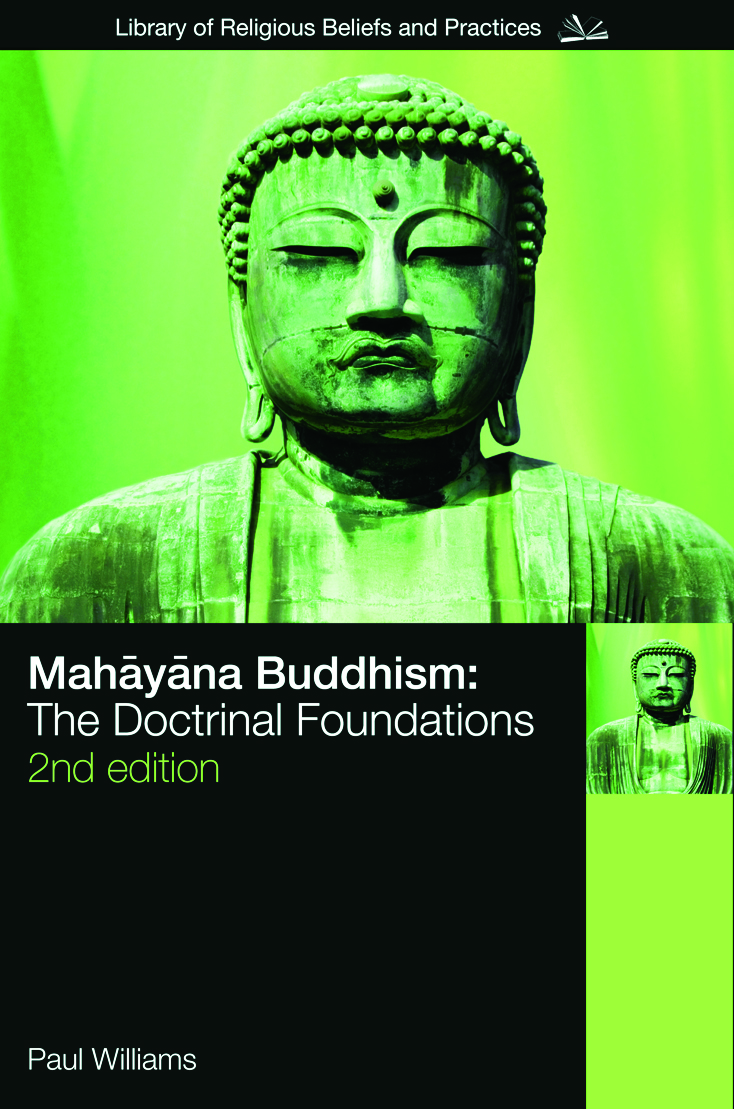
Mahāyāna Buddhism: The Doctrinal Foundations
Book
Please note that many items in our library are simply pages that represent a detailed library catalog entry and citation of someone else's work, presentation, or performance. Read our General Disclaimer for more information. You can find more information about this item on the publisher website.

Description
Originating in India, Mahayana Buddhism spread across Asia, becoming the prevalent form of Buddhism in Tibet and East Asia. Over the last twenty-five years Western interest in Mahayana has increased considerably, reflected both in the quantity of scholarly material produced and in the attraction of Westerners towards Tibetan Buddhism and Zen.
Paul Williams’ Mahayana Buddhism is widely regarded as the standard introduction to the field, used internationally for teaching and research and has been translated into several European and Asian languages. This new edition has been fully revised throughout in the light of the wealth of new studies and focuses on the religion’s diversity and richness. It includes much more material on China and Japan, with appropriate reference to Nepal, and for students who wish to carry their study further there is a much-expanded bibliography and extensive footnotes and cross-referencing. Everyone studying this important tradition will find Williams’ book the ideal companion to their studies. (Source: Routledge)
Citation
Williams, Paul. Mahayana Buddhism: The Doctrinal Foundations. 2nd ed. Library of Religious Beliefs and Practices. New York: Routledge, 2009. https://archive.org/details/mahayanabuddhismthedoctrinalfoundationspaulwilliamsroutledgeseealtruismandreality_202003_445_W/mode/2up.
Publisher Link
Table of contents
- Preface and acknowledgementsx
- 1 Introduction1
- Buddhism: doctrinal diversity and (relative) moral unity1
- The Indian background7
- Factors that may have contributed to change12
- Abhidharma15
- Mahāsāṃghikas and the Lokottaravāda18
- The origins of the Mahāyāna, and the laity21
- Mahāyāna before 'Mahāyāna' – the Ajitasenavyākaraṇanirdeśa Sūtra27
- On the origins of the Mahāyāna – some more sūtras30
- The justification of the Mahāyāna sutras38
- 2 The Perfection of Wisdom (Prajñāpāramitā) Sūtras 45
- On the Mahāyāna sūtras45
- The origins and development of the Prajñāpāramitā literature47
- Wisdom (prajña) and its perfection49
- Absence of Self – the extensive perspective51
- The Bodhisattva55
- 3 Mādhyamika63
- Nāgārjuna and Āryadeva63
- The development of the Mādhyamika tradition in India65
- Emptiness and intrinsic existence – the incompatible rivals68
- A brief note on Mādhyamika method71
- Three Mādhyamika critiques72
- On causation73
- On the Self74
- On nirvāṇa75
- The two truths76
- Meditation and emptiness – an impressionistic outline79
- A final note – Mādhyamika in China and East Asia81
- 4 Yogācāra84
- Background84
- The Yogācāra tradition – scholars and texts86
- The three natures (trisvabhava)88
- Mind92
- Substratum consciousness, consciousness and immaculate consciousness97
- Yet more disputes within the Yogācāra tradition100
- 5 The Tathāgatagarbha103
- Some Tathāgatagarbha Sūtras104
- The Tathāgatagarbha in the Ratnagotravibhāga109
- Tibet – the gzhan stong and rang stong dispute112
- The Dasheng qixinlun (Ta-sheng ch’i-hsin lun) and the
Tathagatagarbha in East Asia115 - Dōgen on the Buddha-nature119
- A note on some contemporary issues: Critical Buddhism and a debate on
not-Self in Thai Buddhism122 - Critical Buddhism122
- Not-Self in contemporary Thai Buddhism125
- 6 Huayan – the Flower Garland tradition129
- Buddhism in China129
- The Avataṃsaka Sūtra132
- The Huayan tradition in China138
- Huayan thought – Fazang’s 'Treatise on the Golden Lion' 141
- A note on some aspects of Huayan practice144
- The Avataṃsaka Sūtra and Vairocana in Buddhist art146
- 7 The Saddharmapuṇḍarīka (Lotus) Sūtra and its influences149
- A note on Tiantai (Tendai)161
- Nichiren Shōnin and his tradition165
- 8 On the bodies of the Buddha172
- Prolegomenon to the Mahāyāna172
- The bodies of the Buddha and the philosophy of emptiness176
- Yogācāra – the system develops179
- A note on the dGe lugs schema of the Buddha's bodies182
- A final note: the 'nonabiding nirvāṇa' and the lifespan of the Buddha185
- 9 The path of the Bodhisattva187
- Buddhism reaches Tibet187
- The eighth-century debates191
- Compassion and the Bodhicitta194
- Bodhisattva stages, paths and perfections200
- 10 Trust, self-abandonment and devotion: the cults of Buddhas
and Bodhisattvas209- Buddhānusmṛti – recollection of the Buddha209
- The pratyutpanna samādhi and Huiyuan212
- The notion of a Buddha Field (buddhakṣetra)214
- Some Bodhisattvas218
- Maitreya218
- Avalokiteśvara221
- Tārā225
- Mañjuśrī226
- Kṣitigarbha229
- Some Buddhas231
- Akṣobhya231
- Bhaiṣajyaguru234
- Amitābha/Amitāyus238
- The Amitābha sūtras238
- Amitābha’s Pure Land in China243
- Hōnen Shōnin (1133–1212)254
- Shinran Shōnin (1173–1262)259
- Notes267
- References389
- Index of names422
- Index of subjects430
Interconnections
3 Scholarship on

The White Lotus of the Good Dharma, popularly known as the Lotus Sūtra, is taught by Buddha Śākyamuni on Vulture Peak to an audience that includes bodhisattvas from countless realms, as well as bodhisattvas who emerge from under the ground, from the space below this world. Buddha Prabhūtaratna, who has long since passed into nirvāṇa, appears within a floating stūpa to hear the sūtra, and Śākyamuni enters the stūpa and sits beside him. The Lotus Sūtra is celebrated, particularly in East Asia, for its presentation of crucial elements of the Mahāyāna tradition, such as the doctrine that there is only one yāna, or "vehicle"; the distinction between expedient and definite teachings; and the notion that the Buddha's life, enlightenment, and parinirvāṇa were simply manifestations of his transcendent buddhahood, while he continues to teach eternally. A recurring theme in the sūtra is its own significance in teaching these points during past and future eons, with many passages in which the Buddha and bodhisattvas such as Samantabhadra describe the great benefits that come from devotion to it, the history of its past devotees, and how it is the Buddha's ultimate teaching, supreme over all other sūtras. (Source: 84000)

One of the longest works in the entire Buddhist canon, the Buddhāvataṃsakasūtra is widely considered to be a compilation of independent scriptures, which was expanded upon over the course of time. It was extremely influential in East Asia, where it was preserved in an eighty-scroll recension. The Tibetan translation of this work fills four volumes in the Derge Kangyur. Though only two sections—namely, the Gaṇḍavyūhasūtra and the Daśabhūmikasūtra—have survived in Sanskrit, both of which have also circulated as independent works.
.jpg)
The Ratnagotravibhāga, commonly known as the Uttaratantra, or Gyu Lama in Tibetan, is one of the main Indian scriptural sources for buddha-nature theory. It was likely composed during the fifth century, by whom we do not know. Comprised of verses interspersed with prose commentary, it systematizes the buddha-nature teachings that were circulating in multiple sūtras such as the Tathāgatagarbhasūtra, the Mahāparinirvāṇasūtra, and the Śrīmaladevisūtra. The Tibetan tradition attributes the verses to the Bodhisattva Maitreya and the commentary to Asaṅga, and treats the two as separate texts, although this division is not attested to in surviving Indian versions. The Chinese tradition attributes the text to *Sāramati (娑囉末底), but the translation itself does not include the name of the author, and the matter remains unsettled. It was translated into Chinese in the early sixth century by Ratnamati and first translated into Tibetan by Atiśa, although this text is not known to survive. Ngok Loden Sherab translated it a second time based on teachings from the Kashmiri Pandita Sajjana, and theirs remains the standard translation. It has been translated into English several times, and recently into French. See the Ratnagotravibhāgavyākhyā, read more about the Ratnagotravibhāga, or take a look at the most complete English translation in When the Clouds Part by Karl Brunnholzl.