Mahāparinirvāṇasūtra

From Bodhicitta
Texts/Mahāparinirvāṇasūtra

🤓 Admin Zone 🛠️ hidden to non-admins
महापरिनिर्वाणसूत्र
Mahāparinirvāṇasūtra
འཕགས་པ་ཡོངས་སུ་མྱ་ངན་ལས་འདས་པ་ཆེན་པོ་ཐེག་པ་ཆེན་པོའི་མདོ།
'phags pa yongs su mya ngan las 'das pa chen po theg pa chen po'i mdo; 'phags pa yongs su mya ngan las 'das pa chen po'i mdo chen po; 'phags pa yongs su mya ngan las 'das pa chen po'i mdo
Great Nirvāṇa Mahāyāna Sūtra
Text


Please note that many items in our library are simply pages that represent a detailed library catalog entry and citation of someone else's work, presentation, or performance. Read our General Disclaimer for more information.

Description

There are three translations in the Tibetan canon under this name:
  1. Mahāparinirvāṇasūtra (RKTSK 119)
  2. Mahāparinirvāṇasūtra (RKTSK 120)
  3. Mahāparinirvāṇasūtra (RKTSK 121)


The Mahāparinirvāṇasūtra is one of the main scriptural sources for buddha-nature in China and Tibet. Set around the time of Buddha's passing or Mahāparinirvāṇa, the sūtra contains teachings on buddha-nature equating it with the dharmakāya—that is, the complete enlightenment of a buddha. It also asserts that all sentient beings possess this nature as the buddhadhātu, or buddha-element, which thus acts as a cause, seed, or potential for all beings to attain enlightenment. Furthermore, the sūtra includes some salient features related to this concept, such as the single vehicle and the notion that the dharmakāya is endowed with the four pāramitās of permanence, bliss, purity, and a self. It may be noted that there are three different texts with similar titles in the Chinese and Tibetan canons. Of the three Tibetan texts with Mahāparinirvāṇa in their title, a short one (Derge Kangyur, No. 121) called Āryamahāparinirvāṇasūtra contains prophecies of events in the centuries after the Buddha's Mahāparinirvāṇa but has nothing on buddha-nature. Thus, this is not the Mahāparinirvāṇāsūtra which is considered as a Tathāgatagarbhasūtra. The two which deal with buddha-nature are Mahāyānasūtras and contain detailed accounts of the final teachings of the Buddha. The first sūtra, the longer one covering two volumes of Derge Kangyur (mdo sde Nya and Ta) is a translation from Chinese, while the second one is a translation from Sanskrit. They appear to be two different recensions of the same original sūtra as they have similar titles and overlapping content. However, the one translated from Chinese is much longer and also contains information on the events after the Buddha entered Mahāparinirvāṇa.

Quoted in the aligned translations

Recensions

Mahāparinirvāṇasūtra (Great Nirvāṇa Sūtra). Recension information:
Sanskrit महापरिनिर्वाणसूत्र (Mahāparinirvāṇasūtra).
Tibetan
Chinese

Citations of Related Scholarship

Interconnections
All 29Books 26Articles 3
7 Recensions
Books1951About this item
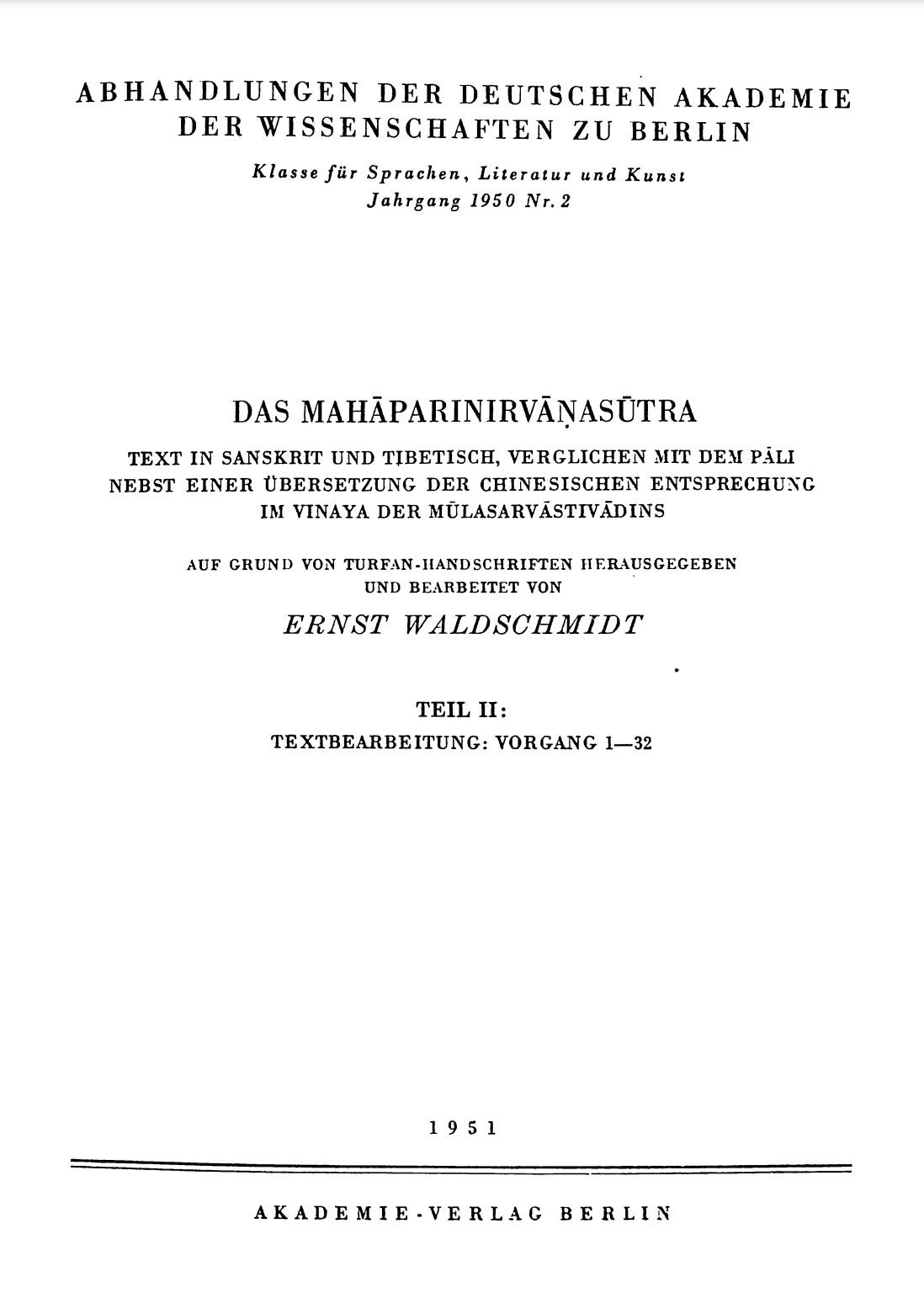
The Mahāparinirvāṇasūtra. Text in Sanskrit and Tibetan, Compared with the Pāli along with a translation of the Chinese equivalent in the vinaya of the Mūlasarvāstivādins. Edited on the basis of Turfan handwritings and edited by Ernst Waldschmidt. Part 2: Text edit: Procedure 1–32.
Books1944About this item
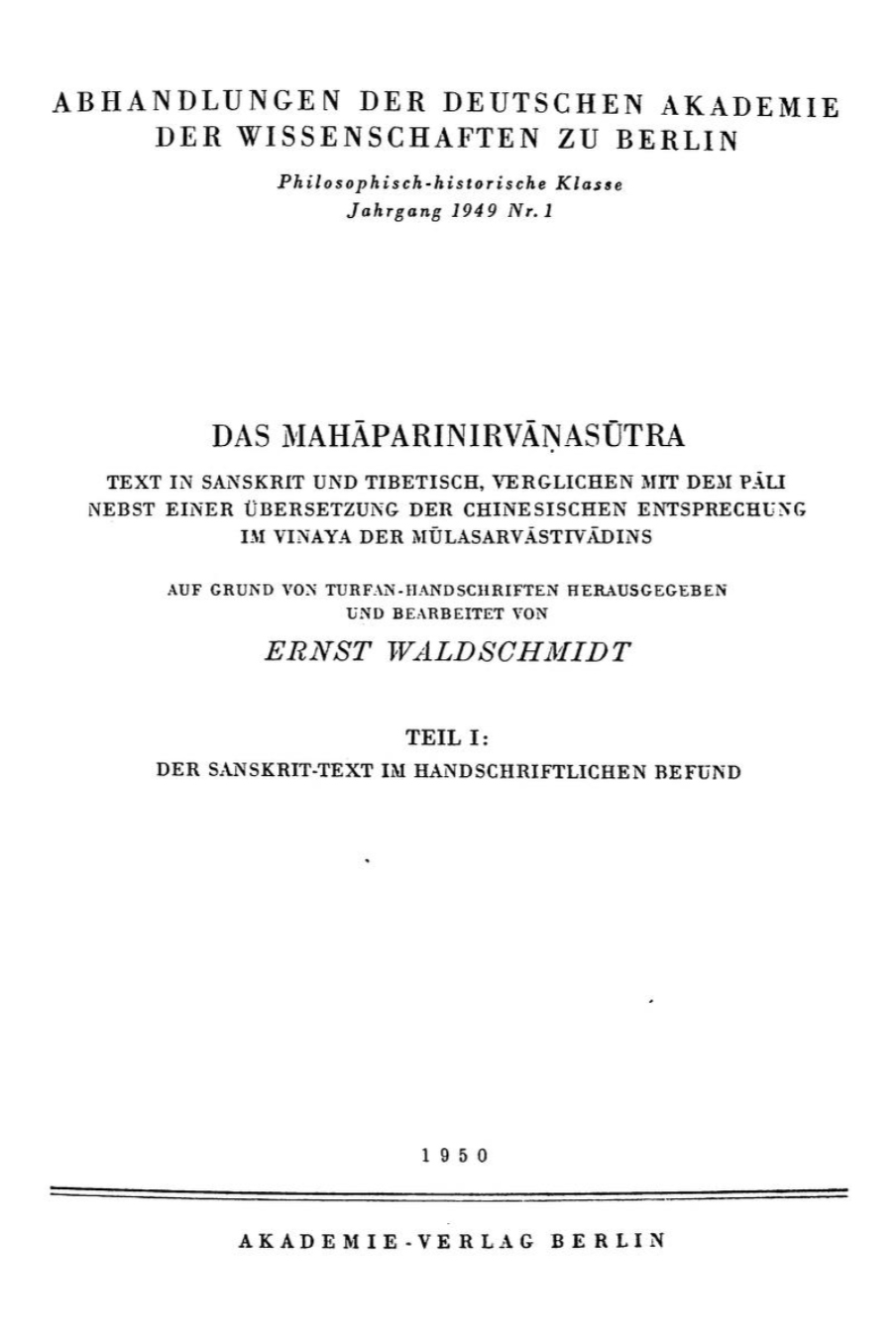
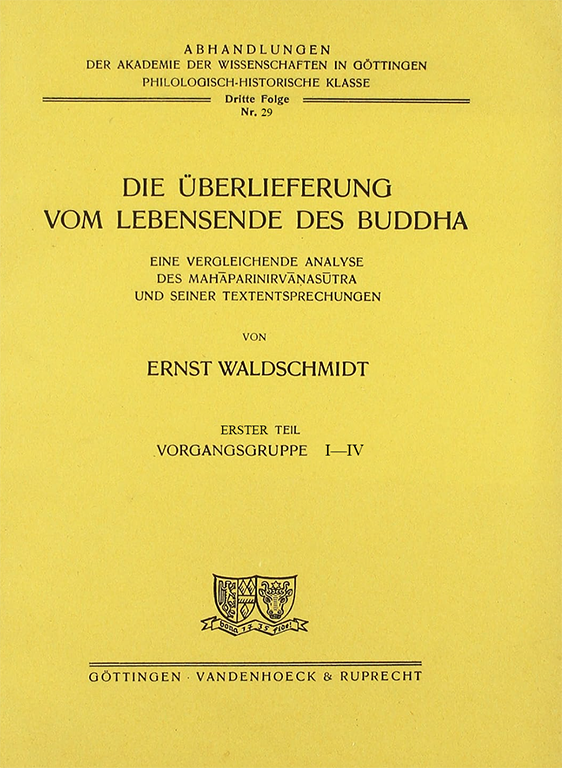
The narration of the Buddha's end of life: a comparative analysis of the Mahāparinirvāṇasūtra and its textual equivalents. Part 1, process group I-IV. Edited in Sanskrit and Tibetan and translated into German. The author, skilled in reading Central Asiatic manuscripts, prepared a critical edition of the Buddist-Sanskrit manuscript of the Mahāparinirvāṇasūtra, but publication was held up because of the war. In the work he collated this manuscript, which was discovered by the Prussian expeditions in Chinese Turkestan, with the Pāli, Chinese, and Tibetan versions. The sūtra describes the last few months before Buddha's death (parinirvāṇa) . Waldschmidt compares the Sanskrit manuscript version with the corresponding printed Pāli texts and the printed Chinese translations. In order to facilitate this comparison, he distinguishes fifty-one events, brought together in six groups, in the last months of Buddha's life, beginning with Minister Varṣākāra's visit to Buddha in Rājagṛha and ending with the cremation of Buddha's body and the distribution of the relics. The present book is the first part of this work, and deals only with the events numbered 1 to 31, the arrival in Kuśinagara. Part Two will deal with the events numbered 32 to 51, all of which took place in Kuśinagara where the Buddha entered parinirvāṇa. Waldschmidt has previously published a comparative study of the texts relating to two events on the day of Buddha's death, under the title, "Beiträge zur Textgeschichte des Mahāparinirvāṇa-sūtra." (Review by Johannes Rahder, Harvard Journal of Asiatic Studies 10, no. 2 (1947): 227-29)
Books1948About this item
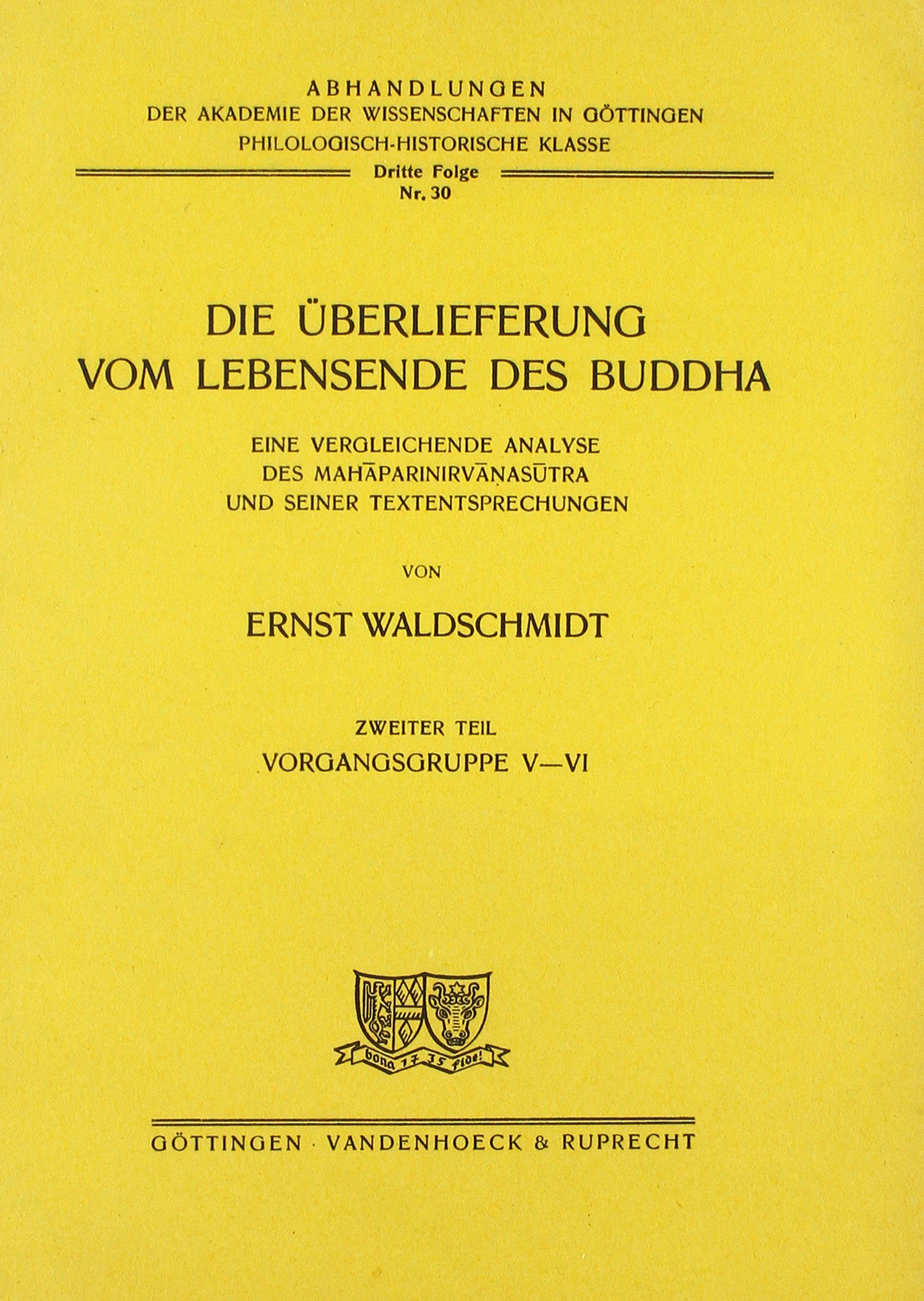
The tradition of the Buddha at the end of life: a comparative analysis of the Mahāparinirvāṇasūtra and its textual correspondences, part two, process group V–VI.

The author, skilled in reading Central Asiatic manuscripts, prepared a critical edition of the Buddist-Sanskrit manuscript of the Mahāparinirvāṇasūtra, but publication was held up because of the war. In the work he collated this manuscript, which was discovered by the Prussian expeditions in Chinese Turkestan, with the Pāli, Chinese, and Tibetan versions. The sūtra describes the last few months before Buddha's death (parinirvāṇa) . Waldschmidt compares the Sanskrit manuscript version with the corresponding printed Pāli texts and the printed Chinese translations. In order to facilitate this comparison, he distinguishes fifty-one events, brought together in six groups, in the last months of Buddha's life, beginning with Minister Varṣākāra's visit to Buddha in Rājagṛha and ending with the cremation of Buddha's body and the distribution of the relics. (Review by Johannes Rahder, Harvard Journal of Asiatic Studies 10, no. 2 (1947): 227-29)

The present book is the second part of this work, and deals with the events numbered 32 to 51, all of which took place in Kuśinagara where the Buddha entered parinirvāṇa. Part 1, published in 1944, deals with the events numbered 1 to 31, the arrival in Kuśinagara.
3 Full translations
Books1944About this item
The narration of the Buddha's end of life: a comparative analysis of the Mahāparinirvāṇasūtra and its textual equivalents. Part 1, process group I-IV. Edited in Sanskrit and Tibetan and translated into German. The author, skilled in reading Central Asiatic manuscripts, prepared a critical edition of the Buddist-Sanskrit manuscript of the Mahāparinirvāṇasūtra, but publication was held up because of the war. In the work he collated this manuscript, which was discovered by the Prussian expeditions in Chinese Turkestan, with the Pāli, Chinese, and Tibetan versions. The sūtra describes the last few months before Buddha's death (parinirvāṇa) . Waldschmidt compares the Sanskrit manuscript version with the corresponding printed Pāli texts and the printed Chinese translations. In order to facilitate this comparison, he distinguishes fifty-one events, brought together in six groups, in the last months of Buddha's life, beginning with Minister Varṣākāra's visit to Buddha in Rājagṛha and ending with the cremation of Buddha's body and the distribution of the relics. The present book is the first part of this work, and deals only with the events numbered 1 to 31, the arrival in Kuśinagara. Part Two will deal with the events numbered 32 to 51, all of which took place in Kuśinagara where the Buddha entered parinirvāṇa. Waldschmidt has previously published a comparative study of the texts relating to two events on the day of Buddha's death, under the title, "Beiträge zur Textgeschichte des Mahāparinirvāṇa-sūtra." (Review by Johannes Rahder, Harvard Journal of Asiatic Studies 10, no. 2 (1947): 227-29)
Books1948About this item
The tradition of the Buddha at the end of life: a comparative analysis of the Mahāparinirvāṇasūtra and its textual correspondences, part two, process group V–VI.

The author, skilled in reading Central Asiatic manuscripts, prepared a critical edition of the Buddist-Sanskrit manuscript of the Mahāparinirvāṇasūtra, but publication was held up because of the war. In the work he collated this manuscript, which was discovered by the Prussian expeditions in Chinese Turkestan, with the Pāli, Chinese, and Tibetan versions. The sūtra describes the last few months before Buddha's death (parinirvāṇa) . Waldschmidt compares the Sanskrit manuscript version with the corresponding printed Pāli texts and the printed Chinese translations. In order to facilitate this comparison, he distinguishes fifty-one events, brought together in six groups, in the last months of Buddha's life, beginning with Minister Varṣākāra's visit to Buddha in Rājagṛha and ending with the cremation of Buddha's body and the distribution of the relics. (Review by Johannes Rahder, Harvard Journal of Asiatic Studies 10, no. 2 (1947): 227-29)

The present book is the second part of this work, and deals with the events numbered 32 to 51, all of which took place in Kuśinagara where the Buddha entered parinirvāṇa. Part 1, published in 1944, deals with the events numbered 1 to 31, the arrival in Kuśinagara.
4 Partial translations
Books1951About this item
The Mahāparinirvāṇasūtra. Text in Sanskrit and Tibetan, Compared with the Pāli along with a translation of the Chinese equivalent in the vinaya of the Mūlasarvāstivādins. Edited on the basis of Turfan handwritings and edited by Ernst Waldschmidt. Part 2: Text edit: Procedure 1–32.
2 Scholarship
Books1916About this item
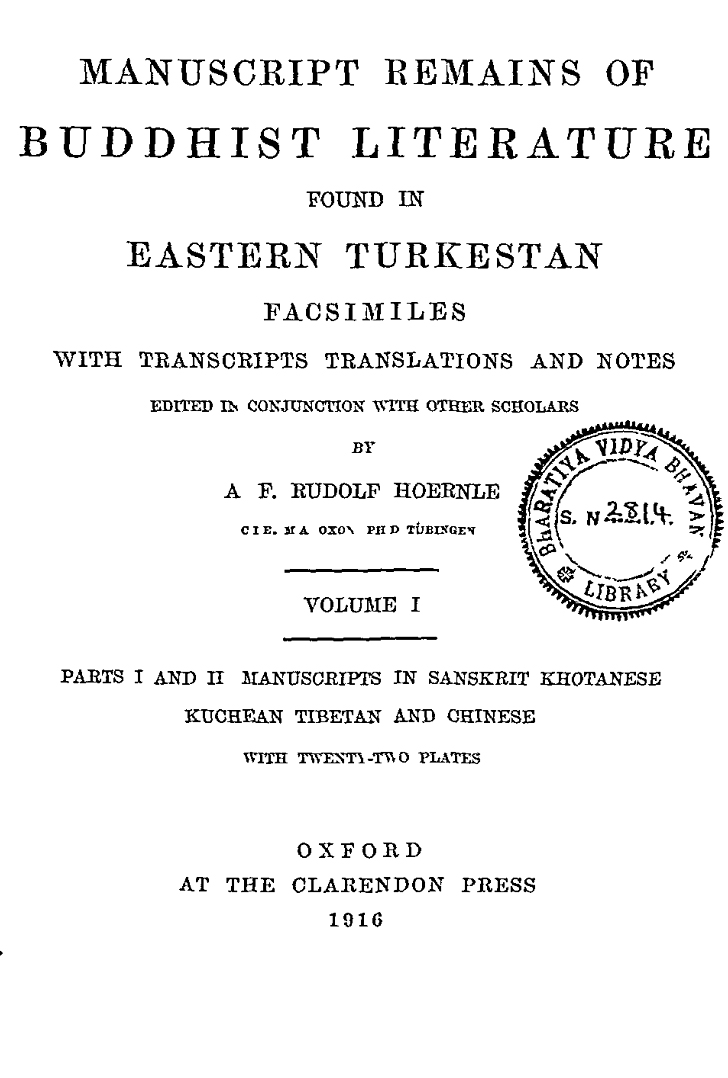
Manuscript Remains of Buddhist Literature Found in Eastern Turkestan: Facsimiles with Transcripts, Translations and Notes, Volume I (Oxford: Clarendon Press, 1916), edited by A. F. Rudolf Hoernle (1841–1918) "in conjunction with other scholars," presents facsimiles, transcriptions, translations, and scholarly notes for Buddhist manuscript fragments recovered from Central Asian sites—chiefly through Sir Aurel Stein's expeditions, alongside material from Hoernle's own and George Macartney's collections—in Sanskrit, Khotanese, Kuchean, Tibetan, and Chinese. Compiled as a genuinely international collaboration, its contributors included Lionel D. Barnett, Édouard Chavannes, Sten Konow, Sylvain Lévi, Heinrich Lüders, F. E. Pargiter, and F. W. Thomas, each responsible for the material in their specialty. Hoernle's lengthy General Introduction argues, based on the newly recovered Khotanese material, that the Tibetan alphabet derived not directly from India but specifically from the script of Khotan. Though conceived as the first volume of an ongoing series, no further volumes were published. The Sanskrit material includes newly discovered fragments of hymns by the celebrated poet Mātṛceṭa, among other canonical and noncanonical texts.
Articles2000About this item
Thanks to several previous studies, the Mahāparinirvāṇasūtra (MPNS) has been proved to shift its central thought from the buddhakāya idea to the tathāgatagarbha/buddhadhātu idea. The present author has shown in another paper (Suzuki [1999]) that the movement between the buddhakāya idea and the tathāgatagarbha/buddhadhātu idea appears in the larger context including the MPNS, and has extracted this context from the various Mahāyāna sūtras under the name of the Mahāparinirvāṇasūtra-Group (MPNS-G), which consists of the Mahāmeghasūtra (MMS), the MPNS, the Aṅgulimālīyasūtra (AMS) and the Mahābherisūtra (MBhS). While the AMS is a direct successor of the MPNS, the MBhS succeeds the MPNS critically and shifts back its central thought from the tathāgatagarbha/buddhadhātu idea to the buddhakāya idea again.
      The MPNS-G declares or suggests the non-emptiness of the tathāgata. This is reinterpretation of the pratītyasamutpāda and the śūnyatā idea, and follows the rule of the historical Buddhist hermeneutics. It is especially worthwhile to note that the MBhS, like the Saṃdhinirmocanasūtra in the Vijñāptimātra idea, devaluates the śūnyatā idea as imperfect. This quite negative attitude toward the śūnyatā idea does not appear in any other Indian texts on the tathāgatagarbha idea including the MPNS and the AMS. Aiming at establishing the theory that every sentient being is able to perform religious efforts and become buddha on account of the nonemptiness and the eternalness of the tathāgata, the MBhS must reject any sūtra concerning the śūnyatā idea as imperfect. Though the MPNS is a pioneer in reinterpretation of the the śúnyatā idea, the MPNS cannot devaluate it perfectly because the śūnyatā idea is one of the main backgrounds to the MPNS. The MBhS's decisive attitude toward the śūnyatā idea devaluation becomes possible by having the MPNS as its basis. (Source: UTokyo Repository)
13 A topic of
Books2019About this item
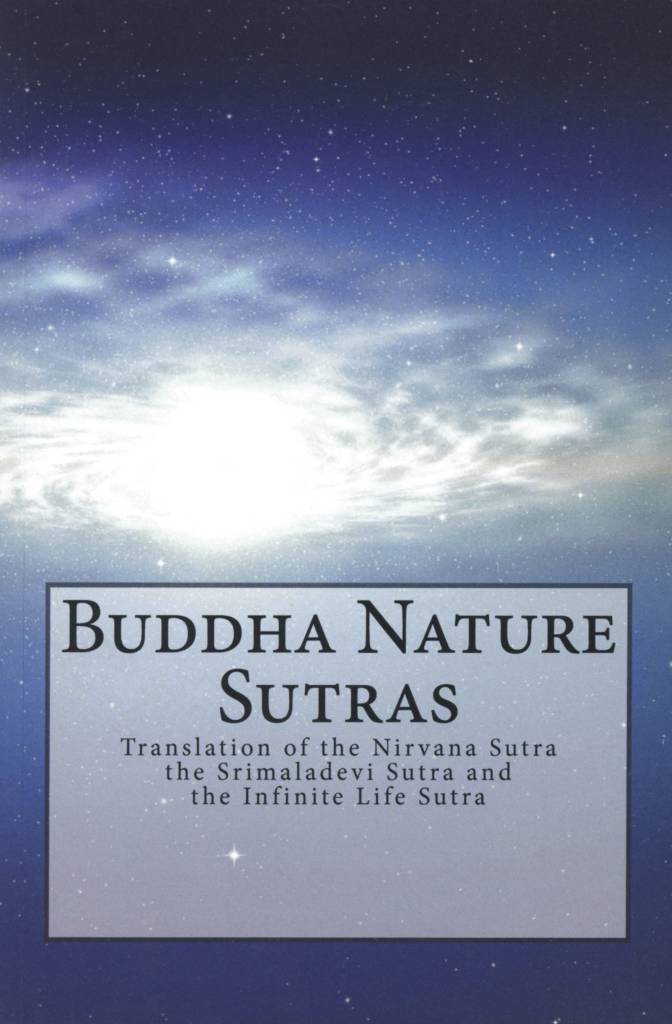
The present compendium aims to give the Buddhist student an opportunity to come into direct contact with these very positive and cataphatic (Truth-affirmative) doctrines and therewith enrich his or her practice of the Dharma. The Nirvana Sutra gives us the Buddha's own direct teachings, and the Srimala Sutra communicates similar doctrines through the person of the great Buddhist queen, while speaking in the approving presence of the Buddha himself. (Tony Page, preface, 4)
Books1951About this item
The Mahāparinirvāṇasūtra. Text in Sanskrit and Tibetan, Compared with the Pāli along with a translation of the Chinese equivalent in the vinaya of the Mūlasarvāstivādins. Edited on the basis of Turfan handwritings and edited by Ernst Waldschmidt. Part 2: Text edit: Procedure 1–32.
Books1944About this item
The narration of the Buddha's end of life: a comparative analysis of the Mahāparinirvāṇasūtra and its textual equivalents. Part 1, process group I-IV. Edited in Sanskrit and Tibetan and translated into German. The author, skilled in reading Central Asiatic manuscripts, prepared a critical edition of the Buddist-Sanskrit manuscript of the Mahāparinirvāṇasūtra, but publication was held up because of the war. In the work he collated this manuscript, which was discovered by the Prussian expeditions in Chinese Turkestan, with the Pāli, Chinese, and Tibetan versions. The sūtra describes the last few months before Buddha's death (parinirvāṇa) . Waldschmidt compares the Sanskrit manuscript version with the corresponding printed Pāli texts and the printed Chinese translations. In order to facilitate this comparison, he distinguishes fifty-one events, brought together in six groups, in the last months of Buddha's life, beginning with Minister Varṣākāra's visit to Buddha in Rājagṛha and ending with the cremation of Buddha's body and the distribution of the relics. The present book is the first part of this work, and deals only with the events numbered 1 to 31, the arrival in Kuśinagara. Part Two will deal with the events numbered 32 to 51, all of which took place in Kuśinagara where the Buddha entered parinirvāṇa. Waldschmidt has previously published a comparative study of the texts relating to two events on the day of Buddha's death, under the title, "Beiträge zur Textgeschichte des Mahāparinirvāṇa-sūtra." (Review by Johannes Rahder, Harvard Journal of Asiatic Studies 10, no. 2 (1947): 227-29)
Books1948About this item
The tradition of the Buddha at the end of life: a comparative analysis of the Mahāparinirvāṇasūtra and its textual correspondences, part two, process group V–VI.

The author, skilled in reading Central Asiatic manuscripts, prepared a critical edition of the Buddist-Sanskrit manuscript of the Mahāparinirvāṇasūtra, but publication was held up because of the war. In the work he collated this manuscript, which was discovered by the Prussian expeditions in Chinese Turkestan, with the Pāli, Chinese, and Tibetan versions. The sūtra describes the last few months before Buddha's death (parinirvāṇa) . Waldschmidt compares the Sanskrit manuscript version with the corresponding printed Pāli texts and the printed Chinese translations. In order to facilitate this comparison, he distinguishes fifty-one events, brought together in six groups, in the last months of Buddha's life, beginning with Minister Varṣākāra's visit to Buddha in Rājagṛha and ending with the cremation of Buddha's body and the distribution of the relics. (Review by Johannes Rahder, Harvard Journal of Asiatic Studies 10, no. 2 (1947): 227-29)

The present book is the second part of this work, and deals with the events numbered 32 to 51, all of which took place in Kuśinagara where the Buddha entered parinirvāṇa. Part 1, published in 1944, deals with the events numbered 1 to 31, the arrival in Kuśinagara.
Books1916About this item
Manuscript Remains of Buddhist Literature Found in Eastern Turkestan: Facsimiles with Transcripts, Translations and Notes, Volume I (Oxford: Clarendon Press, 1916), edited by A. F. Rudolf Hoernle (1841–1918) "in conjunction with other scholars," presents facsimiles, transcriptions, translations, and scholarly notes for Buddhist manuscript fragments recovered from Central Asian sites—chiefly through Sir Aurel Stein's expeditions, alongside material from Hoernle's own and George Macartney's collections—in Sanskrit, Khotanese, Kuchean, Tibetan, and Chinese. Compiled as a genuinely international collaboration, its contributors included Lionel D. Barnett, Édouard Chavannes, Sten Konow, Sylvain Lévi, Heinrich Lüders, F. E. Pargiter, and F. W. Thomas, each responsible for the material in their specialty. Hoernle's lengthy General Introduction argues, based on the newly recovered Khotanese material, that the Tibetan alphabet derived not directly from India but specifically from the script of Khotan. Though conceived as the first volume of an ongoing series, no further volumes were published. The Sanskrit material includes newly discovered fragments of hymns by the celebrated poet Mātṛceṭa, among other canonical and noncanonical texts.
Articles2000About this item
Thanks to several previous studies, the Mahāparinirvāṇasūtra (MPNS) has been proved to shift its central thought from the buddhakāya idea to the tathāgatagarbha/buddhadhātu idea. The present author has shown in another paper (Suzuki [1999]) that the movement between the buddhakāya idea and the tathāgatagarbha/buddhadhātu idea appears in the larger context including the MPNS, and has extracted this context from the various Mahāyāna sūtras under the name of the Mahāparinirvāṇasūtra-Group (MPNS-G), which consists of the Mahāmeghasūtra (MMS), the MPNS, the Aṅgulimālīyasūtra (AMS) and the Mahābherisūtra (MBhS). While the AMS is a direct successor of the MPNS, the MBhS succeeds the MPNS critically and shifts back its central thought from the tathāgatagarbha/buddhadhātu idea to the buddhakāya idea again.
      The MPNS-G declares or suggests the non-emptiness of the tathāgata. This is reinterpretation of the pratītyasamutpāda and the śūnyatā idea, and follows the rule of the historical Buddhist hermeneutics. It is especially worthwhile to note that the MBhS, like the Saṃdhinirmocanasūtra in the Vijñāptimātra idea, devaluates the śūnyatā idea as imperfect. This quite negative attitude toward the śūnyatā idea does not appear in any other Indian texts on the tathāgatagarbha idea including the MPNS and the AMS. Aiming at establishing the theory that every sentient being is able to perform religious efforts and become buddha on account of the nonemptiness and the eternalness of the tathāgata, the MBhS must reject any sūtra concerning the śūnyatā idea as imperfect. Though the MPNS is a pioneer in reinterpretation of the the śúnyatā idea, the MPNS cannot devaluate it perfectly because the śūnyatā idea is one of the main backgrounds to the MPNS. The MBhS's decisive attitude toward the śūnyatā idea devaluation becomes possible by having the MPNS as its basis. (Source: UTokyo Repository)
Books2020About this item
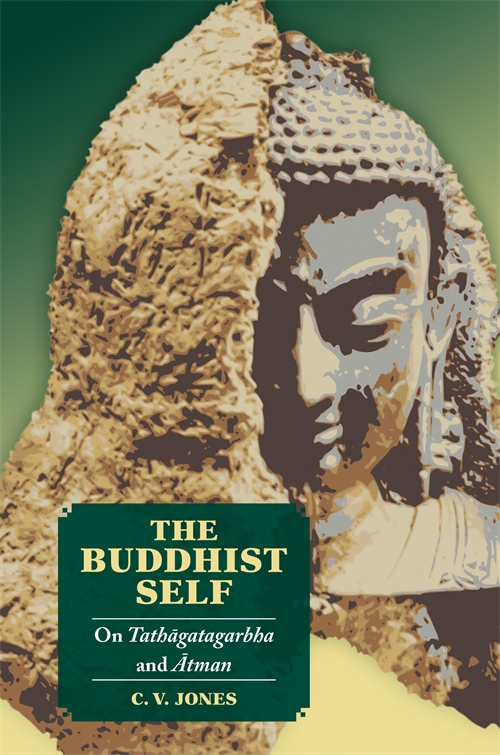
The assertion that there is nothing in the constitution of any person that deserves to be considered the self (ātman)—a permanent, unchanging kernel of personal identity in this life and those to come—has been a cornerstone of Buddhist teaching from its inception. Whereas other Indian religious systems celebrated the search for and potential discovery of one’s “true self,” Buddhism taught about the futility of searching for anything in our experience that is not transient and ephemeral. But a small yet influential set of Mahāyāna Buddhist texts, composed in India in the early centuries CE, taught that all sentient beings possess at all times, and across their successive lives, the enduring and superlatively precious nature of a Buddha. This was taught with reference to the enigmatic expression tathāgatagarbha—the “womb” or “chamber” for a Buddha—which some texts refer to as a person’s true self.

The Buddhist Self is a methodical examination of Indian teaching about the tathāgatagarbha (otherwise the presence of one's “Buddha-nature”) and the extent to which different Buddhist texts and authors articulated this in terms of the self. C. V. Jones attends to each of the Indian Buddhist works responsible for explaining what is meant by the expression tathāgatagarbha, and how far this should be understood or promoted using the language of selfhood. With close attention to these sources, Jones argues that the trajectory of Buddha-nature thought in India is also the history and legacy of a Buddhist account of what deserves to be called the self: an innovative attempt to equip Mahāyāna Buddhism with an affirmative response to wider Indian interest in the discovery of something precious or even divine in one's own constitution. This argument is supplemented by critical consideration of other themes that run through this distinctive body of Mahāyānist literature: the relationship between Buddhist and non-Buddhist teachings about the self, the overlap between the tathāgatagarbha and the nature of the mind, and the originally radical position that the only means of becoming liberated from rebirth is to achieve the same exalted status as the Buddha. (Source: University of Hawai'i Press)
Books1973–1975About this item
An English translation of the Mahāparinirvāṇasūtra by Kosho Yamamoto based on the so-called Southern text (Taishō no. 375). In 3 vols., published 1973–75.
Articles2025About this item
Bodhicitta, the "mind of awakening," constitutes the foundational principle of Mahāyāna Buddhism. This essay traces the concept's historical and doctrinal genesis from its pre-Mahāyāna antecedents to its full articulation in the Indian and Tibetan traditions. It explores the main scriptural and scholastic sources in India, the two great Indian lineages of practice—the "Profound View" of Nāgārjuna and the "Vast Conduct" of Asaṅga—and the pivotal role of Atiśa Dīpaṃkara Śrījñāna in transmitting and systematizing these teachings in Tibet. The article further details how Atiśa's Kadam school and its core mind training (lojong) teachings influenced the subsequent development of bodhicitta cultivation in the Nyingma, Kagyu, Sakya, and Geluk schools. Bodhicitta is not a static concept but a dynamic, multifaceted principle that functions as the soteriological core of the Mahāyāna path, embodying the indivisible union of universal compassion and the profound wisdom that realizes emptiness.


An error occurred during the storage process. Message reads "_https" has not been listed as valid URI scheme.