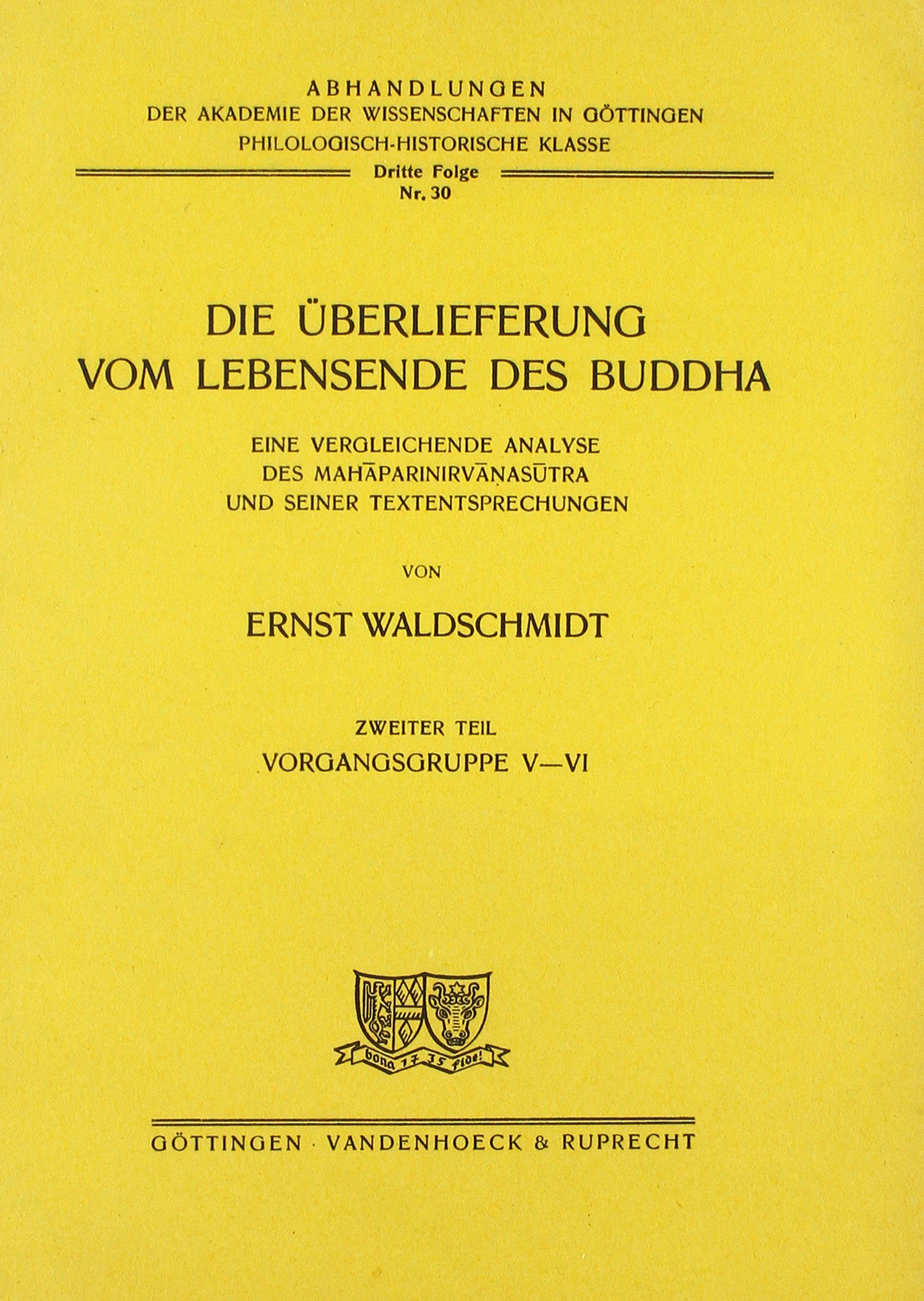
Die Überlieferung vom Lebensende des Buddha - Vol. 2 (Waldschmidt 1948)
| 🤓 Admin Zone 🛠️ hidden to non-admins | |

Description
The author, skilled in reading Central Asiatic manuscripts, prepared a critical edition of the Buddist-Sanskrit manuscript of the Mahāparinirvāṇasūtra, but publication was held up because of the war. In the work he collated this manuscript, which was discovered by the Prussian expeditions in Chinese Turkestan, with the Pāli, Chinese, and Tibetan versions. The sūtra describes the last few months before Buddha's death (parinirvāṇa) . Waldschmidt compares the Sanskrit manuscript version with the corresponding printed Pāli texts and the printed Chinese translations. In order to facilitate this comparison, he distinguishes fifty-one events, brought together in six groups, in the last months of Buddha's life, beginning with Minister Varṣākāra's visit to Buddha in Rājagṛha and ending with the cremation of Buddha's body and the distribution of the relics. (Review by Johannes Rahder, Harvard Journal of Asiatic Studies 10, no. 2 (1947): 227-29)
The present book is the second part of this work, and deals with the events numbered 32 to 51, all of which took place in Kuśinagara where the Buddha entered parinirvāṇa. Part 1, published in 1944, deals with the events numbered 1 to 31, the arrival in Kuśinagara.

- Mahāparinirvāṇasūtra (RKTSK 119)
- Mahāparinirvāṇasūtra (RKTSK 120)
- Mahāparinirvāṇasūtra (RKTSK 121)
The Mahāparinirvāṇasūtra is one of the main scriptural sources for buddha-nature in China and Tibet. Set around the time of Buddha's passing or Mahāparinirvāṇa, the sūtra contains teachings on buddha-nature equating it with the dharmakāya—that is, the complete enlightenment of a buddha. It also asserts that all sentient beings possess this nature as the buddhadhātu, or buddha-element, which thus acts as a cause, seed, or potential for all beings to attain enlightenment. Furthermore, the sūtra includes some salient features related to this concept, such as the single vehicle and the notion that the dharmakāya is endowed with the four pāramitās of permanence, bliss, purity, and a self.
- Mahāparinirvāṇasūtra (RKTSK 119)
- Mahāparinirvāṇasūtra (RKTSK 120)
- Mahāparinirvāṇasūtra (RKTSK 121)
The Mahāparinirvāṇasūtra is one of the main scriptural sources for buddha-nature in China and Tibet. Set around the time of Buddha's passing or Mahāparinirvāṇa, the sūtra contains teachings on buddha-nature equating it with the dharmakāya—that is, the complete enlightenment of a buddha. It also asserts that all sentient beings possess this nature as the buddhadhātu, or buddha-element, which thus acts as a cause, seed, or potential for all beings to attain enlightenment. Furthermore, the sūtra includes some salient features related to this concept, such as the single vehicle and the notion that the dharmakāya is endowed with the four pāramitās of permanence, bliss, purity, and a self.