| 🤓 Admin Zone 🛠️ hidden to non-admins | |
Miaofa lianhua jing shu (Daosheng)
Text
Please note that many items in our library are simply pages that represent a detailed library catalog entry and citation of someone else's work, presentation, or performance. Read our General Disclaimer for more information.
Description
In Chinese, “A Brief Commentary on the 'Lotus Sūtra,'" the earliest extant Chinese commentary on the Saddharmapuṇḍarīkasūtra, though there is considerable controversy regarding its authenticity. The text is attributed to Dao sheng from the Liu-Song period (420-479), who was one of the direct disciples of the Kuchean translator Kumārajīva. Daosheng claimed that the treatise combined the famous translator's lectures notes on the Saddharmapuṇḍarīkasūtra with Daosheng's own insights. If authentic, this commentary would be Daosheng's only surviving work, offering a rare perspective into the way the Saddharmapuṇḍarīkasūtra was understood and interpreted by Kumārajīva and his circle of adherents. Employing expressions found in the Chinese "Book of Changes" (Yijing), this commentary discusses the notions of "consummate perfection" (yuan) and a peculiar Mahāyāna definition of the "middle way" (C. zhongdao, madhyamapratipad), notions that were further elaborated by subsequent Tiantai and Huayan exegetes. (Source: "Fahua jing lüeshu." In The Princeton Dictionary of Buddhism, 289–90. Princeton University Press, 2014. http://www.jstor.org/stable/j.ctt46n41q.27.)
Reference
Daosheng (道生). [A Brief Commentary on the Lotus Sūtra].
Interconnections
2 Full translations

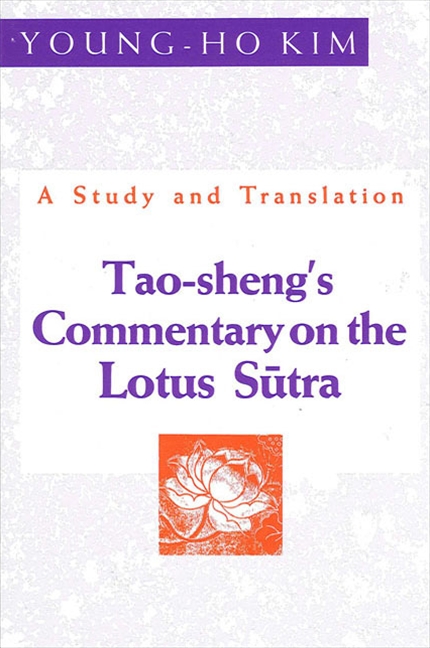
(Chu) Tao-sheng stands out in history as a unique and preeminent thinker whose paradigmatic, original ideas paved the way for the advent of Chinese Buddhism. The universality of Buddha-nature, which Tao-sheng championed at the cost of excommunication, was to become a cornerstone of the Chinese Buddhist ideology. This book presents a comprehensive study of the only complete document by Tao-sheng still in existence. (Source: SUNY Press)

Abstract
This dissertation provides a comprehensive study and complete translation of Tao-sheng's Commentary on the Saddharmapuṇḍarīka-sūtra (CSPS). This document occupies an important place in Chinese Buddhist literature. Its significance in the study of Chinese Buddhism can be described in two ways. Firstly, the CSPS was the first commentary ever written on the Lotus Sūtra, which was to become a scripture of fundamental importance on the Far Eastern Buddhist scene, especially for the later Chinese Buddhist schools. Furthermore, it was the first commentary on any Buddhist scripture that was written in Chinese and structured in fully developed commentarial form. The CSPS set a pattern in many ways for later Buddhists to follow in terms of both structure and ideology.
Secondly, the CSPS is a rich source of Tao-sheng's seminal ideas. Tao-sheng (ca. 360-434) has been regarded, both in his time and subsequently, as a uniquely creative and prophetic thinker. The CSPS, the only writing of Tao-sheng preserved in complete form, is essential to any study of Tao-sheng's own original thought. Most of his theses and arguments, which were controversial in his day, were originally propounded in his other writings, but the commentary may provide at least the general structure of Tao-sheng's thought.
The thesis is composed of two main portions: "Study" (Part I-IV) and "Translation" (Part V). Part I sets out and clarifies the problems involved in the study of Tao-sheng, the aims and method of the present study. Part II as the introductory step to the main task involving the CSPS extensively examines Tao-sheng as a whole as reflected in other sources, in terms of his background, historical and biographical, his works, his doctrines, and his influence. Part III is devoted to a critical examination of the CSPS proper. Here I undertake an in-depth analysis in several different ways in respect with both form and content, or language and ideology. The analysis focuses on how Tao-sheng renders, successfully or otherwise, the ancient Indian system of religious thought into the current Chinese language, which was already laden with indigenous philosophical connotations. Here I also trace and reconstruct Tao-sheng's thought incorporated in the commentary in accordance with his distinct themes. Part IV reviews the findings and significance of the study conducted. In brief, the thesis is the first full-scale study of Tao-sheng and the commentary.
Finally, a complete translation of the text is presented along with detailed annotations including the classical sources of Chinese philosophical terms used and numerous corruptions of the text. In light of the significance of Tao-sheng and the CSPS, the translation answers the need for a complete translation of the text into a modern language and will serve as a basis for further study.
This dissertation provides a comprehensive study and complete translation of Tao-sheng's Commentary on the Saddharmapuṇḍarīka-sūtra (CSPS). This document occupies an important place in Chinese Buddhist literature. Its significance in the study of Chinese Buddhism can be described in two ways. Firstly, the CSPS was the first commentary ever written on the Lotus Sūtra, which was to become a scripture of fundamental importance on the Far Eastern Buddhist scene, especially for the later Chinese Buddhist schools. Furthermore, it was the first commentary on any Buddhist scripture that was written in Chinese and structured in fully developed commentarial form. The CSPS set a pattern in many ways for later Buddhists to follow in terms of both structure and ideology.
Secondly, the CSPS is a rich source of Tao-sheng's seminal ideas. Tao-sheng (ca. 360-434) has been regarded, both in his time and subsequently, as a uniquely creative and prophetic thinker. The CSPS, the only writing of Tao-sheng preserved in complete form, is essential to any study of Tao-sheng's own original thought. Most of his theses and arguments, which were controversial in his day, were originally propounded in his other writings, but the commentary may provide at least the general structure of Tao-sheng's thought.
The thesis is composed of two main portions: "Study" (Part I-IV) and "Translation" (Part V). Part I sets out and clarifies the problems involved in the study of Tao-sheng, the aims and method of the present study. Part II as the introductory step to the main task involving the CSPS extensively examines Tao-sheng as a whole as reflected in other sources, in terms of his background, historical and biographical, his works, his doctrines, and his influence. Part III is devoted to a critical examination of the CSPS proper. Here I undertake an in-depth analysis in several different ways in respect with both form and content, or language and ideology. The analysis focuses on how Tao-sheng renders, successfully or otherwise, the ancient Indian system of religious thought into the current Chinese language, which was already laden with indigenous philosophical connotations. Here I also trace and reconstruct Tao-sheng's thought incorporated in the commentary in accordance with his distinct themes. Part IV reviews the findings and significance of the study conducted. In brief, the thesis is the first full-scale study of Tao-sheng and the commentary.
Finally, a complete translation of the text is presented along with detailed annotations including the classical sources of Chinese philosophical terms used and numerous corruptions of the text. In light of the significance of Tao-sheng and the CSPS, the translation answers the need for a complete translation of the text into a modern language and will serve as a basis for further study.
1 Classical commentary of

The White Lotus of the Good Dharma, popularly known as the Lotus Sūtra, is taught by Buddha Śākyamuni on Vulture Peak to an audience that includes bodhisattvas from countless realms, as well as bodhisattvas who emerge from under the ground, from the space below this world. Buddha Prabhūtaratna, who has long since passed into nirvāṇa, appears within a floating stūpa to hear the sūtra, and Śākyamuni enters the stūpa and sits beside him. The Lotus Sūtra is celebrated, particularly in East Asia, for its presentation of crucial elements of the Mahāyāna tradition, such as the doctrine that there is only one yāna, or "vehicle"; the distinction between expedient and definite teachings; and the notion that the Buddha's life, enlightenment, and parinirvāṇa were simply manifestations of his transcendent buddhahood, while he continues to teach eternally. A recurring theme in the sūtra is its own significance in teaching these points during past and future eons, with many passages in which the Buddha and bodhisattvas such as Samantabhadra describe the great benefits that come from devotion to it, the history of its past devotees, and how it is the Buddha's ultimate teaching, supreme over all other sūtras. (Source: 84000)
2 Scholarship
(Chu) Tao-sheng stands out in history as a unique and preeminent thinker whose paradigmatic, original ideas paved the way for the advent of Chinese Buddhism. The universality of Buddha-nature, which Tao-sheng championed at the cost of excommunication, was to become a cornerstone of the Chinese Buddhist ideology. This book presents a comprehensive study of the only complete document by Tao-sheng still in existence. (Source: SUNY Press)
Abstract
This dissertation provides a comprehensive study and complete translation of Tao-sheng's Commentary on the Saddharmapuṇḍarīka-sūtra (CSPS). This document occupies an important place in Chinese Buddhist literature. Its significance in the study of Chinese Buddhism can be described in two ways. Firstly, the CSPS was the first commentary ever written on the Lotus Sūtra, which was to become a scripture of fundamental importance on the Far Eastern Buddhist scene, especially for the later Chinese Buddhist schools. Furthermore, it was the first commentary on any Buddhist scripture that was written in Chinese and structured in fully developed commentarial form. The CSPS set a pattern in many ways for later Buddhists to follow in terms of both structure and ideology.
Secondly, the CSPS is a rich source of Tao-sheng's seminal ideas. Tao-sheng (ca. 360-434) has been regarded, both in his time and subsequently, as a uniquely creative and prophetic thinker. The CSPS, the only writing of Tao-sheng preserved in complete form, is essential to any study of Tao-sheng's own original thought. Most of his theses and arguments, which were controversial in his day, were originally propounded in his other writings, but the commentary may provide at least the general structure of Tao-sheng's thought.
The thesis is composed of two main portions: "Study" (Part I-IV) and "Translation" (Part V). Part I sets out and clarifies the problems involved in the study of Tao-sheng, the aims and method of the present study. Part II as the introductory step to the main task involving the CSPS extensively examines Tao-sheng as a whole as reflected in other sources, in terms of his background, historical and biographical, his works, his doctrines, and his influence. Part III is devoted to a critical examination of the CSPS proper. Here I undertake an in-depth analysis in several different ways in respect with both form and content, or language and ideology. The analysis focuses on how Tao-sheng renders, successfully or otherwise, the ancient Indian system of religious thought into the current Chinese language, which was already laden with indigenous philosophical connotations. Here I also trace and reconstruct Tao-sheng's thought incorporated in the commentary in accordance with his distinct themes. Part IV reviews the findings and significance of the study conducted. In brief, the thesis is the first full-scale study of Tao-sheng and the commentary.
Finally, a complete translation of the text is presented along with detailed annotations including the classical sources of Chinese philosophical terms used and numerous corruptions of the text. In light of the significance of Tao-sheng and the CSPS, the translation answers the need for a complete translation of the text into a modern language and will serve as a basis for further study.
This dissertation provides a comprehensive study and complete translation of Tao-sheng's Commentary on the Saddharmapuṇḍarīka-sūtra (CSPS). This document occupies an important place in Chinese Buddhist literature. Its significance in the study of Chinese Buddhism can be described in two ways. Firstly, the CSPS was the first commentary ever written on the Lotus Sūtra, which was to become a scripture of fundamental importance on the Far Eastern Buddhist scene, especially for the later Chinese Buddhist schools. Furthermore, it was the first commentary on any Buddhist scripture that was written in Chinese and structured in fully developed commentarial form. The CSPS set a pattern in many ways for later Buddhists to follow in terms of both structure and ideology.
Secondly, the CSPS is a rich source of Tao-sheng's seminal ideas. Tao-sheng (ca. 360-434) has been regarded, both in his time and subsequently, as a uniquely creative and prophetic thinker. The CSPS, the only writing of Tao-sheng preserved in complete form, is essential to any study of Tao-sheng's own original thought. Most of his theses and arguments, which were controversial in his day, were originally propounded in his other writings, but the commentary may provide at least the general structure of Tao-sheng's thought.
The thesis is composed of two main portions: "Study" (Part I-IV) and "Translation" (Part V). Part I sets out and clarifies the problems involved in the study of Tao-sheng, the aims and method of the present study. Part II as the introductory step to the main task involving the CSPS extensively examines Tao-sheng as a whole as reflected in other sources, in terms of his background, historical and biographical, his works, his doctrines, and his influence. Part III is devoted to a critical examination of the CSPS proper. Here I undertake an in-depth analysis in several different ways in respect with both form and content, or language and ideology. The analysis focuses on how Tao-sheng renders, successfully or otherwise, the ancient Indian system of religious thought into the current Chinese language, which was already laden with indigenous philosophical connotations. Here I also trace and reconstruct Tao-sheng's thought incorporated in the commentary in accordance with his distinct themes. Part IV reviews the findings and significance of the study conducted. In brief, the thesis is the first full-scale study of Tao-sheng and the commentary.
Finally, a complete translation of the text is presented along with detailed annotations including the classical sources of Chinese philosophical terms used and numerous corruptions of the text. In light of the significance of Tao-sheng and the CSPS, the translation answers the need for a complete translation of the text into a modern language and will serve as a basis for further study.
2 A topic of
(Chu) Tao-sheng stands out in history as a unique and preeminent thinker whose paradigmatic, original ideas paved the way for the advent of Chinese Buddhism. The universality of Buddha-nature, which Tao-sheng championed at the cost of excommunication, was to become a cornerstone of the Chinese Buddhist ideology. This book presents a comprehensive study of the only complete document by Tao-sheng still in existence. (Source: SUNY Press)
Abstract
This dissertation provides a comprehensive study and complete translation of Tao-sheng's Commentary on the Saddharmapuṇḍarīka-sūtra (CSPS). This document occupies an important place in Chinese Buddhist literature. Its significance in the study of Chinese Buddhism can be described in two ways. Firstly, the CSPS was the first commentary ever written on the Lotus Sūtra, which was to become a scripture of fundamental importance on the Far Eastern Buddhist scene, especially for the later Chinese Buddhist schools. Furthermore, it was the first commentary on any Buddhist scripture that was written in Chinese and structured in fully developed commentarial form. The CSPS set a pattern in many ways for later Buddhists to follow in terms of both structure and ideology.
Secondly, the CSPS is a rich source of Tao-sheng's seminal ideas. Tao-sheng (ca. 360-434) has been regarded, both in his time and subsequently, as a uniquely creative and prophetic thinker. The CSPS, the only writing of Tao-sheng preserved in complete form, is essential to any study of Tao-sheng's own original thought. Most of his theses and arguments, which were controversial in his day, were originally propounded in his other writings, but the commentary may provide at least the general structure of Tao-sheng's thought.
The thesis is composed of two main portions: "Study" (Part I-IV) and "Translation" (Part V). Part I sets out and clarifies the problems involved in the study of Tao-sheng, the aims and method of the present study. Part II as the introductory step to the main task involving the CSPS extensively examines Tao-sheng as a whole as reflected in other sources, in terms of his background, historical and biographical, his works, his doctrines, and his influence. Part III is devoted to a critical examination of the CSPS proper. Here I undertake an in-depth analysis in several different ways in respect with both form and content, or language and ideology. The analysis focuses on how Tao-sheng renders, successfully or otherwise, the ancient Indian system of religious thought into the current Chinese language, which was already laden with indigenous philosophical connotations. Here I also trace and reconstruct Tao-sheng's thought incorporated in the commentary in accordance with his distinct themes. Part IV reviews the findings and significance of the study conducted. In brief, the thesis is the first full-scale study of Tao-sheng and the commentary.
Finally, a complete translation of the text is presented along with detailed annotations including the classical sources of Chinese philosophical terms used and numerous corruptions of the text. In light of the significance of Tao-sheng and the CSPS, the translation answers the need for a complete translation of the text into a modern language and will serve as a basis for further study.
This dissertation provides a comprehensive study and complete translation of Tao-sheng's Commentary on the Saddharmapuṇḍarīka-sūtra (CSPS). This document occupies an important place in Chinese Buddhist literature. Its significance in the study of Chinese Buddhism can be described in two ways. Firstly, the CSPS was the first commentary ever written on the Lotus Sūtra, which was to become a scripture of fundamental importance on the Far Eastern Buddhist scene, especially for the later Chinese Buddhist schools. Furthermore, it was the first commentary on any Buddhist scripture that was written in Chinese and structured in fully developed commentarial form. The CSPS set a pattern in many ways for later Buddhists to follow in terms of both structure and ideology.
Secondly, the CSPS is a rich source of Tao-sheng's seminal ideas. Tao-sheng (ca. 360-434) has been regarded, both in his time and subsequently, as a uniquely creative and prophetic thinker. The CSPS, the only writing of Tao-sheng preserved in complete form, is essential to any study of Tao-sheng's own original thought. Most of his theses and arguments, which were controversial in his day, were originally propounded in his other writings, but the commentary may provide at least the general structure of Tao-sheng's thought.
The thesis is composed of two main portions: "Study" (Part I-IV) and "Translation" (Part V). Part I sets out and clarifies the problems involved in the study of Tao-sheng, the aims and method of the present study. Part II as the introductory step to the main task involving the CSPS extensively examines Tao-sheng as a whole as reflected in other sources, in terms of his background, historical and biographical, his works, his doctrines, and his influence. Part III is devoted to a critical examination of the CSPS proper. Here I undertake an in-depth analysis in several different ways in respect with both form and content, or language and ideology. The analysis focuses on how Tao-sheng renders, successfully or otherwise, the ancient Indian system of religious thought into the current Chinese language, which was already laden with indigenous philosophical connotations. Here I also trace and reconstruct Tao-sheng's thought incorporated in the commentary in accordance with his distinct themes. Part IV reviews the findings and significance of the study conducted. In brief, the thesis is the first full-scale study of Tao-sheng and the commentary.
Finally, a complete translation of the text is presented along with detailed annotations including the classical sources of Chinese philosophical terms used and numerous corruptions of the text. In light of the significance of Tao-sheng and the CSPS, the translation answers the need for a complete translation of the text into a modern language and will serve as a basis for further study.