Visions of Awakening Space and Time

From Bodhicitta
< BooksBooks/Visions of Awakening Space and Time

🤓 Admin Zone 🛠️ hidden to non-admins
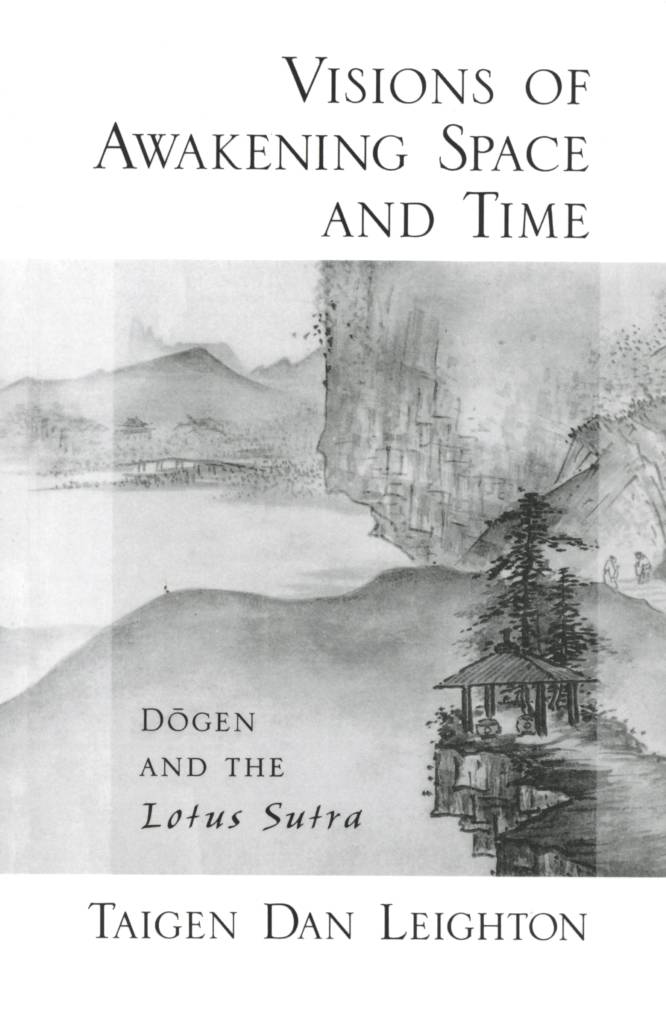
Visions of Awakening Space and Time: Dōgen and the Lotus Sutra
Book


Please note that many items in our library are simply pages that represent a detailed library catalog entry and citation of someone else's work, presentation, or performance. Read our General Disclaimer for more information. You can find more information about this item on the publisher website.
Visions of Awakening Space and Time-front.jpg

Description

As a religion concerned with universal liberation, Zen grew out of a Buddhist worldview very different from the currently prevalent scientific materialism. Indeed, says Taigen Dan Leighton, Zen cannot be fully understood outside of a worldview that sees reality itself as a vital, dynamic agent of awareness and healing. In this book, Leighton explicates that worldview through the writings of the Zen master Eihei Dōgen (1200-1253), considered the founder of the Japanese Sōtō Zen tradition, which currently enjoys increasing popularity in the West.

The Lotus Sutra, arguably the most important Buddhist scripture in East Asia, contains a famous story about bodhisattvas (enlightening beings) who emerge from under the earth to preserve and expound the Lotus teaching in the distant future. The story reveals that the Buddha only appears to pass away, but actually has been practicing, and will continue to do so, over an inconceivably long life span.

Leighton traces commentaries on the Lotus Sutra from a range of key East Asian Buddhist thinkers, including Daosheng, Zhiyi, Zhanran, Saigyo, Myōe, Nichiren, Hakuin, and Ryōkan. But his main focus is Eihei Dōgen, the 13th century Japanese Sōtō Zen founder who imported Zen from China, and whose profuse, provocative, and poetic writings are important to the modern expansion of Buddhism to the West.

Dōgen's use of this sutra expresses the critical role of Mahayana vision and imagination as the context of Zen teaching, and his interpretations of this story furthermore reveal his dynamic worldview of the earth, space, and time themselves as vital agents of spiritual awakening.

Leighton argues that Dōgen uses the images and metaphors in this story to express his own religious worldview, in which earth, space, and time are lively agents in the bodhisattva project. Broader awareness of Dōgen's worldview and its implications, says Leighton, can illuminate the possibilities for contemporary approaches to primary Mahayana concepts and practices. (Source: Oxford University Press)

Citation
Leighton, Taigen Dan. Visions of Awakening Space and Time: Dōgen and the Lotus Sutra. New York: Oxford University Press, 2007.
Publisher Link
Table of contents
  • 1. The Pivotal Lotus Story and Dōgen's Worldview3
  • 2. Hermeneutics and Discourse Styles in Studies of the Lotus Sutra and Dōgen13
  • 3. Selected East Asian Interpretations of the Story41
  • 4. Dōgen's Interpretations of This Lotus Sutra Story67
  • 5. Dōgen's View of Earth, Space, and Time Seen in Mahāyāna Context95
  • Afterword: Implications of Dōgen's Mahāyāna Worldview117
  • Notes129
  • Bibliography151
  • Index169
Interconnections
1 Scholarship on
Kumārajīva Khyentse Foundation.jpg
Classical WorksAbout this item
The White Lotus of the Good Dharma, popularly known as the Lotus Sūtra, is taught by Buddha Śākyamuni on Vulture Peak to an audience that includes bodhisattvas from countless realms, as well as bodhisattvas who emerge from under the ground, from the space below this world. Buddha Prabhūtaratna, who has long since passed into nirvāṇa, appears within a floating stūpa to hear the sūtra, and Śākyamuni enters the stūpa and sits beside him. The Lotus Sūtra is celebrated, particularly in East Asia, for its presentation of crucial elements of the Mahāyāna tradition, such as the doctrine that there is only one yāna, or "vehicle"; the distinction between expedient and definite teachings; and the notion that the Buddha's life, enlightenment, and parinirvāṇa were simply manifestations of his transcendent buddhahood, while he continues to teach eternally. A recurring theme in the sūtra is its own significance in teaching these points during past and future eons, with many passages in which the Buddha and bodhisattvas such as Samantabhadra describe the great benefits that come from devotion to it, the history of its past devotees, and how it is the Buddha's ultimate teaching, supreme over all other sūtras. (Source: 84000)