Jātakamāla

From Bodhicitta
< Texts(Redirected from Jātakamāla (RKTST 3488))
Texts/Jātakamāla

🤓 Admin Zone 🛠️ hidden to non-admins
जातकमाला
Jātakamāla
སྐྱེས་པའི་རབས་ཀྱི་རྒྱུད།
skyes pa'i rabs kyi rgyud
The Garland of Previous Lives (84000)
Text


Please note that many items in our library are simply pages that represent a detailed library catalog entry and citation of someone else's work, presentation, or performance. Read our General Disclaimer for more information.

Description

Jātakamālā. (T. Skyes pa'i rabs kyi rgyud; C. Pusa benshengman lun; J. Bosatsu honjōmanron; K. Posal ponsaengman non 菩薩本生鬘論). In Sanskrit, "Garland of Birth Stories," by the poet Śūra [alt. Āryaśūra; c. second-century CE], a collection of thirty-four jātaka tales related in an elegant and elliptical literary style. Each story includes Śūra's introduction relating the specific point of morality illustrated in the story. This narrative is in mixed prose and verse (a style that comes to be termed campū), with a variety of different meters employed. The beauty of Śūra's literary renderings was so renowned that the Jātakamālā often came to be even more widely read than the Jātaka collections themselves. In Tibet it is a custom for a senior monk to give an explanation of one of the tales from the Jātakamālā on the opening day of the Smon lam chen mo (Great Prayer Festival). The story surrounding the Chinese "translation" of the Jātakamālā, the Pusa benshengman lun ("Treatise on the Bodhisattva's Garland of Birth Stories"), may be one of the strangest tales in the annals of the translation of Buddhist texts. As modern scholarship has shown, the Chinese "translators" had so much difficulty in construing Śūra's elaborate style that they managed to produce an "apocryphal" scripture while having the Sanskrit text right in front of them. Working without dictionary or grammar, or the luxury of an Indian paṇḍita to help them construe the text, and apparently faced with an impossible deadline, the translators simply resorted to forgery: where they found a few random words of Śūra's that they could construe, they lifted wholesale from other texts stories that happened to contain the same words. Except for the titles of some of the stories, there is almost nothing in the Chinese translation that corresponds to Śūra's Sanskrit. (Source: "Jātakamālā." In The Princeton Dictionary of Buddhism, 381–82. Princeton University Press, 2014. http://www.jstor.org/stable/j.ctt46n41q.27.)
Quoted in the aligned translations
Reference
Āryaśūra. jātakamāla [जातकमाला]. skyes pa'i rabs kyi rgyud [སྐྱེས་པའི་རབས་ཀྱི་རྒྱུད།]. [The Garland of Previous Lives (84000)]. Translated by Mañjuśrīvarman, Vidyākarasiṃha. Tengyur, RKTST 3488 http://www.rkts.org/cat.php?id=3488&typ=2.
Interconnections
7 Explore this work
All 33Editorial Content 7Books 14Articles 2Classical Works 6Tibetan Publications 4
3 Recensions
Skyes rabs so bzhi ba'i rtsa 'grel-front.jpg
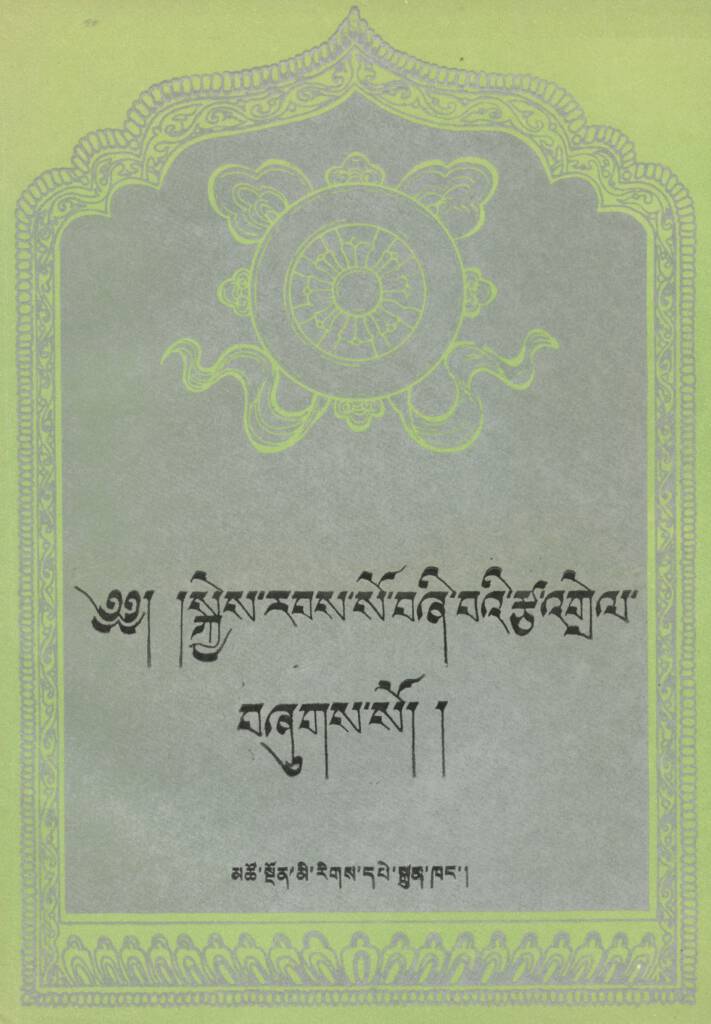
Tibetan Publications1997About this item
Root text of Jātakamāla with its commentary on Gautama Buddha's preexistence. See on BDRC.
The Jataka-Mala or Bodhisattvavadana-Mala-front.jpg
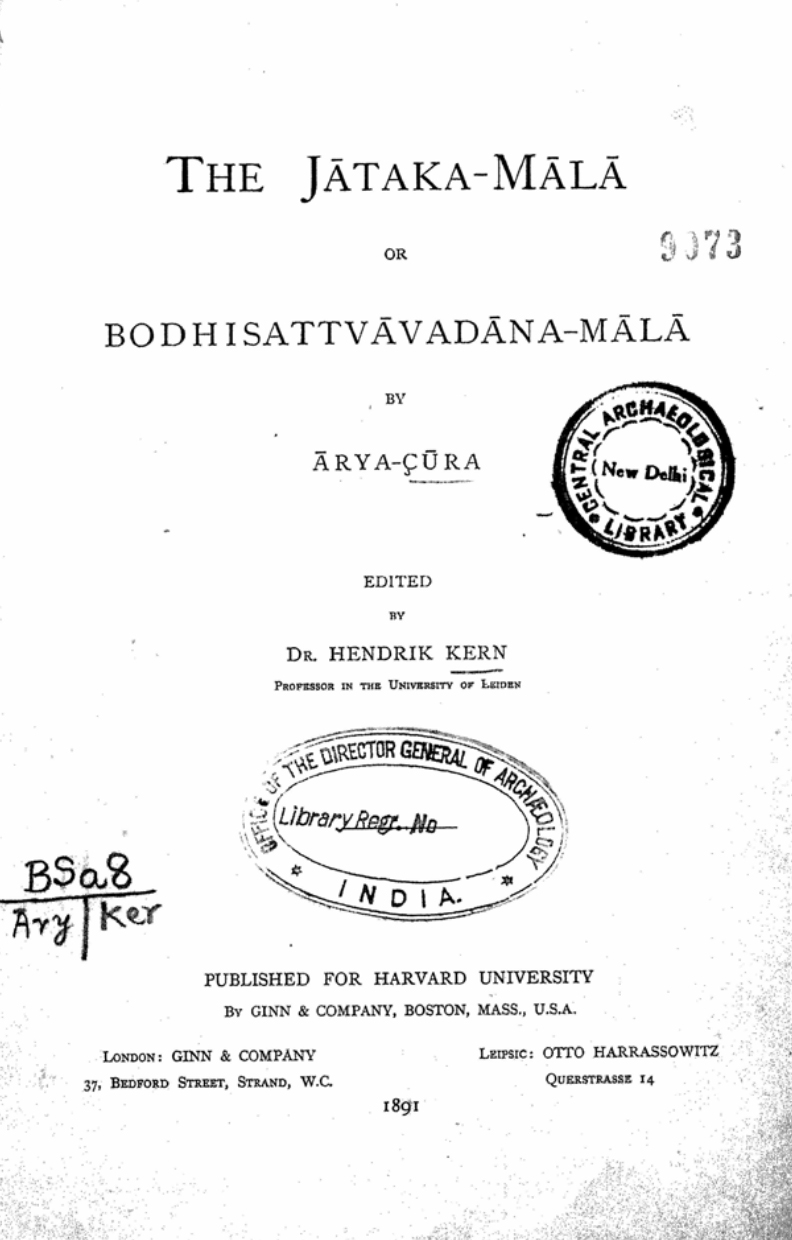
Books1891About this item
H. Kern's edition of Ārya-Śūra's Jātakamālā (or Bodhisattvāvadānamālā), first published in 1891 as the inaugural volume of the Harvard Oriental Series, presents a critical Sanskrit text of this classical collection of thirty-four Buddhist birth-stories (jātakas). The edition is based on three manuscripts — two held at Cambridge University Library and one at the Bibliothèque Nationale in Paris. In his preface, Kern argues that all three descend from a single common archetype, citing their shared scribal errors and textual peculiarities as evidence. He also discusses the manuscripts' orthographic inconsistencies, examines the text's relationship to the Pāli Jātaka collection and the Cariyā-Piṭaka (providing a comparative table of corresponding tales), and addresses questions of textual authenticity, including his decision to retain the collection's concluding verse epilogues despite some doubts about their originality. The volume also includes an appendix containing the Kacchapa-jātaka, which Kern judged spurious to the original collection based on its distinct linguistic style.
4 Full translations
Jatakamala-front.jpg
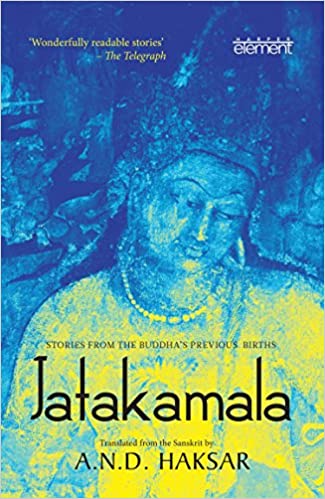
Books2003About this item
The Jatakamala is a famous work in both Buddhist and Sanskrit literature. It recounts thirty-four stories of the Buddha's previous births, and his good deeds in those incarnations as a god, man and animal. Written by Arya Shura in the fourth century AD in elegant Sanskrit prose and verse, these tales were later translated into Chinese and Tibetan languages. Some of the tales are depicted in the Ajanta cave paintings. Their colourful backgrounds range from a sea voyage to a battle scene, a forest fire to a royal hunt and from the charms of the harem to the horrors of hell. Against these are presented a gamut of the predicaments in the course of doing what is right. Twelve of these tales are not found in any other collection including the Pali Jataka texts. Popular through the ages, they remain highly readable today, both for their timeless message of compassion and concord, and the vivid, dramatic imagery with which it is preserved. Source: Back cover of the book
Once the Buddha Was a Monkey-front.jpg
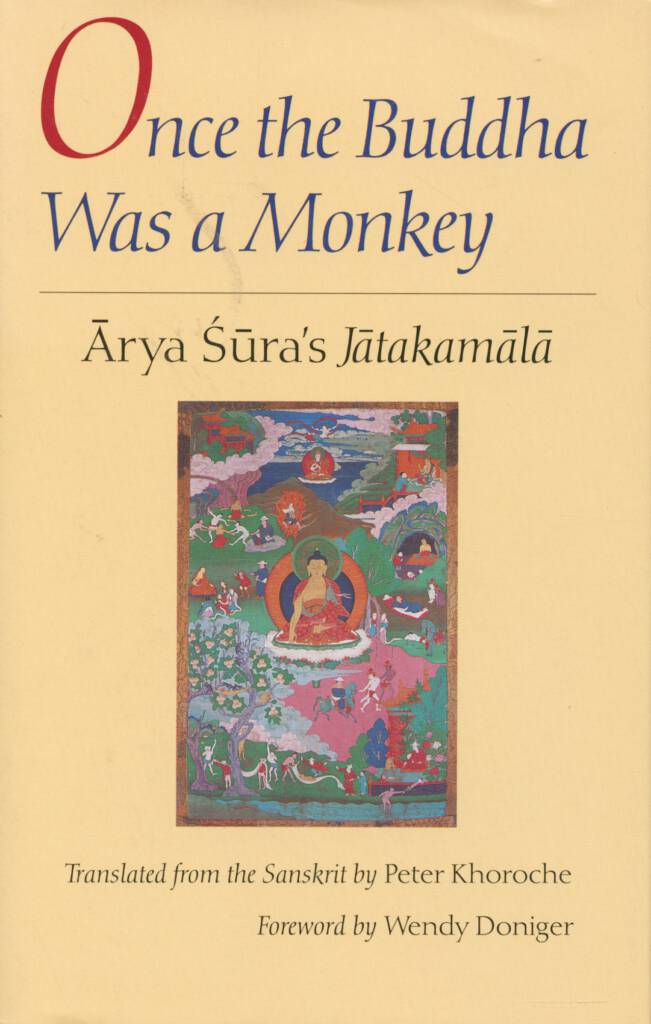
Books1989About this item
Here is one of the most entertaining masterpieces of Sanskrit literature rendered in an English translation that fully captures the original’s artistry and charm.

Written most probably in the fourth century A.D., the Jatakamala is generally considered the masterpiece of Buddhist literature in Sanskrit. In elegant, courtly style, Arya Sura retells thirty-four traditional stories about the Buddha in his previous incarnations, human and animal. Whether as a king, a brahmin, a monkey, or a hare, the Great One is shown in assiduous pursuit of virtue and compassion. Though primarily intended as exemplary tales illustrating the Buddhist virtues, these stories also provide a vivid picture of life at a high point in ancient Indian culture—city life in ordinary households or at the royal court, and country life against a backdrop of mountain, desert, and jungle.

Fresh study of the Sanskrit manuscripts, now scattered in libraries all over the world, has enabled Peter Khoroche to make this new translation faithful to the original in both style and content. His explanatory notes will assist student and general reader alike in appreciating this classic from an ancient and exotic civilization. (Source: The University of Chicago Press)
The Jātakamālā-front.jpg
Books1982About this item
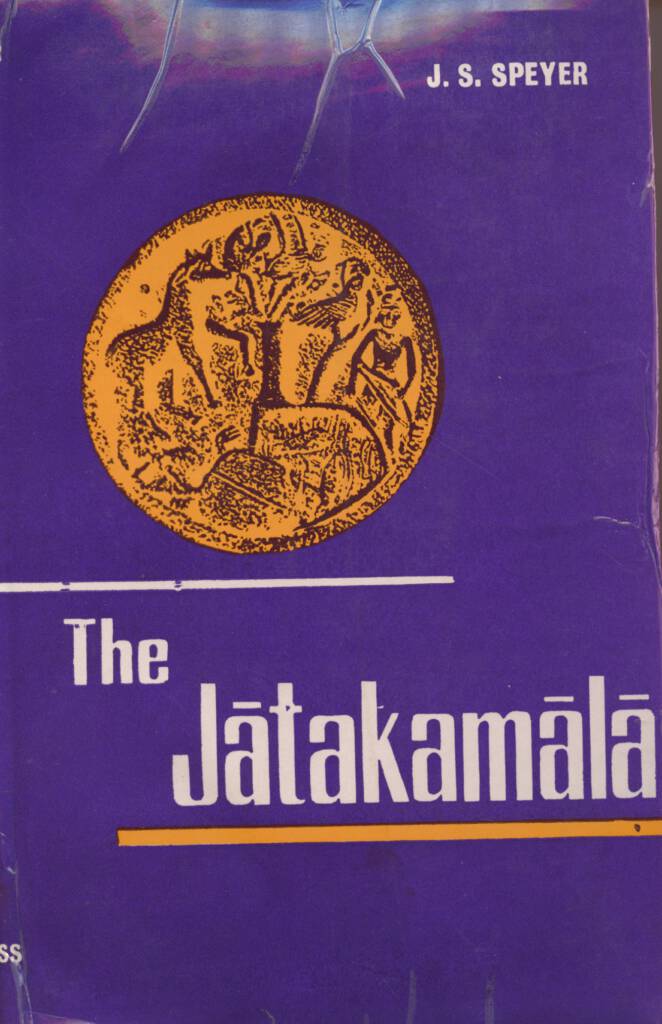
J. S. Speyer's English translation of the Jātakamālā, titled The Jātakamālā: Garland of Birth-Stories of Āryaśūra (this edition published by Motilal Banarsidass, Delhi/Patna/Varanasi), was signed at Groningen and dated 16 April 1895, prepared for the Sacred Books of the East series and based on H. Kern's 1891 critical Sanskrit edition (the first volume of the Harvard Oriental Series). In his introduction, Speyer traces the work's discovery by Western scholarship—from Brian H. Hodgson's identification of it among Nepalese Buddhist manuscripts as early as 1828, through Burnouf's only superficial acquaintance with the text, to Kern's definitive edition—and discusses Jātakamālā as a generic term for a genre of birth-story collections, of which Āryaśūra's is the sole surviving example among several once known to exist. Speyer examines the collection's literary character as a series of homiletic discourses combining ornamented Sanskrit prose and verse, each built around a moral maxim illustrated by a story and reiterated in a concluding epilogue (portions of which Speyer considers later interpolations and brackets accordingly, without omitting them). He also addresses the identity and probable dating of the author—traditionally known as Āryaśūra and distinguished from Aśvaghoṣa, author of the Buddhacarita, despite occasional conflation of the two in Tibetan tradition—situating him earlier than the end of the seventh century CE, and offering both Chinese and Tibetan testimony regarding the text's transmission and reputation. This translation supersedes a partial version of the work Speyer had earlier published in the Bijdragen voor Taal-, Land- en Volkenkunde van Nederlandsch-Indië.
The Marvelous Companion Life Stories of the Buddha-front.jpg
Books1983About this item
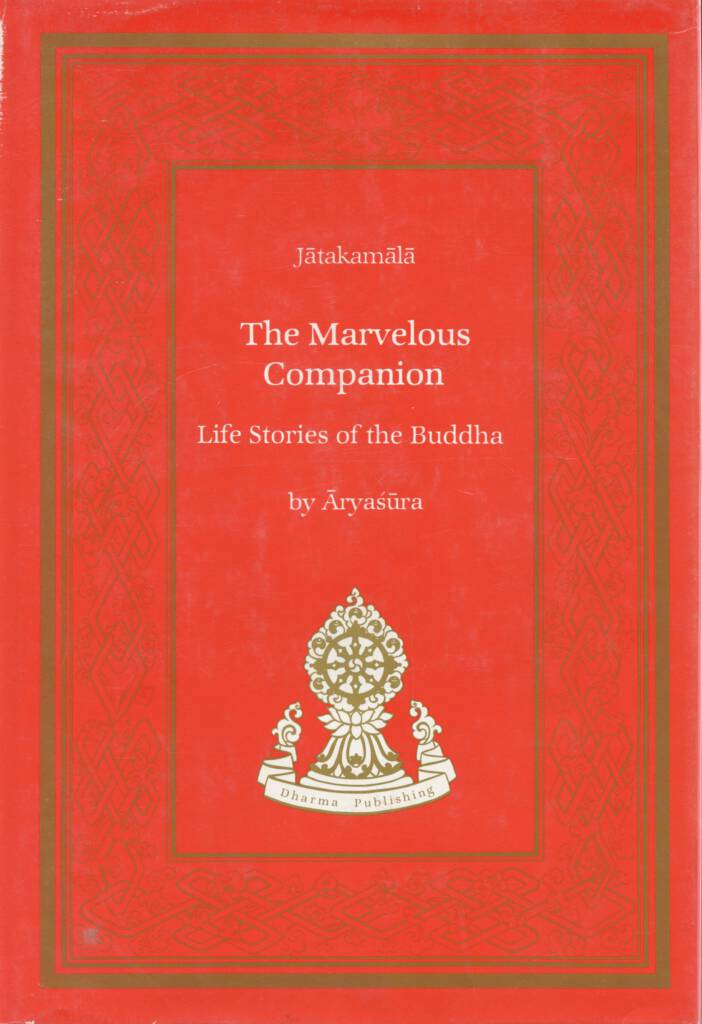
The Marvelous Companion: Aryashura's Jatakamala is a retelling of thirty-four Jatakas, accounts of the Buddha's previous lives, by the great first century Indian master and poet. This book is essentially a rewording into modern English of an earlier translation by Joseph Speyer, undertaken to make it more accessible to Dharma students.

This particular collection of Jatakas, retold by a renowned Buddhist master and poet, enriches understanding of karma and conveys attitudes and actions that develop perfect compassion. The Jatakas can serve as occasions to reflect upon the moral choices in our lives and open our eyes to the reality of karma, helping us develop the insight and discipline we need to acknowledge and change destructive patterns of behavior. This work is dedicated to Western Dharma students with the wish that the teachings it conveys will illuminate their understanding of karma, the indomitable strength of virtue, and the enlightening power of Bodhisattva compassion.

With 34 line drawings by Rosalyn White, working to the directions of Tarthang Tulku. A glossary of Sanskrit terms round out the presentation. Its language is highly accessible and relatable.

(Source: Dharma Publishing)
3 Classical commentaries
Sutra portrait.jpg
Classical WorksAbout this item
The Jātakamālāpañjikā (Tib. Skyes pa'i rabs kyi rgyud kyi dka' 'grel pa, "An Explanation of the Difficult Points of the Words in the Jātaka-mālā") is a commentary by Vīryasiṃha on Āryaśūra's Jātakamālā, preserved in the Derge Tengyur (Toh. no. 4460, vol. PO/212, folios 275v.1–312v.1) and the only work by this author recorded there. True to its title, the commentary proceeds through the root text glossing individual difficult words and phrases rather than offering a continuous paraphrase, opening with its own verses of homage to the Buddha and bodhisattvas before turning to the Jātakamālā itself. Alongside this word-level exegesis, Vīryasiṃha addresses broader interpretive questions about the text's structure—organizing the thirty-four jātakas according to the six perfections (giving, discipline, patience, and so on) and noting where opinions differ on the count and order of subdivisions within each—and records a view held by some that Āryaśūra's work was left unfinished, a question he treats as needing further examination rather than settling outright. According to the Encyclopedia of Buddhism, it is this commentary that is the source of the tradition that Āryaśūra originally intended to compose one hundred jātaka tales, of which only thirty-four are known to survive.
Gser gling pa.jpg
Classical WorksAbout this item
The Jātakamālāṭīkā (Skt. जातकमालटीका; Tib. Skyes pa'i rabs kyi rgya cher bshad pa, "An Extensive Commentary on 'The Garland of Previous Lives'") is a commentary on Āryaśūra's Jātakamālā by Dharmakīrti—likely to be identified with Suvarṇadvīpa Dharmakīrti, principal teacher of Atiśa Dīpaṃkaraśrījñāna—translated by T. Janārdana and Śākya Blo gros. It is preserved in the Derge Tengyur (D 4151, vol. hu, folios 135b1–340a7), as well as in the Peking (Q 5651) and Narthang (N 4418) editions. The commentary proceeds through the Jātakamālā as a running, phrase-by-phrase explanation, taking up individual words and expressions in sequence throughout the thirty-four jātakas.
2 Scholarship
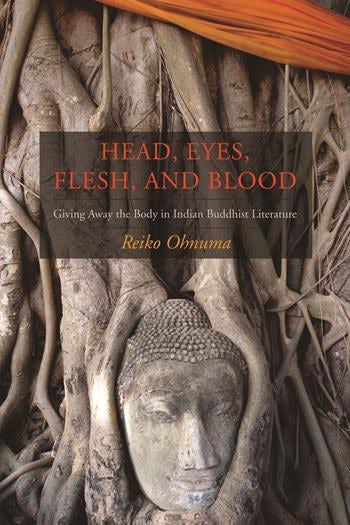
Head Eyes Flesh and Blood-front.jpg
Books2007About this item
Head, Eyes, Flesh, and Blood is the first comprehensive study of a central narrative theme in premodern South Asian Buddhist literature: the Buddha's bodily self-sacrifice during his previous lives as a bodhisattva. Conducting close readings of stories from Sanskrit, Pali, Chinese, and Tibetan literature written between the third century BCE and the late medieval period, Reiko Ohnuma argues that this theme has had a major impact on the development of Buddhist philosophy and culture.

Whether he takes the form of king, prince, ascetic, elephant, hare, serpent, or god, the bodhisattva repeatedly gives his body or parts of his flesh to others. He leaps into fires, drowns himself in the ocean, rips out his tusks, gouges out his eyes, and lets mosquitoes drink from his blood, always out of selflessness and compassion and to achieve the highest state of Buddhahood.

Ohnuma places these stories into a discrete subgenre of South Asian Buddhist literature and approaches them like case studies, analyzing their plots, characterizations, and rhetoric. She then relates the theme of the Buddha's bodily self-sacrifice to major conceptual discourses in the history of Buddhism and South Asian religions, such as the categories of the gift, the body (both ordinary and extraordinary), kingship, sacrifice, ritual offering, and death.

Head, Eyes, Flesh, and Blood reveals a very sophisticated and influential perception of the body in South Asian Buddhist literature and highlights the way in which these stories have provided an important cultural resource for Buddhists. Combined with her rich and careful translations of classic texts, Ohnuma introduces a whole new understanding of a vital concept in Buddhists studies. (Source: Columbia University Press)
Articles.jpeg
Articles2025About this item
This study examines the development and transformation of the bodhisattva concept through comparative analysis of canonical Pāli texts and early Mahāyāna literature. Drawing upon philological evidence from the Jātaka tales, Buddhavaṃsa, and foundational Mahāyāna sūtras including the Lotus Sūtra and Perfection of Wisdom literature, this research traces the evolution from the historical Buddha's preenlightenment journey to the fully developed bodhisattva doctrine. The investigation employs textual criticism and doctrinal comparison to demonstrate how the bodhisattva ideal underwent significant conceptual expansion, shifting from describing the Buddha’s past lives to establishing a universal path of compassionate awakening. Findings reveal that while the Pāli tradition presents the bodhisattva path as exceptional and primarily retrospective, early Mahāyāna sources reconceptualize it as the supreme spiritual ideal accessible to all practitioners. This transformation reflects broader soteriological developments within Buddhist thought, particularly regarding the tension between individual liberation and universal salvation. The study contributes to understanding how fundamental Buddhist concepts evolved across different textual traditions and geographical contexts. Keywords: bodhisattva, Pāli Canon, Mahāyāna Buddhism, comparative Buddhism, Buddhist soteriology.
21 A topic of
Hungry Tigress HAR.png
Editorial ContentAbout this item
The tale "Prince Mahāsattva and the Tigress" illustrates the Buddhist virtue of supreme self-sacrifice. When Prince Mahāsattva, known for his exceptional compassion, encounters a starving tigress about to devour her newborn cubs, he sacrifices his own body to feed her. After his death, he appears to his grieving family as a radiant being, explaining that his compassionate act has led to his rebirth in a higher realm. Years later, the grown tiger cubs return as men to thank the prince's brothers, demonstrating how selfless compassion creates lasting positive effects across generations.
This is a creative retelling of a story from the traditional Jātakamāla and not an exact translation of the text.
Skyflower.jpg
Editorial ContentAbout this item
This tale recounts the story of Skyflower, a remarkable child born amid a shower of heavenly blossoms. Blessed with extraordinary abilities and natural kindness, the boy encounters the Buddha and immediately forms a spiritual connection. After hosting a miraculous feast where his mere wishes manifest as elaborate provisions, Skyflower learns that his current blessings stem from a past life when, as a poor beggar, he humbly offered wildflowers to holy people. Understanding the power of even small acts of generosity, Skyflower becomes the Buddha's disciple and eventually attains great wisdom, demonstrating how a single kind deed can create endless positive effects across multiple lifetimes.
This is a creative retelling of a story from the traditional Jātakamāla and not an exact translation of the text.
Ruru The Golden Deer King.png
Editorial ContentAbout this item
"The Golden Deer King" is a Jātaka tale about Ruru, an extraordinary deer with golden fur and human speech. After rescuing a drowning man named Devadatta, Ruru asks only for secrecy in return. When poverty leads Devadatta to betray Ruru to the king for a reward, the deer confronts him but responds with compassion rather than vengeance. Moved by Ruru's wisdom, King Brahmadatta honors the deer as a teacher rather than a captive, establishes animal sanctuaries throughout his realm, and assigns Devadatta to care for injured animals as a path to redemption. The tale illustrates that true strength lies in compassion, even toward those who have wronged us.
This is a creative retelling of a story from the traditional Jātakamāla and not an exact translation of the text.
Jataka Golden Elephant 2.jpg
Editorial ContentAbout this item
In "The Golden Elephant," a child named Nāga is born with a magical golden elephant companion whose droppings turn to gold. When a jealous warlord tries to steal the elephant, it miraculously returns to Nāga. Recognizing the suffering caused by attachment to possessions, Nāga seeks out the Buddha and becomes a monk. The Buddha instructs him to release his elephant companion, which interferes with the monks' practice. The tale concludes with Buddha revealing that Nāga's connection to the elephant stems from a past life when, as a poor laborer, he repaired a sacred elephant statue with pure intention, demonstrating how small acts of goodness yield tremendous karmic rewards across lifetimes.
This is a creative retelling of a story from the traditional Jātakamāla and not an exact translation of the text.
The Patient Buffalo.png
Editorial ContentAbout this item
The "Patient Buffalo" Jātaka tale recounts how the Buddha, in a previous life as a magnificent water buffalo, endured constant torment from a mischievous monkey without retaliating. When questioned by a forest spirit about his extraordinary patience, the buffalo explains that true strength lies in restraint and compassion toward those weaker than oneself, not in retaliation. The tale illustrates the Buddhist virtues of patience and nonviolence, demonstrating that maintaining compassion during difficult circumstances represents the highest form of spiritual strength.
This is a creative retelling of a story from the traditional Jātakamāla and not an exact translation of the text.
Danapala the Elephant.png
Editorial ContentAbout this item
This Jataka tale recounts the story of Dānapāla, a solitary elephant with distinctive silver tusks who discovers a group of seven hundred banished travelers dying of thirst and hunger in a wasteland. Recognizing their desperate situation, Dānapāla directs them to water and then sacrifices himself by leaping from a cliff, offering his body as sustenance for their journey. The travelers, upon realizing the elephant's selfless sacrifice, proceed with profound reverence and gratitude. The tale illustrates the Buddhist virtue of perfect compassion (dāna pāramitā), showing how the elephant's boundless generosity inspires the rescued humans to contemplate their own capacity for selflessness.
This is a creative retelling of a story from the traditional Jātakamāla and not an exact translation of the text.
Jataka tales generic.png
Editorial ContentAbout this item
This Jātaka tale tells the story of Ke and her husband, who owned only a single cloth between them. When a monk invites them to hear the Buddha teach, Ke makes the extraordinary decision to donate their only possession. The Buddha recognizes this as the most precious offering, declaring that true generosity means giving all one has. The tale illustrates how Ke's selfless act brings not only material rewards but spiritual transformation, as she becomes a revered Buddhist nun whose wisdom attracts students from far and wide. The story teaches that the greatest spiritual gift is an open heart willing to give without reservation.
This is a creative retelling of a story from the traditional Jātakamāla and not an exact translation of the text.
Head Eyes Flesh and Blood-front.jpg
Books2007About this item
Head, Eyes, Flesh, and Blood is the first comprehensive study of a central narrative theme in premodern South Asian Buddhist literature: the Buddha's bodily self-sacrifice during his previous lives as a bodhisattva. Conducting close readings of stories from Sanskrit, Pali, Chinese, and Tibetan literature written between the third century BCE and the late medieval period, Reiko Ohnuma argues that this theme has had a major impact on the development of Buddhist philosophy and culture.

Whether he takes the form of king, prince, ascetic, elephant, hare, serpent, or god, the bodhisattva repeatedly gives his body or parts of his flesh to others. He leaps into fires, drowns himself in the ocean, rips out his tusks, gouges out his eyes, and lets mosquitoes drink from his blood, always out of selflessness and compassion and to achieve the highest state of Buddhahood.

Ohnuma places these stories into a discrete subgenre of South Asian Buddhist literature and approaches them like case studies, analyzing their plots, characterizations, and rhetoric. She then relates the theme of the Buddha's bodily self-sacrifice to major conceptual discourses in the history of Buddhism and South Asian religions, such as the categories of the gift, the body (both ordinary and extraordinary), kingship, sacrifice, ritual offering, and death.

Head, Eyes, Flesh, and Blood reveals a very sophisticated and influential perception of the body in South Asian Buddhist literature and highlights the way in which these stories have provided an important cultural resource for Buddhists. Combined with her rich and careful translations of classic texts, Ohnuma introduces a whole new understanding of a vital concept in Buddhists studies. (Source: Columbia University Press)
Indica et Buddhica Festschrift für Michael Hahn-front.jpg
Books2007About this item
Nepal hat seit den siebziger Jahren des letzten Jahrhunderts eine wichtige Rolle in der Laufbahn vieler deutscher Indologen und Tibetologen gespielt. Das Nepal-German Manuscript Preservation Project bot nicht nur einen zeitweiligen Arbeitsplatz, der es ermoglichte, in einem fill Forschungen aller Art ungemein fruchtbaren Umfeld Landeserfahrung zu sammeln; als gemeinsamer Bezugspunkt verband es auch alle diejenigen, die dort arbeiteten und forschten, und bot es den Jüngeren die Gelegenheit, femab der heimischen Begrenztheiten in unmittelbaren, oft sehr persönlichen Kontakt zu den Autoritäten innerhalb des eigenen Faches zu treten. Das daraus entstandene Beziehungsgeflecht hat die heutige deutsche Indologie durchaus mitgeprägt. So sind auch Michael Hahn und wir, die Herausgeber des vorliegenden Bandes, seit den gemeinsamen Tagen in Kathmandu, die nun schon bald 30 Jahre zurückliegen, durch feste Freundschaft verbunden.
      In jener Zeit in Nepal haben wir den Jubilar als äußerst kenntnisreichen und anregenden Gelehrten kennengelemt, der nicht müde wurde, uns Jüngeren, noch ganz am Anfang Stehenden etwas von der Faszination zu vermitteln, die ihm aus der Beschäftigung mit seinen Forschungsgegenständen erwuchs. Gleichzeitig verstand er es, durch seine offene und aufgeschlossene, Alters- und Wissensunterschiede ignorierende Art die Wurzeln für eine dauerhafte Freundschaft zu legen. Dafür und für all das, was wir seither an Anregung und Förderung von ihm erfahren haben, sind wir dankbar, und wir freuen uns, ihm mit dem vorliegenden Band wenigstens einen kleinen Teil jener Dankesschuld abstatten zu können.
      Wir haben davon abgesehen, den Band in einen engeren thematischen Rahmen zu stellen, etwa durch die Forderung nach einem Bezug zu Nepal oder die Beschränkung auf Beiträge zu den engeren Forschungsgebieten des Jubilars. Michael Hahn ist mit Kollegen aus vie len Bereichen unseres Faches in alter Welt verbunden, und selbst die Arbeiten seiner Schüler umfassen ein so weites Spektrum, daß uns eine thematische Öffnung sinnvoll und notwendig erschien, um niemanden seiner zahlreichen Freunde und Schüler von vomherein von der Mitwirkung an dem Band auszuschließen.
      Unser besonderer Dank gilt Herrn Dr. Helmut Eimer für sein sorgfaltiges Korrekturlesen. Herrn Peter Wyzlic, M. A., haben wir dafür zu danken, daß er stets mit Rat und Tat zur Seite stand, wenn es um die Lösung von Font-Problemen ging, insbesondere von solchen mit chinesischen und griechischen Zeichensätzen. Herr Prof. Dr. Ernst Steinkellner schlug uns vor, als seinen Beitrag zu der Festschrift den Band in die renommierte Reihe der Wiener Studien zur Tibetologie und Buddhismuskunde aufzunehmen, und diesem Vorschlag sind wir sehr gerne gefolgt. So danken wir ihm und den jetzigen Herausgebern, Frau Dr. Birgit Kellner, Herrn PD Dr. Helmut Krasser und Herrn Prof. Dr. Helmut Tauscher, fur die Veröffentlichung des Bandes in ihrer Reihe. (Die Herausgeber, preface, 7–8)
Jatakamala-front.jpg
Books2003About this item
The Jatakamala is a famous work in both Buddhist and Sanskrit literature. It recounts thirty-four stories of the Buddha's previous births, and his good deeds in those incarnations as a god, man and animal. Written by Arya Shura in the fourth century AD in elegant Sanskrit prose and verse, these tales were later translated into Chinese and Tibetan languages. Some of the tales are depicted in the Ajanta cave paintings. Their colourful backgrounds range from a sea voyage to a battle scene, a forest fire to a royal hunt and from the charms of the harem to the horrors of hell. Against these are presented a gamut of the predicaments in the course of doing what is right. Twelve of these tales are not found in any other collection including the Pali Jataka texts. Popular through the ages, they remain highly readable today, both for their timeless message of compassion and concord, and the vivid, dramatic imagery with which it is preserved. Source: Back cover of the book
Sutra portrait.jpg
Classical WorksAbout this item
The Jātakamālāpañjikā (Tib. Skyes pa'i rabs kyi rgyud kyi dka' 'grel pa, "An Explanation of the Difficult Points of the Words in the Jātaka-mālā") is a commentary by Vīryasiṃha on Āryaśūra's Jātakamālā, preserved in the Derge Tengyur (Toh. no. 4460, vol. PO/212, folios 275v.1–312v.1) and the only work by this author recorded there. True to its title, the commentary proceeds through the root text glossing individual difficult words and phrases rather than offering a continuous paraphrase, opening with its own verses of homage to the Buddha and bodhisattvas before turning to the Jātakamālā itself. Alongside this word-level exegesis, Vīryasiṃha addresses broader interpretive questions about the text's structure—organizing the thirty-four jātakas according to the six perfections (giving, discipline, patience, and so on) and noting where opinions differ on the count and order of subdivisions within each—and records a view held by some that Āryaśūra's work was left unfinished, a question he treats as needing further examination rather than settling outright. According to the Encyclopedia of Buddhism, it is this commentary that is the source of the tradition that Āryaśūra originally intended to compose one hundred jātaka tales, of which only thirty-four are known to survive.
Gser gling pa.jpg
Classical WorksAbout this item
The Jātakamālāṭīkā (Skt. जातकमालटीका; Tib. Skyes pa'i rabs kyi rgya cher bshad pa, "An Extensive Commentary on 'The Garland of Previous Lives'") is a commentary on Āryaśūra's Jātakamālā by Dharmakīrti—likely to be identified with Suvarṇadvīpa Dharmakīrti, principal teacher of Atiśa Dīpaṃkaraśrījñāna—translated by T. Janārdana and Śākya Blo gros. It is preserved in the Derge Tengyur (D 4151, vol. hu, folios 135b1–340a7), as well as in the Peking (Q 5651) and Narthang (N 4418) editions. The commentary proceeds through the Jātakamālā as a running, phrase-by-phrase explanation, taking up individual words and expressions in sequence throughout the thirty-four jātakas.
Once the Buddha Was a Monkey-front.jpg
Books1989About this item
Here is one of the most entertaining masterpieces of Sanskrit literature rendered in an English translation that fully captures the original’s artistry and charm.

Written most probably in the fourth century A.D., the Jatakamala is generally considered the masterpiece of Buddhist literature in Sanskrit. In elegant, courtly style, Arya Sura retells thirty-four traditional stories about the Buddha in his previous incarnations, human and animal. Whether as a king, a brahmin, a monkey, or a hare, the Great One is shown in assiduous pursuit of virtue and compassion. Though primarily intended as exemplary tales illustrating the Buddhist virtues, these stories also provide a vivid picture of life at a high point in ancient Indian culture—city life in ordinary households or at the royal court, and country life against a backdrop of mountain, desert, and jungle.

Fresh study of the Sanskrit manuscripts, now scattered in libraries all over the world, has enabled Peter Khoroche to make this new translation faithful to the original in both style and content. His explanatory notes will assist student and general reader alike in appreciating this classic from an ancient and exotic civilization. (Source: The University of Chicago Press)
Skyes rabs so bzhi ba'i rtsa 'grel-front.jpg
Tibetan Publications1997About this item
Root text of Jātakamāla with its commentary on Gautama Buddha's preexistence. See on BDRC.
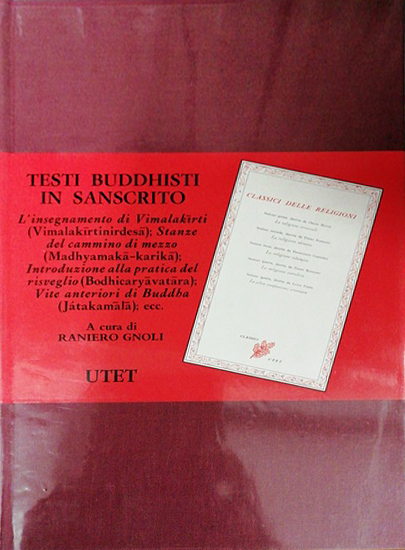
Testi Buddhisti in Sanscrito-front.jpg
Books1983About this item
A compilation of fourteen Sanskrit Buddhist texts translated into Italian, including the Bodhicaryāvatāra. Edited by Raniero Gnoli.
Articles.jpeg
Articles2025About this item
This study examines the development and transformation of the bodhisattva concept through comparative analysis of canonical Pāli texts and early Mahāyāna literature. Drawing upon philological evidence from the Jātaka tales, Buddhavaṃsa, and foundational Mahāyāna sūtras including the Lotus Sūtra and Perfection of Wisdom literature, this research traces the evolution from the historical Buddha's preenlightenment journey to the fully developed bodhisattva doctrine. The investigation employs textual criticism and doctrinal comparison to demonstrate how the bodhisattva ideal underwent significant conceptual expansion, shifting from describing the Buddha’s past lives to establishing a universal path of compassionate awakening. Findings reveal that while the Pāli tradition presents the bodhisattva path as exceptional and primarily retrospective, early Mahāyāna sources reconceptualize it as the supreme spiritual ideal accessible to all practitioners. This transformation reflects broader soteriological developments within Buddhist thought, particularly regarding the tension between individual liberation and universal salvation. The study contributes to understanding how fundamental Buddhist concepts evolved across different textual traditions and geographical contexts. Keywords: bodhisattva, Pāli Canon, Mahāyāna Buddhism, comparative Buddhism, Buddhist soteriology.
The Jataka-Mala or Bodhisattvavadana-Mala-front.jpg
Books1891About this item
H. Kern's edition of Ārya-Śūra's Jātakamālā (or Bodhisattvāvadānamālā), first published in 1891 as the inaugural volume of the Harvard Oriental Series, presents a critical Sanskrit text of this classical collection of thirty-four Buddhist birth-stories (jātakas). The edition is based on three manuscripts — two held at Cambridge University Library and one at the Bibliothèque Nationale in Paris. In his preface, Kern argues that all three descend from a single common archetype, citing their shared scribal errors and textual peculiarities as evidence. He also discusses the manuscripts' orthographic inconsistencies, examines the text's relationship to the Pāli Jātaka collection and the Cariyā-Piṭaka (providing a comparative table of corresponding tales), and addresses questions of textual authenticity, including his decision to retain the collection's concluding verse epilogues despite some doubts about their originality. The volume also includes an appendix containing the Kacchapa-jātaka, which Kern judged spurious to the original collection based on its distinct linguistic style.
The Jātakamālā-front.jpg
Books1982About this item
J. S. Speyer's English translation of the Jātakamālā, titled The Jātakamālā: Garland of Birth-Stories of Āryaśūra (this edition published by Motilal Banarsidass, Delhi/Patna/Varanasi), was signed at Groningen and dated 16 April 1895, prepared for the Sacred Books of the East series and based on H. Kern's 1891 critical Sanskrit edition (the first volume of the Harvard Oriental Series). In his introduction, Speyer traces the work's discovery by Western scholarship—from Brian H. Hodgson's identification of it among Nepalese Buddhist manuscripts as early as 1828, through Burnouf's only superficial acquaintance with the text, to Kern's definitive edition—and discusses Jātakamālā as a generic term for a genre of birth-story collections, of which Āryaśūra's is the sole surviving example among several once known to exist. Speyer examines the collection's literary character as a series of homiletic discourses combining ornamented Sanskrit prose and verse, each built around a moral maxim illustrated by a story and reiterated in a concluding epilogue (portions of which Speyer considers later interpolations and brackets accordingly, without omitting them). He also addresses the identity and probable dating of the author—traditionally known as Āryaśūra and distinguished from Aśvaghoṣa, author of the Buddhacarita, despite occasional conflation of the two in Tibetan tradition—situating him earlier than the end of the seventh century CE, and offering both Chinese and Tibetan testimony regarding the text's transmission and reputation. This translation supersedes a partial version of the work Speyer had earlier published in the Bijdragen voor Taal-, Land- en Volkenkunde van Nederlandsch-Indië.
The Marvelous Companion Life Stories of the Buddha-front.jpg
Books1983About this item
The Marvelous Companion: Aryashura's Jatakamala is a retelling of thirty-four Jatakas, accounts of the Buddha's previous lives, by the great first century Indian master and poet. This book is essentially a rewording into modern English of an earlier translation by Joseph Speyer, undertaken to make it more accessible to Dharma students.

This particular collection of Jatakas, retold by a renowned Buddhist master and poet, enriches understanding of karma and conveys attitudes and actions that develop perfect compassion. The Jatakas can serve as occasions to reflect upon the moral choices in our lives and open our eyes to the reality of karma, helping us develop the insight and discipline we need to acknowledge and change destructive patterns of behavior. This work is dedicated to Western Dharma students with the wish that the teachings it conveys will illuminate their understanding of karma, the indomitable strength of virtue, and the enlightening power of Bodhisattva compassion.

With 34 line drawings by Rosalyn White, working to the directions of Tarthang Tulku. A glossary of Sanskrit terms round out the presentation. Its language is highly accessible and relatable.

(Source: Dharma Publishing)