| 🤓 Admin Zone 🛠️ hidden to non-admins | |
The Jātakamālā
Book
Please note that many items in our library are simply pages that represent a detailed library catalog entry and citation of someone else's work, presentation, or performance. Read our General Disclaimer for more information.

Description
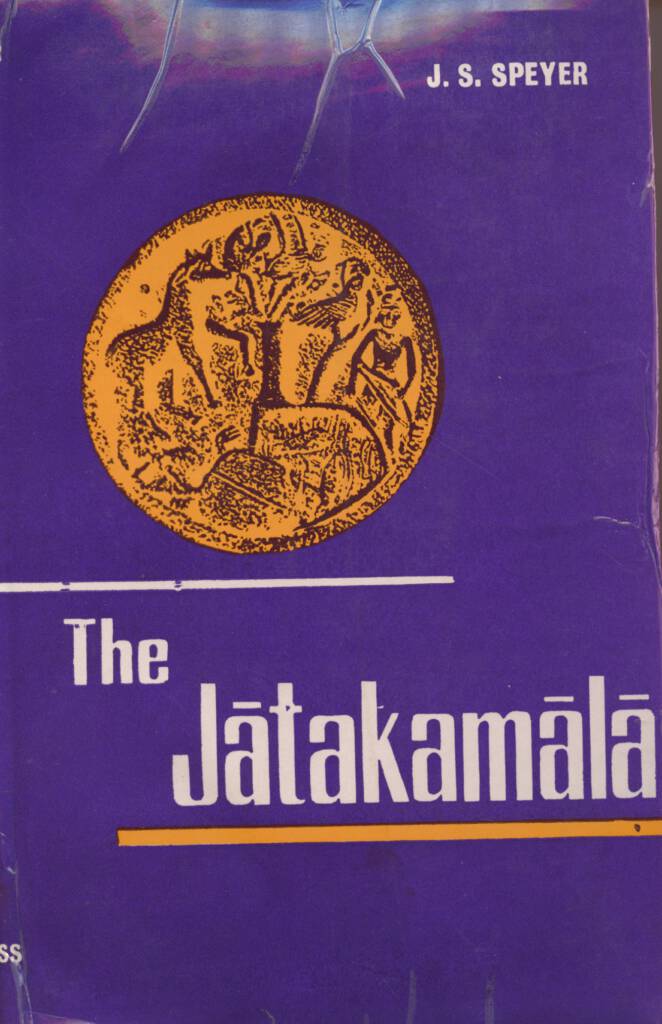
J. S. Speyer's English translation of the Jātakamālā, titled The Jātakamālā: Garland of Birth-Stories of Āryaśūra (this edition published by Motilal Banarsidass, Delhi/Patna/Varanasi), was signed at Groningen and dated 16 April 1895, prepared for the Sacred Books of the East series and based on H. Kern's 1891 critical Sanskrit edition (the first volume of the Harvard Oriental Series). In his introduction, Speyer traces the work's discovery by Western scholarship—from Brian H. Hodgson's identification of it among Nepalese Buddhist manuscripts as early as 1828, through Burnouf's only superficial acquaintance with the text, to Kern's definitive edition—and discusses Jātakamālā as a generic term for a genre of birth-story collections, of which Āryaśūra's is the sole surviving example among several once known to exist. Speyer examines the collection's literary character as a series of homiletic discourses combining ornamented Sanskrit prose and verse, each built around a moral maxim illustrated by a story and reiterated in a concluding epilogue (portions of which Speyer considers later interpolations and brackets accordingly, without omitting them). He also addresses the identity and probable dating of the author—traditionally known as Āryaśūra and distinguished from Aśvaghoṣa, author of the Buddhacarita, despite occasional conflation of the two in Tibetan tradition—situating him earlier than the end of the seventh century CE, and offering both Chinese and Tibetan testimony regarding the text's transmission and reputation. This translation supersedes a partial version of the work Speyer had earlier published in the Bijdragen voor Taal-, Land- en Volkenkunde van Nederlandsch-Indië.
Citation
Speyer, Jacob Samuel, trans. The Jātakamālā. By Āryaśūra. Edited by Max Müller. Delhi: Motilal Banarsidass, 1982.
Table of contents
- Introductionxxi
- Introductory Stanzas1
- I. The Story of the Tigress2
- II. The Story of the King of the Śibis8
- III. The Story of the Small Portion of Gruel20
- IV. The Story of the Head of a Guild25
- V. The Story of Avishahya, the Head of a Guild30
- VI. The Story of the Hare37
- VII. The Story of Agastya46
- VIII. The Story of Maitrîbala55
- IX. The Story of Viśvantara71
- X. The Story of the Sacrifice93
- XI. The Story of Śakra104
- XII. The Story of the Brâhman109
- XIII. The Story of Unmâdayantî114
- XIV. The Story of Supâraga124
- XV. The Story of the Fish134
- XVI. The Story of the Quail's Young138
- XVII. The Story of the Jar141
- XVIII. The Story of the Childless One148
- XIX. The Story of the Lotus-Stalks154
- XX. The Story of the Treasurer164
- XXI. The Story of Kuddabodhi172
- XXII. The Story of the Holy Swans181
- XXIII. The Story of Mahâbodhi200
- XXIV. The Story of the Great Ape218
- XXV. The Story of the Śarabha227
- XXVI. The Story of the Ruru-Deer234
- XXVII. The Story of the Great Monkey244
- XXVIII. The Story of Kshântivâdin253
- XXIX. The Story of the Inhabitant of the Brahmaloka268
- XXX. The Story of the Elephant281
- XXXI. The Story of Sutasoma291
- XXXII. The Story of Ayogṛiha314
- XXXIII. The Story of the Buffalo324
- XXXIV. The Story of the Woodpecker329
- Synoptical Table of the Correspondence between the Stanzas of the Gâtakamâlâ and the Scripture Verses of the Pâli Gâtaka337
- Index341
- Transliteration of Oriental Alphabets adopted for the Translations of the Sacred Books of the Buddhists347
Interconnections
1 Full translation of

Jātakamālā. (T. Skyes pa'i rabs kyi rgyud; C. Pusa benshengman lun; J. Bosatsu honjōmanron; K. Posal ponsaengman non 菩薩本生鬘論). In Sanskrit, "Garland of Birth Stories," by the poet Śūra [alt. Āryaśūra; c. second-century CE], a collection of thirty-four jātaka tales related in an elegant and elliptical literary style. Each story includes Śūra's introduction relating the specific point of morality illustrated in the story. This narrative is in mixed prose and verse (a style that comes to be termed campū), with a variety of different meters employed. The beauty of Śūra's literary renderings was so renowned that the Jātakamālā often came to be even more widely read than the Jātaka collections themselves. In Tibet it is a custom for a senior monk to give an explanation of one of the tales from the Jātakamālā on the opening day of the Smon lam chen mo (Great Prayer Festival). The story surrounding the Chinese "translation" of the Jātakamālā, the Pusa benshengman lun ("Treatise on the Bodhisattva's Garland of Birth Stories"), may be one of the strangest tales in the annals of the translation of Buddhist texts. As modern scholarship has shown, the Chinese "translators" had so much difficulty in construing Śūra's elaborate style that they managed to produce an "apocryphal" scripture while having the Sanskrit text right in front of them. Working without dictionary or grammar, or the luxury of an Indian paṇḍita to help them construe the text, and apparently faced with an impossible deadline, the translators simply resorted to forgery: where they found a few random words of Śūra's that they could construe, they lifted wholesale from other texts stories that happened to contain the same words. Except for the titles of some of the stories, there is almost nothing in the Chinese translation that corresponds to Śūra's Sanskrit. (Source: "Jātakamālā." In The Princeton Dictionary of Buddhism, 381–82. Princeton University Press, 2014. http://www.jstor.org/stable/j.ctt46n41q.27.)