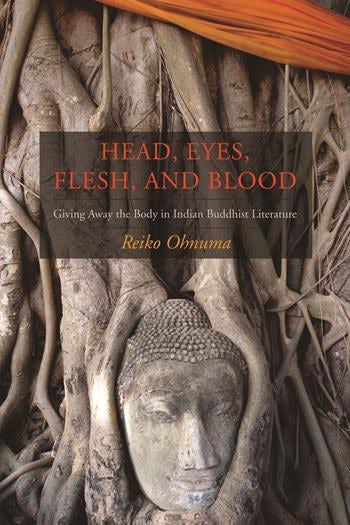
Head, Eyes, Flesh, and Blood

From Bodhicitta
< BooksBooks/Head, Eyes, Flesh, and Blood

🤓 Admin Zone 🛠️ hidden to non-admins
Head, Eyes, Flesh, and Blood: Giving Away the Body in Indian Buddhist Literature
Book


Please note that many items in our library are simply pages that represent a detailed library catalog entry and citation of someone else's work, presentation, or performance. Read our General Disclaimer for more information. You can find more information about this item on the publisher website.
Head Eyes Flesh and Blood-front.jpg

Description

Head, Eyes, Flesh, and Blood is the first comprehensive study of a central narrative theme in premodern South Asian Buddhist literature: the Buddha's bodily self-sacrifice during his previous lives as a bodhisattva. Conducting close readings of stories from Sanskrit, Pali, Chinese, and Tibetan literature written between the third century BCE and the late medieval period, Reiko Ohnuma argues that this theme has had a major impact on the development of Buddhist philosophy and culture.

Whether he takes the form of king, prince, ascetic, elephant, hare, serpent, or god, the bodhisattva repeatedly gives his body or parts of his flesh to others. He leaps into fires, drowns himself in the ocean, rips out his tusks, gouges out his eyes, and lets mosquitoes drink from his blood, always out of selflessness and compassion and to achieve the highest state of Buddhahood.

Ohnuma places these stories into a discrete subgenre of South Asian Buddhist literature and approaches them like case studies, analyzing their plots, characterizations, and rhetoric. She then relates the theme of the Buddha's bodily self-sacrifice to major conceptual discourses in the history of Buddhism and South Asian religions, such as the categories of the gift, the body (both ordinary and extraordinary), kingship, sacrifice, ritual offering, and death.

Head, Eyes, Flesh, and Blood reveals a very sophisticated and influential perception of the body in South Asian Buddhist literature and highlights the way in which these stories have provided an important cultural resource for Buddhists. Combined with her rich and careful translations of classic texts, Ohnuma introduces a whole new understanding of a vital concept in Buddhists studies. (Source: Columbia University Press)

Citation
Ohnuma, Reiko. Head, Eyes, Flesh, and Blood: Giving Away the Body in Indian Buddhist Literature. New York: Columbia University Press, 2007.
Publisher Link
Table of contents
  • Illustrationsix
  • Tablesxi
  • Conventions Used in This Bookxiii
  • Acknowledgmentsxv
  • Introduction1
  • I. The Gift-of-the-Body Genre26
  • II. Conventions of Plot52
  • III. Conventions of Rhetoric90
  • IV. Dāna: The Buddhist Discourse on Giving140
  • V. A Flexible Gift167
  • VI. Bodies Ordinary and Ideal199
  • VII. Kingship, Sacrifice, Offering, and Death: Some Other Interpretive Contexts242
  • Conclusions266
  • Appendix: A Corpus of Gift-of-the-Body Jātakas273
  • Notes285
  • Bibliography of Works Cited337
  • Index359
Interconnections
1 Scholarship on
Sutra portrait.jpg
Classical WorksAbout this item
Jātakamālā. (T. Skyes pa'i rabs kyi rgyud; C. Pusa benshengman lun; J. Bosatsu honjōmanron; K. Posal ponsaengman non 菩薩本生鬘論). In Sanskrit, "Garland of Birth Stories," by the poet Śūra [alt. Āryaśūra; c. second-century CE], a collection of thirty-four jātaka tales related in an elegant and elliptical literary style. Each story includes Śūra's introduction relating the specific point of morality illustrated in the story. This narrative is in mixed prose and verse (a style that comes to be termed campū), with a variety of different meters employed. The beauty of Śūra's literary renderings was so renowned that the Jātakamālā often came to be even more widely read than the Jātaka collections themselves. In Tibet it is a custom for a senior monk to give an explanation of one of the tales from the Jātakamālā on the opening day of the Smon lam chen mo (Great Prayer Festival). The story surrounding the Chinese "translation" of the Jātakamālā, the Pusa benshengman lun ("Treatise on the Bodhisattva's Garland of Birth Stories"), may be one of the strangest tales in the annals of the translation of Buddhist texts. As modern scholarship has shown, the Chinese "translators" had so much difficulty in construing Śūra's elaborate style that they managed to produce an "apocryphal" scripture while having the Sanskrit text right in front of them. Working without dictionary or grammar, or the luxury of an Indian paṇḍita to help them construe the text, and apparently faced with an impossible deadline, the translators simply resorted to forgery: where they found a few random words of Śūra's that they could construe, they lifted wholesale from other texts stories that happened to contain the same words. Except for the titles of some of the stories, there is almost nothing in the Chinese translation that corresponds to Śūra's Sanskrit. (Source: "Jātakamālā." In The Princeton Dictionary of Buddhism, 381–82. Princeton University Press, 2014. http://www.jstor.org/stable/j.ctt46n41q.27.)