Once the Buddha Was a Monkey

From Bodhicitta
< BooksBooks/Once the Buddha Was a Monkey

🤓 Admin Zone 🛠️ hidden to non-admins
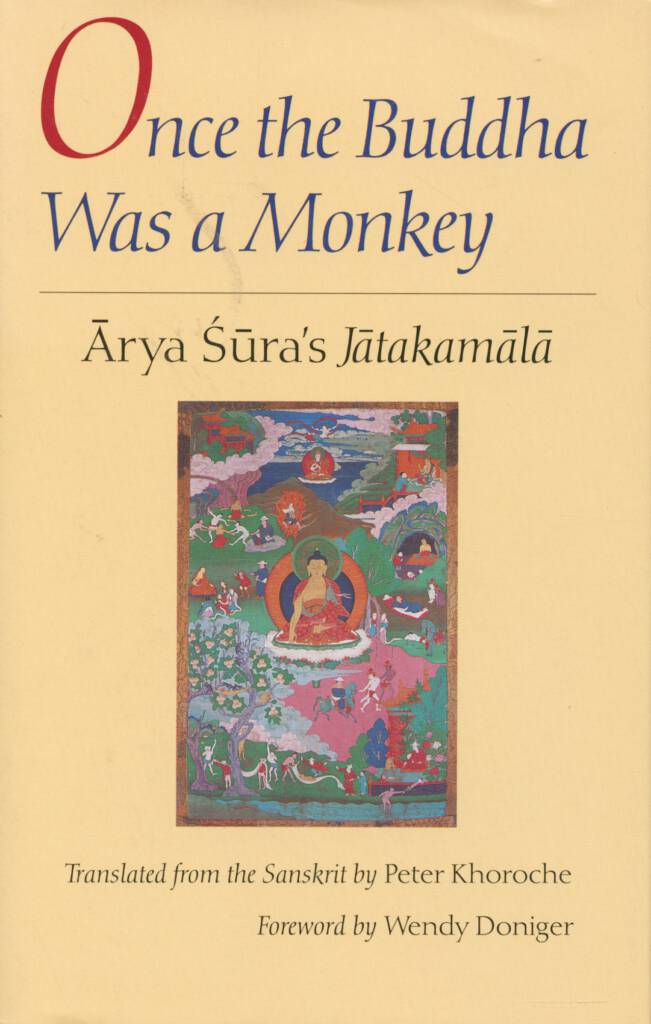
Once the Buddha Was a Monkey: Ārya Śūra's Jātakamālā
Book


Please note that many items in our library are simply pages that represent a detailed library catalog entry and citation of someone else's work, presentation, or performance. Read our General Disclaimer for more information. You can find more information about this item on the publisher website.
Once the Buddha Was a Monkey-front.jpg

Description

Here is one of the most entertaining masterpieces of Sanskrit literature rendered in an English translation that fully captures the original’s artistry and charm.

Written most probably in the fourth century A.D., the Jatakamala is generally considered the masterpiece of Buddhist literature in Sanskrit. In elegant, courtly style, Arya Sura retells thirty-four traditional stories about the Buddha in his previous incarnations, human and animal. Whether as a king, a brahmin, a monkey, or a hare, the Great One is shown in assiduous pursuit of virtue and compassion. Though primarily intended as exemplary tales illustrating the Buddhist virtues, these stories also provide a vivid picture of life at a high point in ancient Indian culture—city life in ordinary households or at the royal court, and country life against a backdrop of mountain, desert, and jungle.

Fresh study of the Sanskrit manuscripts, now scattered in libraries all over the world, has enabled Peter Khoroche to make this new translation faithful to the original in both style and content. His explanatory notes will assist student and general reader alike in appreciating this classic from an ancient and exotic civilization. (Source: The University of Chicago Press)

Citation
Ārya Śūra. Once the Buddha Was a Monkey: Ārya Śūra's Jātakamālā. Translated by Peter Khoroche. Chicago: The University of Chicago Press, 1989.
Publisher Link
Table of contents
  • Forewordvii
  • Prefaceix
  • Introductionxi
  • Prologue3
  • 1. The Tigress5
  • 2. Śibi10
  • 3. The Dumpling18
  • 4. The Merchant22
  • 5. Aviṣahya the Merchant26
  • 6. The Hare32
  • 7. Agastya39
  • 8. Maitrībala47
  • 9. Viśvaṃtara58
  • 10. The Sacrifice74
  • 11. Śakra81
  • 12. The Brahmin84
  • 13. Unmādayantī88
  • 14. Supāraga96
  • 15. The Lord of the Fish103
  • 16. The Young Quail107
  • 17. The Jar Full of Spirits110
  • 18. The Man without an Heir115
  • 19. The Lotus Stalks119
  • 20. The Royal Treasurer126
  • 21. Bodhi133
  • 22. The King of the Geese140
  • 23. Bodhi the Wandering Ascetic153
  • 24. The Great Ape166
  • 25. The Ibex173
  • 26. The Antelope178
  • 27. The King of the Monkeys186
  • 28. Kṣāntivādin193
  • 29. The Inhabitant of Highest Heaven205
  • 30. The Elephant213
  • 31. Sutasoma221
  • 32. Ayogṛha, the Prince in the Iron House237
  • 33. The Buffalo245
  • 34. The Woodpecker249
  • Abbreviations255
  • Notes255
  • Bibliography271
Interconnections
1 Full translation of
Sutra portrait.jpg
Classical WorksAbout this item
Jātakamālā. (T. Skyes pa'i rabs kyi rgyud; C. Pusa benshengman lun; J. Bosatsu honjōmanron; K. Posal ponsaengman non 菩薩本生鬘論). In Sanskrit, "Garland of Birth Stories," by the poet Śūra [alt. Āryaśūra; c. second-century CE], a collection of thirty-four jātaka tales related in an elegant and elliptical literary style. Each story includes Śūra's introduction relating the specific point of morality illustrated in the story. This narrative is in mixed prose and verse (a style that comes to be termed campū), with a variety of different meters employed. The beauty of Śūra's literary renderings was so renowned that the Jātakamālā often came to be even more widely read than the Jātaka collections themselves. In Tibet it is a custom for a senior monk to give an explanation of one of the tales from the Jātakamālā on the opening day of the Smon lam chen mo (Great Prayer Festival). The story surrounding the Chinese "translation" of the Jātakamālā, the Pusa benshengman lun ("Treatise on the Bodhisattva's Garland of Birth Stories"), may be one of the strangest tales in the annals of the translation of Buddhist texts. As modern scholarship has shown, the Chinese "translators" had so much difficulty in construing Śūra's elaborate style that they managed to produce an "apocryphal" scripture while having the Sanskrit text right in front of them. Working without dictionary or grammar, or the luxury of an Indian paṇḍita to help them construe the text, and apparently faced with an impossible deadline, the translators simply resorted to forgery: where they found a few random words of Śūra's that they could construe, they lifted wholesale from other texts stories that happened to contain the same words. Except for the titles of some of the stories, there is almost nothing in the Chinese translation that corresponds to Śūra's Sanskrit. (Source: "Jātakamālā." In The Princeton Dictionary of Buddhism, 381–82. Princeton University Press, 2014. http://www.jstor.org/stable/j.ctt46n41q.27.)