| 🤓 Admin Zone 🛠️ hidden to non-admins | |
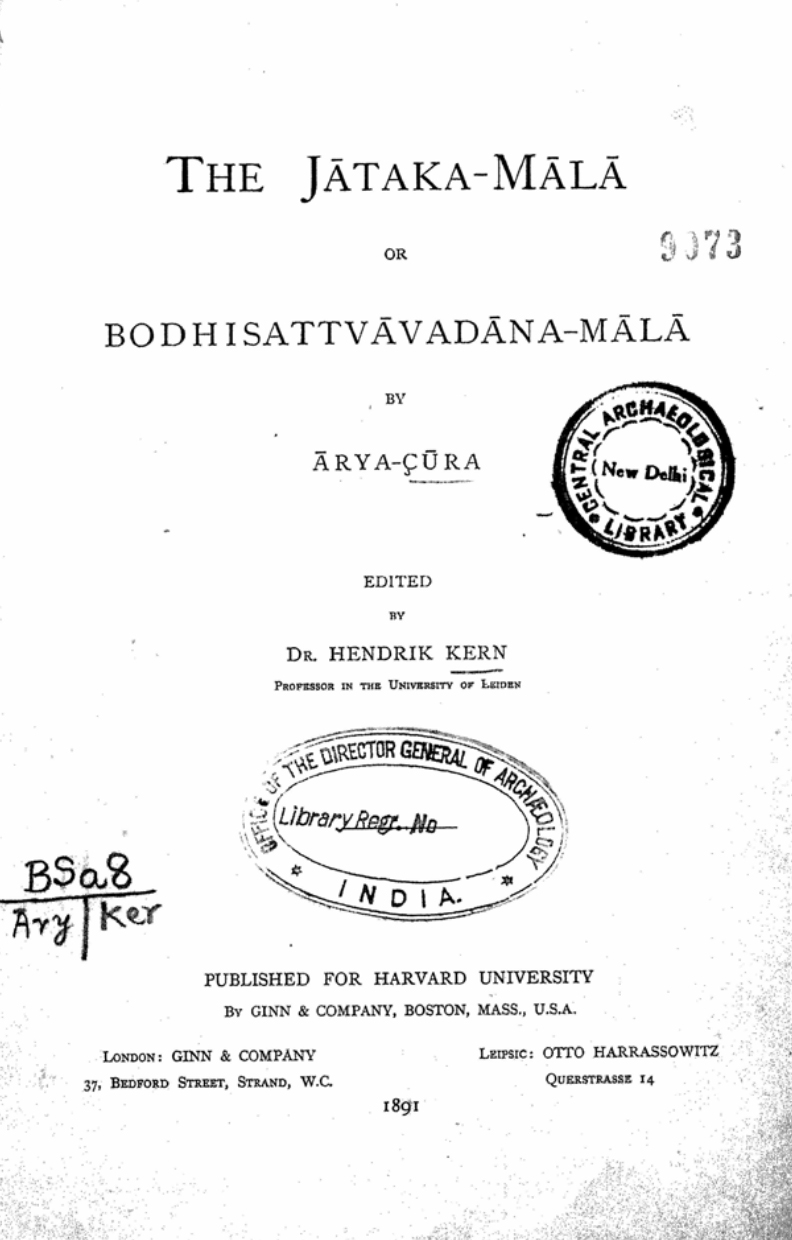
The Jātaka-Mālā or Bodhisattvāvadāna-Mālā by Ārya-Çūra
Book
Please note that many items in our library are simply pages that represent a detailed library catalog entry and citation of someone else's work, presentation, or performance. Read our General Disclaimer for more information.

Description
H. Kern's edition of Ārya-Śūra's Jātakamālā (or Bodhisattvāvadānamālā), first published in 1891 as the inaugural volume of the Harvard Oriental Series, presents a critical Sanskrit text of this classical collection of thirty-four Buddhist birth-stories (jātakas). The edition is based on three manuscripts — two held at Cambridge University Library and one at the Bibliothèque Nationale in Paris. In his preface, Kern argues that all three descend from a single common archetype, citing their shared scribal errors and textual peculiarities as evidence. He also discusses the manuscripts' orthographic inconsistencies, examines the text's relationship to the Pāli Jātaka collection and the Cariyā-Piṭaka (providing a comparative table of corresponding tales), and addresses questions of textual authenticity, including his decision to retain the collection's concluding verse epilogues despite some doubts about their originality. The volume also includes an appendix containing the Kacchapa-jātaka, which Kern judged spurious to the original collection based on its distinct linguistic style.
Citation
Kern, H., ed. The Jātaka-Mālā or Bodhisattvāvadāna-Mālā by Ārya-Çūra. Harvard Oriental Series 1. Boston: Ginn & Company, 1891.
Table of contents
- १. व्याघ्रीजातकम्1
- २. शिबिजातकम्6
- ३. कुल्माषपिण्डीजातकम्14
- ४. श्रेष्ठिजातकम्19
- ५. अविषह्यजातकम्22
- ६. शशजातकम्27
- ७. अगस्त्यजातकम्33
- ८. मैत्रीबलजातकम्41
- ९. विशंतरजातकम्51
- १०. यज्ञजातकम्67
- ११. शक्रजातकम्73
- १२. ब्राह्मणजातकम्77
- १३. उन्मादयन्तीजातकम्80
- १४. सुपारगजातकम्88
- १५. मत्स्यजातकम्95
- १६. वर्तकापोतकजातकम्98
- १७. कुम्भजातकम्100
- १८. अपुत्रजातकम्105
- १९. बिसजातकम्108
- २०. श्रेष्ठिजातकम्116
- २१. चुल्लबोधिजातकम्121
- २२. हंसजातकम्127
- २३. महाबोधिजातकम्142
- २४. महाकपिजातकम्155
- २५. शरभजातकम्162
- २६. रुरुजातकम्167
- २७. महाकपिजातकम्175
- २८. क्षान्तिजातकम्181
- २९. ब्रह्मजातकम्192
- ३०. हस्तिजातकम्200
- ३१. सुतसोमजातकम्207
- ३२. अयोगृहजातकम्224
- ३३. महिषजातकम्232
- ३४. शतपत्रजातकम्235
- परिशिष्टम् (Appendix)240
- पाठान्तराणि (Various Readings)242
Interconnections
1 Recension of

Jātakamālā. (T. Skyes pa'i rabs kyi rgyud; C. Pusa benshengman lun; J. Bosatsu honjōmanron; K. Posal ponsaengman non 菩薩本生鬘論). In Sanskrit, "Garland of Birth Stories," by the poet Śūra [alt. Āryaśūra; c. second-century CE], a collection of thirty-four jātaka tales related in an elegant and elliptical literary style. Each story includes Śūra's introduction relating the specific point of morality illustrated in the story. This narrative is in mixed prose and verse (a style that comes to be termed campū), with a variety of different meters employed. The beauty of Śūra's literary renderings was so renowned that the Jātakamālā often came to be even more widely read than the Jātaka collections themselves. In Tibet it is a custom for a senior monk to give an explanation of one of the tales from the Jātakamālā on the opening day of the Smon lam chen mo (Great Prayer Festival). The story surrounding the Chinese "translation" of the Jātakamālā, the Pusa benshengman lun ("Treatise on the Bodhisattva's Garland of Birth Stories"), may be one of the strangest tales in the annals of the translation of Buddhist texts. As modern scholarship has shown, the Chinese "translators" had so much difficulty in construing Śūra's elaborate style that they managed to produce an "apocryphal" scripture while having the Sanskrit text right in front of them. Working without dictionary or grammar, or the luxury of an Indian paṇḍita to help them construe the text, and apparently faced with an impossible deadline, the translators simply resorted to forgery: where they found a few random words of Śūra's that they could construe, they lifted wholesale from other texts stories that happened to contain the same words. Except for the titles of some of the stories, there is almost nothing in the Chinese translation that corresponds to Śūra's Sanskrit. (Source: "Jātakamālā." In The Princeton Dictionary of Buddhism, 381–82. Princeton University Press, 2014. http://www.jstor.org/stable/j.ctt46n41q.27.)