|
|
| (122 intermediate revisions by 4 users not shown) |
| Line 1: |
Line 1: |
| {{ThemePage | | {{EditorialContent |
| |sub-theme=Chapter Four - Conscientiousness
| | |EditorialAuthor=Houlton, S. |
| |main-text=
| | |subclass=BCA Chapter Summaries |
| | |sub-theme=Chapter 4 |
| | |watermark=Summary |
| | |TermTopics=BCA Chapter 4 |
| | |ExtensiveSummaryPage=Articles/Conscientiousness_Overview |
| | |StoriesPage=Practice/The_Mirror_Clarifying_the_Results_of_Karma:_Chapter_4;Practice/Tales_of_Engaging_the_Way_of_the_Bodhisattva_-_Chapter_Four#::Tales of Engaging the Way of the Bodhisattva: Chapter 4 |
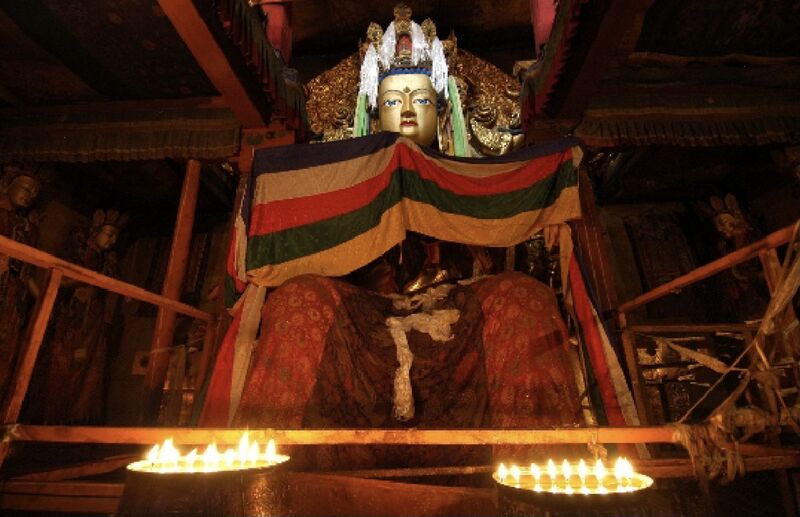
| | |jumbo-image=Maitreya Alex.jpg |
| | |jumbo-text=In chapter 4, Śāntideva addresses the topic of conscientiousness (''apramāda'', བག་ཡོད་), sometimes also translated as carefulness—a mental factor that protects the mind from negative action and helps us discern what to take up and what to avoid on the path. |
| | |add-resources-text= |
| | |add-resources-section={{AddResSection |
| | |header=Learn About Śāntideva's Texts |
| | |tiles=Bodhicaryāvatāra;Śikṣāsamuccaya |
| | }}{{AddResSection |
| | |header=Recommended Texts Related to Chapter 4 |
| | |tiles=Rājāvavādakasūtra;Saddharmasmṛtyupasthānasūtra;Upāyakauśalyasūtra;Nandapravrajyāsūtra;Trisaṃvaranirdeśaparivartasūtra |
| | }}{{AddResSection |
| | |header=Recommended Books Related to Chapter 4 |
| | |tiles=Shantideva's Guide to the Bodhisattva's Way Of Life: An Oral Explanation of Chapter 4; |
| | }}{{AddResSection |
| | |header=Recommended Videos Related to Chapter 4 |
| | |tiles=The Way of the Bodhisattva Workshop (Part 4 of 6);Guide to the Bodhisattva's Way of Life, Chapter 4: Teaching by Geshe Ngawang Tenley (Part 1 of 2);Bodhicaryāvatāra: Chapter 4 - Conscientiousness: Teaching by Drupa Rinpoche (Part 1 of 5);Shantideva's Guide to the Bodhisattva's Way of Life by Ringu Tulku Rinpoche: Lesson 4. Carefulness;Bodhicharyavatara - Chapter 4: Carefulness: Teaching by Ringu Tulku (Part 1 of 16) |
|
| |
|
|
| |
|
| {{Jumbo | | |
| |full-width=yes
| | }}{{AddResSection |
| |image=Maitreya Alex.jpg
| | |header=Explore All Resources Related to Chapter 4 |
| |imageSource=
| | |tilesRaw={{Tile |
| |text=In chapter 4 Śāntideva addresses the topic of conscientiousness (Skt. ''apramādha''), sometimes also translated as carefulness, a mental factor whose function is to protect the mind from negative forms of action. It is a tool which allows us to meticulously examine our actions of body, speech, and mind, particularly within the perspective of what is to be taken up and what is to be avoided on the path.
| | |wrapper-classes=col-lg-6 mb-4 |
| | |image=Shantideva (Sahil Phopal) cropped.jpg |
| | |header=Chapter 4 Topics Page<br> <small></small> |
| | |text=A complete list of sources related to ''Bodhicaryāvatāra'' chapter 4 |
| | |label=Topic |
| | |page=Topics/BCA_Chapter_4 |
| | }} |
| | }}{{AddResSection |
| | |header=Key Terms for Chapter 4 |
| | |tilesRaw={{FloatingTermBox |
| | |size=col-sm-6 col-md-4 |
| | |term=Śīla |
| | }}{{FloatingTermBox |
| | |size=col-sm-6 col-md-4 |
| | |term=Apramāda |
| | }}{{FloatingTermBox |
| | |size=col-sm-6 col-md-4 |
| | |term=Kleśa |
| | }} |
| }} | | }} |
| | |
| | |
| | |main-text= |
|
| |
|
| <h3>Concise Summary of Essential Points</h3> | | <h3>Concise Summary of Essential Points</h3> |
| The first three chapters of ''The Way of the Bodhisattva'' introduce the bodhisattva's way of life and conduct and impress upon us the qualities and benefits of bodhicitta and of developing altruistic compassion for the sake of all others. All of those contemplations come under the section of the text which covers the cultivation of bodhicitta where it has not previously been cultivated. | | The first three chapters of ''The Way of the Bodhisattva'' introduce the bodhisattva's way of life and conduct and impress upon us the qualities and benefits of bodhicitta and of developing altruistic compassion for the sake of all others. All of those contemplations come under the section of the text which covers the cultivation of bodhicitta where it has not previously been cultivated. |
|
| |
|
| In the first verse of chapter 4, Śāntideva urges to make sure that once we have cultivated this precious mind of bodhicitta we never turn away from it. | | In the first verse of chapter 4, Śāntideva urges us to make sure that once we have cultivated this precious mind of bodhicitta we never turn away from it. |
| {{PullBcaVerses|4.1}} | | {{PullBcaVerses|4.1}} |
| The next three chapters, from chapter 4 through chapter 6, are concerned with protecting this freshly arisen bodhicitta from declining. But how do we work with our minds in order to do this? What way of thinking and conduct are needed to protect this incredible mind of bodhicitta? The answer, Śāntideva suggests, is discipline. | | The next three chapters, from chapter 4 through chapter 6, are concerned with protecting this freshly arisen bodhicitta from declining. But how do we work with our minds in order to do this? What way of thinking and conduct are needed to protect this incredible mind of bodhicitta? The answer, Śāntideva suggests, is discipline. |
|
| |
|
| <h4>The Need for Discipline</h4> | | <h4>The Need for Discipline</h4> |
| In order to protect bodhicitta, one of the primary factors needed is discipline, which is the main theme of chapters 4 and 5. Discipline is required in order to subdue our scattered minds and to prevent the awakening mind from weakening. To establish good discipline, we need the mental tools of conscientiousness, mindfulness, and vigilance. [LINK to main terms] These tools are the chief means through which we are able to subdue our minds, and they provide crucial support for the bodhisattva's practice of the perfection (Skt. ''pāramitā'') of ethical discipline. Chapters 4 and 5 lay out the functions and methods of cultivating these three essential mental factors, which aid us in maintaining the wish to attain full enlightenment for the welfare of all sentient beings. To maintain this bodhicitta, these three mental factors assist us in distinguishing between those practices that help our progress and should be taken up on the path from those practices that hinder us and should be avoided. | | In order to protect bodhicitta, one of the primary factors needed is discipline, which is the main theme of chapters 4 and 5. Discipline is required in order to subdue our scattered minds and to prevent the awakening mind from weakening. To establish good discipline, we need the mental tools of conscientiousness, mindfulness, and vigilance. These tools are the chief means through which we are able to subdue our minds, and they provide crucial support for the bodhisattva's practice of the perfection (''pāramitā'') of ethical discipline. These two chapters lay out the functions and methods of cultivating these three essential mental factors, which aid us in maintaining the wish to attain full enlightenment for the welfare of all sentient beings. To maintain this bodhicitta, these three mental factors assist us in distinguishing between those practices that help our progress and should be taken up on the path and those practices that hinder us and should be avoided. |
|
| |
|
| The fourth chapter focuses mainly on conscientiousness (Skt. ''apramādha'') [LINK to main terms], sometimes also translated as carefulness. Conscientiousness is a mental factor which functions to protect the mind from negative forms of action. It is a tool that allows us to meticulously examine our actions of body, speech, and mind within the perspective of what is to be taken up and what is to be avoided. | | The fourth chapter focuses primarily on conscientiousness. The Tibetan historian and Buddhist researcher Geshe Dungkar Rinpoche Lobsang Trinley (1927–1997) describes it as a way of tuning or adjusting our minds such that when we are thinking of engaging in some kind of negative activity, conscientiousness assists us in becoming aware that those actions are faulty and unconstructive. He goes on to explain that the main thrust of the chapter is about how to behave when interacting with others, and how to act when our minds are scattered.<ref>[[Dung dkar blo bzang 'phrin las|Dungkar Rinpoche Lobsang Trinley]], ''An Introduction to the Bodhicaryāvatāra'', ''[[Gsung 'bum blo bzang 'phrin las (pod ta pa) (sa rA bod kyi dpe skrun khang gis par skrun zhus 2017)|Spyod 'jug gi gzhung gi ngo sprod]]'' (Dharamsala: Sara Tibetan Publishing House, 2017), 44.</ref> |
| | |
| The Tibetan historian and Buddhist researcher Geshe Dungkar Rinpoche Lobsang Trinley (1927–1997) describes conscientiousness as a way of tuning or adjusting our minds, such that when we are thinking of engaging in some kind of negative activity, conscientiousness assists us in becoming aware that those actions are faulty and unconstructive. He goes on to explain that the main thrust of the chapter on conscientiousness is about how to behave when interacting with others, how to present ourselves in relation to others, and how to act when our minds are scattered.<ref>Dungkar Rinpoche Lobsang Trinley, ''An Introduction to the Bodhicaryāvatāra'', ''Spyod 'jug gi gzhung gi ngo sprod'' (Dharamsala: Sara Tibetan Publishing House, 2017), 44.</ref> | |
|
| |
|
| <h4>Preciousness of Human Rebirth</h4> | | <h4>Preciousness of Human Rebirth</h4> |
| We may feel that we are always unlucky or lack good fortune and that things often go against us. Śāntideva takes a much wider perspective and reminds us that our current situation actually contains a tremendous opportunity. He does this to impress upon us how important the need for conscientiousness is. | | We may feel that we are always unlucky or lack good fortune and that things often go against us. Śāntideva takes a much wider perspective and reminds us that our current situation actually contains a tremendous opportunity. |
|
| |
|
| Verse 16 of chapter 4, for example, speaks to us of how rare and fortunate we are to be born in the human realm and particularly to have the freedoms and advantages [LINK to main terms] of a precious human rebirth [LINK to main terms]. Moreover, we are encouraged to remember how rare it is to be born in a place where the Buddha's teachings remain. | | Verse 16 of chapter 4, for example, speaks to us of how rare and fortunate we are to be born in the human realm and particularly to have the freedoms and advantages of a precious human rebirth. |
| {{PullBcaVerses|4.16}} | | {{PullBcaVerses|4.16}} |
| Śāntideva encourages us to see the rare opportunity we have right now. We are in reasonable health and have enough sustenance and some amount of freedom to practice. But this life is fleeting and a human rebirth hard to obtain again. It is like something of great value briefly lent to us that could be taken back at any moment. As such, Śāntideva argues, we should seize this moment instead of being despondent about temporary obstacles and difficulties. We should uplift our minds and strive in virtue, sustained by the thought of how much fortune we actually already have. | | Śāntideva encourages us to see the rare opportunity we have right now—fleeting and fragile, like something of great value briefly lent to us. We should therefore uplift our minds and strive in virtue rather than being despondent about temporary obstacles. |
|
| |
|
| <h4>The Defects of the Afflictive Emotions</h4> | | <h4>The Defects of the Afflictive Emotions</h4> |
| In this chapter Śāntideva also reflects on the faults of afflictive mental states as a way to ingrain conscientiousness into our behavior. | | In this chapter, Śāntideva also reflects on the faults of afflictive mental states as a way to ingrain conscientiousness into our behavior. |
| {{PullBcaVerses|4.28}} | | {{PullBcaVerses|4.28}} |
| Here, Śāntideva asserts that we are completely at the beck and call of our emotions, slaves to our desire and our aversion. We may follow these emotions even at the cost of our lives, and yet they lead us only to disaster. Alongside ignorance, these emotions are our own inner enemies, the real enemy. Unlike external enemies, they are lazy and cowardly. Śāntideva reprimands us, asking us how all of us, whether weak or strong, have allowed these stupid afflictions to reduce us to such abject slavery and suffering, deprived of every freedom? He reminds us that external enemies such as thieves or bandits may cause us injury over a period of a few years. In contrast, the mental afflictions have caused us harm over countless lifetimes, and if we do not vanquish them now they will continue to cause us great harm into the future. | | Here, Śāntideva asserts that we are completely at the beck and call of our emotions, slaves to our desire and our aversion. We may follow these emotions even at the cost of our lives, and yet they lead us only to disaster. Alongside ignorance, these emotions are our own inner enemies, the real enemies. Unlike external enemies, they are lazy and cowardly. Śāntideva reprimands us and asks how all of us, whether weak or strong, have allowed these stupid afflictions to reduce us to such abject slavery and suffering, deprived of every freedom. He reminds us that external enemies such as thieves or bandits may cause us injury over a period of a few years, but the mental afflictions have caused us harm over countless lifetimes. If we do not vanquish them now, they will continue to cause us great harm into the future. |
|
| |
|
| <h4>Abandoning Emotional Defilement</h4> | | <h4>Abandoning Emotional Defilement</h4> |
| Chapter 4 ends with some stirring words from Śāntideva, as he incites us to wage war on the defiled emotions. Better, he says, to perish by fire then allow ourselves to become servants to the afflictive emotions. But he also offers us hope in the fight against these negative mental states. Common external enemies, once driven away, can regroup and return again to fight another day. But the afflictions have no such strategy, and once properly routed with the eye of wisdom, they can be forever banished. Therefore, Śāntideva says, we must vow day and night to rise up and challenge the mental afflictions and never give up that fight until we see them overcome before our very eyes. | | Chapter 4 ends with some stirring words from Śāntideva, as he incites us to wage war on the defiled emotions. Better, he says, to perish by fire than allow ourselves to become servants to the afflictive emotions. But he also offers us hope in the fight against these negative mental states. Common external enemies, once driven away, can regroup and return to fight another day. But the afflictions have no such strategy, and once properly routed with the eye of wisdom, they can be forever banished. Therefore, Śāntideva says, we must vow day and night to rise up and challenge the mental afflictions and never give up that fight until we see them overcome before our very eyes. |
| {{QuoteCite | | {{QuoteCite |
| |quote-text=I will not leave the fight until, before my eyes,<br> | | |quote-text=I will not leave the fight until, before my eyes,<br> |
| These enemies of mine are all destroyed. (4.36ab)<ref>Wulstan Fletcher and Helena Blankleder (Padmakara Translation Group), trans., ''The Way of the Bodhisattva: A Translation of the Bodhicharyāvatāra'', by Śāntideva (Boston: Shambhala Publications, 2006), 58.</ref> | | These enemies of mine are all destroyed. (4.36ab)<ref>[[Blankleder, H.|Helena Blankleder]] and [[Fletcher, W.|Wulstan Fletcher]] ([[Padmakara Translation Group]]), trans., ''[[The Way of the Bodhisattva (2006)|The Way of the Bodhisattva: A Translation of the Bodhicharyāvatāra]]'', by [[Śāntideva]] (Boston: [[Shambhala Publications]], 2006), 58.</ref> |
| }} | | }} |
| His last words to us in the chapter encourage us to take the medicine of conscientiousness that has been prescribed. | | His last words to us in the chapter encourage us to take the medicine of conscientiousness that has been prescribed. |
| {{QuoteCite | | {{QuoteCite |
| |quote-text=What invalids in need of medicine | | |quote-text=What invalids in need of medicine |
| Ignored their doctor’s words and gained their health? (4.48cd)<ref>Fletcher and Blankleder, ''Way of the Bodhisattva'', 60.</ref> | | Ignored their doctor’s words and gained their health? (4.48cd)<ref>[[Blankleder, H.|Blankleder]] and [[Fletcher, W.|Fletcher]], ''[[The Way of the Bodhisattva (2006)|Way of the Bodhisattva]]'', 60.</ref> |
| }} | | }} |
| In other words, Śāntideva asks, what kind of patient who is in need of relief from disease would not take the medicine prescribed by their doctor?
| | Spurred on by the thought of our precious and rare opportunity and how fragile that can be, Śāntideva implores us to seize the day and strive to develop this conscientiousness that helps us maintain a healthy and disciplined mind. |
|
| |
|
| Spurred on by the thought of our precious and rare opportunity and how fragile that opportunity can be, Śāntideva implores us to seize the day and strive to develop this conscientiousness that helps us maintain a healthy and disciplined mind.
| | As Nāgārjuna says in his ''Letter to a Friend'' (''Suhṛllekha''): |
| | |
| As Nāgārjuna says in his ''Letter to a Friend'' [LINK to text] (Skt. ''Suhṛllekha''): | |
| {{QuoteCite | | {{QuoteCite |
| |quote-text=Carefulness is the way to deathlessness, | | |quote-text=Carefulness is the way to deathlessness, |
| While carelessness is death, the Buddha taught. | | While carelessness is death, the Buddha taught. |
| And thus, so that your virtuous deeds may grow, | | And thus, so that your virtuous deeds may grow, |
| Be careful, constantly and with respect.<ref>Stephen Gethin, Wulstan Fletcher, and Helena Blankleder (Padmakara Translation Group), trans., ''Nagarjuna's Letter to a Friend: With Commentary by Kangyur Rinpoche'' (New York: Snow Lion Publications, 2005), 31.</ref> | | Be careful, constantly and with respect.<ref>[[Gethin, S.|Stephen Gethin]], [[Blankleder, H.|Helena Blankleder]], and [[Fletcher, W.|Wulstan Fletcher]] ([[Padmakara Translation Group]]), trans., ''[[Nagarjuna's Letter to a Friend (Padmakara 2005)|Nagarjuna's Letter to a Friend: With Commentary by Kangyur Rinpoche]]'' (Ithaca, NY: [[People/Snow_Lion_Publications|Snow Lion Publications]], 2005), 31.</ref>{{TextEndMarker}} |
| }}
| |
| | |
| <h3>Introductory Essay</h3>
| |
| | |
| The first chapter of the ''Bodhicaryāvatāra'' deals with the qualities of bodhicitta, the mind intent on enlightenment for the benefit of all sentient beings, and aims to inspire us to wish to develop such a mind. The second chapter then deals with the practices of confession and purification, and the third chapter deals with taking hold of this awakening mind of bodhicitta. These earlier chapters address the first of three major topics through which the complete text is explained. That topic is the cultivation of bodhicitta where it has not previously arisen. The next three chapters, 4 through 6, introduce the process of how to prevent that bodhicitta from weakening once it has been cultivated. These chapters also have a flow which follows the main practices of a Mahāyāna practitioner, that of the six ''pāramitās'', or perfections. Khenpo Kunpal [LINK to text] sets this scene for the next series of chapters in terms of these six ''pāramitās'':
| |
| {{QuoteCite
| |
| |quote-text=The whole of the Mahayana path may be summarized under two headings: motivation (the generation of the attitude of supreme bodhichitta) and application (the practice of the six paramitas or transcendent perfections). The development of bodhichitta and the practice of the perfection of generosity have already been explained in the foregoing chapters. Shantideva was himself a yogi of extremely simple practice. He therefore did not speak extensively about the practice of giving but did so only from the point of view of a monk staying in retreat. His teaching on the perfection of ethical discipline is to be found in the two chapters that deal with carefulness and vigilant introspection, whereas the four remaining paramitas are explained in the chapters that follow.<ref>Wulstan Fletcher and Helena Blankleder (Padmakara Translation Group), trans., ''The Nectar of Manjushri’s Speech: A Detailed Commentary on Shantideva's Way of the Bodhisattva'', by Kunzang Pelden (Boston: Shambhala Publications, 2010), 139.</ref>
| |
| }}
| |
| Khenpo Kunpal clearly indicates to us how the Mahāyāna path proceeds. Motivation, and then active engagement in the practices of the six ''pāramitās'', [LINK to terms] are the two central elements.
| |
| | |
| Before engaging in the actual practices, cultivating the correct motivation is key. Motivation lays out the perspective within which all the individual practices take place. Since this is a text about the Mahāyāna, then the central motivation is bodhicitta and the goal is the highest welfare for all sentient beings. The basic form of bodhicitta is known as ''aspirational bodhicitta''. [LINK to glossary]. That vast and encompassing motivation alone is unbelievably virtuous, but it also needs grounding in practical application. When conjoined with the actual implementation of the fundamental practices of the bodhisattva, it then becomes what is termed ''engaged bodhicitta'' [LINK to glossary].
| |
|
| |
| As Khenpo Kunpal mentions above, the first three chapters cover motivation as well as the first of the ''pāramitās'', generosity. Generosity is covered in a more simplified way, probably because Śāntideva was a very simple monk practicing the Mahāyāna path. Śāntideva would mentally give away all his happiness to others but would have very few possessions with which to manifestly make such offerings to others.
| |
| | |
| <h4>Ethical Discipline</h4>
| |
| The text then moves on to the next ''pāramitā'', that of ethical discipline [LINK to main terms]. In regard to discipline, the great master Nāgārjuna says the following:
| |
| {{QuoteCite
| |
| |quote-text=Just as the earth's the base for all that’s still or moves,
| |
| On discipline, it's said, is founded all that's good.<ref>Gethin, Fletcher, and Blankleder, ''Letter to a Friend'', 29.</ref>
| |
| }}
| |
| We may be inspired by the idea of orienting our lives more toward others and cultivating altruistic thoughts, but this process needs to be sustained. Discipline is one of the key factors for maintaining bodhicitta and preventing it from declining. This chapter deals with discipline in a broad sense, but Śāntideva also reminds us here that discipline is particularly important for those who have taken up the spirit of bodhicitta.
| |
|
| |
| With the holding of this ideal of an altruistic way of life there comes a commitment to the welfare of sentient beings. The root verses tell us that the worst of all downfalls is to allow our compassion for all beings to weaken and then to lose this mind of bodhicitta. How can we forsake helpless sentient beings when inspired by such noble intentions? We must make good on our promise to follow this altruistic path, otherwise we will fall into the terrible suffering of the lower states of existence.
| |
| | |
| Along with impure practices to avoid, Gyaltsab Je Darma Rinchen (1364–1432), commonly known as Gyaltsab Je, one of the chief disciples of Tsongkhapa and a prolific author of the Geluk tradition, [LINK to text pdf p. 114] explains how to practice once we have taken up this mind wishing to attain enlightenment.
| |
| {{QuoteCite
| |
| |quote-text=After the children of the conquerors, the bodhisattvas, took very firmly the two minds of enlightenment as explained earlier, they should unwaveringly protect them with conscientiousness, so as not to wander from them for even a second. They should also unwaveringly protect the trainings of the six perfections and the four ways of attracting disciples, so as not to waver from them and that they never decrease.<ref>Fedor Stracke, trans., ''The Entrance for the Children of the Conquerors - A Commentary on the Introduction to the Actions of Bodhisattvas. Chapter Four: Conscientiousness'', by Gyaltsab Je Darma Rinchen (N.p.: HappyMonksPublication, 2016), 1, https://happymonkspublication.org/product/bodhisattvacharyavatara-chapter-1-10-commentary/.</ref>
| |
| }}
| |
| <h4>Conscientiousness</h4>
| |
| The next two chapters, chapters 4 and 5, offer us techniques to sustain our discipline and maintain the mind of enlightenment. They discuss conscientiousness and vigilant introspection, with some mention made also of mindfulness [LINK to main terms]. These tools are direct causes for discipline, and they allow us to accomplish the virtuous intentions that we are motivated by.
| |
| | |
| Patrul Rinpoche [LINK to text pdf p. 21] explains how to use these three mental factors to maintain discipline.
| |
| {{QuoteCite
| |
| |quote-text=Firstly, through mindfulness, we do not lose sight of what should be adopted or abandoned. Then secondly, because we are checking the status of our body, speech and mind with vigilance, we recognize any occasions when we are tempted to avoid something virtuous or to do something negative. At that time, because of our conscientiousness, we recall the benefits of virtuous actions and undertake them, or remember the faults of negative conduct and unwholesome actions and avoid them. <ref>Adam Pearcy, trans., ''The Brightly Shining Sun'', by Patrul Rinpoche (Lotsawa House, 2019), https://www.lotsawahouse.org/tibetan-masters/patrul-rinpoche/bodhicharyavatara-brightly-shining-sun.</ref>
| |
| }}
| |
| | |
| Chapter 4 deals mainly with conscientiousness (Skt. ''apramādha'') [LINK to main terms], sometimes also translated as carefulness. Conscientiousness is a mental factor whose function is to protect the mind from negative forms of action. It is a tool which allows us to meticulously examine our actions of body, speech, and mind, particularly within the perspective of what is to be taken up and what is to be avoided on the path. Conscientiousness helps us to be aware of when we are about to engage in negative actions, those actions that are faulty and unconstructive, both for ourselves and others.
| |
| | |
| Asaṅga, in his ''Compendium of Abhidharma'' (Skt. ''Abhidharmasamuccaya''), also says the following of conscientiousness:
| |
| {{QuoteCite
| |
| |quote-text=What is conscientiousness? It is the cultivation of the state which abides in non-attachment, non-aversion, and non-delusion, and which combined with joyous effort protects the mind from contaminated factors.<ref>Sara Boin-Webb, trans., ''Abhidharmasamuccaya: The Compendium of the Higher Teaching (Philosophy) by Asanga''. Originally translated into French and annotated by Walpola Rahula (Fremont, CA: Asian Humanities Press, 2001), 11.</ref>
| |
| }}
| |
| Dungkar Rinpoche [link to TEXT p. 44 Tib.] has two very interesting takes on conscientiousness. He says that it is a form of self-education or way of reproving oneself or subduing one's own mind. Furthermore, he says it is the adjusting of our thinking in order to bring our minds under control. It is educating ourselves in terms of the results of negative actions, understanding that the action, such as killing, is bad in itself, and that there will certainly be unpleasant results if done.
| |
|
| |
| This education helps us to understand that connected to all our actions there are ripening and dominant results and also results concordant with the cause. The ripening result is one that will act as a primary cause to lead us to rebirth in one of the six realms of samsaric existence. The result concordant with the cause is of two kinds—the experiential result concordant with the cause and the active result concordant with the cause.
| |
|
| |
| An example of the experiential result concordant with the cause would be experiencing shorter lifespans in future lives, and one example of the active result concordant with the cause would be, in future lives, having the propensity from a young age to be drawn toward negative actions, such as killing, that we engaged with before. It is often said that this last result of continuing to have the karmic propensity to engage again in that karmic action is the worst result of all.
| |
| | |
| In essence, conscientiousness is a tool of awareness regarding what we are doing and how we are doing it. It is a tool to help us reflect on how to engage in positive acts and how to avoid harmful and negative ones. It is the opposite of negligence, intoxication, or lack of awareness.<ref>Kate Crosby and Andrew Skilton, trans., ''The Bodhicaryāvatāra: A Guide to the Buddhist Path to Awakening'', by Śāntideva (Oxford: Oxford University Press, 1996), 23.</ref>
| |
| | |
| Gyalse Tokme Zangpo divides chapter 4 into three points of focus for conscientiousness: (1) that which is in regard to training in what is to be accomplished, which is bodhicitta, (2) that which is in regard to thinking about the support, which is precious human rebirth, and (3) that which is in regard to what is to be abandoned, which are the afflictions.<ref>Ngul Chu Tokme Zangpo, ''An Ocean of Excellent Explanation'' (Varanasi: Sakya Students Union 2003), 167.</ref>
| |
| | |
| Padma Karpo explains these same divisions in a slightly different way: (1) advice for undertaking perseverance in the practices to be accomplished, (2) advice on exerting oneself in the conducive side of virtue, now that one is endowed with the support, and (3) advice on overcoming the nonconducive side, the enemy of the afflictions. <ref>Pema Karpo, ''A Lamp for the Middle Way: A Commentary on the Bodhisattvacharyavatara, Spyod 'jug gi 'bru 'grel dbu ma'i lam gyi sgron ma'' (Kathmandu: Shree Gautam Buddha Vihara, 2017), 15 (e-book), https://dharmacloud.tsadra.org/library/?post_types=book,book_author&search-terms=A+Lamp+for+the+Middle+Way:+A+Commentary+on+the+Bodhisattvacharyavatara&subjects=any&view=list/</ref>
| |
| | |
| <h4>Conscientiousness in Regard to What Is to Be Accomplished</h4>
| |
| | |
| The discipline mentioned above has two main types—general discipline and the discipline associated with the taking of vows or commitments. With discipline related to vows, we are either committed to engaging in certain paths of positive practice, or we make vows to restrain from ethically unsound actions.
| |
| | |
| This chapter speaks mostly of training our minds in mental factors such as conscientiousness, which help us maintain more general forms of discipline. However, in the very first verse of this chapter Śāntideva indicates that these practices are also to be used in relation to specific forms of discipline related to the taking of vows. Here, that specifically means the vows which are associated with the ceremony of taking bodhicitta.
| |
| | |
| In his commentary ''The Brightly Shining Sun'', Patrul Rinpoche [LINK to text pdf p. 21] mentions three principle things to avoid which run contrary to aspirational bodhicitta: mentally forsaking sentient beings; developing the attitude of a ''śrāvaka'' [LINK to glossary] or ''pratyekabuddha'' [LINK to glossary]; and the four impure practices. Patrul relates the four impure practices in the following verse:
| |
| {{QuoteCite
| |
| |quote-text=Deceiving those who merit veneration, regret that is misplaced,
| |
| Criticizing great beings, and cheating ordinary folk—
| |
| Renounce these four impure practices and adopt their opposites,
| |
| Which are the four pure dharmas.<ref>Pearcy, ''Brightly Shining Sun'', https://www.lotsawahouse.org/tibetan-masters/patrul-rinpoche/bodhicharyavatara-brightly-shining-sun.</ref>
| |
| }}
| |
| In the first verse of the chapter, we see a reference to maintaining the bodhisattva vows, which one takes during the ceremony of taking hold of bodhicitta outlined in the previous chapter. This includes both types of bodhicitta, the aspirational and engaged forms of that mind of enlightenment.
| |
| {{PullBcaVerses|4.1}}
| |
| Khenpo Kunpal [LINK to text pdf p. 180] explains the use of the expression "firmly grasped" in the root text as follows:
| |
| {{QuoteCite
| |
| |quote-text=The expression "firmly grasped" in the root text means that the Children of the Conqueror have assimilated the attitude of bodhichitta perfectly and irreversibly. Similarly, from the moment that we have generated the mind of enlightenment, we too must uphold it firmly, with the zealous wish that, come what may, we will never abandon it. If we have such a concentrated intention, telling ourselves that bodhichitta must be omnipresent even in our dreams, this will come about. It is therefore taught that the focusing of our earnest intention is of great importance.<ref>Fletcher and Blankleder, ''Nectar of Manjushri's Speech'', 141.</ref>
| |
| }}
| |
| Śāntideva reminds us that we have taken vows to attain the highest state of enlightenment for the sake of all living beings and to deliver all beings from the sufferings of samsara as well as the drawbacks of the peace of nirvana and to place them in the state of buddhahood.
| |
| | |
| This is a huge commitment to live by. Having promised to live our lives in a framework dedicated to the welfare of others, how can we turn our backs on helpless sentient beings?
| |
| | |
| Śāntideva warns us that the worst of all downfalls is to lose the mind of bodhicitta. We must make good on our promise to follow this altruistic path or we will be derided by gods and men, and in the future we will fall into the terrible suffering of the lower states of existence.
| |
| | |
| In ''The Questions of Sāgaramati'' (Skt. ''Sāgaramatiparipṛcchāsūtra''), Buddha Śākyamuni, addressing the celestial bodhisattva Sāgaramati, illustrates how grave this downfall is.
| |
| {{QuoteCite
| |
| |quote-text=Sāgaramati, to draw an analogy, if a king or a royal minister were to announce to all the people of a city that he will distribute supplies to them the following day, and then abandons them, giving them no food or drink, then he has let that group of people down. Because they did not receive any food or drink, they will in turn deride him. Analogously, Sāgaramati, if a bodhisattva teaches extensively about finding relief in order to emancipate all beings who have not yet gone beyond, liberate those who have not yet been liberated, offer relief to those who have not found relief, and bring to parinirvāṇa those who have not yet reached parinirvāṇa, [F.95.a] yet himself fails to strive toward the virtues of the factors of awakening, then that bodhisattva has not practiced what he preached. He has let the world and its gods down. If the gods who have previously beheld buddhas see him, they will deride, disparage, and belittle him. Those who pledge to perform offerings and actually go on to perform such offerings are rare. Still, compared to them, those who begin with the great offerings and remain undiscouraged by the unsurpassed Great Vehicle are even more rare. Sāgaramati, a bodhisattva must not make any claims that will let the world and its gods, humans, and asuras down. <ref>Dharmachakra Translation Committee, trans., ''The Questions of Sāgaramati, Sāgaramatiparipṛcchā'', Toh 152 (84000: Translating the Words of the Buddha, 2023),
| |
| https://read.84000.co/translation/toh152.html?#UT22084-058-001-1799.</ref>
| |
| }}
| |
| Śāntideva reminds us of the grave negative consequences of making even small worldly promises, perhaps to give just a little help or a small amount of food, and then reneging on our promise.
| |
| {{PullBcaVerses|4.5}}
| |
| {{PullBcaVerses|4.6}}
| |
| How much more so the fault of allowing our bodhicitta to decline. By taking hold of bodhicitta, we have made a pledge from the depth of our hearts to bring all sentient beings without exception to at least the temporary state of definite goodness [LINK to glossary] and in the long-term to the fully enlightened state of buddhahood. Śāntideva urges us to imagine what kind of fate must be in store for us if we are to shy away from that vast motivation and fail to act. There would be no chance of finding rebirth in any of the happy states and only the worst states of hell could be our possible destination.
| |
| | |
| Several of the commentaries on the ''Bodhicaryāvatāra'' draw here on scriptural quotations from both ''The Sūtra of Close Application of Mindfulness'' (Skt. ''Saddharmasmṛityupasthānasūtra'') and also ''The Compendium of Teachings Sūtra'' (Skt. ''Dharmasaṃgītisūtra''). In these sūtras it is said that if we do not give away something that we intended to offer, even something as small as a tiny morsel of food, then we will suffer rebirth in the realm of the hungry ghosts. Furthermore, if we do not give away something we actually made a promise to give, then we will suffer the worst of fates in the realm of the hell beings.
| |
| | |
| Śāntideva continues to explain how grave this downfall of losing our bodhicitta is and how it will throw down the welfare of all beings.
| |
| {{PullBcaVerses|4.8}}
| |
| From out of the eighteen root downfalls [LINK to glossary] of the bodhisattva vows [LINK TO main terms], losing bodhicitta is the most serious of all. This is because when this wish to benefit all beings deteriorates, then the basis of our Mahāyāna practice declines, which is very harmful to sentient beings. As it is said in ''The Verses that Summarize the Perfection of Wisdom'' (Skt. ''Prajñāpāramitāsañcayagāthā''):
| |
| {{QuoteCite
| |
| |quote-text=If, when coursing for kotis of aeons in the ten paths of wholesome action,
| |
| He engenders a longing for Arhatship or Pratyekabuddhahood,
| |
| Then he becomes one whose morality is broken, and faulty in his morality.
| |
| Weightier than an offence deserving expulsion is such a production of thought.<ref>Edward Conze, trans. ''The Perfection of Wisdom in Eight Thousand Lines and Its Verse Summary'' (Delhi: Sri Satguru Publications, 1994), 68.</ref>
| |
| }}
| |
| In verse 9, Śāntideva explains the further negative consequences not only of allowing our own bodhicitta to decline but also those consequences of obstructing the positive deeds of a bodhisattva.
| |
| {{PullBcaVerses|4.9}}
| |
| We should not for even a moment hinder the merit and activities of the bodhisattvas, as we will then be harming the ability of that bodhisattva to accomplish the welfare of beings.
| |
|
| |
| In his commentary, Sonam Tsemo (1142–1182), the second of the five founding patriarchs of the Sakya tradition, explains this verse by saying that our own ability to work for the welfare of others is also harmed by our creating an obstacle to the intention and activities of a bodhisattva.
| |
| {{QuoteCite
| |
| |quote-text=Those who interrupt another's merit create a karmic obscuration for themselves, and it is impossible to benefit others through such an obscuration. Therefore, nothing will prevent them going to the lower realms.<ref>Adrian O'Sullivan, trans., ''Bodhicaryāvatāra with Commentary'' (Los Angeles: Dechen Foundation, 2019), 98.</ref>
| |
| }}
| |
| The source of this statement seems to have its roots in ''The Absorption of the Miraculous Ascertainment of Peace Sūtra'' (Skt. ''Praśāntaviniścayaprātihāryasamādhisūtra''), where it states:
| |
| {{QuoteCite
| |
| |quote-text=Mañjuśrī, suppose some noble son or daughter was to kill all the beings in Jambudvīpa and rob them of all their possessions. Mañjuśrī, if you compare that act to the act of another noble son or daughter who created obstacles for a bodhisattva's single virtuous intention, be it no more than blocking the roots of virtue of giving a single morsel of food to an animal, then this latter act would create immeasurably more negativity than the former. And why? Because it would create obstacles for the roots of virtue that cause a buddha to appear.<ref>Dharmachakra Translation Committee, trans., ''The Absorption of the Miraculous Ascertainment of Peace'', ''Praśāntaviniścayaprātihāryasamādhisūtra'', Toh 129 (84000: Translating the Words of the Buddha, 2023), https://read.84000.co/translation/toh129.html?#UT22084-055-003-135.</ref>
| |
| }}
| |
| Gyaltsab Je then raises a very important question in relation to this sūtra quotation.
| |
| {{QuoteCite
| |
| |quote-text=Because there are quotes like that, one should be careful regarding this point. One does not know who is a bodhisattvas and so it is very easy to make this mistake. If one is able to protect oneself from this, then one is able to abandon the door of creating faults with regard to people.<ref>Fedor Stracke, trans., ''The Entrance for the Children of the Conquerors - A Commentary on the Introduction to the Actions of Bodhisattvas. Chapter Four: Chapter Four: Conscientiousness'' (N.p.: HappyMonksPublication, 2016), 6, https://happymonkspublication.org/product/bodhisattvacharyavatara-chapter-1-10-commentary/.</ref>
| |
| }}
| |
| Since it is impossible to know who is a bodhisattva and who is not a bodhisattva, we literally have no idea who other people are and if they are spiritually developed or not, however they may appear to us. Therefore, we must refrain as much as possible from creating faults in regard to others.
| |
| | |
| The text goes on to explain how if destroying the happiness of just a single living being will bring our own ruin in the lower realms, what need is there to mention acting as an obstacle to a bodhisattva who is intent on the highest welfare for limitless beings.
| |
| {{PullBcaVerses|4.10}}
| |
| Khenpo Kunpal clarifies the meaning of this verse.
| |
| {{QuoteCite
| |
| |quote-text=The reason for saying this is that the sutras declare that if one destroys the happiness of the higher realms for even one living being (let alone many), one will certainly accomplish the ruin of oneself in the lower realms. What need is there to add that if, by creating an obstacle to the virtue of a Bodhisattva, one destroys the cause of the great happiness of all beings who are numberless as the infinitude of space, one will sink from the states of bliss and will be born countless times in the lower realms? For if the generation of bodhichitta is not hindered, buddhahood will be achieved. And once this is done, rays of light will emanate from the Buddha's body and, entering the lower realms, will instantly establish all beings in a state of well-being and gradually bring them to great enlightenment, the bliss of buddhahood.<ref>Fletcher and Blankleder, Nectar of Manjushri's Speech, 147.</ref>
| |
| }}
| |
| This concludes the section on conscientiousness in regard to what is to be accomplished.
| |
| | |
| <h4>Conscientiousness with Regard to Precious Human Rebirth through Reflection on How Hard It Is to Obtain</h4>
| |
| We may often look at our lives with the perspective that there is something missing, that we have bad luck, or that things don’t go well for us. Although we have met the Buddhist path, we may fall prey to procrastination and be plagued by thoughts such as "If I get a chance in the future, I will try to do some practice at that time." According to Śāntideva, these thoughts are dangerous and cause us to ignore the tremendous opportunity that we currently hold in our hands.
| |
| | |
| The next section of this chapter, from verses 15 to 20, explains how rare and fortunate life in the human realm is, and even more so a human life that is endowed with the freedoms and endowments [LINK to main terms] of a precious human rebirth [LINK to main terms].
| |
| | |
| Śāntideva impresses upon us how fortunate our current situation is and how very hard it is to obtain. If we wish to obtain this precious state again in the future, we must be aware of all our actions of body, speech, and mind, and for this we need conscientiousness.
| |
| | |
| Gyalse Tokme Zangpo mentions three important points in relation to obtaining this precious human rebirth: (1) that it is hard to obtain, (2) that there are the faults if we do not obtain it, and (3) that we must break the habit of not exerting ourselves when we have obtained it.<ref>Ngul Chu Tokme Zangpo, ''An Ocean of Excellent Explanation'' (Varanasi: Sakya Students Union, 2003), 171.</ref>
| |
| | |
| The opportunity provided by a precious human rebirth is extremely rare. The qualities of it are very rare, which is because gathering together the causes for it are rare. As Śāntideva explains in the following verse:
| |
| {{PullBcaVerses|4.15}}
| |
| Sonam Tsemo [LINK to text pdf. P 100] elaborates on this point in his commentary to the ''Bodhicaryāvatāra'' in the following way:
| |
| {{QuoteCite
| |
| |quote-text=The arising of a Tathāgata is the attainment of endowment based upon other. Faith in the remaining teachings and obtaining a human birth are explained as endowments of oneself, as well as freedoms. The conditions for cultivating virtue are the mental basis. They are rare, i.e. they are acquired infrequently.<ref>O’Sullivan, ''Bodhicaryāvatāra with Commentary'', 100.</ref>
| |
| }}
| |
| The root text highlights three particular factors which make our current situation such a rare opportunity: (1) the fact that a Buddha has entered into this world system, (2) the fact that the teachings still remain and we have faith in them, and (3) the fact that we have obtained a precious human body with freedoms and advantages. Because of these three fortunate circumstances, we have the great fortune to be able to engage in virtue.
| |
| | |
| Khenpo Kunpal [LINK to text pdf p.190] explains this as follows:
| |
| {{QuoteCite
| |
| |quote-text=These factors refer respectively to the circumstantial advantages, the individual advantages, and the freedom to practice the Dharma (consisting in the absence of eight conditions in which there is no leisure to implement the teachings). It is indeed extremely rare to find oneself in a situation in which all favorable circumstances are gathered and from which all adverse conditions are absent—a situation, in other words, in which it is possible to practice virtue.<ref>Fletcher and Blankleder, ''Nectar of Manjushri's Speech'', 149</ref>
| |
| }}
| |
| It is said to be supremely rare to be born in a world system where the Buddha has manifested and where the teachings still remain. Such statements can be found, for example, in ''The White Lotus of the Holy Dharma Sūtra'' (Skt. ''Saddharmapuṇḍarīkasūtra'').
| |
| {{QuoteCite
| |
| |quote-text='Bhikṣus, it is very difficult to find the appearance of the tathāgatas.' Why is that? For those beings, it is possible that they may see a tathāgata after many hundred thousands of quintillions of eons, and it is possible that they will not.<ref>Peter Alan Roberts and team, trans., ''The White Lotus of the Good Dharma'', ''Saddharmapuṇḍarīkasūtra'', Toh 113 (84000: Translating the Words of the Buddha, 2023), 15.11, https://read.84000.co/translation/UT22084-051-001.html?#UT22084-051-001-2203.</ref>
| |
| }}
| |
| In Padma Karpo's commentary there is a long section in the first chapter where he discusses the qualities of a precious human rebirth and the tremendous value that it carries.
| |
| {{QuoteCite
| |
| |quote-text=This perfect human physical support possesses eighteen qualities of freedom and endowment. Freedom refers to being free of the unconducive side of the eight unfree states, and endowment means to be endowed with the complete set of ten conducive conditions. With this human body, which is extremely difficult to obtain, a person can achieve what is meaningful for beings, which is to attain buddhahood. So if we do not accomplish the benefit that this support offers us, which is to arouse mind of enlightenment, how could we come upon such a perfect support again in the future, since we have been wandering in samsara from beginning less time until now?<ref>Pema Karpo, ''Lamp for the Middle Way'', page#, https://dharmacloud.tsadra.org/library/?post_types=book,book_author&search-terms=A+Lamp+for+the+Middle+Way:+A+Commentary+on+the+Bodhisattvacharyavatara&subjects=any&view=list/</ref>
| |
| }}
| |
| We have obtained this incredible support for practice. We may feel that there are no obstructing conditions, such as an immediate physical threat, and that we are endowed only with supportive conditions, such as food, water, and some wealth. We may be lured into a false sense of security and hence think to leave our practice to later. However, Śāntideva, while referring to himself, cautions us about the impermanence of our present circumstances.
| |
| {{PullBcaVerses|4.16}}
| |
| Here, Śāntideva reminds us that although one may have obtained circumstances which are today free from contrary conditions, such as being without obstructions like sickness, and endowed with harmonious conditions, the situation is deceptive and unstable. Our lives are fleeting and our situation is fragile, and it can change very rapidly through meeting with a sudden karmic condition. Thus, he argues, we must think of our current bodies like something on loan that could be taken back at any moment.
| |
| | |
| Furthermore, we should not act as though we have leisure, and we need to ensure that we can maintain this precious opportunity from lifetime to lifetime. But what is it that brings about such a precious human rebirth and the conducive circumstances for practice? The answer, Śāntideva asserts, is discipline. As ''The Sūtra of Authentic Discipline'' (Skt. ''Śīlasaṃyuktasūtra'') says, "By having moral discipline one will encounter the presence of buddhas."<ref>Kirtimukha Translation Group, trans., ''The Sūtra on Having Moral Discipline'', ''Śīlasaṃyuktasūtra'', Toh 303 (84000: Translating the Words of the Buddha, 2024), 1.6, https://read.84000.co/translation/UT22084-072-003.html?#UT22084-072-003-25.</ref>
| |
| | |
| Perfect discipline is key to obtaining a precious human rebirth in the future where there will be the chance to meet with a buddha and their teachings. Conscientiousness is essential to maintaining that discipline. We may wish to be reborn in the higher realms, but we must ask ourselves, "Are my actions realistic in relation to that wish? Are they in accord with my pledge to work for the welfare of others?" Conscientiousness is the tool that aids us in taking a closer look at all of our actions. And with this, Śāntideva stresses the continuous practice of virtue.
| |
| {{PullBcaVerses|4.18}}
| |
| We have this incredible opportunity right now to train ourselves in virtue. If we do not seize the chance, we will fail to obtain a precious human rebirth and be born in the lower realms. There will be no opportunity to practice virtue, and all we will accomplish is negativity. We can see this even in the animal realm, where most creatures fight for resources and consume other creatures just to stay alive. There is little room for even the smallest of virtues in their lives, and their negative actions drag them deeper into the lower realms. It is extremely hard for them to escape this cycle, and if we fall into these realms we will wander in these evil states for vast periods of time. A precious human existence is very different. Its main advantageous quality is that it affords us some space and opportunity to think about and engage in doing positive things with our body, speech, and mind. In verse 20 Śāntideva stresses the rarity of a precious human rebirth using the following oft-repeated analogy:
| |
| {{PullBcaVerses|4.20}} | |
| This analogy comes from ''The Sūtra of Nanda's Going Forth'' (Skt. ''Nandapravrajyāsūtra''), where it states the following:
| |
| {{QuoteCite
| |
| |quote-text="Suppose, Nanda, that this whole wide world comprised the waters of one great ocean in which there dwelled a single, blind turtle, and that there was also a single yoke with a hole, tossing about. Considering this, that blind turtle entertains the thought that it must put its neck through the hole of this yoke, but the yoke with its hole is buffeted by the wind and tossed about in all directions. In that case, Nanda, what are the chances that the blind turtle’s neck would ever accidentally enter the hole of that yoke, even in a hundred years? In the same way, Nanda, this human birth may not be found, nor the excellence of a favorable circumstance.
| |
| | |
| "Nanda, it is very difficult for you to find this human birth; and thus, if you have found perfect favorable conditions,
| |
| | |
| "Nanda, you have found the very difficult to find
| |
| Favorable conditions for going forth.
| |
| Nanda, the teacher has appeared before you;
| |
| So, do not disappoint me!<ref>Alexander Csoma de Kőrös Translation Group, trans., ''The Sūtra of Nanda's Going Forth'', ''Nandapravrajyāsūtra'', Toh 328 (84000: Translating the Words of the Buddha, 2023), 1.14–16, https://read.84000.co/translation/toh328.html?#UT22084-072-028-56.</ref>
| |
| }} | | }} |
| From the same sūtra, there is also another, similar analogy for how difficult this precious human rebirth is to obtain.
| |
| {{QuoteCite
| |
| |quote-text="Suppose, Nanda, someone tosses some white mustard seeds at the eye of an upright-standing needle. In that case, Nanda, what are the chances that any single white mustard seed would pass through the eye, even in a hundred years? In the same way, Nanda, this human birth may not be found, nor the excellence of a favorable circumstance."<ref>Alexander Csoma de Kőrös Translation Group, ''Sūtra of Nanda’s Going Forth, 1.17, https://read.84000.co/translation/toh328.html.
| |
| https://read.84000.co/translation/toh328.html?#UT22084-072-028-61</ref>
| |
| }}
| |
| Khenpo Kunpal [LINK to text pdf. P. 191] explains the former example clearly.
| |
| {{QuoteCite
| |
| |quote-text=For this reason, the Lord Buddha gave the hypothetical example, found in a sutra setting forth perfect instruction, in which the entire earth is imagined to be covered by an immense ocean on the surface of which there floats a yoke blown here and there by the wind. Coming to the surface once in a hundred years, a blind turtle living in the ocean's depth could in theory find its head inside the yoke, adrift as it is upon the shoreless sea. But since the ocean is vast, the yoke mindless, and the turtle blind, the odds against such a thing happening would be immense. And yet to find a human birth is far more difficult than this!<ref>Fletcher and Blankleder, ''Nectar of Manjushri's Speech'', 150–51.</ref>
| |
| }}
| |
|
| |
| <h4>Carefulness in Action Resulting from Reflecting on the Difficulty of Escaping from the Lower Realms</h4>
| |
| Verses 21 and 22 provide the reasoning to support these above quotations from ''The Sūtra of Nanda's Going Forth''.
| |
| {{PullBcaVerses|4.21}}
| |
| Specifically, here, an "evil action of a single instant" refers to malevolence toward a bodhisattva or to the five negative actions with immediate effect [LINK to glossary]. These are exceptionally heavy karmic actions which can cause someone to die swiftly and to fall directly into a very bad birth without the usual intervening period in the bardo (Tib. ''bar do'').<ref>bardo (བར་དོ་ Wylie: bar do) is an intermediate, transitional, or liminal state between death and rebirth.</ref> This verse explains how, since we have been accumulating such extremely bad karmic actions since beginningless time, there must be so many nonvirtues imprinted on our mindstreams that have not yet ripened. And since we have not purified nearly all of them, how can we expect again to find a happy state of rebirth. The next verse explains that just by experiencing the negative karmic consequences of an action we will not be free from these unhappy states.
| |
| {{PullBcaVerses|4.22}}
| |
| We may think it will not be difficult to escape the lower realms and that once the results of our earlier negative actions have been exhausted we will again take rebirth in one of the higher realms. But our experience of the karmic effects alone is not what liberates us from these unhappy states. In these lower realms virtue is very rare, and beings constantly accumulate further negative karma through committing terrible negative actions. Such beings are trapped in a vicious downward spiral of negativity. This is partly because karmic effects similar to the cause [LINK to glossary] of previous negative actions will ripen in powerful tendencies toward states of mind such as aggression or extreme desire.
| |
|
| |
| <h4>Having Obtained This Human Form, It Is Important to Strive in Virtue</h4>
| |
| With respect to what is to be done once one has gained the precious human rebirth, Śāntideva instructs us to perform virtuous actions and warns against not doing so.
| |
| {{PullBcaVerses|4.23}}
| |
| Khenpo Kunpal [LINK to text pdf p.194], elaborates on the meaning of this verse and the benefits of practicing virtue in this way:
| |
| {{QuoteCite
| |
| |quote-text=With regard to the practice of the sublime Dharma, it is difficult to find oneself in a situation in which one has an aptitude for its accomplishment. And having found such a thing—the freedoms of this precious human existence and the facts of discovering the Dharma and meeting a perfect teacher—one may, in the best of cases, achieve the ultimate goal in this very lifetime. In the next best case, one will be able to secure the human condition in one’s next life and to awaken therein to the lineage of the Bodhisattvas. In the least of cases, one will have no regrets at the moment of death.<ref>Fletcher and Blankleder, Nectar of Manjushri's Speech'', 153.</ref>
| |
| }}
| |
| Thus, according to Śāntideva, having found it difficult to find freedom with great meaning, if we do not strive to meditate on and generate the cause for higher rebirth
| |
| and liberation, then there is no better method of self-deception. If we fail to train ourselves in virtue and are unable to accomplish anything positive, if we are carried away by the eight worldly concerns (Gain and loss, fame and lack of fame, praise and blame, pleasure and sorrow)[LINK to glossary], our entire lives will be consumed with distractions and we will completely deceive ourselves. For Śāntideva, there is indeed no greater deception than this. There is also no greater delusion than that which prevents us from seeing what needs to be taken up on the path and what needs to be discarded. From this perspective, our awareness is weak and we can easily fall under the sway of confusion. Along these lines, the last two lines of verse 23 have also been translated in the following way:
| |
| {{QuoteCite
| |
| |quote-text=There is no greater deception than this,
| |
| Beyond this no greater delusion.<ref>O'Sullivan, ''Bodhicaryāvatāra with Commentary'', 103.</ref>
| |
| }}
| |
| Thus, Śāntideva tells us, we should also be careful not to follow after the sense objects, which are so cunning and easily mislead us. Instead, we must cultivate conscientiousness and practice the Dharma wholeheartedly.
| |
|
| |
| Sonam Tsemo, in his commentary to the ''Bodhicaryāvatāra'', gives a very interesting interpretation of what deception and delusion specifically mean in this verse. He writes, "The deception here is thinking of this life. The delusion is not understanding the harm for future lives."<ref>O'Sullivan, ''Bodhicaryāvatāra with Commentary'', 104.</ref>
| |
|
| |
| It is so easy for us to deceive ourselves into thinking only about this life, and our conduct becomes easily swayed by that perspective. This causes us to misunderstand how much the negative actions done now will harm us in our future lives. So we must be conscious of our conduct right now, both for the sake of ourselves in this life and all future lives, and for the sake of all others as well.
| |
|
| |
| <h4>Why It Is Necessary to Abandon Negativity and Practice Virtue </h4>
| |
| Next, Śāntideva reflects on how he has not attained a precious human rebirth in a very long time but now by some accident of merit has gained one. He stresses how vital it is not to fall victim to the same forms of senseless conduct as he did in the past. It would be the greatest of losses, he remarks, to allow ourselves to be led back down into the lower realms, a place we have all been before, when this precious life in a human form is exhausted.
| |
| {{PullBcaVerses|4.26}}
| |
| The discernment mentioned here is the wisdom to discern that from the causes of virtue the result of happiness arises, and from the causes of evil the result of suffering will arise. We may wonder how we could know that we have come from the hells into this life. To illustrate this, Khenpo Kunpal [LINK to text pdf p. 195] quotes a story of the historical Buddha.
| |
| {{QuoteCite
| |
| |quote-text=As he was about to enter his parinirvana, the Buddha, like a father who, before embarking on a sea voyage leaves his will and testament for his young son in the safe keeping of his relatives, said to the supremely noble Avalokita and Manjughosha and others, "When beings now in hell who have some slight connection with me are freed from their sufferings and gain a human form, give them this treasury of knowledge that I have accumulated for three countless kalpas."<ref>Fletcher and Blankleder, ''Nectar of Manjushri's Speech'', 154.</ref>
| |
| }}
| |
| For Śāntideva, if by some amazing chance we are blessed with this wisdom to be able to discern the qualities of virtue and the faults of negative actions, and yet we allow this chance, replete with so many conducive conditions, to slip through our fingers, it is as if we have come under some powerful and self-destructive spell.
| |
| {{QuoteCite
| |
| |quote-text=I am as if benumbed by sorcery,
| |
| As if reduced to total mindlessness. (4.27ab)<ref>Fletcher and Blankleder, ''Way of the Bodhisattva'', 57.</ref>
| |
| }}
| |
| In relation to this verse, Khenpo Kunpal [LINK to text pdf p.195] quotes Longchenpa (1308–1364), the renowned scholar of the Nyingma sect known for his teachings on Dzogchen (Tib. ''rdzogs chen'') [LINK to glossary].
| |
| {{QuoteCite
| |
| |quote-text=We do not grasp things when explained;
| |
| We do not understand when things are shown to us.
| |
| Great balls of iron are our hearts, great lumps of flint.
| |
| We're mindless—there’s the honest truth!<ref>Fletcher and Blankleder, ''Nectar of Manjushri's Speech'', 155.</ref>
| |
| }}
| |
| It is a bit harsh to say that our hearts are great balls of stone, but according to Śāntideva we continue to mindlessly want goodness for ourselves here in this contaminated samsaric world, and we ignore the causes which lead us on to the path to enlightenment. In this way, we have lost our autonomy by failing to recognize our confusion and stupidity, and we are like someone being manipulated by an evil mantra.
| |
|
| |
| <h4>Conscientiousness in Regard to the Afflictions Which Are to Be Abandoned</h4>
| |
| It is important for us to identify what the real "sorcery" is that holds us spellbound. This question then leads us on to the next focus of conscientiousness, which is how to get rid of afflictive emotions.
| |
|
| |
| At the end of this section on how to develop conscientiousness of our precious human rebirth, Minyak Kunzang Sönam, in his commentary to the ''Bodhicaryāvatāra'' [LINK to text pdf. Tib p.204], quotes from Nāgārjuna's ''Letter To a Friend'' (Skt. ''Suhrllekha'') in order to remind us of one of the main purposes of practice.
| |
| {{QuoteCite
| |
| |quote-text=Of these eight defective states that give no opportunity
| |
| You must be free, and, finding opportunity,
| |
| Be diligent, to put a stop to birth.<ref>Gethin, Fletcher, and Blankleder, ''Letter to a Friend'', 53.</ref>
| |
| }}
| |
| Nāgārjuna, illustrates that one of the main purposes of practice is to be able to cut the chain of rebirth in samsara whilst under the power of ignorance and karma. To do this, one of the most important factors is having the freedoms and endowments of a precious human rebirth. Therefore, we must be conscious and pay heed to our actions at all times or run the risk of falling into the unhappy states of existence.
| |
|
| |
| <h4>Verses 28 to 35 reflect on the defects of the afflictive emotions.</h4>
| |
| In verse 27 Śāntideva tells us that we have become mindless, as if overcome by some form of sorcery. Therefore, we need to investigate this situation and ask ourselves, "What is it that renders us so stupid?"
| |
| {{QuoteCite
| |
| |quote-text=I do not know what dulls my wits.
| |
| O what is it that has me in its grip? (4.27cd)<ref>
| |
| }}
| |
|
| |
|
| |
|
| |
|
| |
|
| |
|
| |
| }} | | }} |