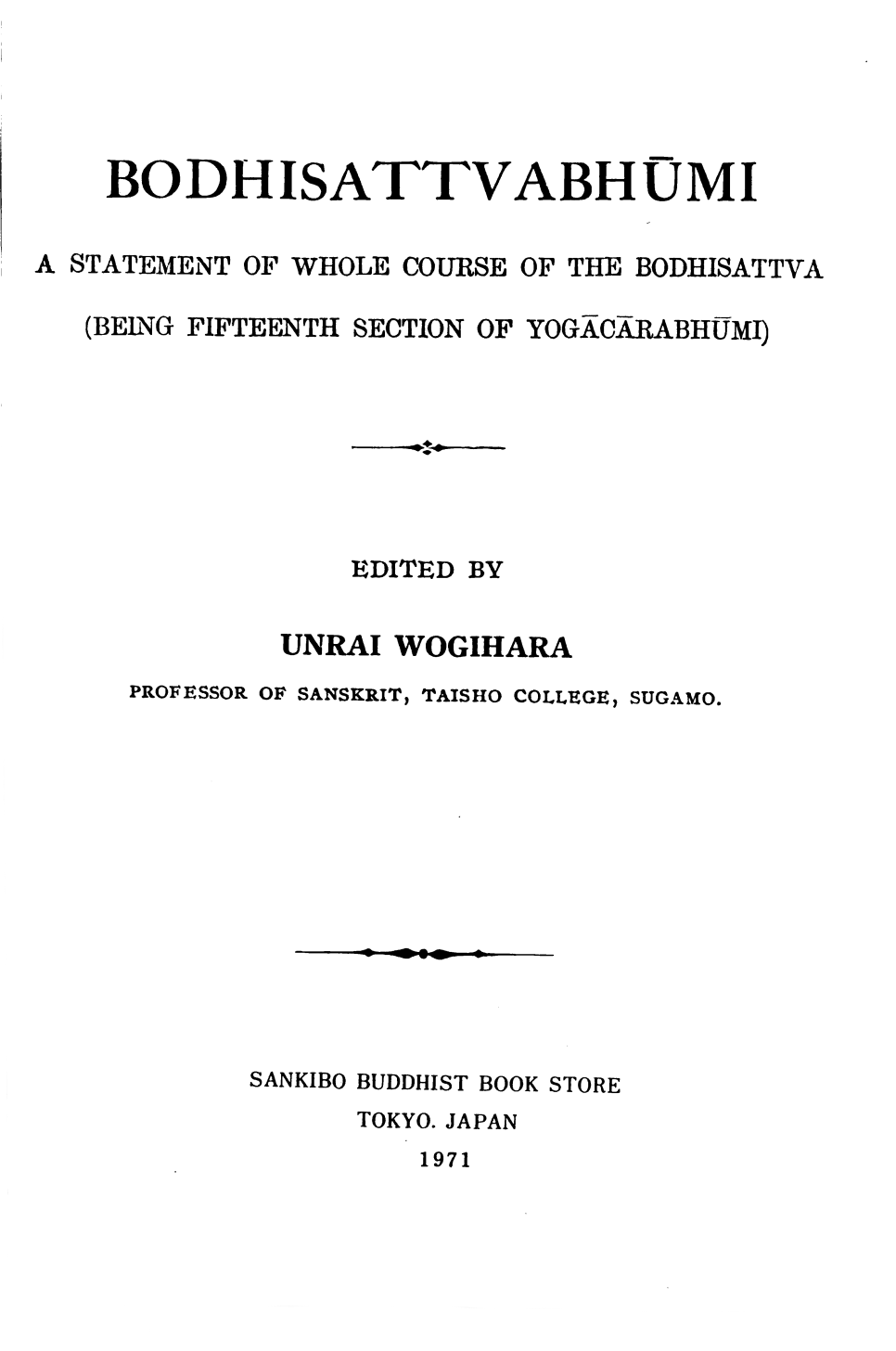
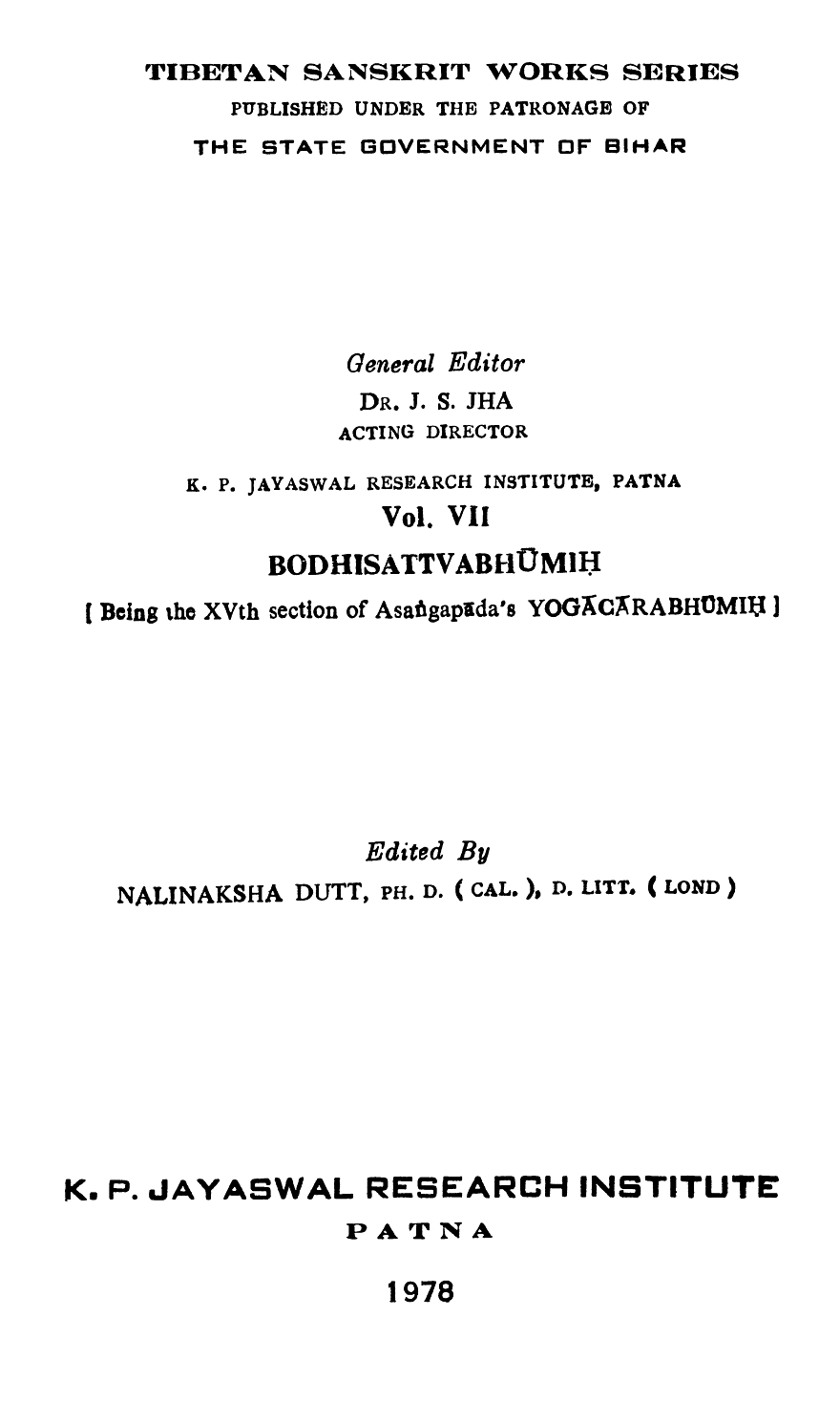
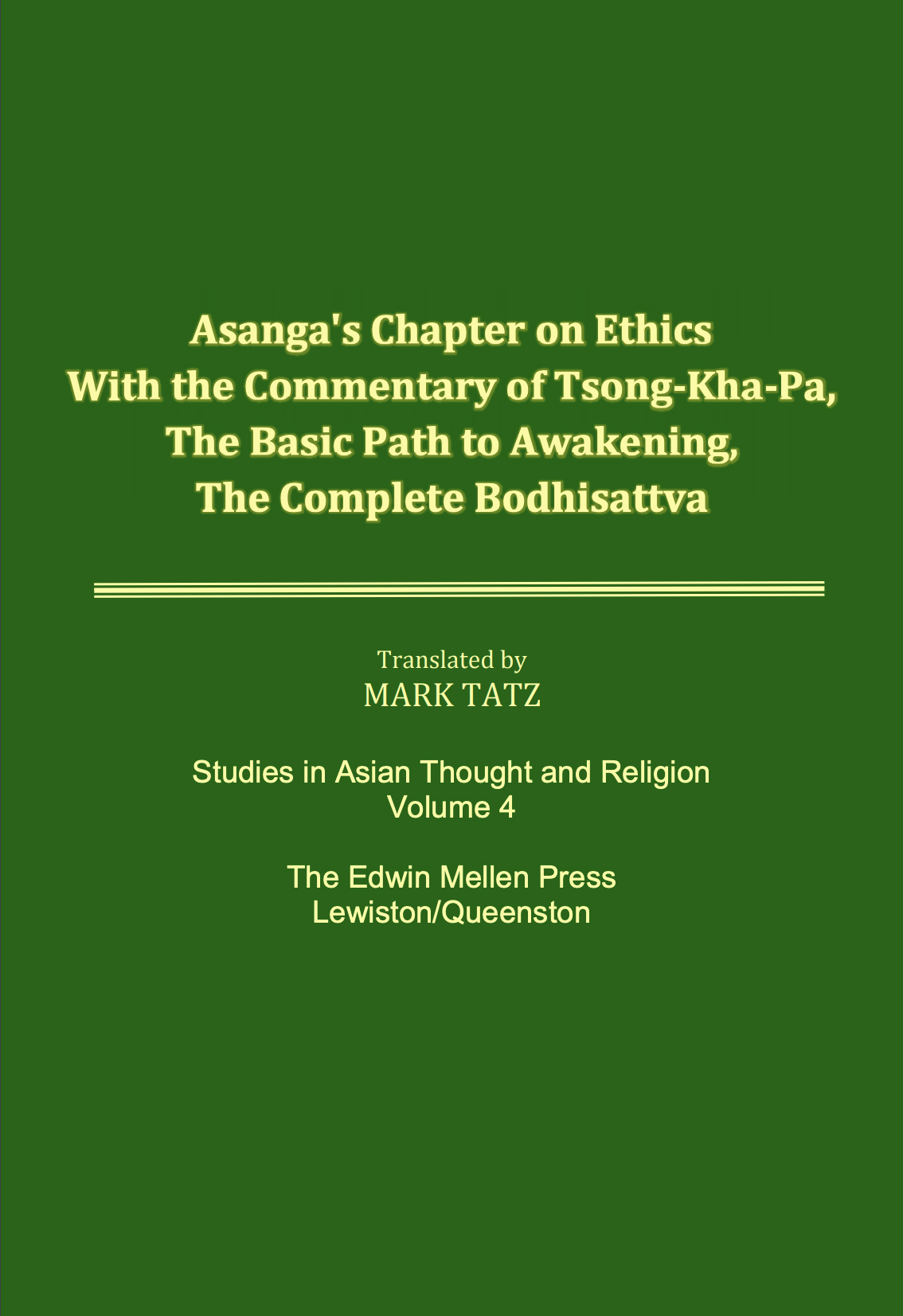
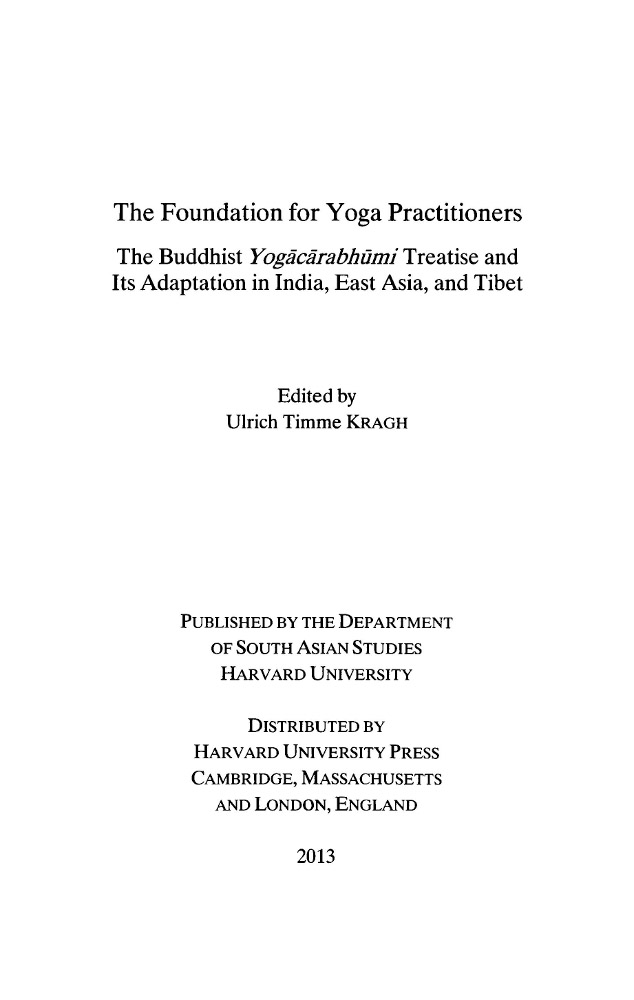
Yogācārabhūmau Bodhisattvabhūmiḥ
| 🤓 Admin Zone 🛠️ hidden to non-admins | |


Description
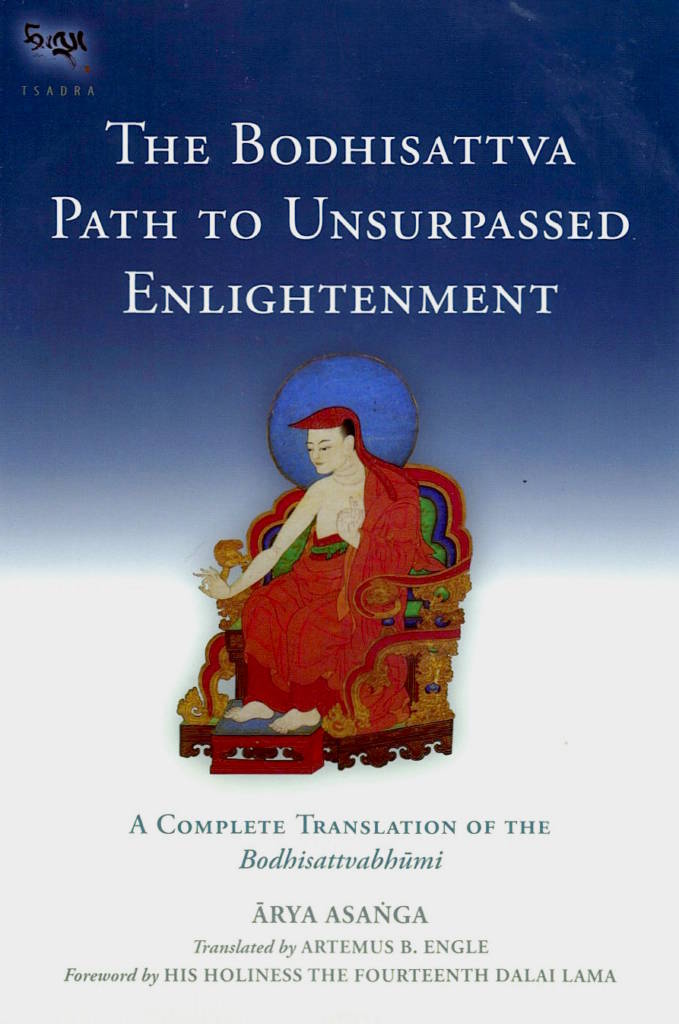
Traditionally attributed to Ārya Asaṅga (c. fourth–fifth century CE) through revelation from the future buddha Maitreya, the text likely represents a compilation of earlier materials (c. 230–300 CE) that predates the fully developed Yogācāra philosophical system. Its existence in multiple Chinese translations from the early fifth century onward confirms its early date and widespread influence across Asian Buddhism.


.jpg)


The Yogacara school has long been considered by scholars, East and West, as advocating a fully idealistic view of reality. But Janice D. Willis argues that Asanga himself had no such intention, and that in fact he rejected idealism as forcefully as he rejected the notion that ordinary beings know things as they really are. Instead, the chapter "On Knowing Reality" shows that Asanga expounded voidness (sunyata), rather than mind (citta), as the only absolute mode of being. He attempted to redefine sunyata in a more positive way than had Nagarjuna and other philosophers of so-called "critical" school, setting up a philosophical scheme to meditate between inexpressible reality and the distortions of ideation and language.
In addition to her translation and extensive commentary, Willis has written an introduction which describes the history of the text and of its author, discusses the place of the Yogacara school in Buddhist philosophical history, and interprets key terms in Asanga's system. The result is a work of fundamental importance to the study of the Mahayana Buddhist tradition. (Source: Namse Bangdzo Bookstore)

The Yogacara school has long been considered by scholars, East and West, as advocating a fully idealistic view of reality. But Janice D. Willis argues that Asanga himself had no such intention, and that in fact he rejected idealism as forcefully as he rejected the notion that ordinary beings know things as they really are. Instead, the chapter "On Knowing Reality" shows that Asanga expounded voidness (sunyata), rather than mind (citta), as the only absolute mode of being. He attempted to redefine sunyata in a more positive way than had Nagarjuna and other philosophers of so-called "critical" school, setting up a philosophical scheme to meditate between inexpressible reality and the distortions of ideation and language.
In addition to her translation and extensive commentary, Willis has written an introduction which describes the history of the text and of its author, discusses the place of the Yogacara school in Buddhist philosophical history, and interprets key terms in Asanga's system. The result is a work of fundamental importance to the study of the Mahayana Buddhist tradition. (Source: Namse Bangdzo Bookstore)


The Bodhisattvabhūmi contains a systematic description of the bodhisattva path of practice (bodhisattva-śikṣāmārga) that emphasises broad knowledge and general education in the pursuit of enlightenment and liberation. The subjects of that education are the "five sciences" (pañcavidyāsthānāni) which range from Buddhist textual scholarship to the study of non-Buddhist religious literature and secular subjects, including works on grammar, logic, medicine and crafts.
The historical accounts of the seventh century Chinese pilgrim travellers Hsüan-Tsang and I-Tsing confirm that these five sciences were the basis for the curriculum at Nālandā Mahāvihāra, India's most renowned monastic university. Corroborating information indicates that the Bodhisattvabhūmi was studied at Nālandā Mahāvihāra and that its views and values were influential in Nālandā's approach to education.
The inclusion of non-traditional subjects as valid areas of "liberating knowledge" for Buddhists required an innovative philosophy of education. This was achieved in the Bodhisattvabhūmi by reformulating certain key Buddhist concepts, most notably dharma ("teachings"), prajñā ("wisdom-insight") and bodhi ("enlightenment"). The result was a comprehensive vision of religious education that encouraged a quest for general learning and broadened the range of knowledge deemed necessary for attainment of complete enlightenment (anuttarasamyaksambodhi).
To illustrate the importance of education and embody principles of its acquisition
and proper application, the Bodhisattvabhūmi also developed portrayals of role types. These include the bodhisattva depicted as a novice beginner, teacher, and mentor; and the Tathāgata Buddha portrayed as the personification of "all-knowledge" and defender of the faith. The Chinese travellers' accounts confirm that the students and masters of Nālandā Mahāvihāra were involved, in their daily lives, in activities that corresponded to these roles.
What made this new school, with part of its roots strongly anchored in an orthodox Śrāvakayāna tradition, develop a totally new outlook? Obviously, the answer is not simple, and the origins of this novel perspective are complex. From the standpoint of the textual history, however, one could reasonably argue that what lies between the traditional views of the Śrāvakabhūmi and the revolutionary ideas presented in the Saṃdhinirmocanasūtra are the Bodhisattvabhūmi and the earlier parts of the Viniścayasaṃgrahaṇī The former is a treatise (or rather anthology) dedicated to the philosophy and practice of the ideal Mahāyāna virtuoso (bodhisattva) treading along the messianic path of liberating all sentient beings and of perfecting himself for the attainment of the Awakening. Like the Śrāvakabhūmi, this text also became part of the Yogācārabhūmi. The Viniścaya-saṃgrahaṇī is the auto-commentarial portion of the Yogācārabhūmi which glosses and elaborates upon terms and subjects in the preceding (and most likely, earlier) parts of the text.
It is tempting to refer to the Bodhisattvabhūmi as a 'missing link'. 'Link' it is but 'missing' would be an overstatement. Modern scholars, mainly in Japan, have examined many of its philosophical and philological facets. Nevertheless, to the best of my knowledge, a systematic examination of the meditative practices in the Bodhisattvabhūmi has not been undertaken so far. The present paper attempts to fill in this gap, albeit in a very limited fashion and scope. (Source: "Meditative Practices in the Bodhisattvabhūmi," 884–85)


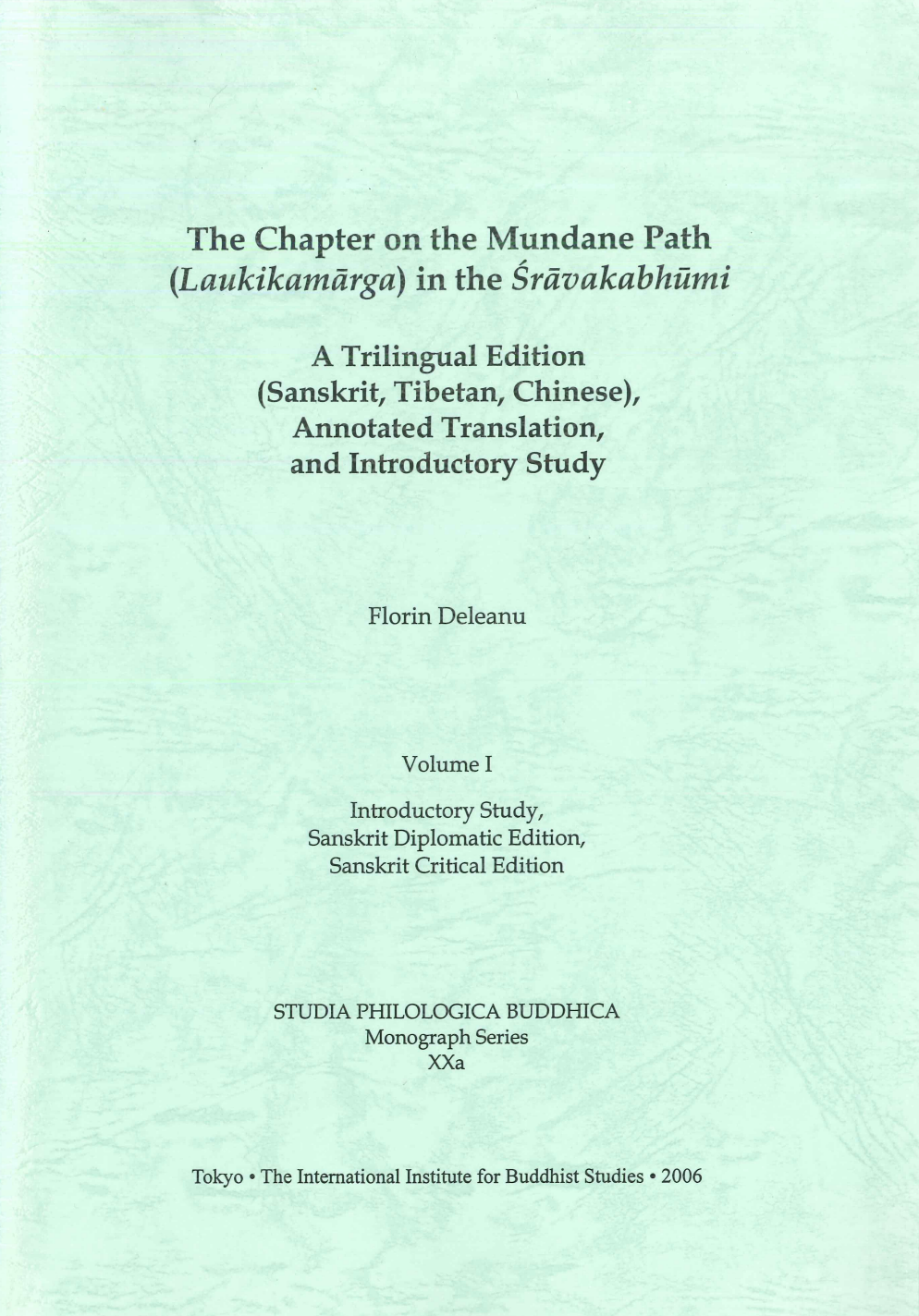
online in the Oxford Bibliographies in Buddhism (https://www.oxfordbibliographies.com/view/document/obo-9780195393521/obo-9780195393521-0254.xml) as the entry dedicated to the ‘Bodhisattvabhūmi’ bibliographical survey. This version represents the preprint initially submitted to the editors, and later abridged due to exceeding the allowed length. Posting this complete version on such platforms as the Academia and ResearchGate makes, I believe, more sense since the deleted materials (see mainly end of the paper)
can hopefully provide ampler information to the interested readers.


Secondly, based on the aforementioned conclusion, in order to develop a measuring scale and study the brain imaging measurements of fMRI/DIT, we surveyed some relevant papers, and we found that there are five questions or topics which need to be discussed between Buddhists and researchers in psychological studies and neurosciences in the future.