| 🤓 Admin Zone 🛠️ hidden to non-admins | |
Asaṅga-Maitreya(nātha)
Chapter in a Book
Please note that many items in our library are simply pages that represent a detailed library catalog entry and citation of someone else's work, presentation, or performance. Read our General Disclaimer for more information.
Description
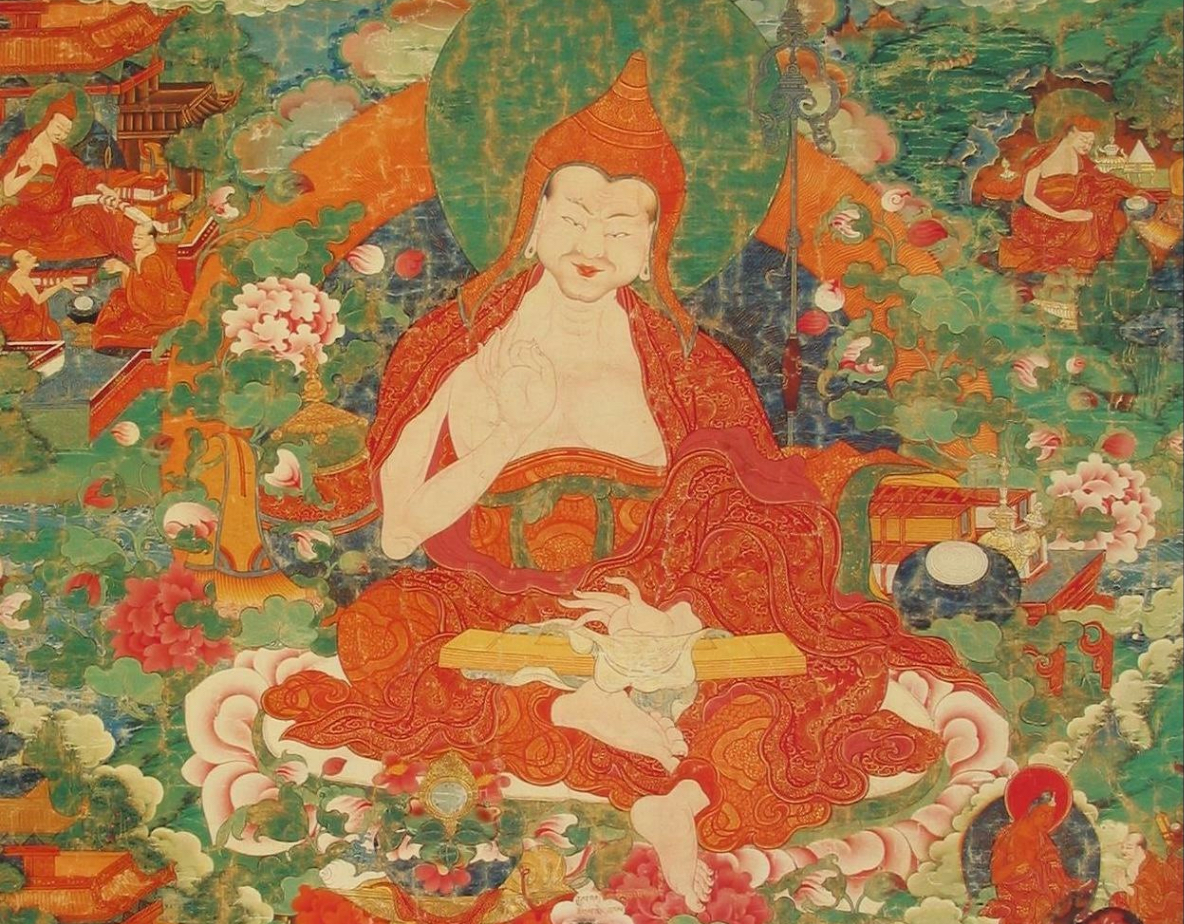
Asaṅga (Chn. Wuzhuo [無著], Tib. Thogs med) was an Indian scholar-monk and author of influential treatises. Early sources have it that he hailed from Gandhara, and most modern scholars place him in the 4th or 5th century CE. Both tradition and modem scholarship regard him as a key figure in the establishment of the Yogācāra or Vijñanavāda school of Mahāyāna Buddhism. Like Asaṅga, his teacher Maitreya or Maitreyanātha (Chn. Cizun [慈尊], Tib. Byams pa, Byams pa mgon po) — who should not be confused with the 11th-century tantric master Maitreyanātha, also known as Advayavajra — is credited with the authorship of several important treatises, of which the majority are Yogācāra works, but the identity and even the very existence of Maitreya are subject to much scholarly debate. Traditional Buddhist sources agree in identifying Maitreya with the high-ranking heavenly bodhisattva and future buddha of this name (Chn. Mile [彌勒], Tib. Byams pa). Since fairly early times, the Buddhist tradition was also more or less unanimous in ascribing the production and promulgation of all the early treatises associated with the Yogācāra school to the activities and cooperation of these two figures, although historical sources often disagree regarding the authorship of the individual works. Moreover, in the traditional legends and attributions of authorship, the third great Yogācāra master, Vasubandhu, repeatedly comes into play as well. Leaving aside the already mentioned debates over Maitreya's identity, historical-minded modern scholarship tends to deviate from the traditional perspective with regard to the bulky and fundamental Yogācārabhūmi(śāstra) (Treatise on the Levels of Those who Engage in Spiritual Practice). (Source: Delhey, "Asaṅga/Maitreya(nātha)," 73).
Citation
Delhey, Martin. "Asaṅga/Maitreya(nātha)." In Brill's Encyclopedia of Buddhism, Vol. 2: Lives, edited by Jonathan A. Silk et al., 73–80. Leiden: Brill, 2019.
Interconnections
1 Scholarship on

The Bodhisattvabhūmi (literally "The Stage of a Bodhisattva") stands as one of the most comprehensive and systematic expositions of the Mahāyāna Buddhist path from classical India. Formally the fifteenth section of the massive Yogācārabhūmi corpus, this foundational treatise provides an encyclopedic manual detailing the entire spiritual trajectory of a bodhisattva—from the initial arising of the "mind of awakening" (bodhicitta) to the ultimate attainment of perfect buddhahood.
Traditionally attributed to Ārya Asaṅga (c. fourth–fifth century CE) through revelation from the future buddha Maitreya, the text likely represents a compilation of earlier materials (c. 230–300 CE) that predates the fully developed Yogācāra philosophical system. Its existence in multiple Chinese translations from the early fifth century onward confirms its early date and widespread influence across Asian Buddhism.