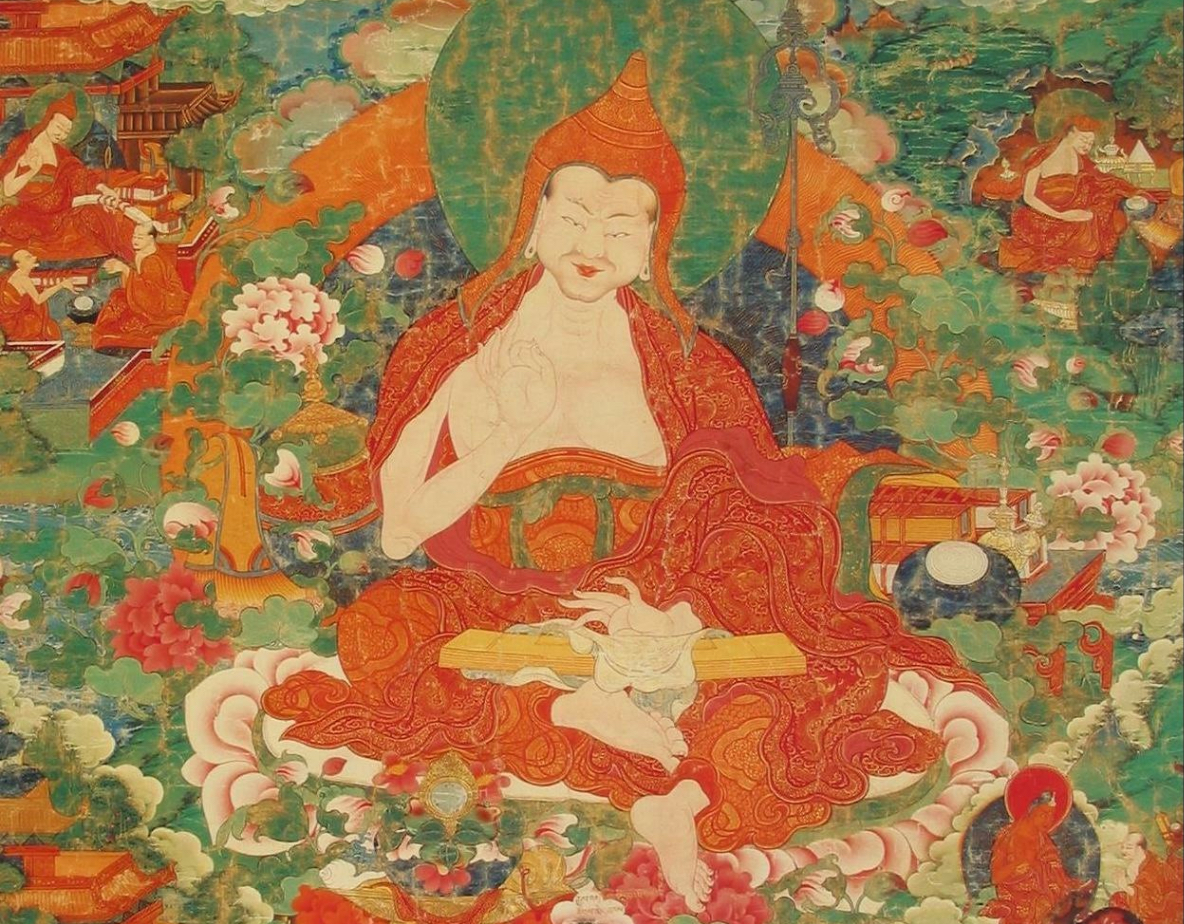
Observations on Asanga's Bodhisattvabhumi
| 🤓 Admin Zone 🛠️ hidden to non-admins | |
Description
Observations on Asanga’s Bodhisattvabhūmi by Art Engle
The following notes contain remarks that informed my presentation at the Tsadra Foundation Conference in Atlanta, GA, March 18–23, 2011.
Background
One way to look at the principal writings of Asaṅga, by which I mean in particular the Sa sde lnga and the two derivative works Mahāyānasaṃgraha and the Abhidharmasamuccaya, is that they represent the seminal literature of a major new movement in Buddhism within the Mahāyāna tradition. Just as Nāgārjuna’s Rigs tshogs drug are viewed as the central works of the Buddhist Mahāyāna philosophical innovation known as the Middle Way School, Asaṅga’s major works mark the effort to establish and systematize a new way of understanding Buddhist Abhidharma, from a Mahāyāna perspective. For example, up this period the dominant philosophical tradition in Northern India seems to have been that of the Sarvāstivāda tradition, one that had been established and undergone further codification for centuries. The scant biographical material that is available on Vasubandhu from Chinese sources indicates that he studied the literature of this tradition even though he did not ultimately espouse its views, as evidenced by the Abhidharmakośa, both the root texts and autocommentary, and the criticism of it by a number of Sarvāstivādin scholars. Although the Sautrāntika position seems to have been somewhat well established by this time, clearly Asaṅga was not in agreement with its realist underpinnings, and there was no comparable body of writings that put forth a comprehensive exposition of Mahāyāna doctrine.
Sems tsam Literature
Of the sixteen volumes of the Sems tsam section of the Tengyur, the first thirteen are made up of four of the five Byams chos lnga, the five parts of the Sa sde lnga, the Mahāyānasaṃgraha and the Abhidharmasamuccaya, along with the related commentaries. Of these, the Mahāyānasūtrālaṃkāra, the Madhyāntavibhāga, the majority of their Indian commentaries, all of the Sa sde lnga—which is to say the seventeen sections of the Yogācārabhūmi and its four companion works (the four "compendia” (Saṃgrahaṇī, T: bsdu ba)—the Mahāyānasaṃgraha, the Abhidharmasamuccaya, as well as their principal Indian commentaries, were all translated during the early period of translation. The respective colophons of all these works list either Ye shes sde or dPal brtsegs as the primary Tibetan translators. (Two exceptions are Vasubandhu’s commentary to the Mahāyānasaṃgraha, which was translated by Tshul khrims rgyal ba in conjunction with Atiśa Dīpaṃkara Śrījñāna, which would date it to the eleventh century, and Sthiramati’s commentary to the Mahāyānasūtrālaṃkāra. The Tibetan translator of the latter is identified as lCe bkra shis, and Gangs can mkhas grub rim byon ming mdzod (author: Go shul grags pa ’byung gnas), p. 535, dates him at the end of eleventh century).
Of these, the first four volumes of the Sems tsam section deal with the four works of the Byams chos lnga and their commentaries. Of these, the latter two volumes are Sthiramati’s commentary on the Mahāyānasūtrālaṃkāra.
Three relatively minor works at the end of the sems tsam section are Candragomī’s Bodhisattvasaṃvaraviṃśikā (T: Byang chub sems dpa’i sdom pa nyi shu pa) and its two commentaries, one by Śāntarakṣita and a second by Bodhibhadra (one of Atiśa’s Indian teachers).
In his History of Buddhism, Butön Rinchen Drup refers to the collection of Asaṅga’s major writings on Buddhist doctrine as the Five Sections on Levels (T: Sa sde lnga). He explains this term as follows: The first of the five texts, Levels of Spiritual Practice (S: Yogācārabhūmiḥ, T: Rnal ’byor spyod pa’i sa), is the principal work of the collection. Organized in seventeen levels, it is referred to in the Tibetan tradition as the Main Text on the Levels (T: Sa’i dngos gzhi). In the Tengyur collection, this work appears in three parts. The first of the three, which carries the title of the complete work—that is, Stages of Spiritual Practice (S: Yogācārabhūmiḥ, T: Rnal ’byor spyod pa’i sa)—actually contains only fifteen of the just-mentioned seventeen levels. This portion of the work is also referred to in the Tibetan tradition as Multiple Levels (T: Sa mang po pa). The remaining two levels—the thirteenth and the fifteenth—are Listeners’ Stage (T: nyan thos kyi sa) and Bodhisattvas’ Level (T: byang chub sems dpa’i sa), respectively. Extracted from the main work, they are presented as separate titles. At the place where these two sections occur in Asaṅga’s original composition, the Tibetan translation states that they are to be found in separate volumes. Each of the three parts constitutes a complete volume of the Derge Tengyur. The volume that contains Multiple Levels is made up of 283 folios; those that contain Listeners’ Level and Bodhisattvas’ Level come to 195 and 213 folios, respectively.
The Yogācārabhūmi takes up three volumes. The four companion works make up two volumes, plus the first 68 folios of a third volume. The Yogācārabhūmi is Asaṅga’s original composition that represents a new Mahāyāna Abhidharma formulation. That is, the original Abhidharma is grounded in a realist philosophy. Nāgārjuna criticizes the realist foundation of that tradition. The Sautrāntika school criticizes the Sarvāstivāda/Vaibhāṣika doctrine without formulating a comprehensive alternative system. The Yogācārabhūmi gives a systematic description of the foundation, path, and results of the three vehicles. The Abhidharmasamuccaya is a condensed presentation of that system.
Moreover, because of its focus on the Mahāyāna tradition, the Bodhisattvabhūmiḥ is certainly one of his most important works for all the Tibetan Buddhist traditions. It takes up one complete volume in the Tengyur and is made up of 213 folios. In the past, I was most familiar with those sections and passages that were either quoted or alluded to in Lamrim literature. In addition, I was familiar with the chapter on Mahāyana morality, as Je Tsongkapa wrote an extensive commentary, which is considered important in this tradition. The entire work is also available in the original Sanskrit in two published editions, which is a tremendous asset for anyone that would attempt to translate it. In addition, there is an excellent and very useful Indian commentary by rGya mtsho sprin (Samudramegha or Sagaramegha) that has been very helpful in clarifying the reading of passages in the original work. This work is entitled Bodhisattva-bhūmivyākhā (T: Byang chub sems dpa’i sa’i rnam par bshad pa) by Samudramegha/ Sāgaramegha. Tāranātha lists rGya mtsho sprin among a number of important Buddhist scholars that lived around the time of King Dharmapāla of Bengal, whose reign lasted from 770–810 A.D. He was roughly contemporaneous with Haribhadra and Buddhajñāna. About rGya mtsho sprin, Tāranātha says very little: "rGya mtsho sprin experienced a vision of Maitreya and was directed to compose a commentary on the entire Sa sde lnga. For that reason, it is believed that he composed a commentary on the entire corpus. However, it is his commentary on the Bodhisattvabhūmi that is widely known” (T: slob dpon rgya mtsho sprin ni rgyal ba mi pham pa’i zhal gzigs nas / rnal ’byor spyod pa’i sa sde lnga la ’grel pa rtsom par lung bstan thob pas yongs rdzogs la ’grel pa mdzad par yang grags shing / byang sa’i ’grel pa ni grags che’o). I am fairly certain that this is the only work by this author in the entire Tengyur collection.
There is a 70 folio commentary on a portion Yogācārabhūmi entitled Yogācārabhūmivyākhā (T: Rnal ’byor spyod pa’i sa’i rnam par bshad pa) No author or translators are identified in the colophon. However, the Derge catalog attributes the work somewhat tentatively to a Jinamitra on the basis of a remark in a work called gna’ mchan, which appears to be early notes on the Yogācārabhūmi text that were perhaps created at the time of its translation into Tibetan. Jinamitra appears as one of the Indian Pandits who participated in the translation of signification portions of the Sa sde lnga and related commentaries. The Bodhisattvabhūmi has two general commentaries, and two more works that are commentaries on just the morality chapter. Of these commentaries, Guṇaprabhā wrote a commentary in 40 folios to the Bodhisattvabhūmi called Bodhisattvabhūmivṛtti (T: Byang chub sems dpa’i sa’i ’grel pa) and another work of only ten folios on just the morality chapter. Samudramegha (T: rGya mtsho sprin) wrote a large work (338 folios) to the entire Bodhisattvabhūmi and Jinaputra wrote a 30 folio commentary to the morality chapter. Samudramegha’s chapter on the morality chapter seems to be the very same Jinaputra work, meaning that the latter is considered definitive on the subject.
The remaining four works that complete the Five Sections (T: Sa sde lnga) are considered supplements to the just-described principal work. They are: (1) Compilation of Determinations (T: Rnam par gtan la dbab bsdu ba); (2) Compilation of Topics (T: Gzhi bsdu ba); (3) Compilation of Terms (T: Rnam grangs bsdu ba); and (4) Compilation of Explanations (T: Rnam par bshad pa bsdu ba). The first of these, Compilation of Determinations, takes up about one and a half volumes in the Tengyur, or some 416 folios. Explanatory in nature, it further elucidates the main work in seventeen levels and is an important work in its own right. Compilation of Topics, which takes up about half a volume in the Tengyur or a little over more than 200 folios, describes how the subject matter in the main treatise relates to the three divisions of the Buddhist canon—that is, the Sūtra, Vinaya, and Abhidharma. The final two works are much shorter; only slightly more than twenty folios each. Compilation of Terms explains the specific sense of a variety of terminology that occurs in the literature. The final text describes the manner in which all the various topics should be explained and taught. The entire five-part collection encompasses five complete volumes of the Tengyur and about sixty folios of a sixth volume. Of this material, the seventeen-part Levels of Spiritual Practice and Compilation of Determinations are the most substantive in their content and represent major sources for much of the Tibetan commentarial literature on Mahāyāna theory and practice.
The only other works in the Sems tsam section of the Tengyur that were authored by Asaṅga are his Compendium of Abhidharma (S: Mngon pa kun las btus pa) and his Compendium of the Mahāyāna (T: Theg pa chen po bsdus pa). While the Tibetan tradition attributes the so-called autocommentary to the Uttaratantra to Asaṅga, I am not counting it as one of his works here because his authorship is not universally accepted. The other two works, which were unquestionably composed by Asaṅga, are abbreviated summaries of the material that is contained in the Five Sections. Both were translated into French some time ago and have more recently become available in English. However, the English translations were based principally upon the French versions, which is an approach that I personally consider rather dubious. Of the Five Sections on Levels described above, I am only aware of two chapters from Bodhisattvas’ Level that have been translated into English—one is the chapter on ultimate reality (S: tattvārtham, T; de kho na nyid kyi don) and the other is the chapter on Mahāyāna ethics (S: śīlam, T: tshul khrims). The work that contains a translation of the ethics chapter, in particular, is rather expensive. A significant portion of Levels of Spiritual Practice survives in the original Sanskrit. The Tengyur also contains several Indian commentaries on this material by scholars other than Asaṅga. However, the remaining four of the Five Sections exist only in Tibetan translation and there are no Indian commentaries on them in the Tengyur.
Comparing the Mahāyānasūtrālaṃkāra and the Bodhisattvabhūmi
The instructions of the Lamrim tradition that were received by Je Tsongkapa are related to three Kadampa lineages: Treatise Followers (T: gZhung pa ba), Followers of the Stages of the Path (T: Lam rim pa), and Followers of Personal Instruction (T: gDams ngag pa). In the traditions of the Treatise Followers, six Indian works are accorded special importance: (1) Mahāyānasūtrālaṃkāra, (2) Bodhisattvabhumi (T: Byang sa), (3) Bodhicaryāvatāra (T: Spyod ‘jug), (4) Śīkṣāsamuccaya (T: Bslab btus), (5) Udānavarga (T: Ched du brjod pa’i tshoms), and (6) Jātakamālā (T: Skyes pa’i rabs kyi rgyud). They are popular referred to as Sa rgyan gnyis, bslab spyod gnyis, skyes tshoms gnyis.
Regarding the first two of these six works, Je Tsongkapa writes in his Brief Account of My Spiritual Life (T: Rang gi rtogs pa brjod pa mdo tsam du bshad pa, also known as Mdun legs ma):
དེ་ནས་བྱང་ས་མདོ་སྡེའི་རྒྱན་གཉིས་པོ། ། ལེགས་པར་སྦྱར་ཏེ་ཚུལ་བཞིན་རབ་འབད་པས། ། མི་ཕམ་ཆོས་རྗེའི་གཞུང་དང་རྗེས་འབྲང་གི ། གཞུང་ཀུན་ཉམས་སུ་ལེན་པའི་གདམས་པར་ཤར། །
Following that, by carefully comparing the Bodhisattvabhūmi and the Sūtrālaṃkāra And striving [to contemplate their meanings] properly, All of the Dharma Lord Ajita’s texts and those of his followers Were recognized as bodies of instruction on spiritual practice.
Purchok Ngawang Jampa’s (1682-1762) commentary on this verse notes:
"Even when you don’t compare the wording of the Bodhisattvabhūmi with that of the Mahāyānasūtrālaṃkāra, the former text explains fully and in an excellent manner all the meanings [regarding how after the person who possesses the Mahāyāna spiritual lineage generates the two types of bodhicitta, he or she progressively attains the ten stages of the Mahāyāna path and ultimately achieves the one hundred and forty qualities [of a Buddha]. But when you carefully establish the manner in which the Sūtrālaṃkāra serves as the root text and the Bodhisattvabhūmi represents a commentary on it, and then strive to reflect properly on all the various meditation topics as they are presented in the Lamrim Chenmo, then all the related works will be recognized not as works that merely delineate an abstract literary understanding (phyi’i go rgya gcod pa tsam min par, go rgya = thos rgya, wide literary learning or verbal understanding, by which is meant abstract, general, impersonal theory, understanding that has no direct bearing on or method of application to one’s personal spiritual development), but rather as personal instruction that reveals how to pursue one’s own spiritual practice.
Asaṅga’s Bodhisattvabhūmi should not be seen a commentary on the Mahāyānasūtrālaṃkāra in the way that Vasubandhu’s and Sthiramati’s works are. It doesn’t quote or address the language of any of the text’s specific verses, as, for example, the Mahāyānasaṃgraha does. Nevertheless, if you compare the two works carefully, you can find the germ for a great many of Asaṅga’s discussions in specific verses. However, the character of his discussions also has an independent quality. Thus, one could describe the two as companion works. That is to say, a simultaneous side-by-side reading of them enhances one’s understanding of both.
The tone of the respective works is also different. MSA has an almost otherworldly quality and its focus is to delineate the essential qualities of the Mahāyāna as a distinct spiritual tradition. By contrast, the Bodhisattvabhūmi is more practical, and presents a systematic framework for a practitioner to develop in pursuit of the path and goals of the tradition. In addition, Asaṅga’s work goes a long way toward giving some substance to the concepts and ideals that are set forth in Mahāyānasūtrālaṃkāra. The Lamrim tradition describes the entire body of practice as a one that enables a practitioner at whatever level of development he or she may be to pursue the ultimate goal of Buddhahood (T: gang zag gcig ’tshang rgya ba’i nyams len). This description could also apply to the Bodhisattvabhūmi.
The subject matter of the first two chapters of MSA are not addressed in BBh. With regard to the chapter on gotra, the BBh discussion can be seen to parallel a number of the verses of MSA. BBh limits its discussion to a description of the Mahāyāna gotra and does not present any reasons or arguments for its explanations. It does not seem to feel the necessity to prove anything. It is merely expository. One can think of it as having a coherent and interconnected structure to the presentation of all the topics. With regard to the chapters on generating bodhicitta, the first verse of MSA addresses four types of bodhicitta that range from its inception through enlightenment. BBh focuses more on the initial form in which it is generated and the factors that are conducive to generating it. In this sense it is largely a discussion that relates to verse 7. What is interesting is that the formulation is not identical with the five factors or strengths mentioned in that verse, but the substance of Asaṅga’s presentation can be seen as having direct parallels with the points made in that verse. It is absolutely clear that MSA was the inspiration for the structure and content of Asaṅga’s BBh; nevertheless, it is written in the author’s own voice. It seems clear that he used MSA as a model for the order in which to present the subject matter. As a consequence, the presentation of the BBh is written in a manner that can be read independently of MSA. BBh is also presented in the larger context of the YB, which is a work in the tradition of the Abhidharma literature. The Śrāvakabhūmi and the Bodhisattvabhūmi are extensive works that describe the respective paths and methods of practice that pertain to the two vehicles.
The Bodhisattvabhūmiḥ is a Mātṛkā (T: ma mo) for the Entire Collection of Bodhisattva Scriptures
Asaṅga states in the closing paragraph of the Bodhisattvabhūmi:
This is the presentation of the Bodhisattvas’ entire path of training as well as the result of that training. It constitutes a vessel (adhiṣṭhānabhūtam, "basis,” "base,” "seat”) for describing every aspect of the bodhisattva path of training and the results of that path of training. Indeed, this Bodhisattva Stage is also called "A Manual for the Bodhisattva Collection.” It is called "a Summary of the Mahāyāna.” It is called "An Explanation of the Path that Leads to Destruction and [the Path that] Avoids Destruction.” It is also called "the Basis (mūlam) for Developing the Purity of Unobstructed Knowledge.”
The Sanskrit term that I translate here as "manual” (S: mātṛkā, T: ma mo), has a range of meanings, such as "mother” (including the figurative sense of a source or origin); "divine mother” (i.e. certain female deities or powerful spirits); "nurse”; "grandmother”; and "alphabet.” Asaṅga’s use of this term to describe the Bodhisattvabhūmi is clearly related to the early Buddhist tabular compilations of Abhidharma terminology and their meanings that are also referred to as mātṛkā. A discussion of the origin and nature of these mātṛkā lists can be found in Vol. 7 of the Encyclopedia of Indian Philosophy (pp. 84–89), which covers Abhidharma Buddhism from its inception to 150 A.D. The authors of the third chapter of this work state (p. 84):
This penchant of the Buddha’s disciples to compile categorized lists of dharmas culminates in the tabulation of matrices (i.e. mātṛkā) which form the nucleus of the formal Abhidharma. Such listings were made (quite probably with the Buddha’s approval) by such eminent elders as Śāriputra, Maudgalyāyana, and Mahākātyāyana, who were all renowned for their skill in exposition, and seem to have been well known to the early Buddhists.
A more precise sense of what Asaṅga means when he describes the Bodhisattvabhūmi as a mātṛkā can be gained from two passages that appear in several of his other writings. The first is the opening discussion of the third chapter of the Abhidharmasamuccaya, which presents a twelve-fold classification of the Buddha’s teachings. Of these twelve categories, the tenth is referred to as the "extensive teachings” (S: vaipulyam, T: shin tu rgyas pa’i sde) and the twelfth is called "authoritative instructions” (S: upadeśaḥ, T: gtan la dbab par bstan pa’i sde). The extensive teachings are identified as those discourses that make up the Bodhisattva collection of scriptures. As for the authoritative instructions, they are described as the material that makes up the Abhidharma collections of both the Listener disciples and the Bodhisattvas. Asaṅga provides the link between these two categories and the Bodhisattvabhūmi in the following passage from his Compendium of Explanations (S: Vyākhyāsaṃgrahāṇī, T: Rnam par bshad pa bsdu ba):
Regarding this [topic], the extensive teachings fully present the bodhisattva path—which is to say, the seven stages and the four of four types of conduct —and fully present the qualities of a buddha—which is to say, [the collection of] one hundred and forty unique buddha qualities that includes [a series of attributes] ranging from the four forms of complete purity up to the transcendent knowledge that is supreme in every respect—[all of which are] described in the Bodhisattvabhūmi.
Here again Asaṅga asserts that the Bodhisattvabhūmi contains a description of all the topics that are found in the entire corpus of Mahāyāna canonical literature. A few lines later he addresses the category of authoritative instructions:
Regarding this [topic], the authoritative instructions contain the mātṛkā compilations that have been extracted from the sūtra scriptures. Regarding these, all [these extracts from] the sūtra scriptures that constitute the definitive meaning (S: nītārtham, T: nges pa’i don) [of the Buddha’s teaching] are called mātṛkā compilations. [Those sūtra teachings] in which the defining characteristics of entities are presented, as well those [instructions] in which the defining characteristics of entities are presented unerringly by those Listener disciples who are abiding in the realization that perceives the nature of things, are [what are contained in] the mātṛkā compilations and they are also [what are contained in] the Abhidharma [collection].
Just as the alphabet (S: mātṛkā, T: yi ge’i phyi mo) is the starting point for [learning] the treatises on language and [the treatises on] crafts, the explanations of the defining characteristics of entities should be understood [as the starting point for learning the Buddha’s overall teaching]. Just as the written word cannot become evident without an alphabet, likewise [the meanings of] the twelve categories of the sūtra teachings will not become evident if [the meanings of] the defining characteristics of entities have not been established and they will become evident when [the meanings of the defining characteristics of entities] have been established. The mātṛkā compilations are called the Abhidharma because they present the defining characteristics [of entities] unerringly. [Thus,] the explanations of [all] the remaining [categories of] sūtra teachings that are based upon the mātṛkā compilations are what make up the category [of Buddhist teachings] that is called "authoritative instructions.”
These two passages clearly demonstrate that Asaṅga considers the Bodhisattvabhūmi to be a concise compilation of all the authoritative instructions that pertain to the Mahāyāna tradition. As such, it should be regarded as an Abhidharma work on the Mahāyāna path and its result. Just as learning an alphabet is the first step in gaining the ability to read essential treatises on any topic, the Bodhisattvabhūmi serves as an introductory manual or guide to the vast and profound subject matter contained in the literature of Mahāyāna Buddhism. This is what he means when he refers to his work as a "mātṛkā for the Bodhisattva collection of scriptures.” I translate the term mātṛkā here as "manual” because, unlike the early Abhidharma mātṛkā compilations, the Bodhisattvabhūmi is a prose literary work that presents a comprehensive and orderly account of the entire Mahāyāna path and its result. Its style and scope are unparalleled among all the Indian treatises that were translated and incorporated into the Tibetan Buddhist tradition. It is also important to recognize that the order and structure of the Bodhisattvabhūmi is based upon of the Mahāyānasūtrālaṃkāra.
The Structure of the Bodhisattvabhūmi
Book One: The State of Mental Application that Relates to the Support
The Bodhisattvabhūmi is organized into three sections called "states of mental application” (S: yogasthānam, T: rnal ’byor gyi gnas). The first section, entitled the "State of Mental Application that Relates to the Support” is made up of eighteen chapters that encompass roughly three quarters of the entire text of the BBh. These eighteen chapters address all but the last chapter of the MSA. The term "support” (S: ādhāra, T: gzhi) refers to the foundation of the entire practice of the Mahāyāna path. Asaṅga explains this term in relation to three subjects: (1) the Bodhisattva’s own [Mahāyāna] spiritual lineage, (2) the initial development of enlightenment mind, and (3) all the spiritual qualities that are conducive to enlightenment. He explains this usage in the following terms:
Regarding this [point], through relying upon and remaining steadfast in the [Mahāyāna] spiritual lineage, the bodhisattva has the capacity and is able to become enlightened in the state of unsurpassed true and complete enlightenment. Therefore, the [Mahāyāna] spiritual lineage is called a support by virtue of its endowing [a person] with the capacity [to attain supreme enlightenment].
Regarding this [point], relying upon and remaining steadfast in the initial development of enlightenment mind, the bodhisattva is fit to undertake generosity, and he [or she] is fit as well to undertake morality, patience, effort, concentration, and wisdom. Put another way, he [or she] is fit to undertake the six perfections and all the entities that are conducive to enlightenment and that relate to the merit accumulation and the wisdom accumulation. Therefore, the initial development of enlightenment mind is called the support for a bodhisattva to undertake the conduct [of the Mahāyāna path].
Regarding this [point], through relying upon and remaining steadfast in that very undertaking of bodhisattva conduct, the bodhisattva will complete [the process that culminates in] unsurpassed true and complete enlightenment. Therefore, that undertaking of bodhisattva conduct is called the support for attaining the fulfillment of unsurpassed enlightenment.
The opening passage of the Bodhisattvabhūmi states that there are ten topics that encompass the bodhisattvas’ Mahāyāna path, together with its result. The ten are (1) support, (2) signs, (3) factions, (4) superior attitude, (5) states of abiding, (6) births, (7) embracing, (8) stages, (9) conduct, and (10) preeminence. The first of these refers to the entire first section of the work. The remaining nine refer to individual chapters in the latter two sections.
The structure of the first section is identified in a passage that appears at the beginning of the third chapter.
What is the bodhisattva practice [that is undertaken] by those bodhisattvas that have generated [enlightenment] mind in the manner that was just described? In sum, the combining together of everything that is included in: (1) that in relation to which [bodhisattvas] train themselves, (2) the manner in which they train themselves, and (3) that in which they train themselves is called "the bodhisattva practice.”
The first of these formulations, that in relation to which in relation to which bodhisattvas train themselves, consists of seven subjects: (1) one’s own aim, (2) the aim of others, (3) the meaning of reality, (4) supernatural power, (5) the ripening of beings, (6) the ripening of a Buddha’s qualities in oneself, and (7) true and complete enlightenment. These seven topics are addressed in chapters three through seven. These topics correspond closely to the topics identified in a summary verse that appears at the beginning of the chapter of MSA that is entitled "Devotion” (S: adhimuktiḥ, T: mos pa). The verse states:
(1) Introduction, (2) proof, (3) refuge, (4) lineage, and likewise, (5) developing the mind (6) One’s own and others’ aims, (7) reality, (8) Power, (9) ripening, and (10) enlightenment.
Vasubandhu’s terse remark about this verse identifies a direct link between the chapters of the MSA and Asaṅga’s BBh:
This chapter on enlightenment, the last [in a group of chapters] that begins with the group of introductory verses, should be understood as conforming to [the corresponding group of chapters from the Bodhisattvabhūmi that end with] the chapter on enlightenment.
Chapter Eight of BBh is entitled "The Lineages of the Powers” (S: balagotram, T: stobs kyi rigs). Asaṅga begins the chapter with this remark:
[The presentation of] the subjects in relation to which a bodhisattva should train himself [or herself] has been completed. Now I shall describe the manner in which [a bodhisattva] should train [himself or herself].
Then he presents the following summary verse:
Abundance of devotion, Seeking and teaching Dharma, Practice and likewise Correct instruction and counsel, And, lastly, deeds of body, speech and mind That are supported by means.
The topics mentioned in these lines are all addressed in this single chapter of BBh. They also correspond exactly to the following series of six chapters in MSA: (1) devotion (S: adhimukti, T: mos pa), (2) seeking the (S: dharmaparyeṣaṇam, T: chos yongs su tshol ba), (3) teaching the dharma (S: dharmadeśanā, T: bshad pa), (4) practice (S: pratipatti, T: sgrub pa), (5) instruction and counsel (S: avavādānuśāsanī, T: gdams ngag dang rjes su bstan pa), and (6) the actions that are supported by skillful means (S: upāyasahitakarma, T: thabs dang ldan pa’i las). In fact, the first verse in the last of these six chapters from MSA is identical with the first four lines of Asaṅga’s summary verse cited above summary.
The final verse in the preceding chapter of MSA is described in Vasubandhu’s commentary simply as nigamanaśloka or a summary verse. Although the Tibetan translation of Vasubandhu’s commentary doesn’t include this word, Sthiramati’s subcommentary does refer to it as a bsdu ba. Sthiramati also seems to make reference to the same threefold formulation that Asaṅga mentions in BBh:
Regarding the term "summary,” the lines [or this verse] present a summary statement of (1) that in relation to which one trains oneself, (2) the manner in which one trains oneself, and (3) that by which one trains oneself (i.e. the trainings themselves).
The remainder of the first section of BBh addresses the nature of the training itself and consists of six chapters on the six perfections (S: pāramitā, T: phar phyin); a chapter on the four principles for attracting a following (S: saṃgrahavastu, T: bsdu ba’i dngos po bzhi); a chapter on the topics of worship, service, and the four immeasurables; a chapter on the qualities that are conducive to enlightenment; and a chapter on the qualities of a bodhisattva. This material also corresponds to a series of chapters in MSA. Of the chapters on the six perfections, the first two are presented in a particularly detailed manner. All six chapters are arranged around nine respects. Ācārya Dhammapāla wrote an important Pali commentary on the "ten pāramitās.” His remarks on generosity include references to material that also appears in BBh.
Chapter Sixteen of the first section (worship of the Tathāgata, service to a spiritual teacher, and the four immeasurables) includes an extraordinary discussion of 110 ways in which to cultivate great compassion. Chapter Seventeen (The Qualities that are Favorable to Enlightenment) makes direct reference to a sūtra that is identified by Rgya mtsho sprin’s commentary as the Sūtra of the Tufted One (T: Gtsug phud can gyi mdo). This corresponds to the Sigalovada Sutta, which is the 31st Sutta described in the Pāli Collection known as the Long Discourses of the Buddha (Dīgha Nikāya). Buddhagosha referred to this sutta as "the Vinaya [Buddhist code of discipline] of the householder.” In modern times, the Western monk and translator Bhikkhu Bodhi has identified this sutta as the "most comprehensive Nīkaya text” which pertains "to the happiness directly visible in this present life.” Verse 33 of Nāgārjuna’s Letter to a Friend addresses the portion of this sūtra that identifies the six vices that lead to the squandering wealth: (1) intoxication, (2) roaming the streets at inappropriate times, (3) habitual partying, (4) compulsive gambling, (5) bad companionship, and (6) laziness.
====Book Two: The Qualities that Accord with the Support ====
The second section of BBh addresses elements that accord with, or naturally follow from, practicing the topics that were presented in the first section. They are (1) are signs that become evident through practice (i.e. liṅgāni, T: rtags; MSA, ch. 21, vv. 1–2) or (2) the two main categories of practitioner (pakṣa, T: phyogs; MSA, ch. 21, vv. 3–5), (3) various forms of a Mahāyāna practitioner’s superior intention (adhyāśāya, T: lhag pa’i bsam pa; MSA, ch. 21, v. 6), and (4) thirteen "states of abiding” (S: vihārāḥ, T: gnas pa; MSA, ch. 21, vv. 9–32). The last of these four is the second longest chapter in BBh. Ten of the thirteen states of abiding correspond exactly to the more familiar ten ārya bodhisattva stages (S: bhūmi, T: sa). This chapter is by and large an abbreviated summary of the Daśabhūmsūtra. Rgya mtsho sprin’s commentary establishes the correspondence between Asaṅga’s text and the related passages from the sūtra. Asaṅga includes an interesting discussion of the shortcomings that are met with in the state of abiding in conduct that is based upon conviction (adhimukticaryāvihāra) that is not found in the sūtra.
Book Three: The Perfection of the Support
The six chapters of the final section are: (1) births (MSA, ch. 21, vv. 8); (2) embracing (S: parigraha, MSA, ch. 21, v. 7); (3) seven stages (does not correspond exactly with the formulation of the ten bhūmis); (4) conduct (MSA, ch. 21, v. 42); (5) the thirty-two marks and eighty secondary signs of a buddha (MSA, ch. 21, v. 49); and (6) preeminence (MSA, ch. 21, vv. 43–61).
At the beginning of the fifth of these chapters, Asaṅga presents a list of one hundred and forty unique qualities of a buddha. They are: (1) the thirty-two marks of a great person, (2) the eighty secondary signs, (3) the four forms of purity that are complete in every respect, (4) the ten powers of a Tathāgata, (5) the four forms of intrepid confidence, (6) the three closely placed recollections, (7) the three objects that never need to be concealed, (8) great compassion, (9) the state of being free of bewilderment, (10) complete destruction of the [mental afflictions’] traces, and (11) the transcendent knowledge that is supreme in every respect.
Regarding the thirty-two marks, Asaṅga makes reference to a Sanskrit Lakṣanasūtra as the source of his discussion. There is no mention of the Mahāyāna doctrine of a Buddha’s three bodies. On the other hand, his discussion of the eighty secondary signs is unusual and does not appear to correspond to the versions that are found in such texts as the Dharmasaṃgraha and the Perfection of Wisdom Sūtras. Rather than describing these attributes in the manner that typically begins with "copper-colored nails,” etc., Asaṅga assigns a specific number of secondary signs to various parts of the body. For example, he begins by stating: "The twenty fingers and toes of the hands and feet, together with the joints and nails, make up twenty secondary signs.” The entire collection of eighty secondary signs is divided into two groups: the sixty that are situated in the lower part of the body and the remaining twenty that are found in the area above the neck. Asaṅga’s explanation of the term "secondary sign” seems to suggest that they are to be understood as a sort of substratum for the thirty-two marks:
Moreover, [the eighty secondary signs] support those very thirty-two marks of a great person by serving as their seat (S: āśrayaḥ, T: rten), and they cause [a Tathāgata] to appear beautiful by their agreeable form. Therefore, they are called "secondary signs.”
The final substantive topic in this chapter is a description of the merit that is required to produce the marks and secondary signs. Although Asaṅga does not refer to the sūtra by name, his presentation corresponds exactly to a discussion that is found in the Akṣayamatinirdeśasūtra.
The final chapter of the Bodhisattvabhūmi addresses formulations of a buddha’s attributes that are largely mental in nature. Among the various sets of qualities, the presentation that is devoted to the ten powers is quite extensive and takes up about two thirds of the chapter. It is the most detailed treatment of this topic that I have encountered in any of the Indian commentaries that play a central role in all the Tibetan Buddhist traditions. All of the discussions in this final chapter are tied to descriptions that appear in Buddhist canonical literature. In a number of instances, Asaṅga begins his remarks with the remark: "The scriptural description of . . . should be understood as it appears in the sūtras.”
In several conversations with Geshe Thupten Jinpa at the recent Tsadra conference in Atlanta, I learned of the existence of a short text by the eighteen century Tibetan scholar Thüken Losang Chökyi Nyima (1737–1802) that addresses how to carry out the combined study of the Mahāyānasūtrālaṃkāra and the Bodhisattvabhūmi. While I have not yet had a chance to read this text carefully, it may prove to be a useful resource in my effort to prepare an introduction to the English translation of Asaṅga’s work. My informal discussions with Geshe Thupten Jinpa also brought to light that an oral transmission lineage for the Bodhisattvabhūmi still exists in the Gelukpa tradition. I plan to investigate the history of this transmission and who the current lineage holders. I intend to provide further details of this lineage in my next quarterly report.
Notes
.jpg)
Traditionally attributed to Ārya Asaṅga (c. fourth–fifth century CE) through revelation from the future buddha Maitreya, the text likely represents a compilation of earlier materials (c. 230–300 CE) that predates the fully developed Yogācāra philosophical system. Its existence in multiple Chinese translations from the early fifth century onward confirms its early date and widespread influence across Asian Buddhism.