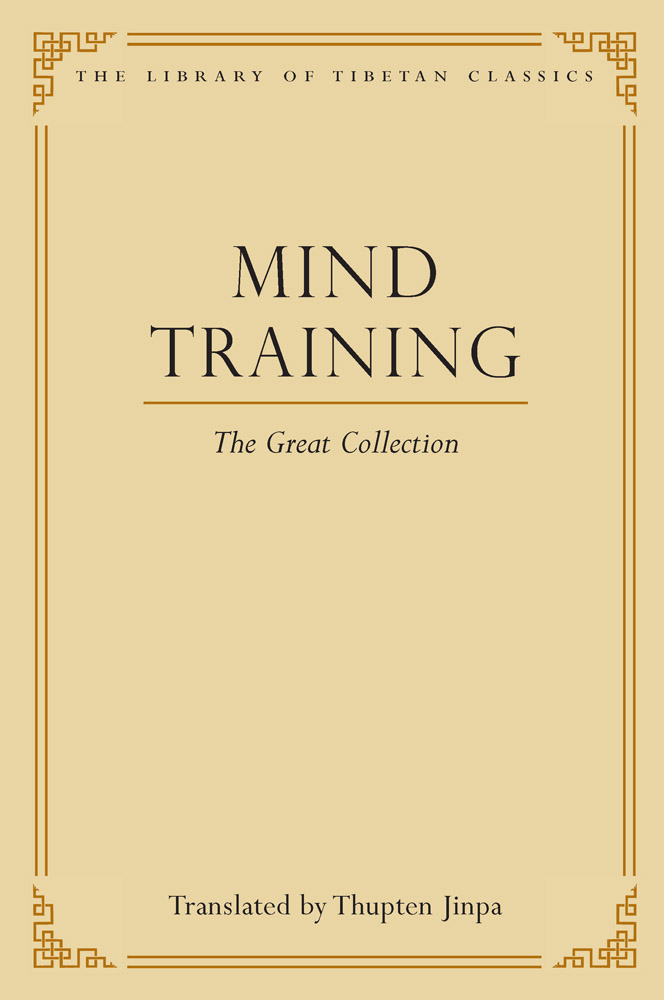
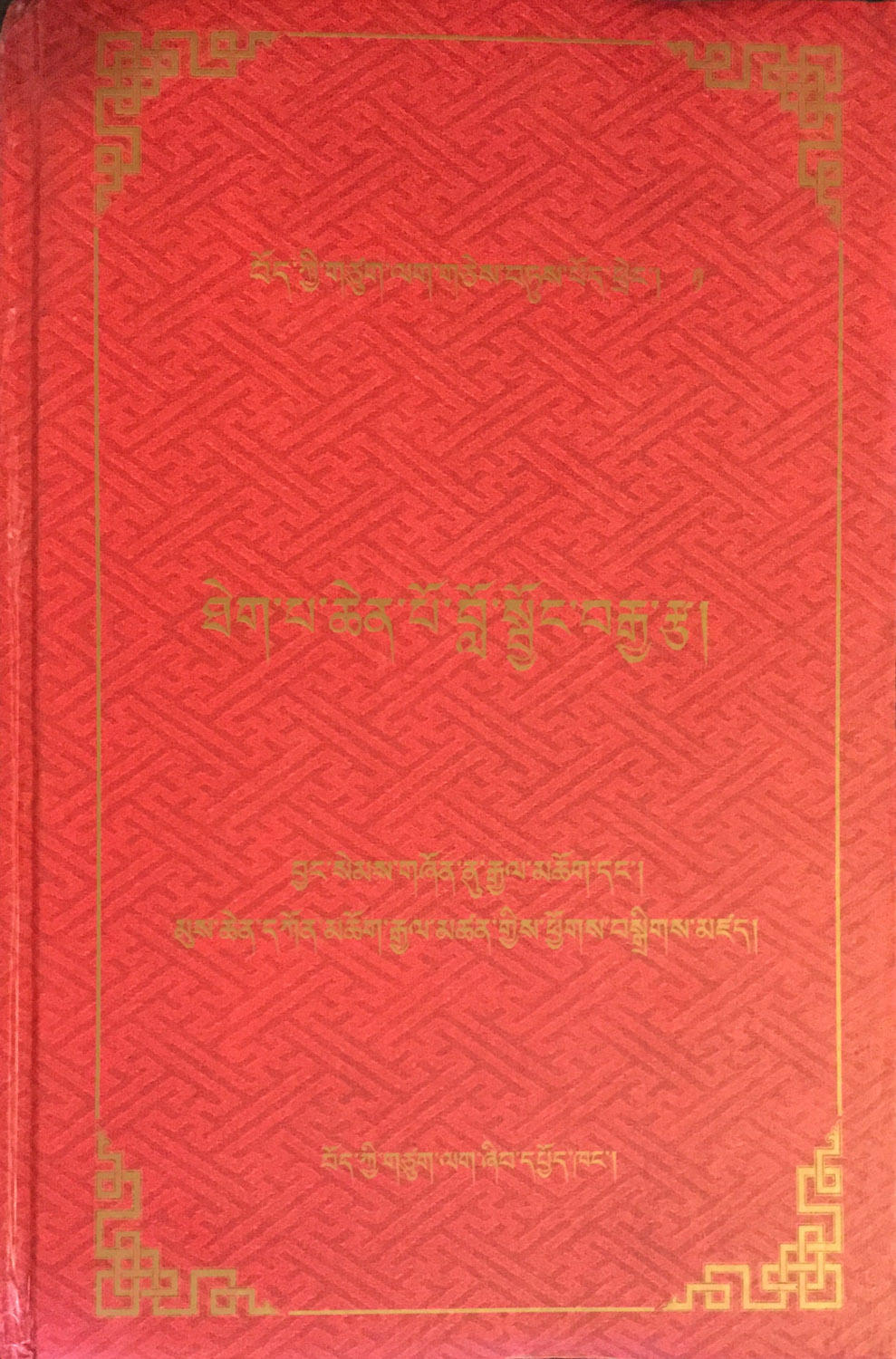
Mind Training: The Great Collection
| 🤓 Admin Zone 🛠️ hidden to non-admins | |

Description
The volume contains forty-four individual texts, including the most important works of the mind training cycle, such as Serlingpa's well-known Leveling Out All Preconceptions, Atisha's Bodhisattva's Jewel Garland, Langri Thangpa's Eight Verses on Training the Mind, and Chekawa's Seven-Point Mind Training together with the earliest commentaries on these seminal texts. An accurate and lyrical translation of these texts, many of which are in metered verse, marks an important contribution to the world's literary heritage, enriching its spiritual resources. (Source: Wisdom Publications)
- Prefacexiii
- Introduction1
- Technical Note17
- MIND TRAINING: THE GREAT COLLECTION
- 1. Bodhisattva's Jewel Garland
Atiśa Dīpaṃkara (982-1054)21 - 2. How Atisa Relinquished His Kingdom and Sought Liberation
Dromtönpa (1005-64)27 - 3. The Story of Atiśa's Voyage to Sumatra57
- 4. Root Lines of Mahayana Mind Training
Atiśa Dīpaṃkara (982-1054)71 - 5. Annotated Root Lines of Mahayana Mind Training75
- 6. Seven-Point Mind Training
Chekawa (1101-75)83 - 7. A Commentary on the "Seven-Point Mind Training"
Sé Chilbu (1121-89)87 - 8. The Wheel of Sharp Weapons133
- 9. The Peacock's Neutralizing of Poison155
- 10. Melodies of an Adamantine Song: A Chanting Meditation on Mind Training171
- 11. Stages of the Heroic Mind177
- 12. Leveling Out All Conceptions195
- 13. A Teaching on Taking Afflictions onto the Path197
- 14. Guru Yoga Mind Training199
- 15. An Instruction on Purifying Negative Karma203
- 16. Mahayana Purification of Grudges205
- 17. Two Yoginis' Admonition to Atiśa to Train His Mind207
- 18. Kusulu's Accumulation Mind Training209
- 19. Mind Training Taking Joys and Pains onto the Path213
- 20. Sumpa Lotsawa's Ear-Whispered Mind Training215
- 21. Bodhisattva Samantabhadra's Mind Training217
- 22. Eight Sessions Mind Training225
- 23. Mind Training Removing Obstacles239
- 24. Mahayana Mind Training Eliminating Future Adversities241
- 25. Atisa's Seven-Point Mind Training247
- 26. Mind Training in a Single Session
Chim Namkha Drak (1210-85)257 - 27. Advice to Namdak Tsuknor
Atiśa Dīpaṃkara (982-1054)263 - 28. Glorious Virvapa's Mind Training
Lo Lotsāwa (twelfth-thirteenth century)269 - 29. Eight Verses on Mind Training
Langri Thangpa (1054-1123)275 - 30. A Commentary on "Eight Verses on Mind Training"
Chekawa (1101-75)277 - 31. The Story of the Repulsive Mendicant291
- 32. A Commentary on "Leveling Out All Conceptions"293
- 33. Mahayana Mind Training299
- 34. Public Explication of Mind Training
Sangyé Gompa (1179-1250)313 - 35. Yangonpa's Instruction on Training the Mind
Yangönpa (1213-58)419 - 36. Guide to the Heart of Dependent Origination423
- 37. Supplement to the "Oral Tradition"
Könchok Gyaltsen (1388-1469)431 - 38. Root Lines of "Parting from the Four Clingings"517
- 39. Parting from the Four Clingings
Drakpa Gyaltsen (1147-1216)519 - 40. Unmistaken Instruction on "Parting from the Four Clingings"
Sakya Paṇḍita (1182-1251)525 - 41. An Instruction on "Parting from the Four Clingings"
Nupa Rikzin Drak (thirteenth century)527 - 42. A Key to the Profound Essential Points:
A Meditation Guide to "Parting from the Four Clingings"
Goram Sönam Sengé (1429-1489)529 - 43. A Concise Guide to "Parting from the Four Clingings"
Künga Lekpai Rinchen (fifteenth century)541
- 1. Bodhisattva's Jewel Garland
- Table of Tibetan Transliteration567
- Notes577
- Glossary655
- Bibliography665
- Index681
- About Thupten Jinpa695

According to the Wheel of Sharp Weapons, the way to make an end of this cycle is to understand how this process comes about and how it is rooted in the grasping at a self or "I". When we contemplate how our actions, rooted in the sense of self and other, cause suffering, then we use these very negative actions we have done in the past as a contemplative "weapon" to attack self grasping, the real "foe" in our lives. Thus, the weapon which harms us is turned against the heart or source of our suffering, our "true enemy".
Despite the fact that Wheel of Sharp Weapons has come to be considered a Mahāyāna text, Dharmarakṣita is said to have subscribed to the Vaibhāṣika view. His authorship of the text is considered questionable by scholars for various reasons. (Adapted from Source April 25, 2025)

cultivating the awakening mind of compassion, wisdom, and love. This eight-verse lojong enshrines the very heart of Dharma, revealing the true essence of the Mahayana path to liberation. Even a single line of this practice can be seen as encapsulating the entire teaching of the Buddha. For even a single statement of this mind training practice has the incredible power to help us subdue our self-oriented behavior and mental afflictions. The fundamental theme of mind training practice is the profound reorientation of our basic attitude, both toward our own self and toward our fellow human beings, as well as toward the events around us. The goal of mind training practice is the radical transformation of our thoughts, attitudes, and habits. Presently, we tend to cherish the welfare of our own self at the expense of all others. However, the mind training teaching challenges us to reverse this process. This involves a deep understanding of others as true friends, and the recognition that our
true enemy lies inside of ourselves, not outside. Source Accessed Jan 30, 2025)
According to Thupten Jinpa,
"Although this text appears in the Tengyur (Toh 3951) as a self-standing work, it also exists almost in its entirety in another of Atiśa's works, entitled Letter of Unblemished Precious Jewels (Toh 4188), a letter sent by Atiśa to the Indian Bengali royalty Nayapāla from Nepal. Noting this, the Tibetan historian Pawo Tsuklak Trengwa asserts that Bodhisattva's Jewel Garland may actually have been compiled by Dromtönpa by drawing from Atiśa's writings. See his Joyful Feast for the Learned (Mkas pa'i dga' ston), p. 709." (Source Accessed Mar 14, 2025)
Compiled by Shonu Gyalchok (ca. fourteenth-fifteenth centuries) and Konchok Gyaltsen (1388-1469)
Compiled in the fifteenth century, Mind Training: The Great Collection (Theg pa chen po blo sbyong rgya rtsa) represents the earliest anthology of a special genre of Tibetan spiritual literature known simply as "mind training" or lojong in Tibetan. Tibetans revere the mind training tradition for its pragmatic and down-to-earth advice, especially the teachings on "transforming adversities into favorable opportunities." This volume contains forty-three individual texts, including the most important works of the mind training cycle, such as Serlingpa's Leveling out All Conceptions, Atisa's Bodhisattva's Jewel Garland, Langri Thangpa's Eight Verses on Mind Training, and Chekawa's Seven-Point Mind Training, together with the earliest commentaries on these seminal texts as well as other independent works. These texts expound the systematic cultivation of such altruistic thoughts and emotions as compassion, love, forbearance, and perseverance. Central to this discipline are the diverse practices for combating our habitual self-centeredness and the afflictive emotions and way of being that arise from it. (Source: Mind Training: The Great Collection translated by Thupten Jinpa)
Compiled in the fifteenth century, Mind Training: The Great Collection is the earliest anthology of a special genre of Tibetan literature known as "mind training," or lojong in Tibetan. The principal focus of these texts is the systematic cultivation of such altruistic thoughts and emotions as compassion, love, forbearance, and perseverance.
The mind-training teachings are highly revered by the Tibetan people for their pragmatism and down-to-earth advice on coping with the various challenges and hardships that unavoidably characterize everyday human existence. The volume contains forty-four individual texts, including the most important works of the mind training cycle, such as Serlingpa's well-known Leveling Out All Preconceptions, Atisha's Bodhisattva’s Jewel Garland, Langri Thangpa's Eight Verses on Training the Mind, and Chekawa's Seven-Point Mind Training together with the earliest commentaries on these seminal texts. (Source Accessed Apr 30, 2025)

sbyong). Attribution of this short work to Atiśa is made both in the opening lines and in the colophon of the text and is accepted by Yeshé Döndrup in his Treasury of Gems, where he cites the entire piece in the section on the selection of works attributed to Atiśa. Shönu Gyalchok (Mind Training, p. 245) lists this work as
"Atiśa's Counsel to Namdak Tsuknor." . . . Interestingly, in terms of its theme and style, this oeuvre echoes a well-known Mahayana scripture entitled Samādhirāja, or King of Meditations (Toh 127 Kangyur, mdo sde, da). (Thupten Jinpa, Mind Training: The Great Collection, 610n390.

- Ratnaguru relied on his teacher's words;
I, too, have applied the meaning a little in my mind;
So through [showing the] interrelations, sequence, and essential instructions,
I here present this [instruction on] training the mind.

- If you can tolerate anything, whatever you do brings happiness;
If your mind rests where it's placed, you can journey anywhere;
If your mind is fused with Dharma, it's okay even if you die;
If you have recognized the mind as unborn, there is no death.
The mention of Drakmarwa in the opening stanza may be a clue to its origin. Drakmarwa was a student of an influential Kadam teacher Jayülwa Shönu Ö (1075-1138), who was in turn a student of Chengawa, one of the three Kadam brothers. Drakmarwa's lineage is known as the "Kadam lineage of instructions." Chekawa, who is the source of the seven-point instruction, on the other hand, belongs to the lineage of Potowa through to Sharawa, the lineage known as the "Kadam lineage of treatises." Interestingly, in the brief account of Chekawa's discovery of the mind training instruction found in Sangyé Gompa's Public Explication, Chekawa is reported as naming Shang Drakmarwa as a possible source when searching for the instruction. This suggests that Drakmarwa was already established as an authoritative Kadam teacher while Chekawa was on his quest.
The Lhasa edition of the Tibetan original of this work unfortunately suffers from a number of spelling corruptions . . . Given the absence of any textual support, it is difficult to speculate who the author of this eloquent work might be. The conciseness of its literary style, the extremely practical approach, and the frequent use of archaic Tibetan all seem to confirm its antiquity. Most probably the work was composed by a student of both Drakmarwa and Chekawa. So we can confidently date the text in the latter part of twelfth century at the earliest. (Thupten Jinpa, Mind Training: The Great Collection, 617–18n472)
-front.jpg)
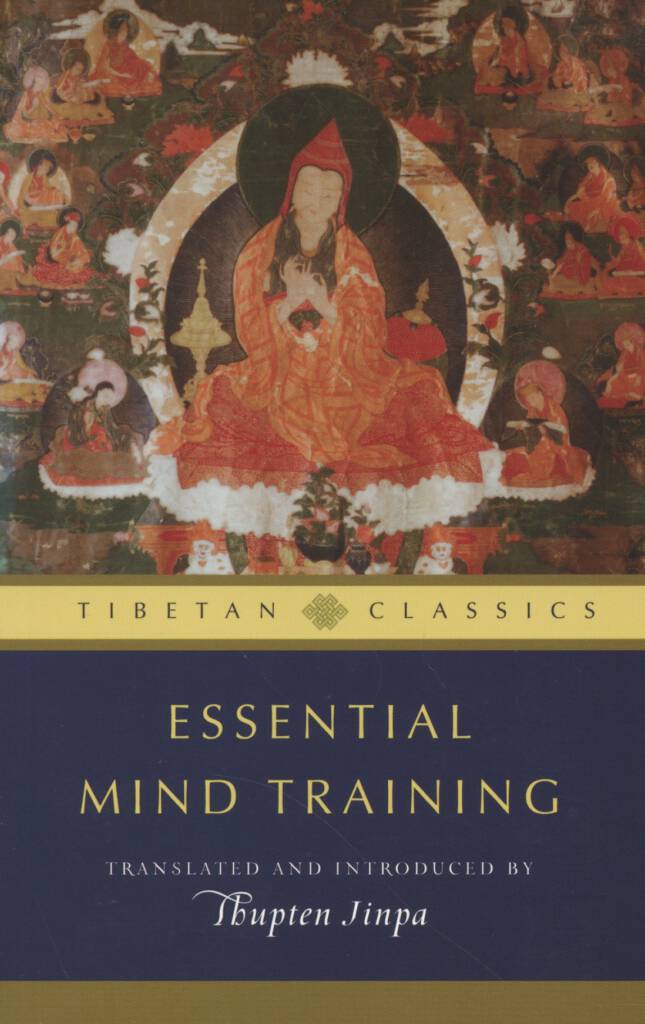
This volume contains eighteen individual works selected from Mind Training: The Great Collection, the earliest compilation of mind-training (lojong) literature. The first volume of the historic Tibetan Classics series, Essential Mind Training includes both lesser-known and renowned classics such as Eight Verses on Mind Training and The Seven-Point Mind Training. These texts offer methods for practicing the golden rule of learning to love your neighbor as yourself and are full of practical and down-to-earth advice.
The techniques explained here, by enhancing our capacity for compassion, love, and perseverance, can give us the freedom to embrace the world. (Source: Wisdom Publications)
- Library Items
- Books
- Jinpa, Thupten
- 'brom ston pa
- Atiśa
- Dge bshes glang ri thang pa
- Go rams pa bsod nams seng ge
- Sa skya paN+Di ta
- Rje btsun grags pa rgyal mtshan
- 'chad kha ba
- Mchims nam mkha' grags pa
- Rgyal mtshan dpal
- Ngor mkhan chen, 2nd
- Nub pa rigs 'dzin grags
- Kun dga' legs pa'i rin chen
- Se spyil pu chos kyi rgyal mtshan
- Sangs rgyas sgom pa seng ge
- Glo lo stA ba
- Wisdom Publications
- Topic: Mind Training
- Decade: 2000s