- Buddha-Nature
- Compassion
- Defining Bodhicitta
- Emptiness
- Equalizing & Exchanging Self and Others
- Equanimity
- History of Bodhicitta Teachings
- How to Develop Bodhicitta
- Interdependent Origination
- Lineage of the Profound View
- Lineage of the Vast Conduct
- Mahāyāna
- Mind Training
- Non-Self
- Seven-Point Instructions of Cause and Effect
- The Bodhisattva Ideal
- The Bodhisattva Path
- The Bodhisattva Vow
- The Bodhisattva's Goal
- The Four Immeasurables
- The Six Perfections
- The Three Higher Trainings
- The Two Accumulations
- The Two Truths
- Tonglen: The Practice of Sending and Receiving
- Types of Bodhicitta
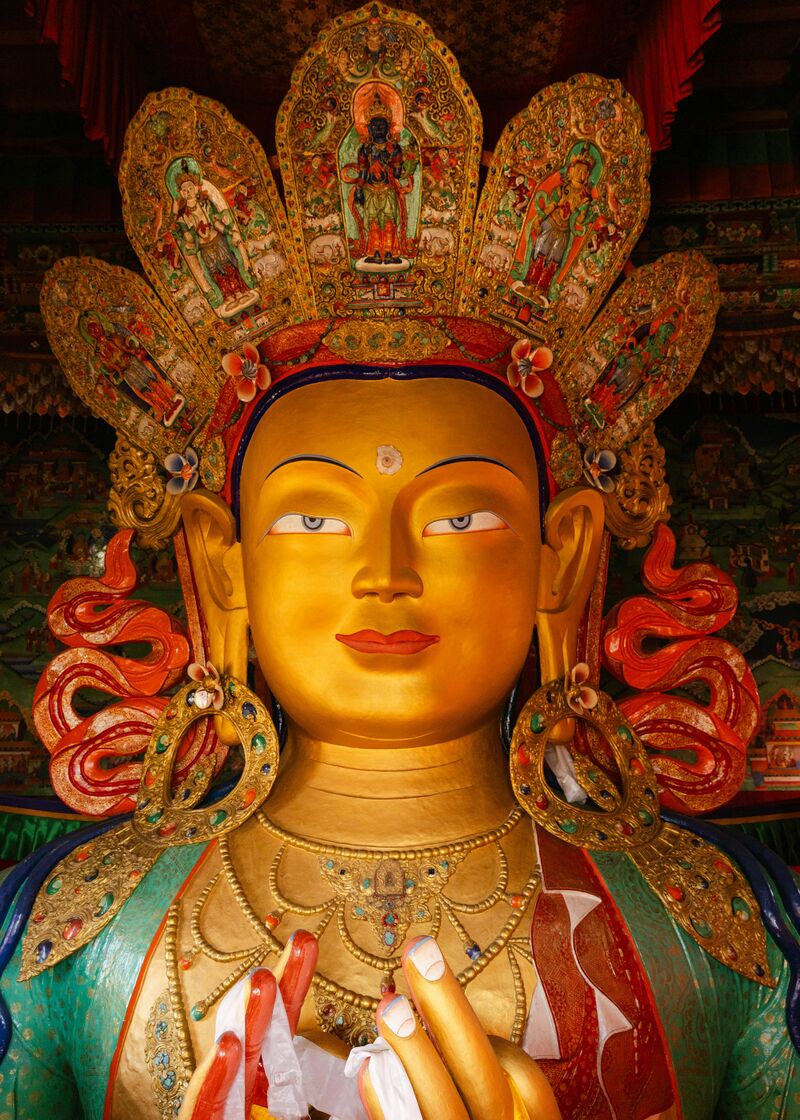
Bodhisattvas are spiritual warriors who have surrendered personal desires to become vessels of universal healing. These luminous beings walk among us, driven by an unquenchable fire to liberate all beings from suffering. Here, explore what the bodhisattva ideal actually means and learn how bodhisattvas become the embodiments of wisdom and compassion.
What Is the Ideal of the Bodhisattva?
A bodhisattva can appear anywhere, in different times and places, in any of the realms of existence. They can be born as the lowliest beggar or the greatest monarch, in the spirit world or even as one of the creatures of the earth. A bodhisattva is not defined by their class, their gender, or the place in which they are born.
So what is it that defines a bodhisattva? Bodhisattvas are essentially characterized by the motivation that drives their life and deeds. They are inspired by the central pillars of compassion and wisdom, and these guiding principles form the foundation of everything they do. They relinquish any cherishing of their own aims, and by training to cherish others more than themselves, they act solely for the sake of others.
Supported by this wisdom and compassion, they hold close to the motivating force of the powerful mind of bodhicitta— the wish to attain the fully enlightened state of a buddha. But this is not done for selfish reasons. This state of enlightenment is prized as the final goal of all bodhisattvas because from that omniscient state they can be most effective in working spontaneously and effortlessly for the welfare of all other beings. With the attainment of buddhahood, they can connect with other beings in the most appropriate and relevant ways, according to their dispositions and inclinations.
When engaging with other beings, the bodhisattva naturally wishes to bring temporary relief and happiness to whomever they meet. But their long-term goal is to eventually help all beings attain the highest state of bliss for themselves, the state of complete enlightenment, which is the perfection of one's own aims as well as the aims of others.
According to The Treatise on the Grounds of Yogic Practice (Yogācārabhūmi), a bodhisattva who gives rise to bodhicitta will formulate the following thought and state these words:
Oh, how I wish to attain unsurpassed true and complete enlightenment! May I be one who accomplishes the welfare of all sentient beings, and may I establish them in the [form of] nirvana that is an absolute termination and in the knowledge of a tathāgata.[1]
This is the basic mindset and prayer of the bodhisattva. Their fundamental wish is to attain complete enlightenment so that they can then help place all other beings in that very state—a state that is characterized by the irreversible abandoning of everything negative and the possession of the omniscient mind of a buddha.
The bodhisattvas are known as "the children of the conquerors." The bodhisattvas are taught by those who have already attained or conquered the enlightened state, the buddhas. They listen to teachings from them, contemplate and analyze the teachings to understand them, and then meditate on the meaning. Following the stages of the Mahāyāna path to buddhahood, they eventually become a buddha themselves.
From listening to the teachings of the buddhas, we will eventually develop bodhicitta and become a bodhisattva. With the constant practice of engaging in the conduct and trainings of a bodhisattva, practices such as the six perfections, we will ourselves eventually become a buddha. This is why Candrakīrti says the following in the opening verse of his great text Entering the Middle Way (Madhyamakāvatāra):
Buddhas are born from bodhisattvas. (1.1b)[2]
This refers to our personal journey to enlightenment, the journey of an individual person. From the state of an ordinary being, through wisdom and compassion, we become a bodhisattva and eventually a buddha.
The Three Causes of Bodhisattvas
Having understood that bodhisattvas are driven by this ideal to attain buddhahood for the welfare of all beings, and having understood that buddhas arise from bodhisattvas, we may then wonder from what causes do bodhisattvas arise? In Entering the Middle Way, Candrakīrti introduces us to the three principal causes of bodhisattvas:
The compassionate mind and nondual cognition as well [sic] the awakening mind: these are causes of bodhisattvas. (1.1cd)[3]
The mind of great compassion that wishes all beings to be free of every form of suffering; the nondualistic wisdom that sees the ultimate truth directly; as well as the awakening mind of bodhicitta: these three are the primary causes of bodhisattvas.
The tradition of presenting these factors—compassion, nondual awareness, and bodhicitta—as the three primary causes of the bodhisattva is rooted in verses from Nāgārjuna's Precious Garland (Ratnāvalī), where it states:
If you and the world wish to attain unexcelled awakening, its roots are bodhicitta that is as firm as the king of mountains, compassion that is as vast as space, and the wisdom that relies not on duality. (2.73cd–74)[4]
In his text Illuminating the Intent, which is a commentary on Candrakīrti's Entering the Middle Way, Tsongkhapa mentions a quote from the Perfectly Gathering the Teachings Sūtra (Dharmasaṃgītisūtra) that highlights one very important aspect in relation to these three causes:
Having realized the suchness of one’s own reality, one generates the mind with the thought, "I will help sentient beings realize this ultimate nature of things," and this is called awakening mind.[5]
The quote from this sūtra cannot be considered a complete definition of bodhicitta, as it only focuses on one aspect of the objective of the awakening mind and doesn't include the wish to attain the goal of enlightenment. But it still reveals a very important element of the bodhisattva way that connects to all three causes. In order to develop deep compassion for ourselves and others, we need to understand the true nature of reality and realize that without wisdom we will always create suffering for ourselves. When we understand our own situation at this most profound level of wisdom, then our compassion for others will deepen and we will naturally wish to help them to also develop the wisdom that understands the true nature of everything.
Inspiration
Enthused with compassion, wisdom, and the mind of enlightenment, the bodhisattva sets out on their journey to enlightenment for the sake of others, inspiring themselves along the way with verses such as the following from Nāgārjuna's Precious Garland:
As long as there is even some single sentient being somewhere who is not yet free, may I remain (in the world) for that being's sake, even if I have attained unexcelled awakening. (5.85)[6]
This sentiment is reflected in the famous and inspiring verse from the dedication chapter of Śāntideva's The Way of the Bodhisattva (Bodhicharyāvatāra).
And now as long as space endures, As long as there are beings to be found, May I continue likewise to remain To drive away the sorrows of the world. (9.55)[7]
This verse is quoted again and again by His Holiness the Dalai Lama and is one that he regards as one of the greatest inspirations of his life.
This indeed is the spirit and ideal of the bodhisattva.
Notes
- ↑ Artemus B. Engle, trans., The Bodhisattva Path to Unsurpassed Enlightenment: A Complete Translation of the Bodhisattvabhūmi, by Ārya Asaṅga (Boulder, CO: Snow Lion Publications, 2016), 21.
- ↑ Thupten Jinpa, trans., Illuminating the Intent: An Exposition of Candrakīrti's Entering the Middle Way, by Tsongkhapa (Somerville, MA: Wisdom Publications, 2021), 40.
- ↑ Jinpa, Illuminating the Intent, 42.
- ↑ John Dunne and Sarah McClintock, trans., The Precious Garland: An Epistle to a King, by Nāgārjuna (Boston, MA: Wisdom Publications, 1997), 36.
- ↑ Jinpa, Illuminating the Intent, 42. See also, n76.
- ↑ Dunne and McClintock, Precious Garland, 86.
- ↑ Helena Blankleder and Wulstan Fletcher (Padmakara Translation Group), trans., The Way of the Bodhisattva: A Translation of the Bodhicharyāvatāra, by Śāntideva, rev. ed. (Boston: Shambhala Publications, 2006), 171.
