- Buddha-Nature
- Compassion
- Defining Bodhicitta
- Emptiness
- Equalizing & Exchanging Self and Others
- Equanimity
- History of Bodhicitta Teachings
- How to Develop Bodhicitta
- Interdependent Origination
- Lineage of the Profound View
- Lineage of the Vast Conduct
- Mahāyāna
- Mind Training
- Non-Self
- Seven-Point Instructions of Cause and Effect
- The Bodhisattva Ideal
- The Bodhisattva Path
- The Bodhisattva Vow
- The Bodhisattva's Goal
- The Four Immeasurables
- The Six Perfections
- The Three Higher Trainings
- The Two Accumulations
- The Two Truths
- Tonglen: The Practice of Sending and Receiving
- Types of Bodhicitta
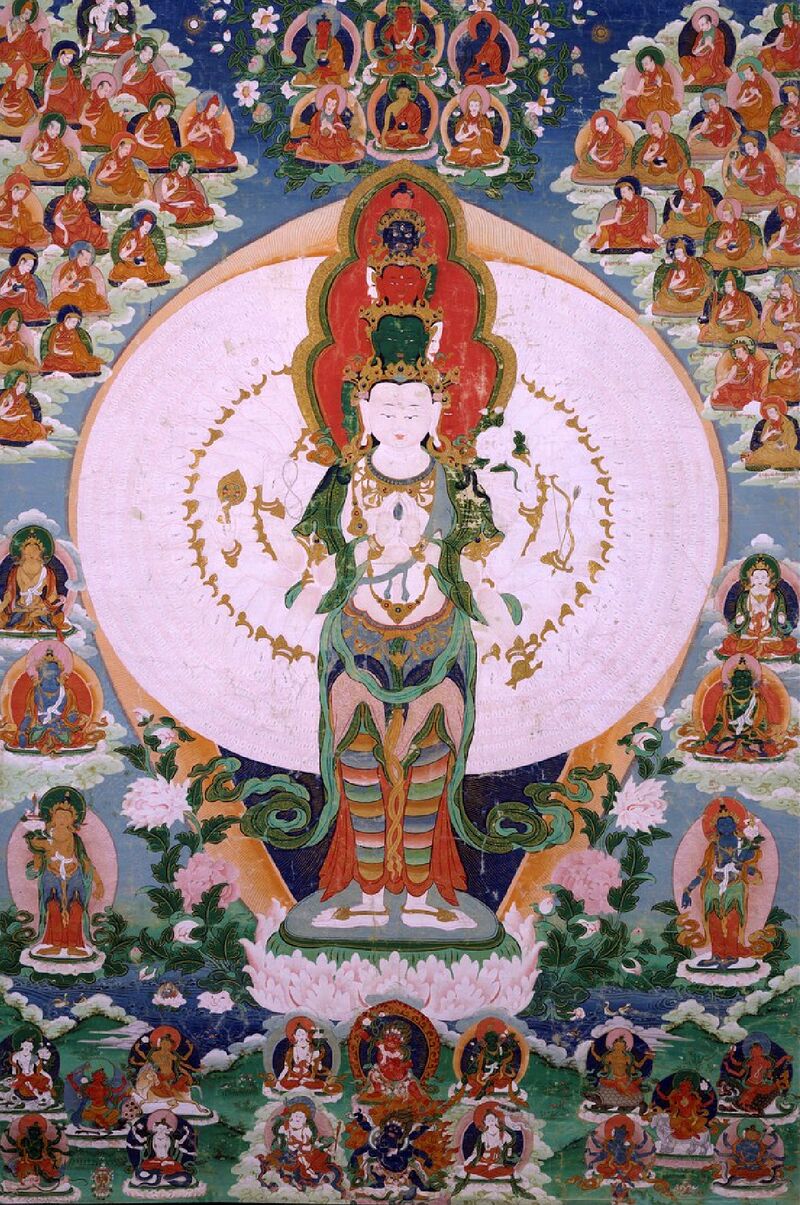
Within the Buddhist tradition, compassion represents an active intention for all beings to be free from suffering, extending far beyond natural sympathy for loved ones. Unlike ordinary pity, compassion must be deliberately cultivated to encompass every living being without bias. Buddhist teachings emphasize transforming our limited, selective empathy into universal concern through systematic spiritual practice.
Compassion in Relation to Bodhicitta
Compassion forms a central pillar for nearly all religions, and this is particularly true of the Buddhist tradition. Compassion (karuṇā, ཐུགས་རྗེ་) is often misunderstood as mere pity, yet in the Buddhist context, it is a dynamic state of mind that actively seeks to alleviate the suffering of oneself and others. It can range from the mere wish that someone be relieved of a headache to the universal compassion that wishes for every being without exception to be free of even the subtlest forms of suffering.
In all the Buddhist traditions, compassion plays a fundamental role in all aspects of practice, from those just beginning their journey on the path to the highest levels of practice. The Buddhist teachings encourage us to engage in practices and to develop ways of thinking that extend our compassion out to a much wider circle than just our loved ones and those close to us. Eventually, through training and awareness, we will be able to extend our compassion out even to our enemies and those who harm us. In the sūtras, the feeling of love and compassion is likened to a mother who would risk her own life to protect her only child.
We may all feel this sense of concern in the face of the suffering of those close to us. This immediate form of compassion is very powerful, but at this basic biological level it is still very biased. It focuses only on those we like, not on those toward whom we have neutral or negative feelings.
In contrast, Buddhism stresses that our compassion should not be biased. It should focus not on a small number of people who we hold dear to us. The Buddhist teachings inspire us to cultivate this strong feeling of concern equally in relation to all beings, whether they are our friends or our enemies. However, this kind of compassion does not arise naturally within us. It has to be cultivated through training and awareness.
Starting with our innate feeling of compassion for those close to us, we extend that same feeling out so that it eventually encompasses every single living being. We try to overcome our limited ways of thinking and feeling until the wish for others to be free of suffering becomes limitless. Eventually, with diligence, our compassion for all beings can become effortless and spontaneous.
This way of thinking finds one of its fullest expressions in the form of compassion that is included in the four immeasurable thoughts (in Pāli, cattāribrahmavihārā)—immeasurable equanimity, love, compassion, and joy. Here, immeasurable compassion is the wish for all beings to be free of all suffering and all the causes of that suffering.
To help us achieve the transformation from an attitude focused mainly on our own suffering to one focused on all others' suffering, the Buddhist teachings provide us with techniques to break down our self-centered outlook and to help open us up to the pain and suffering of others around us.
His Holiness on Compassion for Peace of Mind
In the following extract, the Dalai Lama offers profound insights into the nature of human well-being and the path to inner peace through his teachings on mental cultivation and compassion:
For a start, it is possible to divide every kind of happiness and suffering into two main categories: mental and physical. Of the two, it is the mind that exerts the greatest influence on most of us. Unless we are either gravely ill or deprived of basic necessities, our physical condition plays a secondary role in life. If the body is content, we virtually ignore it. The mind, however, registers every event, no matter how small. Hence we should devote our most serious efforts to bringing about mental peace.
From my own limited experience I have found that the greatest degree of inner tranquility comes from the development of love and compassion.
The more we care for the happiness of others, the greater our own sense of well-being becomes. Cultivating a close, warm-hearted feeling for others automatically puts the mind at ease. This helps remove whatever fears or insecurities we may have and gives us the strength to cope with any obstacles we encounter. It is the ultimate source of success in life. (Source Accessed June 12, 2025)
Roots of Compassion in the Buddhist Tradition
The basic meaning of compassion is the wish for someone to be free of their suffering, and this essential factor is found at the very heart of the Buddhist tradition. Its primary importance is stressed by the Buddha in the Pāli suttas:
As a mother would risk her life to protect her child, her only child, even so should one cultivate the heart limitlessly with regard to all beings. With goodwill for the entire cosmos, cultivate the heart limitlessly: above, below, & all around, unobstructed, without hostility or hate.[1]
Here we can clearly see, in the early roots of the tradition, the Buddha exhorting us to cultivate goodwill for every single living being. That goodwill should have the same strength of feeling that a mother would have toward their very own child, wishing to protect them from any form of danger or suffering.
Widening Our Compassion
The mental state of compassion can take many forms. At its most basic level it may be focused on just a single living being who is very dear to us, and we may wish only for their relief from a very temporary form of suffering. While this in itself is considered to be a positive state of mind, the Buddha stressed the importance of widening the circle of our compassion. Eventually, our compassion should be able to encompass even those toward whom we feel animosity or hatred.
This sense of how our compassion must reach out in every direction is captured in the Kālāmasutta, where the Buddha describes to his listeners how vast this mind must become:
He keeps pervading the first direction — as well as the second direction, the third, & the fourth — with an awareness imbued with compassion. Thus he keeps pervading above, below, & all around, everywhere & in every respect the all-encompassing cosmos with an awareness imbued with compassion: abundant, expansive, immeasurable, free from hostility, free from ill will.[2]
Free from bias and even the subtlest thoughts of ill will, our compassion must reach out in all directions to every living being.
Deepening Our Compassion
We may be able to cultivate the wish that every living being we encounter be free of their suffering. But having widened the scope of the object of our compassion, it is also very important to examine how deep that feeling of compassion really goes.
Since compassion is the wish that beings be free of suffering, a close examination of what compassion means will eventually lead us to examine the nature of suffering itself. The depth of our compassion is ultimately linked to the depths of our understanding about what it means to suffer. Our compassion can only be as deep as our understanding of suffering.
The Buddhist tradition stresses the importance of sharpening the lens through which we see the suffering of beings. This lens should not just be focused on the level of obvious and manifest pain. There is no one who does not recognize this as suffering. Instead, we must understand the very subtlest forms of suffering that beings experience.
The Meaning of Duḥkha
What is really meant when we say "suffering"? Is it the desire that someone be free of the pain of a headache or even a serious illness? Does it refer to just physical pain and situations such as the loss of a loved one? Is this the deepest level of suffering that beings experience, or is there some further subtle meaning? From the perspective of the Buddhist tradition, the extent of what it means to suffer goes much deeper than just these experiences. The Sanskrit word duḥkha has been translated in many ways into English and other non-Indian languages. The most common translation of the term in English is "suffering," but this word does not capture the full range of the Sanskrit term duḥkha. In the Buddhist context, the word has much subtler tones and meanings beyond the manifest pain of life that we all experience. It also applies to deeper levels of experience, many of which we actually feel are happy or pleasant experiences.
Beyond pain and loss, the word duḥkha points to a fundamental instability and unsatisfactoriness characterizing conditioned existence. We can see from our own personal experience that even though manifest suffering is temporarily absent, it will eventually return to haunt us. It seems to be embedded in the very fabric of our lives, and we can never seem to shake it off. The Buddhist teachings explain that this is because more subtle forms of suffering underlie this grosser form of suffering and provide a ground out of which more manifest forms of suffering arise.
Beyond the manifest level of suffering that the Buddha called the suffering of suffering (duḥkhaduḥkhatā), he described two further levels of suffering—the suffering of change (vipariṇāmaduḥkhatā) and all-pervasive conditioned suffering (saṃskāraduḥkhatā).
In his very first teaching, Setting in Motion the Wheel of the Dharma (in Pāli: Dhammacakkappavattanasutta), the Buddha exhorts us to identify these deeper levels of duḥkha when he says the following:
Now this, bhikkhus, is the noble truth of suffering: birth is suffering, aging is suffering, illness is suffering, death is suffering; union with what is displeasing is suffering; separation from what is pleasing is suffering; not to get what one wants is suffering; in brief, the five aggregates subject to clinging are suffering . . .[3]
Deeper forms of compassion must look beyond the manifest layer of suffering that is the basic pain of the world of sickness, old age, and death, a pain that even animals are aware of. We must also look beyond the suffering of not getting what we want and encountering what we do not want.
While acknowledging that all beings wish to be free from these manifest forms of suffering, the Buddha explained that there were much subtler levels of duḥkha. These subtler forms of suffering come from our mistaken views about ourselves and phenomena. Specifically, we cling to things as permanent and as if they have some kind of intrinsic nature, and then, under the sway of these wrong views, we engage in unconstructive actions that create negative karma.
Here, in his very first teaching, the Buddha is pointing out that birth itself is suffering. He is showing us that the whole cycle of birth and death, because it is under the influence of contaminated karma (sāsravakarma, ཟག་བཅས་ཀྱི་ལས་) and mental afflictions (kleśa, ཉོན་མོངས་), is in the very nature of suffering. Under the sway of these two factors, we must continue to be reborn in samsara, taking up again and again the contaminated aggregates (ཟག་བཅས་ཉེར་ལེན་གྱི་ཕུང་པོ་) of body and mind. Because the causes of these aggregates of body and mind are contaminated, the nature of the body and mind of beings born from these factors is in the very nature of suffering. Therefore, understanding that these subtle levels of conditioned existence are in fact duḥkha requires us to develop wisdom of the subtle momentary nature of all things and the subtlest nature of the existence of phenomena.
Compassion in the Mahāyāna Tradition
For the Mahāyāna tradition, compassion forms an extremely important framework for practice that aids in moving the practitioner's focus away from personal self-interest toward a much wider and more altruistic point of reference.
In The Teachings of Akṣayamati Sūtra (Akṣayamatinirdeśasūtra), it states:
Furthermore, Venerable Śāradvatīputra, the bodhisatvas' great compassion is also imperishable. Why? Because it is a prerequisite. Venerable Śāradvatīputra, just as breathing in and out is a prerequisite for the power of life of a great being, great compassion is also a prerequisite for the bodhisatvas' accomplishment of the Great Vehicle.[4]
As is explained here, for a bodhisattva, compassion should be as important to their practice as breathing is to life itself.
Besides influencing their daily practice, for a Mahāyāna practitioner, compassion must also influence the goal that they aim for in their spiritual practice. They forsake the more modest goal of personal liberation from samsara and absorption in the solitary peace of nirvana. Instead, their goal of attaining the fully enlightened state is purely for the purpose of attaining a state where they can most effectively help remove others' suffering and bring them also to the highest state of happiness.
In Kamalaśīla's Stages of Meditation (Bhāvanākrama), the primary importance of compassion for the bodhisattva on the Mahāyāna path is further stressed:
The Compendium of Perfect Dharma reads, "O Buddha, a Bodhisattva should not train in many practices. If a Bodhisattva properly holds to one Dharma and learns it perfectly, he has all the Buddha's qualities in the palm of his hand. And, if you ask what that one Dharma is, it is great compassion."[5]
By keeping close to the one central practice of compassion, and by training deeply in it, the bodhisattva is able to hold in their hands all the qualities and practices of the buddhas.
In Praise of Compassion in the Beginning, the Middle, and the End of the Path
Very often, at the beginning of the great Indian Buddhist works, the authors praise the great beings, such as one of the buddhas or bodhisattvas. However, in his seminal work, Entering the Middle Way (Madhyamakāvatāra), Candrakīrti (pronounced Chandrakirti) takes a very different approach. Right at the beginning of the text, rather than praising the buddhas, he chooses instead to praise the quality of compassion itself:
As compassion alone is accepted to be the seed of the perfect harvest of buddhahood, the water that nourishes it, and the fruit that is long a source of enjoyment, I will praise compassion at the start of all. (MAv 1 .2)[6]
Besides being a praise for the quality of compassion in a general sense, here Candrakīrti praises compassion for three important ways in which it nourishes the practice of a bodhisattva. Firstly, compassion acts as the seed from which the fully ripened result of the enlightened state of a buddha comes. Second, compassion continues to act as a primary condition to nourish that seed so that it does not dry up or lie dormant. And third, it is said to resemble the ripened fruit that can forevermore be a source of enjoyment for the beings who train in the path.
In his master work, The Great Treatise on the Stages of the Path to Enlightenment (Lamrim Chenmo, ལམ་རིམ་ཆེན་མོ།), Tsongkhapa explains in greater detail the importance of compassion throughout all stages of the path.
Firstly, he comments on why compassion acts as a seed for the harvest of complete enlightenment:
Once your mind is moved by great compassion, you will definitely make the commitment to free all living beings from cyclic existence. If your compassion is weak, you will not. Therefore, compassion is important in the beginning because feeling responsible to free all beings requires great compassion and because, if you do not take on this responsibility, you are not ranked as a Mahāyāna practitioner.[7]
Tsongkhapa then stresses that even after we have cultivated the mind of enlightenment (bodhicitta), compassion is still very important in the middle of our journey to buddhahood.
You may develop the spirit of enlightenment at one time and then engage in the bodhisattva deeds. But when you see that living beings are innumerable and act improperly, that the training is very difficult and limitless, and that you need an immeasurable length of time, you may lose heart and fall into the Hīnayāna. However, by accustoming yourself to increasingly greater compassion that is not just a one-time development, you become less concerned with your own happiness or suffering and are not discouraged at providing others' welfare.[8]
Finally, compassion is important at the end of the path, even when we have attained the fully enlightened state. In his second volume of Stages of Meditation, Kamalaśīla reminds us that even though the buddhas have attained the ultimate state of enlightenment, they still need compassion. Compassion, even at this most advanced stage of spiritual development, helps the buddhas to abide until the end of cyclic existence to guide all other beings along the path:
The Buddhas have already achieved all their own goals, but remain in the cycle of existence for as long as there are sentient beings. This is because they possess great compassion. They also do not enter the immensely blissful abode of nirvana like the Hearers. Considering the interests of sentient beings first, they abandon the peaceful abode of nirvana as if it were a burning iron house. Therefore, great compassion alone is the unavoidable cause of the non-abiding nirvana of the Buddha.[9]
Great compassion, even at the point when we have become fully enlightened, becomes a cause for the nonabiding nirvana of a buddha. Instead of entering into their own state of perfect peace, they remain to appear in the world forever, to be of benefit for all beings.
The Three Compassions
With respect to deepening our compassion, in his work Entering the Middle Way, Candrakīrti pays homage to the increasingly deepening levels of compassion that we need to develop in relation to the different forms of suffering that beings experience. These three levels of compassion are: (1) compassion that takes sentient beings as its object, (2) compassion that takes phenomenal reality as its object, and (3) compassion that takes no reference as its object.
Compassion That Takes Sentient Beings as Its Object
In relation to compassion that takes sentient beings as its object, Entering the Middle Way reads:
First, with the thought "I am," they cling to a self; then, with the thought "mine," they become attached to things; like buckets on a waterwheel, they turn without control; I bow to the compassion that cares for such suffering beings. (MAv 1.3)[10]
Here, Candrakīrti explains the basic process through which beings find themselves trapped in the continuing cycle of samsaric existence. The whole process begins because we cling to the notion of the self as having some kind of inherent reality, unrelated and independent of any other factors. Focusing on the self that is the referent of the thought "I am," we take that self to have some kind of intrinsic nature. From this mistaken view of "I," we then cling to things in close relation to the "I"—the closest of these being our own aggregates of body and mind. We take these aggregates to be intrinsically "mine," and thus we cling to "mine" as existing inherently and independently of anything else.
The above verse highlights a very important fact—before any thought of "mine" can arise, it must be preceded by the thought of "I." That mistaken identity that clings to an inherently existent "mine" leads us to become strongly attached to things. Dividing the world up into categories of "mine" and "others'," we become overly attached to anything that is mine. We grasp so tightly that we develop attachment to what appears pleasant to us and are averse to that which appears unpleasant, and from here arises the whole range of afflictive mental states. Thus, we set in motion the whole process of life on the wheel of samsara.
On this verse, Lama Tsongkhapa, in his commentary Illuminating the Intent (དབུ་མ་དགོངས་པ་རབ་གསལ།), states:
Thus, like buckets on a waterwheel in motion or spinning in a circle, sentient beings turn in a cycle without control, and it is to the compassion that cares for such suffering beings that I bow here.[11]
The analogy used here for this process of samsara is that of an irrigation wheel, as was often found in ancient India. The perpetual process of the wheel turning without break is used to show how we are trapped on the wheel and carried away uncontrollably through the different realms of cyclic existence. Even if we temporarily attain a higher state, inevitably we must again plunge down to much lower states of existence.
This is the way that Candrakīrti pays homage to compassion that takes sentient beings as its object.
2. Compassion That Takes Phenomenal Reality as Its Object, and 3. Compassion That Takes No Reference as Its Object
The next verse of Candrakīrti’s text covers the last two levels of compassion. The verse is read in different ways according to which form of compassion is being highlighted:
Beings are like reflections of the moon in rippling water; seeing them as fleeting and as devoid of intrinsic nature, the bodhisattva's mind falls under compassion's sway, yearning to set free every transmigrating being. (MAv 1.4)[12]
How These Different Forms of Compassion Deepen Our Practice
It is important to remember that these three states of mind are all forms of compassion. The aspect of the mind for each of them is the same—it is still the wish that the object, which is all beings, be free of suffering. The deepening levels of wisdom associated with each of these levels of compassion infuse and support that compassion. As the wisdom that holds that compassion in its embrace deepens, the related compassion begins to deepen. As we are able to see more and more clearly the subtler levels of suffering that a being can experience, so our compassion deepens.
As we meditate on the nature of subtle impermanence, we understand that all beings, and indeed all compounded phenomena, do not abide even in the next moment. And yet because we do not see this subtle level of momentariness, we cling to things in the hope that they will remain with us continuously. This clinging attachment gives rise to negative emotions, afflictive mental states that cause us immediate suffering, but also lays down the karmic imprints for future unwanted results. Seeing that phenomena are in a process of constant flux and that they cannot abide even in the next moment, we start to understand how things are neither permanent nor have an abiding self. Compassion infused with this wisdom is the compassion that takes phenomenal reality as its object.
Under the sway of the ignorance that clings to things as existing independently and from their own side, we divide the world into positive and negative and then act with aversion or attachment. This eventually leads to complications, difficulties, and suffering in our lives. At its deepest level, this ignorance drives the whole process of rebirth in samsara, acting as the very first link in the twelve links of dependent origination (Dvādaṡāṅga pratītyasamutpāda).
Although phenomena appear to exist solidly and intrinsically from their own side, when we analyze them in search of this kind of existence, we cannot find a single trace of them existing in this way. As we develop the wisdom that understands this true reality of all things—the lack of inherent existence of all phenomena—we slowly release our clinging to "I" and "mine." As our understanding deepens, we are then able to loosen the grip of this false identity view and eventually break free from the cycle of birth and rebirth forever.
Seeing the tremendous value of this deepest form of wisdom for ourselves, we then understand that beings who are unaware of this subtlest level of reality will be trapped in the wheel of life and death and must endure the unbearable suffering that entails. With this wisdom of the nature of phenomena supporting our compassion, we are able to see through to the all-pervasive conditioned suffering that is the basic underlying suffering of beings trapped in cyclic existence. This is what is called compassion that takes no reference as its object.
Notes
- ↑ Thānissaro Bhikkhu, trans., Karaṇīya Mettā Sutta — Goodwill, in Khuddakapāṭha (Khp 9) of Khuddaka Nikāya (Collection of Short Discourses), Dhammatalks.org: Talks, Writings and Translations of Thānissaro Bhikkhu, https://www.dhammatalks.org/suttas/KN/Khp/khp9.html.
- ↑ Thānissaro Bhikkhu, trans., Kalama Sutta: To the Kalamas, in Anguttara Nikaya, 3.65, accesstoinsight.org, 1994, http://www.accesstoinsight.org/tipitaka/an/an03/an03.065.than.html.
- ↑ Bhikkhu Bodhi, trans., Setting in Motion the Wheel of the Dhamma (Dhammacakkappavattanasutta), in Saṁyutta Nikāya, 56.11, Suttacentral.net, 2000, https://suttacentral.net/sn56.11/en/bodhi?lang=en&reference=none&highlight=false.
- ↑ Jens Braarvig and David Welsh, trans., The Teaching of Akṣayamati (Akṣayamatinirdeśa, Blo gros mi zad pas bstan pa, Toh 175), Online publication (84000: Translating the Words of the Buddha, 2023), https://84000.co/translation/toh175.
- ↑ Fourteenth Dalai Lama, Stages of Meditation: The Buddhist Classic on Training the Mind, root text by Kamalashila, trans., Venerable Geshe Lobsang Jordhen, Losang Choephel Ganchenpa, and Jeremy Russell (Boulder, CO: Shambhala Publications, 2019), 30.
- ↑ Thupten Jinpa, trans., Illuminating the Intent: An Exposition of Candrakīrti's Entering the Middle Way, by Tsongkhapa (Somerville, MA: Wisdom Publications, 2021), 45.
- ↑ Lamrim Chenmo Translation Committee, trans., The Great Treatise on the Stages of the Path to Enlightenment, by Tsongkhapa, vol. 2, ed. Joshua W. C. Cutler and Guy Newland (Ithaca, NY: Snow Lion Publications, 2000), 28.
- ↑ Lamrim Chenmo Translation Committee, Great Treatise, 29.
- ↑ Fourteenth Dalai Lama, Stages of Meditation, 30.
- ↑ Jinpa, Illuminating the Intent, 47.
- ↑ Jinpa, Illuminating the Intent, 47.
- ↑ Jinpa, Illuminating the Intent, 50.
