- Buddha-Nature
- Compassion
- Defining Bodhicitta
- Emptiness
- Equalizing & Exchanging Self and Others
- Equanimity
- History of Bodhicitta Teachings
- How to Develop Bodhicitta
- Interdependent Origination
- Lineage of the Profound View
- Lineage of the Vast Conduct
- Mahāyāna
- Mind Training
- Non-Self
- Seven-Point Instructions of Cause and Effect
- The Bodhisattva Ideal
- The Bodhisattva Path
- The Bodhisattva Vow
- The Bodhisattva's Goal
- The Four Immeasurables
- The Six Perfections
- The Three Higher Trainings
- The Two Accumulations
- The Two Truths
- Tonglen: The Practice of Sending and Receiving
- Types of Bodhicitta
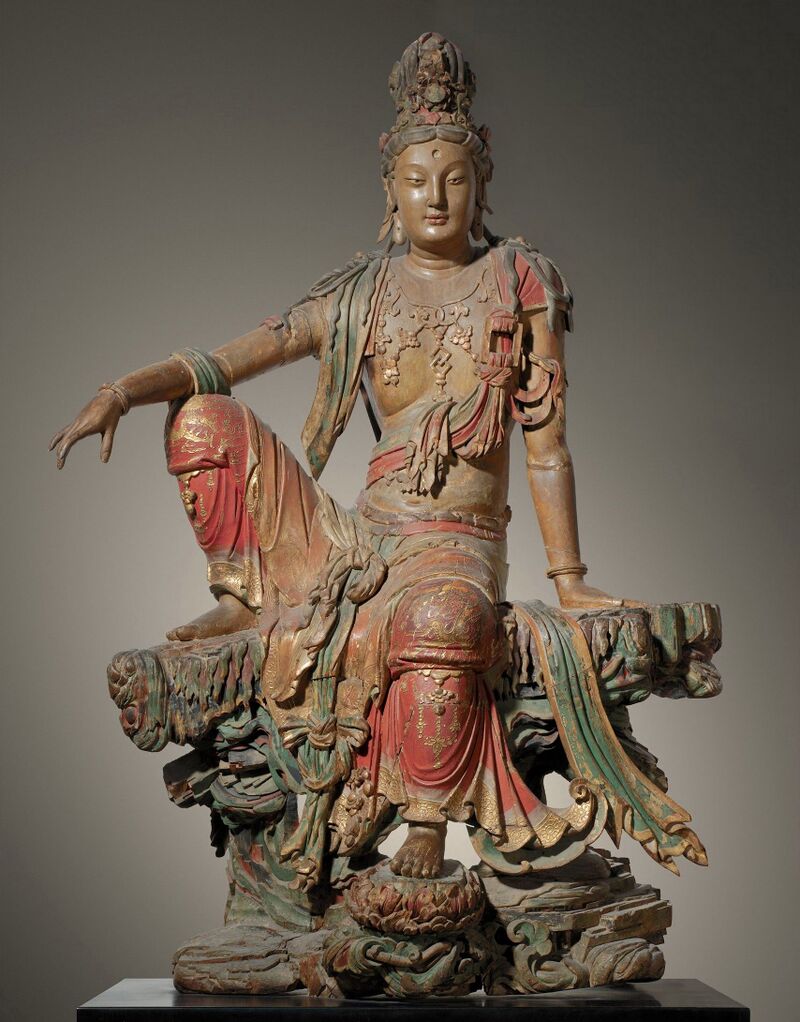
The bodhisattva vow is a personal commitment to the altruistic ideal of bodhicitta. It involves wholeheartedly giving rise to and maintaining a benevolent attitude that wishes to free all beings from suffering and help them along the path to enlightenment, as well as the responsibilities associated with dedicating this, and all future lives, to attaining buddhahood for the sake of oneself and others. The vow is traditionally bestowed in a formal ceremony that typically involves a qualified preceptor—one who has received the vow and maintained it accordingly—and a suitable recipient: an individual or group that is intent upon following the bodhisattva path and has prepared themselves to take up this commitment.
Introduction
The bodhisattva vow is the commitment a follower of the bodhisattva path makes to observe a set of rules and precepts. The Sanskrit term saṃvāra and the Tibetan word dompa (སྡོམ་པ་) refer to holding back or restraint but also to adopting or binding oneself to other types of actions or practices. In this respect, the Mahāyāna practice of the bodhisattva vow constitutes the oath a practitioner formally takes and the associated precepts and prohibitions that one must follow in order to reinforce and strengthen the practice of bodhicitta.
As with vows in mainstream Buddhism, there are physical, mental, and other prerequisites for taking the bodhisattva vow; rituals and procedures to follow during the vow ceremony; the corollary precepts and practices to observe; and the methods for making amends if one transgresses the vow. As the Mahāyāna tradition was passed down from India to Tibet through two main lines—the Profound View tradition and the Vast Conduct tradition—the bodhisattva vow likewise follows these two transmission lines, with minor differences in their rituals and observances.
Vows in Buddhism
In general Buddhist practice, a follower of the Buddhist path is required to take refuge in the Three Jewels—the Buddha, the Buddha's teachings (i.e., the Dharma), and the community of followers (Saṅgha)—by accepting them as the teacher, way of life, and companions on the spiritual path. The commitment to accept the Three Jewels as objects of refuge is known as the refuge vow (སྐྱབས་འགྲོའི་སྡོམ་པ་). It entails a set of precepts, such as not accepting worldly gods as the ultimate refuge, having taken refuge in the Buddha, not taking the life of a sentient being, having taken refuge in the Dharma, and not spiritually allying with non-Buddhist teachers, having taken refuge in the Saṅgha. Observing these precepts helps the practitioner remain focused on the spiritual path, uphold the right values and principles, and avoid distractions and negative influences.
In addition to the refuge vows, a person who takes the vows of a lay Buddhist practitioner must also observe further precepts, including not killing, not taking what is not given, not engaging in sexual misconduct, not speaking falsely, and not consuming intoxicating substances. The first four precepts are known as the four root vows. The precept of avoiding intoxicating substances is sometimes added to these to make the five root vows of a lay Buddhist. If a practitioner becomes a celibate renunciate by taking the vows of a novice monk or a fully ordained monk, there are more precepts to follow, including the observance of celibacy. A novice has eight major precepts and thirty-three minor ones, a fully ordained monk has 251 precepts, including four root precepts, and a fully ordained nun has 360 precepts, including eight root precepts.
The mainstream Buddhist vows are generally taken for one's entire life, as expressed in the common phrase "as long as one lives" (yāvaj jīvikam, ཇི་སྲིད་འཚོ་བའི་བར་དུ་). However, some vows are taken for a limited period, such as the lay Buddhist vow called upavāsa (བསྙེན་གནས་), in which one observes eight precepts for a single day and night, or the practice of temporary monkhood for months and years as observed in some Buddhist countries. The vows are bestowed on the postulant by one or more officiants who have themselves received the vows, observed them properly, and become proficient in the rituals for administering them.
These mainstream Buddhist vows, known as vows for individual liberation (prātimokṣa, སོ་སོར་ཐར་པ་), originated in the days of the Buddha and are followed by all Buddhist traditions. The Sanskrit term prāti and the Tibetan term so sor (སོ་སོར་) are rendered as "individual," and the Sanskrit word mokṣa and its Tibetan equivalent thar pa (ཐར་པ་) refer to liberation. Thus, the prātimokṣa vow is a vow for individual liberation. The term prāti is also etymologically explained as "first time." Thus, prātimokṣa is understood as the first instance of liberation. As it is the beginning of the path to liberation, it is seen as the first instance of liberation. The term prāti also refers to "expedience." Thus, prātimokṣa is interpreted as the expedient means to liberation because it brings about liberation. In this respect, prātimokṣa vows are seen as an initial reflection or image of the actual state of liberation, or nirvāṇa. The lay Buddhist vows and the vows of the celibate followers of the Buddha generally fall within this mainstream practice of the prātimokṣa vows, although there are also other much more rigorous and demanding Buddhist vows associated with the Mahāyāna and Vajrayāna or tantric systems of Buddhism.
The Bodhisattva Vow
The bodhisattva vow is based on and builds upon the mainstream Buddhist vows for individual liberation (prātimokṣasaṃvāra, སོ་སོར་ཐར་པའི་སྡོམ་པ་). It expands the mainstream Buddhist vows in terms of the scope of their objective, mode of their practice, and profundity of their purpose. Mainstream Buddhist vows, whether taken by lay practitioners or renunciates, are taken in order to seek the spiritual goal of liberation or enlightenment for the individual practitioner. Thus, a monk or nun observing the mainstream Buddhist vows primarily aims to reach nirvāṇa for their own sake. Although the enlightened saints (arhats) are said to have perfected the practice of the prātimokṣa and to possess compassion and loving-kindness for other beings, their spiritual pursuit is mainly defined by the wish to attain nirvāṇa for themselves.[1] The bodhisattva vow, on the other hand, is primarily taken for the sake of all sentient beings and motivated by strong compassion. It is distinguished by bodhicitta—the intention to deliver all sentient beings from suffering and bring them to the state of buddhahood, not merely the state of ordinary nirvāṇa, but the great, complete nirvāṇa (mahāparinirvāṇa, མི་གནས་པའི་མྱང་འདས་).
The mainstream prātimokṣa vows also primarily deal with the discipline of body and speech, focusing on avoiding the seven negative actions of body and speech and the offences associated with them (སྤོང་བདུན་འཁོར་དང་བཅས་པ་)—a prescriptive system governed by a fixed set of rules.[2] The bodhisattva vow, by contrast, stresses the role of the mind and mental states and aims to avoid ten negative actions, the seven physical and verbal nonvirtues and three additional nonvirtuous mental actions.[3] In addition to eschewing the negative actions, the bodhisattva vow places great importance on altruism and benefit for others. Thus, the bodhisattva vow involves active compassionate engagement and altruistic action. A bodhisattva is even required to engage in seemingly negative actions if it brings benefit to others. For example, a bodhisattva is permitted, and in fact required, to tell a white lie in order to benefit others, take an individual's life in order to save many others, or give up chastity if it brings a great benefit to others. In this way, the bodhisattva vow is informed more by the intention and circumstances than by hard and fast rules. In observing the bodhisattva vow, one practices a voluntaristic and consequentialist mode of ethical consideration by looking at the intention and the expected outcome of the action rather than an axiological perspective of seeing intrinsic ethical values in specific actions.
While the prātimokṣa vows are taken from a qualified master who observes the vows and is proficient in administering the vows, the bodhisattva vow is normally taken from a master who is both learned in the Mahāyāna and an adept in the practice of bodhicitta. A human officiant or preceptor is required for all prātimokṣa vows, but the bodhisattva vow can be taken, particularly in the Profound View tradition, even in the presence of a holy relic, sacred site, or imaginary buddhas and bodhisattvas. Similarly, while only a human being is considered to be the viable vessel for the prātimokṣa vows, the bodhisattva vow can be administered also to nonhuman forms of life. Thus, there can be bodhisattvas in the celestial, animal, hungry ghost, and hell realms. The prātimokṣa vows normally need to be taken only once, and one loses them either by transgressing the root precepts or by relinquishing them. A root transgression involves a conscious and clear execution of a physical or verbal action such as taking the life of a human being or telling a lie, like claiming a supernatural power one does not have. The bodhisattva vow, however, can be taken repeatedly. It is a practice of reinforcing the bodhicitta practice and thus frequent repetition, particularly for a beginner, is highly recommended. Unlike the prātimokṣa vows, a practitioner can lose the bodhisattva vow merely by mentally forsaking a sentient being and declining to help someone in need where one can help. It is primarily a mental commitment, and any thought of giving up the cause of sentient beings or harming a sentient being annuls the bodhisattva vow until one takes it again.
The prātimokṣa vows are taken until one's death or "as long as one lives," and they are said to cease upon the time of death. In contrast, the bodhisattva vow is taken until one reaches the heart of enlightenment or becomes a buddha. Thus, the vow is believed to continue across lifetimes unless it has been lost or broken. The observance of the bodhisattva vow is, therefore, extended across many lifetimes and innumerable eons, as vividly illustrated by the Jātaka stories of the Buddha's previous lives.
Taking the Bodhisattva Vow
The rituals of taking the bodhisattva vow can vary from a brief session of chants to a long and elaborate ceremony lasting a whole day. There are also two main Mahāyāna traditions for administering the bodhisattva vow coming down through the Profound View and Vast Conduct lines of transmission. While they have some differences in the preconditions for taking the vow, the mode of administering the vows, and the precepts to follow, they share the general framework for conducting the vow ceremony. A brief account is provided below and a clear and systematic process for practice can be found in the Practice Section.
The first important prerequisite is the physical medium. Human rebirth is considered the most conducive condition for taking the bodhisattva vow because it combines both the cognitive acumen and emotional sensitivity required to pursue spiritual fulfillment. It also comes with sufficient space, time, and comfort, as well as exposure to suffering, which helps trigger discontent with the cycle of existence and the pursuit of higher existential goals. Thus, Buddhist spiritual practice in general and the process of taking the bodhisattva vow in particular are often preceded by a rigorous reflection on the rarity and preciousness of human rebirth. Such meditation is traditionally carried out by contemplating the eight freedoms (དལ་བ་བརྒྱད་) and ten endowments (འབྱོར་པ་བཅུ་) and the rarity of the causes for human rebirth.[4] Such contemplation is also done by comparing the number of human beings to the number of other species such as insects and fish, and by using traditional analogies.
Reflection on the rarity, preciousness, and precariousness of the human body inspires one to take up spiritual practice in general and the bodhisattva vow in particular with more urgency and seriousness lest one should suddenly lose this opportunity and fail to regain it again. However, unlike the case of prātimokṣa vows, the bodhisattva vow is not limited to human beings. According to the Profound View tradition coming down from Nāgārjuna through Śāntideva, both bodhisattva vows of aspiring bodhicitta and applied bodhicitta can be received by humans as well as other forms of life as long as the recipient understands the significance of the bodhisattva vow, the procedures for taking the vow, and the commitment required to follow the precepts. In the Vast Conduct tradition coming down through Asaṅga to Atiśa, any being with the ability to grasp the purpose, procedures, and precepts of the vow can receive the bodhisattva vow for aspiring bodhicitta, but the postulant for the vow of applied bodhicitta is required to have one of the prātimokṣa vows. Therefore, a human birth is essential for the applied bodhisattva vow in this tradition.
Once the physical condition has been obtained, it is of utmost importance to cultivate the right mental and emotional conditions. Thus, a person seeking the bodhisattva vow must have faith and confidence in the Buddha, in the efficacy of the Mahāyāna teachings, and in the pursuit of perfect enlightenment. Above all, the person receiving the bodhisattva vow must have a strong sense of compassion toward sentient beings—an intense desire both to eliminate their suffering forever and to bring them the highest and most lasting happiness.
Motivated by loving-kindness to bring happiness to all sentient beings and compassion to remove their suffering, a postulant must seek a qualified Mahāyāna master from whom to take the bodhisattva vow. Having a master physically present to administer the vow is crucial, both to ensure the continuity of the transmission and to invest the undertaking with the seriousness and efficacy it requires. In the Vast Conduct tradition, the presence of a master is indispensable for the vow of applied bodhicitta, as the procedure includes a dialogue in which the preceptor has to read out the liturgy for the vow. However, as one can take the bodhisattva vow repeatedly in order to strengthen the practice of bodhicitta, it is not always necessary to have a human master present while taking the vow. One can chant the words and take the bodhisattva vow on one's own in the presence of shrines, sacred sites, holy relics, or by visualizing the buddhas and bodhisattvas.
The actual procedure for taking the bodhisattva vow begins with chants inviting the buddhas and bodhisattvas, followed by prostrations and offerings. Often, the seven-limb prayer is also performed. This includes verses for making prostrations, offerings, and confessions, rejoicing in good deeds, requesting the enlightened beings to spread the Dharma, pleading with the enlightened beings to remain in the world, and dedicating all merits and good deeds for the benefit of the world. The practice of offering also extends to all the riches of the world, presented symbolically through the maṇḍala offering of the entire universe and its contents. The postulant also offers their body, possessions, and virtues—the three primary objects of worldly attachment.
After the ritual of prostration, offering, confession, rejoicing, and so forth—seen as expedient means for accumulating the necessary spiritual resources and methods for overcoming hindrances—the postulant engages in a mind training exercise, which is compared to tilling the land before sowing the seed. One way the postulant can do this is by earnestly generating the four immeasurable thoughts of loving kindness, compassion, sympathetic joy, and equanimity. Having done this effectively, the postulant beseeches the buddhas, bodhisattvas, and enlightened masters to pay heed to the words for taking the vow. The specific liturgy for taking the bodhisattva vow is then chanted three times. In the Profound View tradition, two verses from Śāntideva's The Way of the Bodhisattva (v. 3.23-24) are commonly used to take the vow of both aspiring and applied bodhicitta at once. The master may recite these verses and have the postulant repeat them, or the master may just listen as the postulant chants these verses.
In the Vast Conduct tradition, the officiating master recites the liturgy, taken mainly from Asaṅga's Stages of a Bodhisattva, and the postulant repeats after the master in order to take the vow for aspiring bodhicitta. For the vow of applied bodhicitta, the officiating master recites the lines three times and the postulant has to listen attentively, grasp the meaning, and respond at the end with the affirmation "I do accept all of them."
At the end of the repetition of the words or as one responds to the question, it is crucial for the postulant to consciously think that they have taken the oath and received the vow. The postulant does not properly receive the vow without such mental awareness and conscious acceptance. Having received the vow, the rituals conclude in both traditions with words of exultation for having received such a rare and precious opportunity of becoming a bodhisattva and joining the family of enlightened beings. The postulant rejoices in the great merit and virtue accumulated by taking the vow and also invites all enlightened beings and sentient beings to rejoice. The ritual concludes with prayers for bodhicitta to flourish and for those with bodhisattva vows to be able to observe the precepts without failure or lapse.
Having taken the bodhisattva vow, one is required to observe the bodhisattva precepts and train in the bodhisattva discipline, which is presented in three sets:
- The discipline of abstaining from misdeeds
- The discipline of gathering virtue
- The discipline of working for the welfare of sentient beings.
The discipline of abstaining from misdeeds encompasses the many prohibitions a person with the bodhisattva vow must observe. These prohibitions are usually presented in two categories: root downfalls and minor downfalls. The Sūtra of Ākāśagarbha lists eighteen root downfalls, including five that a king is prone to commit, five that a minister is prone to commit, and eight that even an ordinary bodhisattva is prone to commit. The Jewel Heap Sūtra presents four dark dharmas to avoid and four white dharmas to adopt. These are listed in the Practice Section.
Minor downfalls consist of many physical, verbal, and mental transgressions and misdeeds, such as unintentional harm caused by reckless physical behavior, useless gossip, or a moment of anger. Unlike the prātimokṣa vows, virtuous and nonvirtuous deeds in the bodhisattva vow are determined not primarily by physical or verbal conduct but by intention. In the prātimokṣa system, if a monastic engages in sexual intercourse, the prātimokṣa vow is broken irrespective of intention. On the bodhisattva path, one must engage in sexual intercourse if such an act brings great benefit to others. Thus, in the bodhisattva practice, if one engages in a seemingly unwholesome action, such as sexual intercourse or lying, out of compassion for others, such an action is not a downfall but a semblance of one. If one engages in a seemingly wholesome physical or verbal action such as the recitation of scriptures or a meditation session but is motivated by desire for wealth or fame, such an action is a downfall in reality despite its virtuous appearance. This is called a semblance of a non-downfall.
As ordinary practitioners are likely to fail in observing all precepts properly and may commit a downfall, procedures for making amends are also presented as a part of the bodhisattva vow. A person with the bodhisattva vow is recommended to carry out reparations in the watch—one-sixth of a full day and night—following the watch in which the downfall was committed. Reparations should be carried out through the four powers of intense remorse, sincere restoration, remedial action, and reliable support, and through different methods of reparation such as chanting The Sūtra of the Three Heaps or making confessions to the bodhisattva Ākāśagarbha.
The second discipline of gathering virtue constitutes the practice of the six perfections (ṣaṭpāramitā, ཕར་ཕྱིན་དྲུག་) of giving, discipline, patience, diligence, meditative concentration, and wisdom. The third discipline of benefiting sentient beings is normally presented through the four means of attraction (catvāri saṃgrahavastūni, བསྡུ་བའི་དངོས་པོ་བཞི་), which are skillful strategies to place sentient beings on the right path to enlightenment. More details on this can be found in the Practice Section.
Notes
- ↑ Arhats are also known as "foe destroyers" because they have destroyed the foes of the afflictive emotions and have reached nirvāṇa.
- ↑ In the context of the prātimokṣa, the seven negative actions refer to three physical nonvirtues—killing, stealing, and sexual misconduct—and the four verbal nonvirtues—lying, divisive speech, harsh speech, and idle gossip.
- ↑ The three nonvirtuous mental actions or states include covetousness, malicious thoughts, and wrong view.
- ↑ The eight freedoms are freedom from being born (1) in the hell realm, (2) in the hungry ghost realm, (3) in the animal realm, (4) as celestial beings with long life engrossed in sensual distractions, (5) as barbarians who promote violence as virtue, (6) as people with wrong views who deny cause and effect (7) in a dark age without Buddhist teachings, and (8) as dumb people with serious disability. The ten endowments include the five points with regard to external conditions and five with regard to one's own situation. The first five are: (1) the Buddha has come, (2) he has given teachings, (3) the teachings exist, (4) one has the chance to follow them, and (5) there are kind masters who can provide guidance. Five with regard to one's situation are: (1) Becoming a human being, (2) being born in a central civilized land, (3) possessing all faculties, (4) not being engaged in wrong views and practices, and (5) having faith in righteous things.
