- Buddha-Nature
- Compassion
- Defining Bodhicitta
- Emptiness
- Equalizing & Exchanging Self and Others
- Equanimity
- History of Bodhicitta Teachings
- How to Develop Bodhicitta
- Interdependent Origination
- Lineage of the Profound View
- Lineage of the Vast Conduct
- Mahāyāna
- Mind Training
- Non-Self
- Seven-Point Instructions of Cause and Effect
- The Bodhisattva Ideal
- The Bodhisattva Path
- The Bodhisattva Vow
- The Bodhisattva's Goal
- The Four Immeasurables
- The Six Perfections
- The Three Higher Trainings
- The Two Accumulations
- The Two Truths
- Tonglen: The Practice of Sending and Receiving
- Types of Bodhicitta
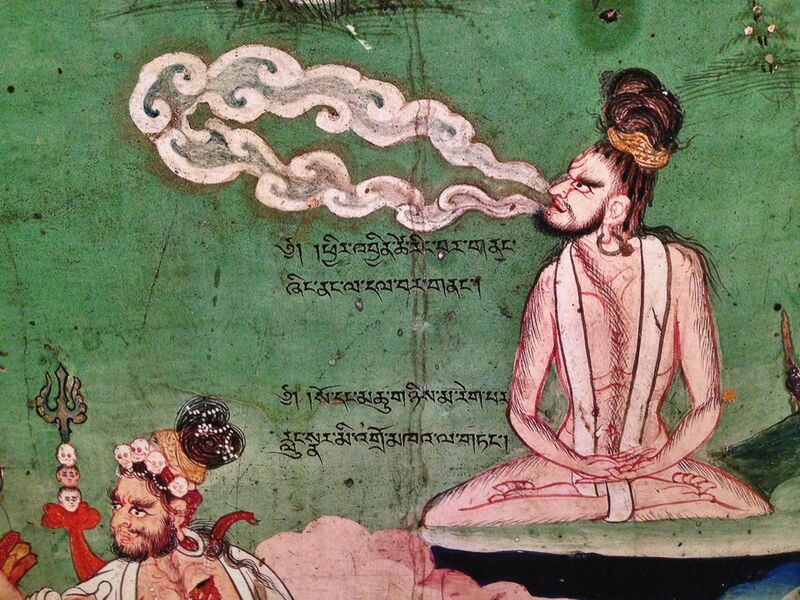
Tonglen (literally "sending and receiving") is a Tibetan Buddhist meditation practice for cultivating bodhicitta through the visualization of breathing. Practitioners visualize breathing in the suffering, pain, and negativity of others—often depicted as dark smoke—and breathing out happiness, health, and wellbeing—visualized as bright light or healing energy. This counterintuitive practice directly challenges self-centeredness by training the mind to willingly take on others' difficulties while offering them relief, thereby developing the compassionate motivation central to bodhicitta.
Introduction
Imagine breathing in someone else's pain and breathing out joy and happiness to them. This may feel completely counterintuitive to us, but this is the practice that lies at the heart of tonglen, one of Tibetan Buddhism's most profound meditation techniques.
The Tibetan word tonglen (གཏོང་ལེན་) combines tong, to send or give, and len, to take or receive. Therefore, the practice is usually referred to as "sending and taking" or "giving and taking."
The core of the practice is to take on the suffering of others and to send out to others all our happiness and light. At first this may sound strange or even frightening. The idea of taking on more suffering from others when we already feel overwhelmed by our own pain can feel very challenging indeed. And if we already feel we have too little true happiness ourselves, the thought of giving what little we have away may feel daunting.
We may worry that tonglen might even be harmful—that taking on others' suffering will overwhelm or damage us. However, experienced practitioners report the opposite: tonglen helps dissolve the tight, defensive, and anxious ego and replaces it with a more spacious, courageous quality of heart. The practice doesn't deny or bypass our own suffering but offers a radical method for transforming our relationship with the suffering of both ourselves and others.
Unlike many meditation practices that focus on achieving peace and tranquility, tonglen deliberately engages with difficulty and pain. Rather than trying to push away uncomfortable feelings, practitioners learn to breathe them in with compassion, then breathe out by offering relief, healing, and happiness to others. This reversal of our usual self-protective instincts lies at the core of the bodhisattva path—that is, bodhicitta—the Buddhist commitment to working for the liberation of all beings.
Tonglen lies at the heart of the method for developing the mind of enlightenment called exchanging self and others. There is no way to literally exchange oneself for others, or indeed to exchange our own happiness for others' suffering. But by shifting the focus of our attention away from ourselves and our own selfish needs, and placing much greater importance on the happiness of others, we reduce our self-cherishing, which is the main factor standing in the way of our cultivation of bodhicitta. Tonglen has its roots in the Tibetan Buddhist mind training (lojong) tradition, particularly in the teachings passed down through the lineage of the Kadampa masters. In recent decades, teachers like Pema Chödrön have introduced tonglen to Western audiences, where it has found applications not only in spiritual practice but also in therapeutic contexts such as hospice care and social justice work.
Tonglen practice does not require us to hold Buddhist beliefs. People from various traditions and those with no spiritual tradition at all have found it to be a valuable aid for training in compassion and altruistic courage.
Understanding What Tonglen Is
Before taking a closer look at the practice itself, it's essential to understand what tonglen is—and what it is not. The practice of tonglen does not claim that you can literally take away someone else's cancer or depression and absorb it into your body. Instead, it works on the level of intention and as a way to open our hearts. When we practice tonglen, we are training ourselves to stay present with suffering rather than turning away from it. We train ourselves to develop genuine compassion rather than pity or fear and to recognize our fundamental interconnection with all beings.
The practice rests on several key Buddhist principles. First is the understanding that our habitual self-centeredness—the way we obsessively ask ourselves "What about me? How does this affect me?"—is actually a source of suffering rather than protection.
Second is the recognition that all beings want happiness and want to avoid suffering, just as we do. Third is the insight that by opening our hearts to others' pain, we don't increase our own suffering; instead, we actually develop courage, resilience, and genuine compassion.
It is important to understand that this practice of taking on the suffering of others and giving them our happiness is the quickest way to generate bodhicitta, to abandon all of our samsaric suffering, and to achieve the fully enlightened state of a buddha.
The Tradition of Tonglen
We can see the early roots of the tonglen tradition in statements found throughout the Buddhist canon. For instance, in Nāgārjuna's Precious Garland, we find a beautiful expression of the wish to take on the suffering of all other beings:
Like the earth, water, wind, and fire, medicinal herbs, and the trees of the wilderness, may I always be made use of freely by all beings just as they wish. (5.83)
May I be as beloved to beings as life itself, and may they be more beloved to me than myself. May I bear the results of their sins, and may they have the results of all my virtue. (5.84)[1]
These very famous lines are often cited as an early source for the practice of tonglen. They express the openness with which we offer ourselves and all our happiness and good qualities to others. Just like the elements and wild trees offer themselves freely for the world, so do we offer all beings to enjoy everything from us just as they wish, and without anything held back from our side. This prayer wishes that we be beloved to other beings and them to us, and it continues with the heartfelt wish to bear away all their negativities and offer up to them all our happiness.
This theme is further developed in a powerful verse from Panchen Lobsang Chogyen's Offering to the Guru (བླ་མ་མཆོད་པ།) that reveals the depth of suffering we must aspire to take from others:
And thus, perfect, pure compassionate gurus, I seek your blessings that all karmic debts, obstacles, and sufferings of mother migrators May without exception ripen upon me right now, And that by giving my happiness and virtue to others All migrators may experience happiness. (v. 95)[2]
As we can see from this verse, when our practice of tonglen deepens, we not only take from others their manifest pain and suffering, their depression and despair. We must take on the whole range of their suffering. This includes not only all the obstacles they currently face but also the karmic imprints of all the negative actions that they have done that would ripen in suffering in the future if left unconfessed. This shows us the importance of taking not just the present suffering from others but also their potential future difficulties.
How to Do Tonglen
Taking
It is often said that when doing tonglen, we should begin with taking on others' suffering, although this may feel more daunting than giving. This requires cultivating genuine connection and compassion toward those we visualize.
To adjust to the practice, we can begin by taking on the suffering of someone we care about and wish to help, but we can also do it simultaneously for ourselves and others if we are experiencing a lot of difficulty. We can identify situations that are real to us and then breathe in the sufferings and problems of all those experiencing something similar. For example, we may do tonglen for a friend with a critical disease, but we can also expand that to breathe in the suffering of all people with serious illness.
Besides taking their manifest suffering, we can also take the painful feelings of others. For instance, we could breathe in someone's lack of confidence or feelings of low self-worth.
We imagine all the pain of the suffering of others being drawn into us in the form of thick black smoke or as a feeling of darkness and heaviness. We absorb it into us through all our pores, not just into our mouths or nostrils. All the suffering goes inside of us and it helps to destroy our self-cherishing thoughts.
We can work with difficult people in our lives—those who've hurt us or whom we find challenging. We recognize that their harmful behavior often comes from their own suffering, confusion, and pain. And we breathe in their suffering and the suffering they cause others.
Gradually, we expand our field of taking outward until we eventually imagine all mother sentient beings of all the realms of existence in front of ourselves, and imagine taking away all the sufferings of each of the beings of all the samsaric realms. It is important to also take the cause of the sufferings, the karma and delusions and even the subtle negative imprints that have yet to ripen.
As we take in all this suffering, it enters into us and destroys our self-cherishing egoistic thoughts. Although we think of the ego as our friend and focus on the need to cherish and protect ourselves, in fact, it is our own worst enemy.
Self-cherishing thoughts have caused all our suffering from beginningless rebirth and will continue to do so until we can eradicate it. This practice of taking others' suffering actually helps us to break down our strong ego-clinging. The practice is therefore our friend.
We imagine the sufferings of others being absorbed into us and also destroying our fundamental ignorance that clings to the illusion of an inherently existent self. As we do this, we can reflect for a moment on the meaning of emptiness, so that we combine meditation on bodhicitta and emptiness together.
Giving
After taking the suffering of other beings, we then practice giving them our happiness and joy. We think of others with loving-kindness and affectionate love, and as we breathe out we imagine giving to others our happiness and positive qualities, all our merit of the past, present, and future, our own bodies, and all our enjoyments and possessions. All this flows out from within us and is all given freely to others.
This giving goes out from us in the form of soothing rays of light—like moonbeams or milky-white clouds—that fill the world with their benevolent healing power, their joy and happiness. As these enter the recipients, we imagine them being filled with this joy and bliss, and we imagine the whole environment and world being filled with this positive energy.
Again, we start by imagining in front of us those who we naturally feel close to. But if we can, we expand that circle of giving out to include even those we feel distant from or are in conflict with. Eventually, we give to all the beings across all the realms who are suffering.
We offer temporary happiness to those who do not have even temporary happiness. To those who have temporary happiness, we give with the wish they will have the ultimate happiness of complete enlightenment. All this is given out without any sense of holding back.
This practice of giving helps dramatically reduce our miserliness and resistance to give and opens us to the needs of others and our relationship to their needs.
Mounting Tonglen on the Breath
Of course, these two practices are not done in isolation of each other. We do not practice taking on its own, then stop and start our giving practice. These practices follow each other naturally as we breathe in and out. As we inhale, we take in all the suffering of the world in the form of dark thick clouds of smoke or mist, and as we exhale, we offer out to the whole world happiness and bliss in the form of white light.
This is a practice that does not need to be done in formal meditation posture on a cushion. It can be taken with us wherever we go, breathing in suffering wherever we encounter it and breathing out light and joy.
The Benefits of Tonglen
Tonglen is a very transformative practice. It directly counters our habitual patterns of self-protection and our fear of suffering. By deliberately engaging with what we usually avoid, we discover that we're more resilient and spacious than we thought. The practice helps dissolve the tight, anxious quality of ego-clinging.
Tonglen cultivates genuine empathy rather than pity or mere sympathy. When we breathe in someone's suffering, we're not looking down on them but are recognizing our shared vulnerability. This recognition of our common humanity is at the heart of compassion.
Many practitioners report that tonglen gradually changes their fundamental orientation toward life. Rather than constantly trying to arrange conditions for their own comfort and avoiding discomfort, they become more willing to be present with reality as it is. This doesn't mean becoming passive or fatalistic; rather, it means developing the courage to engage with life fully, including its difficulties.
The beauty of tonglen is that it offers a way forward through difficulty rather than around it. We don't have to wait for perfect conditions or the absence of problems to practice compassion. We can work with whatever arises, using our very struggles as the path to awakening. In this way, tonglen embodies one of Buddhism's deepest insights: suffering itself, when met with wisdom and compassion, can become the vehicle for liberation.
Notes
- ↑ Sarah McClintock and John Dunne, trans., Nāgārjuna's Precious Garland: Ratnāvalī (New York: Wisdom Publications, 2024), 69.
- ↑ Lama Thupten Zopa, "The Preliminary Practice of Tonglen," advice on the practice of tonglen dictated by Lama Zopa Rinpoche to Kendall Magnussen in 2006, ed. Ven. Sarah Thresher (Lama Yeshe Wisdom Archive, 2012), https://www.lamayeshe.com/article/preliminary-practice-tonglen.
