Manuscript Remains of Buddhist Literature Found in Eastern Turkestan

From Bodhicitta
< Books(Redirected from Manuscript Remains of Buddhist Literature Found in Eastern Turkestan)
Books/Manuscript Remains of Buddhist Literature Found in Eastern Turkestan

🤓 Admin Zone 🛠️ hidden to non-admins
Manuscript Remains of Buddhist Literature Found in Eastern Turkestan: Facsimiles with Transcripts Translations and Notes
Book


Please note that many items in our library are simply pages that represent a detailed library catalog entry and citation of someone else's work, presentation, or performance. Read our General Disclaimer for more information.
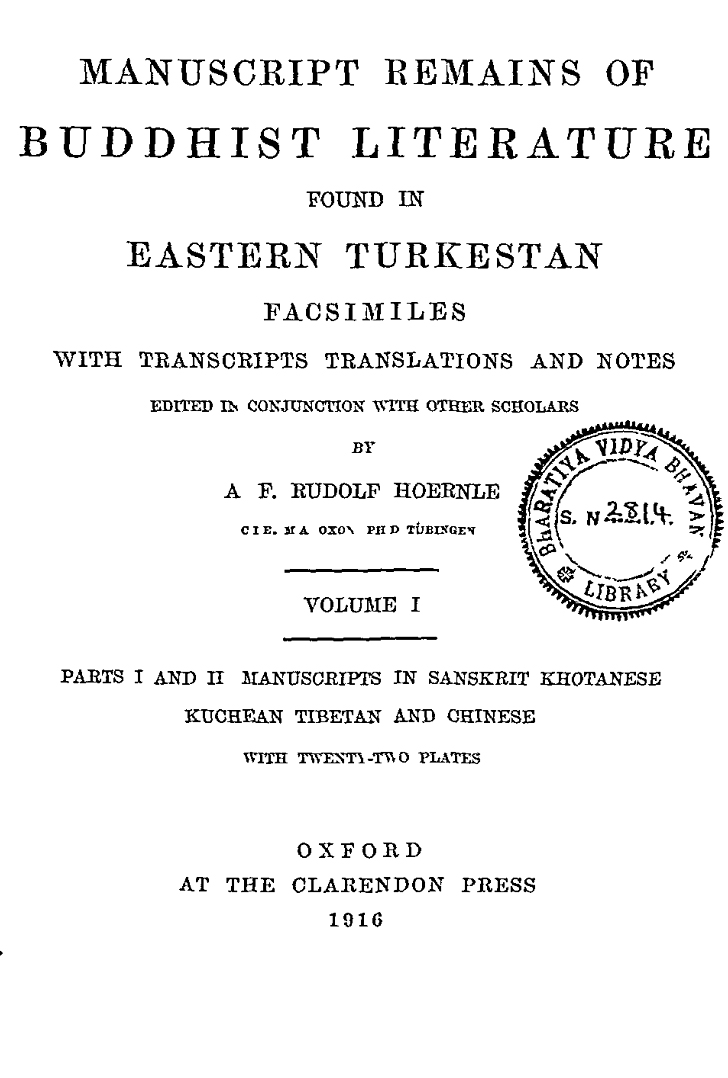
Manuscrip Remains of Buddhist Literature Found in Eastern Turkestan 1916-front.jpg

Description

Manuscript Remains of Buddhist Literature Found in Eastern Turkestan: Facsimiles with Transcripts, Translations and Notes, Volume I (Oxford: Clarendon Press, 1916), edited by A. F. Rudolf Hoernle (1841–1918) "in conjunction with other scholars," presents facsimiles, transcriptions, translations, and scholarly notes for Buddhist manuscript fragments recovered from Central Asian sites—chiefly through Sir Aurel Stein's expeditions, alongside material from Hoernle's own and George Macartney's collections—in Sanskrit, Khotanese, Kuchean, Tibetan, and Chinese. Compiled as a genuinely international collaboration, its contributors included Lionel D. Barnett, Édouard Chavannes, Sten Konow, Sylvain Lévi, Heinrich Lüders, F. E. Pargiter, and F. W. Thomas, each responsible for the material in their specialty. Hoernle's lengthy General Introduction argues, based on the newly recovered Khotanese material, that the Tibetan alphabet derived not directly from India but specifically from the script of Khotan. Though conceived as the first volume of an ongoing series, no further volumes were published. The Sanskrit material includes newly discovered fragments of hymns by the celebrated poet Mātṛceṭa, among other canonical and noncanonical texts.
Citation
Hoernle, A. F. Rudolf, ed. Manuscript Remains of Buddhist Literature Found in Eastern Turkestan: Facsimiles with Transcripts Translations and Notes. Oxford: Clarendon Press, 1916. https://archive.org/details/cu31924023185584/page/n5/mode/2up.
Table of contents
  • PART I
  • List of Contributorsv
  • General Introductionix
  • List of Manuscript Remains in Volume Ixxxiii
  • Method of Transcriptionxxxv
  • Abbreviationsxxxvi
  • Sanskrit Texts1
  • Vocabulary to Sanskrit Texts196
  • PART II
  • Khotanese Texts214
  • Vocabulary to Khotanese Texts330
  • Kuchean Texts357
  • Vocabulary to Kuchean Texts377
  • Bilingual Fragment, Chinese-Khotanese387
  • Bilingual Fragment, Tibetan-Khotanese400
  • Vocabulary to the Khotanese of Bilingual Texts405
  • Addenda410
  • Errata412
Interconnections
All 12Articles 5Classical Works 7
5 Contains chapter or part
Articles.jpeg
Articles1916About this item
An edited edition and English translation of two folios of the same manuscript of the Suvarṇaprabhāsottamasūtra (Hoernle MSS., No. 143 a, SB. 9, and No. 143, SA. 16) by Frederick William Thomas in the book Manuscript Remains of Buddhist Literature Found in Eastern Turkestan, edited by A. F. Rudolf Hoernle et al.
Articles.jpeg
Articles1916About this item
No abstract given. Here are the first relevant paragraphs:

This is a part, between one-half and two-thirds of a folio, imperfect on the left, and therefore lacking a number. But for one small gap near the right lower corner, the existing part, measuring 258 x 121 mm. (or 10 x 4 4/5 inches), is undamaged. The writing, eight lines on either side, in Upright Gupta characters, is fine, bold, formal, black, and clear: a little rubbed at the left lower corner of the obverse and corresponding upper corner of the reverse; but the reverse lines 6-8, with continuation 8 a, are in a different, smaller, thinner, distinctly cursive hand, and probably by another scribe (footnote 13, p. 127), and contain a different text.
      The text is the conclusion of a Śūraṁgama-samādhi Sūtra, followed by a Dhāraṇī, or charm (in the cursive hand). A Tibetan version, with, however, an amplified ending, may be seen in the Bkah-hgyur, Mdo. vol. 5 (ix), foll. 407 b–510 a of the India Office edition. It was translated into Chinese in A.D. 384-417 (Nanjio, No. 399, col. 98). For some passages, cited in the Śikṣāsamuccaya, see the Index I to the edition by the late

Professor Bendall. For convenience in following the drift of the passage a conjectural Sanskrit rendering of the corresponding portion of the Tibetan text is appended in parallel columns. (Thomas, preliminary remarks, 125-26)
7 Scholarship on
Gunabhadra-dakinitranslations.jpg
Classical WorksAbout this item
The Anantamukhasādhakadhāraṇī (also called The Incantation for Achieving the Boundless Gate) is an important Buddhist dhāraṇī text from the Mahāyāna tradition. It belongs to the early dhāraṇī literature that eventually developed into full tantric practices.

The text likely dates to around the 3rd-4th century CE, originating during the later development of Mahāyāna Buddhism in India. Like many dhāraṇī texts, its specific author is unknown, as these works were typically attributed to the Buddha himself or were considered to have emerged from collective spiritual practice rather than individual authorship.

The text contains mantras and incantations believed to possess spiritual power. It focuses on the concept of "unimpeded" or "infinite entrances" (anantamukha) to dharma realization. The dhāraṇī is recited to remove obstacles to spiritual practice and to gain insight into the nature of reality.

The Anantamukhasādhakadhāraṇī was influential in several ways:

  • It was translated into Chinese multiple times, including versions by Zhiyan in the 5th century and later by Xuanzang.
  • It contributed to the development of esoteric Buddhist practices in East Asia
  • It served as an important text in the transition from earlier Mahāyāna Buddhism to later tantric forms.
  • Elements of its practices were incorporated into various Buddhist rituals across Asia. (Generated by Claude.ai Apr 4, 2025)
Jinamitra translator.jpg
Classical WorksAbout this item
There are three translations in the Tibetan canon under this name:
  1. Mahāparinirvāṇasūtra (RKTSK 119)
  2. Mahāparinirvāṇasūtra (RKTSK 120)
  3. Mahāparinirvāṇasūtra (RKTSK 121)


The Mahāparinirvāṇasūtra is one of the main scriptural sources for buddha-nature in China and Tibet. Set around the time of Buddha's passing or Mahāparinirvāṇa, the sūtra contains teachings on buddha-nature equating it with the dharmakāya—that is, the complete enlightenment of a buddha. It also asserts that all sentient beings possess this nature as the buddhadhātu, or buddha-element, which thus acts as a cause, seed, or potential for all beings to attain enlightenment. Furthermore, the sūtra includes some salient features related to this concept, such as the single vehicle and the notion that the dharmakāya is endowed with the four pāramitās of permanence, bliss, purity, and a self.

It may be noted that there are three different texts with similar titles in the Chinese and Tibetan canons. Of the three Tibetan texts with Mahāparinirvāṇa in their title, a short one (Derge Kangyur, No. 121) called Āryamahāparinirvāṇasūtra contains prophecies of events in the centuries after the Buddha's Mahāparinirvāṇa but has nothing on buddha-nature. Thus, this is not the Mahāparinirvāṇāsūtra which is considered as a Tathāgatagarbhasūtra. The two which deal with buddha-nature are Mahāyānasūtras and contain detailed accounts of the final teachings of the Buddha. The first sūtra, the longer one covering two volumes of Derge Kangyur (mdo sde Nya and Ta) is a translation from Chinese, while the second one is a translation from Sanskrit. They appear to be two different recensions of the same original sūtra as they have similar titles and overlapping content. However, the one translated from Chinese is much longer and also contains information on the events after the Buddha entered Mahāparinirvāṇa.
PNT Nanam Yeshe de.jpg
Classical WorksAbout this item
The very title Ratnarāśi means "a heap or hoard of treasure or gems."[1] For the authors of the sutra, the reference is clearly to the life of strict observance of discipline, a life structured by Buddhist ascetic practice: this is the gem, and the text is a collection of advice on how to properly conduct oneself in order to realize for oneself and in oneself this jewelled goal. The monastic, ascetic, renunciant life is a treasure because it is the key to liberation from the suffering of the round of samsāra, not only for the ascetic but for those who materially support him. (Silk, "The Origins and Early History of the Mahāratnakūṭa Tradition of Mahāyāna Buddhism," 29)
Jinamitra translator.jpg
Classical WorksAbout this item
There are three translations of this text included in the Tibetan canon:
  1. Suvarṇaprabhāsottamasūtrendrarājasūtra (RKTSK 550) translated from the Chinese by Gö Chödrub.
  2. Suvarṇaprabhāsottamasūtrendrarājasūtra (RKTSK 551) translated from the Sanskrit by Jinamitra, Śīlendrabodhi, and Ye shes sde.
  3. Suvarṇaprabhāsottamasūtrendrarājasūtra (RKTSK 552). Translator not listed.
Suvarṇaprabhāsottamasūtra. (T. Gser ’od dam pai mdo; C. Jinguangming zuishengwang jing; J. Konkōmyō saishōōkyō; K. Kǔmgwangmyǒng ch’oesǔngwang kyǒng). In Sanskrit, "Sūtra of Supreme Golden Light," an influential Mahāyāna sūtra, especially in East Asia. Scholars speculate that the text originated in India in the fourth century and was gradually augmented. It was translated into Chinese by Yijing in 703. The sūtra contains many dhāraṇī and is considered by some to be a proto-tantric text; in some editions of the Tibetan canon it is classified as a tantra. It is important in East Asian Buddhism for two main reasons. First was the role the sūtra played in conceptualizing state-protection Buddhism (huguo fojiao). The sūtra declares that deities will protect the lands of rulers who worship and uphold the sūtra, bringing peace and prosperity, but will abandon the lands of rulers who do not, such that all manner of catastrophe will befall their kingdoms. The sūtra was thus central to "state protection" practices in East Asia, together with the Saddharmapuṇḍarikasūtra and the Renwang jing. Second, the sūtra provides the locus classicus for the "water and land ceremony" (shuilu hui), a ritual intended for universal salvation, but especially of living creatures who inhabit the most painful domains of saṃsāra; the ceremony was also performed for a variety of this-worldly purposes, including state protection and rain-making. According to the sūtra, in a previous life, the Buddha was a merchant s son named Jalavāhana, who one day encountered a dried-up pond in the forest, filled with thousands of dying fish. Summoning twenty elephants, he carried bags of water from a river into the forest and replenished the pond, saving the fish. He then sent for food with which to feed them. Finally, recalling that anyone who hears the name of the buddha Ratnaśikhin will be reborn in the heavens, he waded into the pond and pronounced the Buddha's name, followed by an exposition of dependent origination. When the fish died, they were reborn in the Trāyastriṃśa heaven. Recalling the reason for their happy fate, they visited the world of humans, where each offered a pearl necklace to Jalavāhana's head, foot, right side, and left side. The sūtra also tells the story of Prince Mahāsattva who sees a starving tigress and her cubs. He throws himself off a cliff to commit suicide so that the tiger might eat his body (see Namo Buddha). This is one of the most famous cases of dehadāna, or gift of the body. (Source: "Suvarṇaprabhāsottamasūtra." In The Princeton Dictionary of Buddhism, 877. Princeton University Press, 2014. http://www.jstor.org/stable/j.ctt46n41q.27.)
Kumārajīva Khyentse Foundation.jpg
Classical WorksAbout this item
Śūraṃgamasamādhisūtra [or Śūraṅgamasamādhisūtra]. (T. Dpa' bar 'gro ba'i ting nge 'dzin gyi mdo; C. Shoulengyan sanmei jing; J. Shuryōgon zanmaikyō; K. Sunǔngǒm sammae kyǒng). In Sanskrit, "Sūtra on the Heroic-March Concentration," an early Mahāyāna sūtra that explains how the mind becomes free and unimpeded like the "march" (gama) of a "hero" (śūra), who "walks alone, fearlessly, like a lion." (This translated sūtra should be distinguished from the *Śūraṃgamasūtra, a Chinese apocryphal scripture of similar name, which dates from the early eighth century.) The Śūraṃgamasamādhi as taught in this sūtra not only enables bodhisattvas quickly to attain complete, perfect enlightenment (anuttarasamyaksaṃbodhi), but also ensures that even śrāvakas, pratyekabuddhas, and arhats are put on the right path leading to buddhahood. In addition, the Śūraṃgamasamādhi also permits enlightened beings to manifest themselves in any variety of forms in order to teach sentient beings. The sūtra also includes descriptions of the world systems of many other buddhas (buddhakṣetra), including Abhirati, the buddha-land of Akṣobhya. Although some fragments of the Sanskrit recension of the Śūraṃgamasamādhisūtra have survived, the full sūtra is extant only in an early-fifth-century translation attributed to the eminent Kuchean translator Kumārajīva, in two rolls, and in an early-ninth-century Tibetan translation. (Source: "Śūraṃgamasamādhisūtra." In The Princeton Dictionary of Buddhism, 873. Princeton University Press, 2014. http://www.jstor.org/stable/j.ctt46n41q.27)