| 🤓 Admin Zone 🛠️ hidden to non-admins | |
आर्यरत्नराशिनाममहायानसूत्र
Ratnarāśisūtra
འཕགས་པ་རིན་པོ་ཆེའི་ཕུང་པོ་ཞེས་བྱ་བ་ཐེག་པ་ཆེན་པོའི་མདོ།
'phags pa rin po che'i phung po zhes bya ba theg pa chen po'i mdo
The Mass of Jewels (84000)
Text
Please note that many items in our library are simply pages that represent a detailed library catalog entry and citation of someone else's work, presentation, or performance. Read our General Disclaimer for more information.


Description
The very title Ratnarāśi means "a heap or hoard of treasure or gems."[1] For the authors of the sutra, the reference is clearly to the life of strict observance of discipline, a life structured by Buddhist ascetic practice: this is the gem, and the text is a collection of advice on how to properly conduct oneself in order to realize for oneself and in oneself this jewelled goal. The monastic, ascetic, renunciant life is a treasure because it is the key to liberation from the suffering of the round of samsāra, not only for the ascetic but for those who materially support him. (Silk, "The Origins and Early History of the Mahāratnakūṭa Tradition of Mahāyāna Buddhism," 29)
Quoted in the aligned translations
Reference
Ratnarāśisūtra [आर्यरत्नराशिनाममहायानसूत्र]. 'phags pa rin po che'i phung po zhes bya ba theg pa chen po'i mdo [འཕགས་པ་རིན་པོ་ཆེའི་ཕུང་པོ་ཞེས་བྱ་བ་ཐེག་པ་ཆེན་པོའི་མདོ།]. [The Mass of Jewels (84000)]. Translated by Surendrabodhi, Ye shes sde, Tao Kung. Kangyur, RKTSK 88 http://www.rkts.org/cat.php?id=88&typ=1.
Interconnections
2 Full translations


An English translation of the Ratnarāśisūtra from the Chinese edition by Tao Kung; published in A Treasury of Mahāyāna Sūtras, edited by Garma C. C. Chang.
2 Scholarship

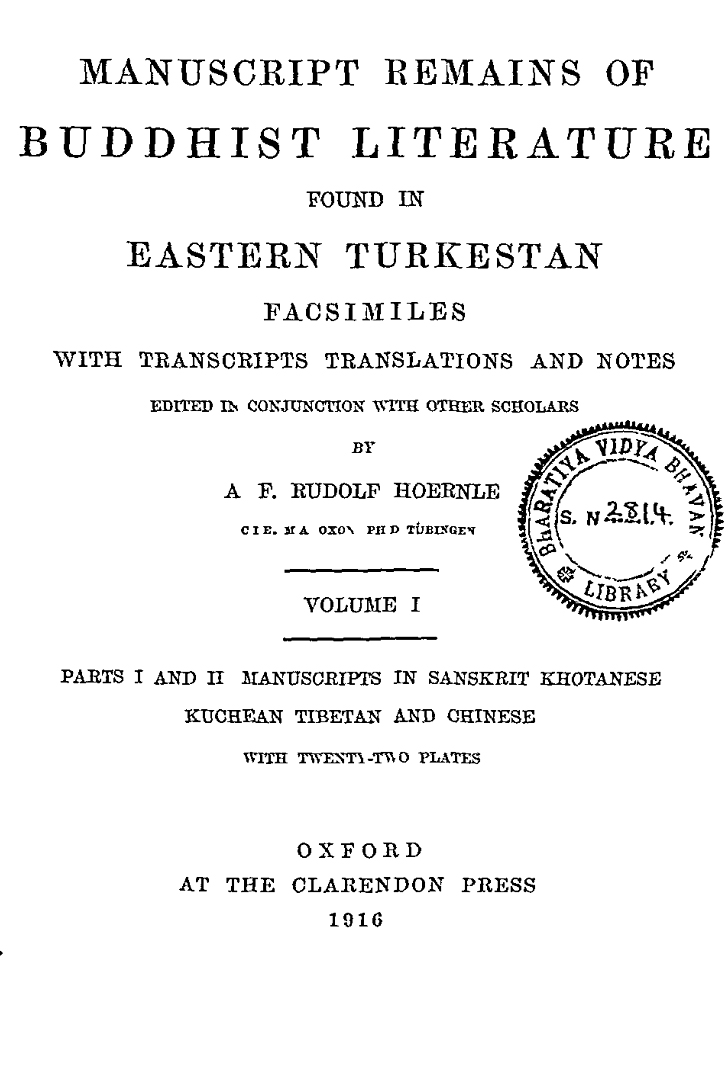
Manuscript Remains of Buddhist Literature Found in Eastern Turkestan: Facsimiles with Transcripts, Translations and Notes, Volume I (Oxford: Clarendon Press, 1916), edited by A. F. Rudolf Hoernle (1841–1918) "in conjunction with other scholars," presents facsimiles, transcriptions, translations, and scholarly notes for Buddhist manuscript fragments recovered from Central Asian sites—chiefly through Sir Aurel Stein's expeditions, alongside material from Hoernle's own and George Macartney's collections—in Sanskrit, Khotanese, Kuchean, Tibetan, and Chinese. Compiled as a genuinely international collaboration, its contributors included Lionel D. Barnett, Édouard Chavannes, Sten Konow, Sylvain Lévi, Heinrich Lüders, F. E. Pargiter, and F. W. Thomas, each responsible for the material in their specialty. Hoernle's lengthy General Introduction argues, based on the newly recovered Khotanese material, that the Tibetan alphabet derived not directly from India but specifically from the script of Khotan. Though conceived as the first volume of an ongoing series, no further volumes were published. The Sanskrit material includes newly discovered fragments of hymns by the celebrated poet Mātṛceṭa, among other canonical and noncanonical texts.

A complete, annotated translation of the Ratnarāśisūtra with critical editions of the Tibetan canonical translation, with Sanskrit fragments, and the Chinese canonical translation.
6 A topic of
Contains 22 of the 49 Sūtras of the Mahāratnakūṭa (or "Treasury") Sūtra, many translated for the first time in a Western language
An English translation of the Ratnarāśisūtra from the Chinese edition by Tao Kung; published in A Treasury of Mahāyāna Sūtras, edited by Garma C. C. Chang.
Manuscript Remains of Buddhist Literature Found in Eastern Turkestan: Facsimiles with Transcripts, Translations and Notes, Volume I (Oxford: Clarendon Press, 1916), edited by A. F. Rudolf Hoernle (1841–1918) "in conjunction with other scholars," presents facsimiles, transcriptions, translations, and scholarly notes for Buddhist manuscript fragments recovered from Central Asian sites—chiefly through Sir Aurel Stein's expeditions, alongside material from Hoernle's own and George Macartney's collections—in Sanskrit, Khotanese, Kuchean, Tibetan, and Chinese. Compiled as a genuinely international collaboration, its contributors included Lionel D. Barnett, Édouard Chavannes, Sten Konow, Sylvain Lévi, Heinrich Lüders, F. E. Pargiter, and F. W. Thomas, each responsible for the material in their specialty. Hoernle's lengthy General Introduction argues, based on the newly recovered Khotanese material, that the Tibetan alphabet derived not directly from India but specifically from the script of Khotan. Though conceived as the first volume of an ongoing series, no further volumes were published. The Sanskrit material includes newly discovered fragments of hymns by the celebrated poet Mātṛceṭa, among other canonical and noncanonical texts.

Taking an instance of intertextuality between a pair of passages from two texts quoted in the Śikṣāsamuccaya, this paper explores the usage of the phrase tṛṇagulmauṣadhivanaspati.
A complete, annotated translation of the Ratnarāśisūtra with critical editions of the Tibetan canonical translation, with Sanskrit fragments, and the Chinese canonical translation.

This article (in Japanese) by Morinobu Asano discusses the Ratnarāśisūtra as quoted in the Śikṣāsamuccaya. Published in the Journal of Indian and Buddhist Studies.