Śūraṁgama-Samādhi Sūtra (Thomas)

From Bodhicitta
Articles/Śūraṁgama-Samādhi Sūtra (Thomas)

🤓 Admin Zone 🛠️ hidden to non-admins
Śūraṁgama-Samādhi Sūtra
Chapter in a Book


Please note that many items in our library are simply pages that represent a detailed library catalog entry and citation of someone else's work, presentation, or performance. Read our General Disclaimer for more information.

Description

No abstract given. Here are the first relevant paragraphs:

This is a part, between one-half and two-thirds of a folio, imperfect on the left, and therefore lacking a number. But for one small gap near the right lower corner, the existing part, measuring 258 x 121 mm. (or 10 x 4 4/5 inches), is undamaged. The writing, eight lines on either side, in Upright Gupta characters, is fine, bold, formal, black, and clear: a little rubbed at the left lower corner of the obverse and corresponding upper corner of the reverse; but the reverse lines 6-8, with continuation 8 a, are in a different, smaller, thinner, distinctly cursive hand, and probably by another scribe (footnote 13, p. 127), and contain a different text.
      The text is the conclusion of a Śūraṁgama-samādhi Sūtra, followed by a Dhāraṇī, or charm (in the cursive hand). A Tibetan version, with, however, an amplified ending, may be seen in the Bkah-hgyur, Mdo. vol. 5 (ix), foll. 407 b–510 a of the India Office edition. It was translated into Chinese in A.D. 384-417 (Nanjio, No. 399, col. 98). For some passages, cited in the Śikṣāsamuccaya, see the Index I to the edition by the late Professor Bendall. For convenience in following the drift of the passage a conjectural Sanskrit rendering of the corresponding portion of the Tibetan text is appended in parallel columns. (Thomas, preliminary remarks, 125-26)

Citation
Thomas, Frederick William, ed. and trans. "Śūraṁgama-Samādhi Sūtra." In Manuscript Remains of Buddhist Literature Found in Eastern Turkestan: Facsimiles with Transcripts Translations and Notes, edited by A. F. Rudolf Hoernle et al., 125–32. Oxford: Clarendon Press, 1916. https://archive.org/details/cu31924023185584/page/124/mode/2up.
Interconnections
1 Partial translation of
Classical WorksAbout this item
Śūraṃgamasamādhisūtra [or Śūraṅgamasamādhisūtra]. (T. Dpa' bar 'gro ba'i ting nge 'dzin gyi mdo; C. Shoulengyan sanmei jing; J. Shuryōgon zanmaikyō; K. Sunǔngǒm sammae kyǒng). In Sanskrit, "Sūtra on the Heroic-March Concentration," an early Mahāyāna sūtra that explains how the mind becomes free and unimpeded like the "march" (gama) of a "hero" (śūra), who "walks alone, fearlessly, like a lion." (This translated sūtra should be distinguished from the *Śūraṃgamasūtra, a Chinese apocryphal scripture of similar name, which dates from the early eighth century.) The Śūraṃgamasamādhi as taught in this sūtra not only enables bodhisattvas quickly to attain complete, perfect enlightenment (anuttarasamyaksaṃbodhi), but also ensures that even śrāvakas, pratyekabuddhas, and arhats are put on the right path leading to buddhahood. In addition, the Śūraṃgamasamādhi also permits enlightened beings to manifest themselves in any variety of forms in order to teach sentient beings. The sūtra also includes descriptions of the world systems of many other buddhas (buddhakṣetra), including Abhirati, the buddha-land of Akṣobhya. Although some fragments of the Sanskrit recension of the Śūraṃgamasamādhisūtra have survived, the full sūtra is extant only in an early-fifth-century translation attributed to the eminent Kuchean translator Kumārajīva, in two rolls, and in an early-ninth-century Tibetan translation. (Source: "Śūraṃgamasamādhisūtra." In The Princeton Dictionary of Buddhism, 873. Princeton University Press, 2014. http://www.jstor.org/stable/j.ctt46n41q.27)
1 Chapter or part of
Books1916About this item
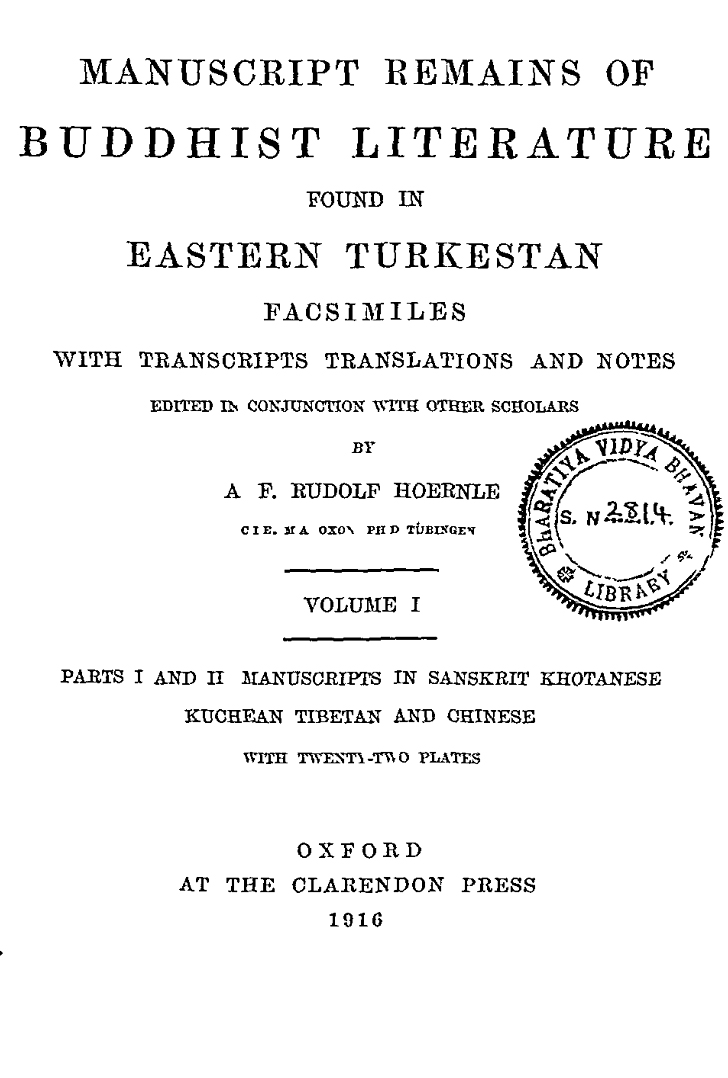
Manuscript Remains of Buddhist Literature Found in Eastern Turkestan: Facsimiles with Transcripts, Translations and Notes, Volume I (Oxford: Clarendon Press, 1916), edited by A. F. Rudolf Hoernle (1841–1918) "in conjunction with other scholars," presents facsimiles, transcriptions, translations, and scholarly notes for Buddhist manuscript fragments recovered from Central Asian sites—chiefly through Sir Aurel Stein's expeditions, alongside material from Hoernle's own and George Macartney's collections—in Sanskrit, Khotanese, Kuchean, Tibetan, and Chinese. Compiled as a genuinely international collaboration, its contributors included Lionel D. Barnett, Édouard Chavannes, Sten Konow, Sylvain Lévi, Heinrich Lüders, F. E. Pargiter, and F. W. Thomas, each responsible for the material in their specialty. Hoernle's lengthy General Introduction argues, based on the newly recovered Khotanese material, that the Tibetan alphabet derived not directly from India but specifically from the script of Khotan. Though conceived as the first volume of an ongoing series, no further volumes were published. The Sanskrit material includes newly discovered fragments of hymns by the celebrated poet Mātṛceṭa, among other canonical and noncanonical texts.