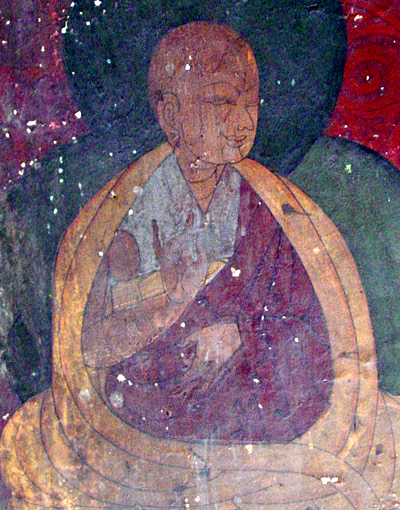
Kyotön Monlam Tsultrim on the Bodhicaryāvatāra: One Text to Practice Them All
| 🤓 Admin Zone 🛠️ hidden to non-admins | |
Featured on
Introduction
The thirteenth century marked a transformative period in Tibetan Buddhist history, as the tradition evolved from primarily receiving and translating Indian Buddhist teachings to developing distinctive Tibetan approaches to both doctrine and practice. During what David Seyfort Ruegg termed the "classical-systematic period," Tibetan Buddhist masters began consolidating and reinterpreting the vast corpus of Buddhist literature they had inherited.[1] Within this context, Kyotön Monlam Tsultrim (1219–1299/1300) emerged as a significant figure who helped shape how Śāntideva's Bodhicaryāvatāra was transmitted and practiced.
As the eighth abbot of Narthang Monastery, one of the most important centers of Buddhist learning in Tibet at that time, Kyotön stands as a pivotal figure in the transmission and practice of Śāntideva's Bodhicaryāvatāra. While the Bodhicaryāvatāra had been a subject of study and practice within the Kadam tradition since Atiśa's arrival in the eleventh century, Kyotön’s unique contribution lies in his role in the transmission of Atiśa's "wheel-like" (khor lo lta bu) approach to the text. This approach, which was revealed to Ācārya Akṣayamati by Mañjuśrī, emphasized the interconnectedness of all aspects of the bodhisattva path, integrating scholarly understanding with practical application. In Kyotön's collected works, a short text composed by Lhatsunpa (Lha btsun pa) in the style of Atiśa's commentary contains annotations probably made by Kyotön himself. Other practical instructions related to this practice lineage of the Bodhicaryāvatāra are also found in this collection.[2]
Kyotön's Life and Times
Early Life and Training at Narthang Monastery
Born in 1219 in Tanak (Rta nag) in the Tsang region of Central Tibet, Kyotön came from the Kyo (Skyo) clan, whose religious heritage encompassed both Buddhist and Bön traditions. His childhood, during which he was known by the nickname "Stardom" (snyan grags), was shaped by this dual religious environment. His father's practice of both traditions established a pattern of religious inclusivity that would later influence Kyotön's approach to Buddhist practice. Before his formal Buddhist education, he received teachings from both traditions under the guidance of the family priest Gyaring Sherab Gyaltsen (Rgya rings Shes rab rgyal mtshan).
Two key figures were instrumental in shaping Kyotön's early spiritual trajectory. The first was Gyaring Sherab Gyaltsen, who recognized his potential and predicted his future as a Buddhist master. The second was Tsongtön Repa (Tshong ston ras pa), who provided his first Buddhist initiation into the practice of Vajravārāhī. A significant prophetic dream in which Tshongtön saw Kyotön holding up a sun would later prove prescient of his role in transmitting Buddhist teachings.
Kyotön's entry into the Buddhist path proper came through his ordination at Narthang Monastery in 1238, where he received both novice and full ordination from Zhangtön Chökyi Lama (Zhang ston chos kyi bla ma, 1184–1253). This timing proved fortuitous, as Narthang was entering its golden age as a center of both scholarly learning and contemplative practice. Under the guidance of three successive abbots–Zhangtön Chökyi Lama, Sangye Gompa (Sangs rgyas sgom pa, 1203–1280), and most significantly, Chim Namkha Drak (Mchims nam mkha' grags, 1210–1285)—Kyotön received a comprehensive Buddhist education that would shape his future contributions to Tibetan Buddhism. The sources reveal the extraordinary breadth and depth of Kyotön's education at Narthang. According to the biographical accounts preserved in the texts, he received teachings on over 350 texts and topics from Chim Namkha Drak alone. This transmission was described as being "like filling one vase from another," suggesting the completeness and precision of the teaching transmission.
Institutional Leadership
As the eighth abbot of Narthang (1285–1299/1300), Kyotön's leadership coincided with significant political changes in Tibet. Following the Drikung revolt of 1290 and the subsequent civil war between Drikung and Sakya, Kyotön needed to secure Narthang's position. The monastery's location near Sakya provided some protection, as did Kyotön's diplomatic skills in maintaining relationships with both religious and political authorities. His leadership during this turbulent period was characterized by both institutional development and spiritual innovation. Under his guidance, Narthang experienced significant physical expansion, including the construction of new temple buildings and the "great iron mountains" (lcags ri chen mo), fortress-like walls that encircled the monastery.
Kyotön's daily responsibilities as abbot were structured around a well-established monastic schedule that integrated contemplative practice, administrative duties, and scholarly activities. The early and late portions of each day were allocated to personal spiritual cultivation and academic writing. Despite not matching the literary output of his predecessor, Chim Namkha Drak, Kyotön produced significant contributions to multiple genres of Buddhist literature, including exegetical works on Indian treatises, pedagogical manuals on the graduated path, and philosophical commentaries, with most works being relatively concise in length.
The institutional responsibilities at Narthang occupied his afternoons, encompassing ritual observances, administrative oversight, and pastoral care for his disciples. The pedagogical schedule followed the established pattern at Narthang, with seasonal variations in the student population. In terms of his pedagogical focus, while maintaining the traditional Narthang curriculum that included foundational texts like the Bodhicaryāvatāra, Kyotön distinguished himself through an emphasis on experiential instruction over purely scholastic exposition. Of particular significance was his role in transmitting the core Kadam texts, including Śāntideva's works, through an approach that prioritized direct practical application.
Final Teachings and Death
Kyotön's liberation story, or namthar (rnam thar),[3] provides a detailed account of his final period of teaching and death. In his later years, particularly during the Dog year on the fifteenth day of the later spring month, he announced that "now there is no need for further dates" (da phyi tshes kyi dgos pa med), indicating his awareness of his approaching death.
The text records that when asked to provide detailed instructions by Chen Ngawa (Spyan snga ba), he replied that he would remain for at most two more months, saying "Although this old elemental body has no strength, since this is a time when the teachings are declining, if even just uninterrupted teaching and listening can occur, it might serve as a circumstantial cause [for preserving the teachings]."[4] Kyotön's final teachings, delivered just before his death in 1299/1300, were extensive instructions on the Bodhicaryāvatāra. His insistence on teaching the winter session of the Dharma at Narthang even after acknowledging his impending death attests to his unwavering commitment to the transmission of these teachings. His passing was marked by elaborate funerary rituals, and his remains were enshrined in a reliquary alongside those of previous Narthang abbots.
Kyotön's Reception of the Bodhicaryāvatāra
The Transmission of Śāntideva's Works at Narthang Monastery
The Bodhicaryāvatāra played a central role in Kadam education from the tradition's earliest days, embedded within a sophisticated curricular structure that evolved through several generations. When Atiśa arrived in Tibet in 1040, he brought not only new texts but also a distinctive approach to Buddhist education that would shape how the Bodhicaryāvatāra was taught and practiced. His Lamp for the Path to Enlightenment (Bodhipathapradīpa) established a framework for systematic Buddhist education that would come to characterize Kadam approaches to texts like the Bodhicaryāvatāra.
At Narthang Monastery, founded in 1153, we can trace how this systematic approach developed through successive generations. The monastery's founder, Tumtön (Thum ston, mid-12th c.), taught the Bodhicaryāvatāra alongside Śāntideva's Śikṣāsamuccaya, establishing a pattern of paired textual study that would become characteristic of the Kadam curriculum. This pairing wasn't arbitrary—it reflected a deliberate pedagogical strategy that connected philosophical understanding with practical application. As such, these two texts were part of the six core texts (gzhung drug) of the Kadam scriptural tradition (gzhung lugs) transmitted by Potowa Rinchen Sal (Po to ba rin chen gsal, 1027–1105) and his student Sharawa (Sha ra ba yon tan grags, 1070–1141).[5]
While much of Kyotön's writings have been lost, including his extensive commentary on the Bodhicaryāvatāra, Karma Phuntsho recently edited and published Kyotön's extant works as found in The Collected Works of Kadam series. These texts are extremely helpful to understand the central role played by Śāntideva's works in the education of monks at Narthang specifically and in the Kadam tradition in general. Four works in this collection help us appreciate the importance of Śāntideva's Bodhicaryāvatāra and Śikṣāsamuccaya in Narthang’s curriculum:
- The Golden Ring: A Beautiful Ornament of the Life Story [Which Is Like] Mount Meru with Four Magnificent Precious [Qualities]
- Record of Teachings Received by Kyötön Mönlam Tsultrim[6]
- A Garland of Praised Qualities: The Biography of Chim Namkha Drak[7]
- Accomplishing the Purpose of Beings: An Excellent Explanation Commentary on the Abhisamayālaṃkāra[8]
The examination of these works reveals a sophisticated system of transmission at Narthang that encompassed both study and practice traditions. The monastery developed a structured seasonal approach to teaching these texts. According to the biographical sources (rnam thar), winter sessions were dedicated to the Bodhicaryāvatāra together with the Lamrim (dgun spyod 'jug lam rim), while summer sessions focused on the Śikṣāsamuccaya paired with the Lamrim (dbyar bslab btus lam ston).
The study tradition at Narthang was characterized by multiple layers of textual engagement, drawing upon an extensive commentarial tradition. The root text was taught alongside major Indian commentaries, particularly Prajñākaramati's authoritative Bodhicaryāvatārapañjikā. According to Kyotön's Illuminating Rays: An Introduction to Teaching and Learning the Dharma,[9] there were also three primary commentaries that explained the text according to the Svātantrika system, reflecting the sophisticated philosophical framework through which the Bodhicaryāvatāra was interpreted at Narthang. The study of the root text and its commentaries was supplemented by comprehensive study aids, including detailed outlines (sa bcad), historical accounts (lo rgyus), analytical explanations (rnam par dpyad pa), and "excellent explanations" (legs bshad) that formed the scholarly apparatus of textual study. In addition, teachers would provide personal analytical explanations (nyid kyis rnam par dpyad pa), ensuring that students received both traditional interpretations and fresh insights into the text. The text's central role in the doctrinal education of students at Narthang can be perceived in the way it was used to explain other major treatises. For instance, in Kyötön's commentary on the Abhisamayālaṃkāra, the Bodhicaryāvatāra is cited as an authoritative source on the nature of ultimate truth, particularly drawing on its famous statement that "The ultimate is not an object of mind" (don dam blo yi spyod yul min).[10] This citation appears in a complex doctrinal discussion of the relationship between conceptual and nonconceptual cognition in the context of the path of meditation, demonstrating how the Bodhicaryāvatāra served as a key reference point for explaining complex philosophical concepts across different textual traditions.
The practice tradition developed distinctive pedagogical approaches. One notable format was the "wheel-like" teaching system ('khor lo lta bu), which involved a nineteenfold cyclical progression (lan bcu dgu'r 'khor ba). This was complemented by systematic presentations directly drawn from Serlingpa and Atiśa's lineage, such as the "thirty-six topics" (don sum cu rtsa drug), summary of eleven main points (gtso bo’i don bcu gcig bsdus), as well as various forms of practical instruction (lag len). The tradition preserved both written commentaries (ti ka) and oral instructions (bla ma'i gsung sgros), combining textual scholarship with direct experiential guidance. Kyotön's record of teachings received (gsan yig) provides additional evidence of the text's comprehensive transmission, listing various specialized formats including direct instructions (khrid), practical instructions (lag khrid), and lists of essential points in Śāntideva's texts (gzhung 'bril). The tradition also preserved historical accounts of Śāntideva's lineage (zhi ba lha'i brgyud pa) and teachings about his qualities (slob dpon zhi ba lha'i yon tan), contextualizing the text within its Indian origins and explaining the importance of his teachings.
This layered tradition of commentary and instruction on Śāntideva's works shows the centrality of this tradition at Narthang. They attest to the sophisticated hermeneutical approaches developed for understanding and transmitting the Bodhicaryāvatāra's teachings in this particular tradition. The monastery's systematic organization of both study and practice ensured that students received not only scholarly exegesis but also practical guidance for integrating Śāntideva's teachings into their daily lives, fulfilling thereby the Kadam ideal of uniting textual learning with meditative practice.
The Transmission of the Bodhicaryāvatāra to Kyotön
Textual sources document Kyotön's extensive reception of the Bodhicaryāvatāra from multiple masters.[11] From his principal teacher Zhangtön Chökyi Lama, who served as his ordination preceptor, he received the Bodhicaryāvatāra along with other major Mahāyāna texts, including the Śikṣāsamuccaya, Jātakamālā, and Sūtrālaṃkāra commentary.[12] This transmission established his foundational understanding of the bodhisattva path. It is worth noting that Zhangtön Chökyi Lama transmitted to him the complete text of the Bodhicaryāvatāra eight times.
From Sangye Gompa, described in the sources as "the holy spiritual friend who with the lion's roar of scriptural understanding and realization became a sacred refuge for all beings," Kyotön received three separate transmissions of the Bodhicaryāvatāra along with its ancient shorter commentary ('grel chung rnying ma),[13], demonstrating the text's importance in his training.[14]
A particularly significant transmission came from Chumigpa Drakpa Gyaltsen (Chu mig pa grags pa rgyal mtshan, 13th c.), who provided both the root text and detailed instructional manuals. These included the Bodhicaryāvatāra's Thirty-Six Points (Spyod 'jug gi don sum cu rtsa drug), Summary in Eleven Main Points (Gtso bo'i don bcu gcig tu bsdus pa), and notably, the Wheel-Like Path Arising in the Mindstream Nineteen Times (Spyod 'jug 'khor lo lta bu'i lam rgyud la skye ba'i rim pa lan bcu dgur 'khor ba).[15]
From Dorje Senge (Rdo rje seng ge, 13th c.), Kyotön received both the root text and Prajñākaramati's Bodhicaryāvatārapañjikā, demonstrating his engagement with the Indian scholastic tradition surrounding the text.[16] The depth of his study is further shown by his reception of various practical instruction manuals (khrid) on the Bodhicaryāvatāra, including oral instructions (zhal gyi gdams pa) and condensed essential points (don bsdus) from these various masters.
In addition, it is plausible that he received teachings on the Wisdom chapter (shes rab le'u) from Chim Namkha Drak, who himself received these teachings from Drutön Sherab Tsöndru (Gru ston shes rab brtson 'grus, 1203–1267).[17]
This extensive series of transmissions of the root text of the Bodhicaryāvatāra was complemented by various practical instruction manuals, oral instructions, and condensed essential points from multiple masters. The nature of the text transmitted shows how Kyotön engaged with the Bodhicaryāvatāra not just as a philosophical text but as a complete system of practice supported by both Indian commentarial traditions and Tibetan practical instruction lineages, which, in these days, would have played a central role in the Narthang monastic tradition. Moreover, the sources indicate that these teachings were often received alongside other major Mahāyāna works, suggesting a comprehensive approach to understanding the text within the broader context of Buddhist thought and practice as exemplified in Atiśa's own commentary to the Bodhicaryāvatāra.
The Bodhicaryāvatāra in Kyotön's Extant Works
Three texts in Kyotön's collected works are directly about the Bodhicaryāvatāra:
- A Concise Ritual for Generating Bodhicitta according to the System of Ācārya Śāntideva[18]
- Oral Instructions, Sayings, and Historical Accounts[19]
- The Wheel-like Method for Meditating on the Profound Path of the Bodhicaryāvatāra
A Concise Ritual for Generating Bodhicitta according to the System of Ācārya Śāntideva
This text focuses on Śāntideva's approach to the generation of bodhicitta. It emphasizes the paramount importance of bodhicitta as the foundational element for attaining buddhahood, asserting that enlightenment is unattainable without its generation. Kyotön begins his teaching on the topic by first establishing its authenticity through the mention of its transmission from Mañjuśrī to Śāntideva.[20]
The ritual manual itself is systematically organized into two major sections: the preliminary practices (sngon du 'gro ba) and the main ritual (cho ga dngos). This structure reflects the typical approach of gradually preparing the practitioner's mind before engaging in the main practice. The preliminary section encompasses several essential elements: supplication to the guru, arrangement of sacred objects (rten), presentation of offerings (mchod pa), accumulation of merit through service to the guru and sangha (bsnyen bkur), and cultivation of loving-kindness and compassion (byams snying rje). The text emphasizes the foundational role of bodhicitta in the great vehicle. This is explained by a citation from the Bodhicaryāvatāra that establishes the soteriological importance of bodhicitta generation within the broader framework of Mahāyāna practice:
If the merit of bodhicitta were to take physical form, it would more than fill the entire realm of space.[21]
The main ritual section is further subdivided into three phases: preparation (sbyor ba), main practice (dngos gzhi), and conclusion (mjug). The preparatory phase includes the offering of flowers to the guru, receiving teachings on bodhicitta's benefits, purification of obscurations (sgrib pa sbyong ba), and cultivation of the appropriate mindset. The core practice incorporates the traditional seven-limbed prayer (yan lag bdun pa) along with taking refuge in the Three Jewels, confession of negative actions, rejoicing in others' virtues, requesting the buddhas to teach and remain in the world, and dedication of merit.
A distinctive feature of Kyotön's presentation is his integration of the concept of illusion (sgyu ma) within the practical framework of bodhicitta generation. This is most explicitly articulated in short instructions on mind training (rjes mthun pa'i blo sbyong ba), where he prescribes three key points: viewing the guru as Buddha, cultivating compassion for all beings, and recognizing one's own nature as dreamlike and illusory (rang la rmi lam sgyu ma lta bu'i 'du shes). This tripartite framework effectively combines devotional practice, altruistic motivation, and philosophical understanding.
This passage is significant because it shows how the understanding of the illusory nature of reality is integrated into the practical aspects of bodhicitta practice. In the context of practicing this path, this understanding of illusory reality is not just an abstract philosophical concept but a tool for cultivating compassion and detachment. By seeing oneself and one's experiences as dreamlike, many key aspects become easier, such as letting go of ego-clinging and developing a genuine concern for the well-being of all beings. This approach, combining detachment, compassion, and the overall understanding of the noninherent existence of phenomena, encapsulates the main aspects of bodhicitta in Śāntideva's tradition.
The text concludes with sections on expressions of joy, commitment to the bodhisattva precepts, and expressions of gratitude to the guru. Of particular note is the emphasis on maintaining the bodhisattva vows, with specific mention of avoiding the eighteen root downfalls (rtsa ltung bco brgyad) and various minor infractions (nyes byas). As a whole, Kyotön's ritual manual represents a concise synthesis of the Mahāyāna view of reality and its practical application.
Oral Instructions, Sayings, and Historical Accounts
The first part of this short text provides a detailed account of the transmission lineage of the Bodhicaryāvatāra, beginning with Śāntideva himself. The narrative opens with Śāntideva's early life, identifying him as the son of King Kalyāṇavarman (Dge ba go cha) near Nālandā. After his father's passing, when asked to assume the throne, Śāntideva received direct instruction from Mañjuśrī to pursue spiritual practice instead of accepting royal authority.
This biographical detail emphasizes the text's legitimacy through its connection to both royal lineage and divine guidance. The text then chronicles Śāntideva's ordination at Nālandā under Khenpo Gyalwe Lha (Mkhan po Rgyal ba'i lha, likely Jayādeva), where he became renowned as the miraculous practitioner Bhusuku. The account includes seven significant episodes from Śāntideva's life, including his recitation of the Bodhicaryāvatāra, his defeat of non-Buddhist opponents at the Śrī Nālandā stūpa, and various miraculous demonstrations of compassionate activity. This significant historical account describes a crucial phase in the transmission of Śāntideva's teachings, beginning with a miraculous event in an Eastern Indian magical city (sgyu ma'i grong khyer) where Śāntideva converted non-Buddhists through supernatural displays. The lineage then proceeds through a succession of authenticated transmissions, starting with two monks possessing the "unforgetting dhāraṇī" (mi brjed pa'i gzungs), who passed the teachings to Suvarṇadvīpa (i.e., Serlingpa, Gser gling pa chos kyi grags pa, 10th–11th c.). The text details how Suvarṇadvīpa, after dedicated practice and praying to Mañjuśrīvajra and Śāntideva themselves, composed condensed instruction manuals on three fundamental texts: the Bodhicaryāvatāra, Śikṣāsamuccaya, and Sūtrasamuccaya.[22] The lineage then split into two major Tibetan transmissions through masters Dhanaśrī of Nepal and a Chinese teacher, with particular emphasis on the master Gyenkarwa (Rgyan dkar ba, alias Rgya ther ba), who, along with Kamawa (Ka ma ba), was considered one of only two Tibetan masters to have fully dedicated themselves to the Bodhicaryāvatāra, mastering both its philosophical views (lta ba) and the wide scope of bodhisattva conduct (spyod pa).
The second part of the text comes in the form of a systematic meditation manual (lag khrid) organized around several key contemplative frameworks, demonstrating how Tibetan teachers integrated philosophical insights with practical meditation methods. The text begins with instructions on contemplating the two truths (bden gnyis kyi lag khrid), citing BCA 9.2ab.[23] It then proceeds to explain that conventional truth has two aspects: incorrect conventional truth (log pa'i kun rdzob), characterized by ordinary beings' grasping at appearances as real, and correct conventional truth (yang dag pa'i kun rdzob), which is the yogic perspective that realizes appearances as illusory. The text states: "By realizing appearances as illusion, one proceeds on the path."[24]
The instruction then moves to personal selflessness (gang zag bdag med). The text provides a systematic deconstruction of the body parts to counter ordinary ego-grasping through analytical investigation. The four foundations of mindfulness (dran pa nyer bzhag bzhi) form the core framework for developing phenomenal selflessness (chos kyi bdag med). For body mindfulness, the text prescribes both gross and subtle analysis, from body parts down to the atoms. For feelings mindfulness, the text presents three aspects of analysis: what is experienced, contact between subject and object as the cause for experiencing things, and the ground of experience, mind. This instruction emphasizes understanding how feelings arise dependently and lack inherent existence. Mind mindfulness focuses on the six consciousnesses. This investigation aims to reveal the unlocatable nature of mind through systematic analysis. The fourth foundation, phenomena mindfulness, integrates conventional appearance with ultimate emptiness through the notion of non-arising. This instruction synthesizes the earlier understanding of the two truths and turns it into direct contemplative experience.
The text then presents methods for overcoming reification through the "vajra-splinter" analysis (rdo rje gzegs ma), examining how phenomena lack true causation. This leads to the experiential realization that appearances are dreamlike, beyond arising or ceasing.
Finally, the text presents six aspects of compassion meditation (snying rje'i lag khrid drug) to ensure that the realization of wisdom is inseparable from profound compassion.
The meditation structure of these short instructions reflects key themes from the Bodhicaryāvatāra, particularly chapters 8 and 9:
- The two truths (bden gnyis) section corresponds to BCA 9.2 and its subsequent verses. The text's emphasis on conventional truth being like an illusion (sgyu ma) directly parallels BCA 9.2–8.
- The analysis of selflessness through examination of body parts echoes BCA 9.57–59, where Śāntideva analyzes the body into its constituent parts to explain the lack of inherent existence.
- The compassion meditation section (snying rje'i lag khrid) reflects contemplations found in chapters 7 and 8 of the Bodhicaryāvatāra, particularly regarding equalizing and exchanging self and others (bdag gzhan mnyam pa and bdag gzhan brje ba).
- The emphasis on overcoming reification through understanding phenomena as dreamlike mirrors BCA 9.5, which stresses how yogis perceive phenomena as illusions.
What's particularly significant is how this text systematizes the Bodhicaryāvatāra's philosophical content into structured meditation practices. While the Bodhicaryāvatāra presents philosophical arguments about emptiness, this text transforms those arguments into step-by-step contemplative exercises through the framework of the four foundations of mindfulness. Kyotön's Oral Instructions, Sayings, and Historical Accounts therefore represents a fascinating teaching showing how the Bodhicaryāvatāra was received and practiced in Tibet—transforming its philosophical discourse into systematic meditation instructions while maintaining its core emphasis on unifying wisdom and compassion. The concluding emphasis on both studying the text's meaning and developing direct experience reflects the Bodhicaryāvatāra's approach of uniting scholarly understanding with meditation practice.
The Wheel-like Method for Meditating on the Profound Path of the Bodhicaryāvatāra
The text known as The Wheel-like Method for Meditating on the Profound Path of the Bodhicaryāvatāra (Spyod 'jug 'khor lo lta bu'i zab lam sgom don)[25] builds upon an earlier text composed by Atiśa Dīpaṃkara (982–1054). Kyotön's text is indeed directly inspired by Atiśa's commentary on the Bodhicaryāvatāra. Both texts use the wheel metaphor to explain the unified nature of the path and its transformative power. Like Atiśa's commentary, The Wheel-like Method for Meditating presents the Bodhicaryāvatāra's ten chapters as spokes of a wheel that systematically cut through various obstacles to awakening, with the practitioner's mind serving as the hub or axle that powers the entire transformative process. Kyotön expands upon Atiśa's foundation by elaborating a more detailed correspondence between the wheel's components and specific aspects of the path while maintaining the core insight that the Bodhicaryāvatāra's teachings function as an integrated system of spiritual transformation.
The Wheel-like Method starts with a fascinating dialogue between Akṣayamati (i.e., Śāntideva) and Mañjuśrī like the one found in Atiśa's original text. In this dialogue, Mañjuśrī responds by revealing a sophisticated framework that uses the metaphor of a wheel to elucidate the entire way of the bodhisattva as expounded in the practice tradition of the Bodhicaryāvatāra.[26] The wheel metaphor serves as the organizing principle for understanding the text's entire pedagogical approach. Just as a wheel's hub turns through the power of conditions and thereby moves its spokes, the text explains that the practitioner progresses through spiritual development by engaging with the ten chapters (compared to the wheel spokes) of the Bodhicaryāvatāra. This dynamic metaphor emphasizes the interconnected nature of the practice, where progress in one area naturally stimulates development in others. The text elaborates this through the analogy of the wheel of a scythed chariot according to which the wheel hub set in motion through the power of external conditions causes the spokes to turn, mowing down all obstacles and clearing the chariot's path.
Just like in Atiśa's commentary, the text presents a sophisticated three-tiered system of practice corresponding to practitioners of different capacities: superior (rab), middling ('bring), and inferior (tha ma). For advanced practitioners, the text organizes the Bodhicaryāvatāra into three essential aspects: the first five chapters dealing with the bodhisattva and bodhicitta, the final two chapters on the bodhisattva way of life inspired by wisdom and compassion, and the middle three chapters on how to engage in this path. This tripartite structure provides accomplished practitioners with a concise framework for understanding the text's essential points.
For practitioners of middling capacity, the text expands this framework into eleven key points, carefully mapping how each chapter of the Bodhicaryāvatāra builds upon and reinforces the others. This begins with the recognition of one's precious human birth as the foundation of one's path, progresses through the generation and strengthening of bodhicitta, and culminates in the perfection of wisdom and compassionate activity for the benefit of all beings. Each chapter is understood not as an isolated teaching but as part of an integrated system where progress in one area naturally stimulates advancement in others.
For beginning practitioners, the text provides an extensive framework of thirty-six key points that offer detailed guidance for implementing the Bodhicaryāvatāra's teachings in daily life. These aspects cover everything from the initial contemplation of bodhicitta's benefits to specific methods for protecting and strengthening one's resolve, practical applications of the six perfections, and techniques for transforming adverse circumstances into the path. This detailed exposition ensures that even novice practitioners have clear direction at every stage of their development.
The text is particularly noteworthy for its sophisticated treatment of what it terms "the three types of cutting of what must be eliminated" (dgag bya bcad pa rnam pa gsum). This framework addresses three distinct dimensions of the path: the progression through the ten worldly grounds, the advancement through the ten transcendent grounds, and the specific ways in which the practices serve as antidotes to afflictive emotions on the path of accumulation.
Another major feature of Kyotön's text is its emphasis on what it calls "the nineteen aspects that are the actual path" (bcu dgu po ni lam gyi dngos). This teaching, also found in the second part of Atiśa's commentary on the Bodhicaryāvatāra, includes nineteen stages outlining the bodhisattva's complete development from initial aspiration to full buddhahood. These nineteen stages are organized according to the three levels of practitioners. This approach allows the integration of the traditional Kadampa emphasis on graduated paths into this wheel-like practice method.
Comparison between Atiśa's and Kyotön's Works
Atiśa's commentary contains two texts in which the wheel metaphor is used: An Explanation of the Bodhisattvacaryāvatāra and The Wheel-like Path of Engaging in the Conduct [through] the Nineteen Turns [of the Wheel].[27]
Atiśa's first text and the instructions found in Kyotön's collected works are very similar in terms of narrative emplotment and structure but represent distinct approaches to interpreting Śāntideva's Bodhicaryāvatāra through the metaphor of the scythed chariot's wheel. Atiśa's Explanation of the Bodhisattvacaryāvatāra offers a more elaborate theoretical framework that systematically develops the wheel metaphor in relation to broader Mahāyāna doctrinal categories, whereas Kyotön's text presents a concise exposition focused primarily on practical implementation. In contrast, Atiśa's commentary develops the wheel metaphor more extensively, particularly in how the turning of the wheel integrates a variety of Mahāyāna frameworks. To illustrate this point, their treatment of the three capacities of practitioners reveals distinctive pedagogical approaches. While Kyotön focuses on practical instructions to provide a gradual approach to practice, Atiśa integrates the three capacities model into his overarching soteriological model, connecting them explicitly with the stages of the path and their philosophical implications.
Atiśa's second text and Kyotön's instructions follow a similar pattern. Atiśa's commentary shows a clear soteriological emphasis, systematically relating the text's contents to the progressive stages of meditation and realization. In contrast, Kyotön appears to underline the practical application of the wheel metaphor with his focus on the worldly paths. He thus presents a unique dual structure of the grounds, distinguishing between worldly ('jig rten pa'i sa) and transcendent ('jig rten las 'das pa'i sa) sequences, with an emphasis on the former, a dimension more directly related to the practitioners' immediate concerns. From the perspective of practice, the key distinction between both authors' texts lies in their pedagogical value. Atiśa's treatment provides concrete markers of attainment as landmarks on the path toward realization. Kyotön, for his part, follows a simple and practical perspective that bridges conventional practice and ultimate realization. His explanations on the worldly stages of the path provide a detailed map for contemplative development, while his explanations on the transcendent stages maintain a connection with Atiśa's vision of the transcendent stages of the path. Kyotön's presentation of the worldly stages is particularly noteworthy. Phrases like "stage where coarse phenomenal appearances are extinguished" (mtshan ma rags pa 'gags pa'i sa) fuse Mahāyāna soteriological frameworks with actual practical guidance. This sequence of worldly stages creates a more graduated approach to the transcendent grounds, potentially making them more accessible to practitioners and beginners on the path.
To conclude on this point, Atiśa integrates all Mahāyāna soteriological frameworks into the instructions imparted by Mañjuśrī to show that this text encapsulates all teachings. Kyotön incorporates all Mahāyāna practices into these instructions to ensure that this text is the only teaching practitioners need to attain awakening. In that sense, both serve distinct but complementary pedagogical functions in guiding practitioners through the soteriological and practical aspects of the bodhisattva path.
Bodhicaryāvatāra Transmission Lineages according to Kyotön
The transmission lineages of the Bodhicaryāvatāra, as preserved in Oral Instructions, Sayings, and Historical Accounts (Gdams ngag kha gtam lo rgyus) and The Wheel-like Method, provide fascinating insights into how this foundational Mahāyāna text was transmitted from India to Tibet. These accounts, while sharing significant overlap, also present interesting variations that reflect the complex nature of Buddhist textual transmission in medieval Asia.
Both lineages begin with the divine origin of the teaching, tracing back to Mañjuśrī's direct instruction to Śāntideva. According to the biographical details found in the Oral Instructions, Śāntideva was originally known as Prince Śāntivarmā (Rgyal bu zhi ba'i go cha), son of King Kalyāṇavarman (Rgyal po dge ba'i go cha). After receiving ordination from Abbot Jayādeva (Mkhan po rgyal ba'i lha) at Nālandā, he became known by the epithet "Bhusuku."
The first major divergence between the lineages found in these sources appears in the immediate post-Śāntideva transmission line. The Oral Instructions presents a more generalized account, referring to "two monks who had obtained the unforgetting dhāraṇī" (mi brjed pa'i gzungs). This text emphasizes the significance of the dhāraṇī as a mechanism for preserving both the words and meaning of the teaching. From these unnamed monks, the teaching passed to the Nepali master Dhanaśrī (Bla ma bal po'i dha na shrī). In contrast, The Wheel-like Method provides specific names for the early transmission lineage. It identifies Eladhāri (E la dha ri) and Vīravajra (Dpa' bo rdo rje) as key figures, followed by Mahāratna (Ma hā ratna).[28] This more detailed account suggests a different pathway of transmission, though it ultimately converges with the Oral Instructions lineage with Serlingpa, Atiśa's teacher from Sumatra.
The figure of Serlingpa represents a crucial junction in both lineages. The Oral Instructions provides additional details about his practice, noting that after intensive meditation, he prayed to Mañjuśrīvajra and Śāntideva themselves. This led him to compose condensed instruction manuals on Śāntideva's three main works: Bodhicaryāvatāra, Śikṣāsamuccaya, and Sūtrasamuccaya. From Serlingpa, both lineages converge in their account of the transmission to Tibet through Atiśa Dīpaṃkara Śrījñāna. The Tibetan phase of transmission splits into two main branches according to the information found in our two sources before reaching the eighth abbot of Narthang, Kyotön. It is worth noting that the Oral Instructions mentions that only two masters in Tibet truly penetrated the meaning of the Bodhicaryāvatāra: Gyenkharwa (Rgyan mkhar ba, also known as Rgya ther ba) and Kamawa (Ka ma ba). The text stresses that Gyenkharwa was learned in Madhyamaka and epistemology as taught in the Ngok tradition as well as with all aspects of the Bodhicaryāvatāra. According to the Oral Instructions, any deep understanding of the Bodhicaryāvatāra in Tibet was due to Gyenkharwa and Kamawa.

Specific Practice Instructions of The Wheel-like Method
The Wheel-Like Method for Meditating on the Profound Path of the Bodhicaryāvatāra contains a "roadmap" and detailed instructions for practitioners who want to integrate the entire Mahāyāna path into the practice framework of this work. Practitioners following these instructions can use the short anthologies of the Bodhicaryāvatāra that Serlingpa put together.[29]
The outline of the following overview is based on the structure of Mañjuśrī's verses.
Introduction and Root Verses
Practice Instruction: Begin by considering that even after achieving complete buddhahood, there is no conceptual engagement with conduct. This paradox is resolved through Mañjuśrī's teaching on the wheel metaphor.
Explanation of the Wheel Metaphor
Practice Instruction: Rely completely on a qualified spiritual friend (dge ba'i bshes gnyen) who can set the wheel of Dharma in motion. Just as a scythed chariot's wheel cuts through obstacles when properly activated, the spiritual friend's instructions will enable the practitioner to cut through both cognitive and afflictive obscurations (sgrib gnyis).
The Three Levels of Teaching
Practice Instruction: There are three types of capacity with regard to this path:
- Superior practitioners should focus on the three key points encapsulating Śāntideva's teaching.
- Middling practitioners should work with eleven key points summarizing the entire text.
- Beginning practitioners should systematically practice thirty-six key points detailing the content of the Bodhicaryāvatāra.
The Three Key Points for Practitioners of Superior Capacity
Practice Instruction: For those of highest capacity, focus on three essential elements:
- Become a bodhisattva by generating and protecting bodhicitta (chapters 1–5 of the Bodhicaryāvatāra).
- Enter the bodhisattva path by practicing patience, diligence, and concentration (chapters 6–8).
- Embrace the bodhisattava way of life through wisdom and compassion (chapters 9–10).
The Eleven Key Points for Practitioners of Middling Capacity
Practice Instruction: Progress sequentially through the following stages:
- Recognize your precious human birth as the foundation.
- Cultivate the proper intention (chapter 1 of the Bodhicaryāvatāra).
- Develop bodhicitta as the precious mind (chapter 2).
- Make proper aspirations (chapter 3).
- Be mindful of preserving bodhicitta (chapter 4).
- Guard bodhicitta through maintaining your training commitments (chapter 5).
- Practice patience over long periods (chapter 6).
- Strive for perfect accomplishment (chapter 7).
- Gather the accumulations necessary for the realization of wisdom (chapter 8).
- Manifest wisdom as the result of these accumulations (chapter 9).
- Effortlessly work for others' benefit (chapter 10).
The Thirty-Six Key Points for Practitioners of Lesser Capacity
Practice Instruction: Engage in the following essential aspects of practice according to the root text.
Chapter 1: Generate Bodhicitta
- Recognize bodhicitta's nature
- Act for those wishing to engage in the path and those already engaging in it
- Marvel at the aspiration to enlightenment
- Transform your intentions into offerings
- Cultivate the wish to remove suffering while amidst it
- Rest in the object of such compassion
Chapter 2: Perfect Your Intention
- Make offerings to the supreme object
- Praise the ocean of qualities of awakened beings
- Take refuge in the heart of enlightenment
- Purify all obscurations in every direction
- Rejoice in beings' virtuous roots
- Supplicate in all directions
Chapter 3: Cultivate Aspiration
- Aspire to benefit others
- Aspire to benefit both self and others
- Aspire to the provisional meaning
Chapter 4: Don the Armor
- Armor yourself with commitment
- Armor yourself against faults
- Armor yourself with reasoning
Chapter 5: Engage in Practice
- Guard the mind through the two doors of body and mind
- Protect mindfulness and awareness
- Rely on the spiritual friend and sūtras
Chapter 6: Develop Patience
- Accept suffering willingly
- Contemplate the unborn nature of phenomena
- Remain unperturbed by harm and develop universal compassion
Chapter 7: Perfect Your Practice
- Transform faults through faith
- Stabilize practice through ritual
- Find joy in virtuous activity
- Overcome obstacles through reasoning
- Conquer laziness through diligence
- Master practice through persistence
Chapter 8: Deepen Concentration
- Accumulate both merit and wisdom
- Accumulate merit
- Accumulate wisdom through both doors
Chapter 9: Realize Wisdom
- Understand the nature of phenomena and mind
- Remove conceptual obstacles to awakening
Chapter 10: Benefit Beings
- Benefit all beings
- Bring happiness to all realms
The Unity of Cause and Result
Practice Instruction: Understand that path and result are inseparable through:
- Correct view leading to discernment
- Realization leading to understanding
- Verbal expression confirming view
- Pure conduct through discipline
- Reducing material needs
- Applying antidotes to obscurations
- Maintaining mindfulness
- Developing concentration
The Three kinds of Misconceptions to be Eliminated
To avoid misconceptions about the result of the path and how it is attained, three kinds of misconceptions must be eliminated with regard to the worldly grounds, the transcendent grounds, and the path of accumulations.
Practice Instruction: You should know the sequential nature of these stages as follows.
The Ten Worldly Grounds
- The Ground of Spiritual Lineage: where one can distinguish between the three vehicles
- The Ground of Undertaking and Discipline: where one can generate bodhicitta and maintain vows
- The Ground of Learning: where one has capacity for study and contemplation of the three vehicles
- The Ground of Śamatha and Vipaśyanā: reflecting nonconceptual insight and calm abiding that overcomes hindrances
- The Ground of Transcending the Ordinary: where one gains certainty in the Mahāyāna path
- The Ground of Cessation of Coarse Characteristics: where coarse conceptual grasping at objects ceases
- The Ground of Cessation of Subtle Characteristics: where subtle object-grasping ceases
- The Ground of Characteristiclessness: where subject-grasping ceases
- The Ground of Nonfabricated Benefit: where meditative equipoise on emptiness predominates
- The Ground of Samādhi Mastery: where compassion arises naturally through meditation on emptiness
The Ten Transcendent Grounds
- The Ground of Joy: Where one first directly realizes emptiness and experiences great joy at beginning the bodhisattva path.
- The Ground of Stainless: Where all stains of unethical conduct are purified and one becomes free from even subtle infractions.
- The Ground of Luminous: Where the light of wisdom shines forth and one gains special powers of meditative concentration.
- The Ground of Radiant: Where wisdom blazes like flames and burns away the remaining afflictive obscurations.
- The Ground of Difficult to Overcome: Where one masters the most subtle aspects of the path and conquers the most difficult opposing forces.
- The Ground of Manifest: Where reality becomes directly manifest and one realizes the nature of dependent arising.
- The Ground of Gone Far: Where one reaches far beyond ordinary existence and can manifest in any way needed to help beings.
- The Ground of Immovable: Where one becomes unshakeable in realization and cannot be turned back from enlightenment.
- The Ground of Good Intelligence: Where one gains perfect discriminating wisdom and attains mastery of teaching the Dharma.
- The Ground of Cloud of Dharma: Where Dharma rains down effortlessly on beings and complete buddhahood is imminent.
On the path of accumulation, one should apply specific antidotes:
Lesser Path of Accumulation
1. Benefits Chapter
- Obstacle: Hostility and jealousy toward others
- Antidote: Generating bodhicitta
2. Confession Chapter
- Obstacle: Self-centeredness
- Antidote: Developing supreme resolve
3. Guarding Bodhicitta Chapter
- Obstacle: Being distracted and forgetting study and contemplation
- Antidote: Making aspirational prayers
4. Vigilance Chapter
- Obstacle: Fixation on self and others as separate
- Antidote: Maintaining protective mindfulness
5. Mindfulness Chapter
- Obstacle: Entering the lesser vehicle
- Antidote: Engaging in the bodhisattva path
Middling Path of Accumulation
1. Patience Chapter
- Obstacle: Anger and resentment
- Antidote: Cultivating patience
2. Diligence Chapter
- Obstacle: Subtle forms of laziness
- Antidote: Developing perseverance
Greater Path of Accumulation
1. Meditation Chapter
- Obstacle: Fixation on emptiness alone
- Antidote: Unifying method and wisdom
2. Wisdom Chapter
- Obstacles: Conceptualizing permanence and conceptualizing acting for beings' benefit
- Antidote: Realizing ultimate reality
3. Dedication Chapter
- Obstacles: One-sided pacification and view of annihilation
- Antidote: Dedicating merit for others' benefit
Final Instructions
Practice Instruction: Maintain consistent effort to transform the wheel of samsara into the wheel of nirvana. Without proper application, one continues cycling through ignorance to death. With proper practice, every rotation becomes a step toward liberation.
The Historical and Contemporary Significance of Kyotön's Approach to the Bodhicaryāvatāra
Kyotön Monlam Tsultrim's approach to the Bodhicaryāvatāra illustrates the Kadampa practice and transmission of practice instructions centered on Śāntideva's works. Through his position as the eighth abbot of Narthang Monastery (1285–1299/1300), Kyotön systematized and preserved this essential practice tradition of the text, particularly The Wheel-like Method first revealed by Mañjuśrī to Akṣayamati and later transmitted through Atiśa.
While maintaining the philosophical sophistication of his illustrious Indian predecessor, Kyotön, following Lhatsunpa, contributed to a pedagogical framework that made the text's profound teachings accessible to practitioners of all levels. The specificity of his implementation of this spiritual tradition lies in his elaboration of the "worldly grounds" ('jig rten pa'i sa) alongside the traditional "transcendent grounds" ('jig rten las 'das pa'i sa), providing practitioners with concrete markers of progress that bridge conventional practice and ultimate realization.
The extant works in Kyotön's collected writings, particularly The Wheel-like Method for Meditating on the Profound Path of the Bodhicaryāvatāra, shows how he merged a doctrinal discourse on the structure of the Mahāyāna path with practical contemplative instructions, making Atiśa's original text easier to understand for all those inspired by Śāntideva's vision of the bodhisattva path. Kyotön's approach resolves the apparent paradox presented at the beginning of his text—that is, even after achieving buddhahood, there is no conceptual engagement with conduct, although one does not cease to act for the benefit of beings. As he elaborates on Mañjuśrī's systematic presentation of the path as a wheel whose every turn "transforms" samsara into nirvana, Kyotön provides practitioners with both the theoretical framework and practical methods needed on this journey. His work, in the spirit of Atiśa's original text, explains in practical terms how Mahāyāna practitioners can use this single text from their initial steps on the path up to their final awakening. His systematic presentation shows how the Bodhicaryāvatāra guides practitioners through each stage of the Mahāyāna path, from foundational teachings to the most advanced practices. As a practical roadmap, Kyotön's instructions therefore remain particularly relevant for those seeking to bring together the scholarly approach of the paṇḍita and the contemplative practice of the yogi.
Notes
- ↑ The present paper draws all historical information on Kyotön's life and background from Michael Schuman, "Building Place and Shaping Lives: Nartang Monastery from the 12th through 15th Centuries" (PhD diss, University of Virginia, 2016), and Karma Phuntsho, The Life and Works of Kyotön Monlam Tsultrim (Bhutan: Loden Foundation, 2023). Unless otherwise stated by referring to Kyotön's works, the main sources of this essay are these two excellent monographs.
- ↑ See Karma Phuntsho, The Life and Works of Kyotön Monlam Tsultrim (Bhutan: Loden Foundation, 2023), which contains biographical information about Kyotön as well as his collected works transcribed by Phuntsho from volumes 50 and 61 of the Paltsek edition of The Collected Works of Kadam series. See Phuntsho, Life and Works of Kyotön, iii ff.
- ↑ The Golden Ring: A Beautiful Ornament of the Life Story [Which Is Like] Mount Meru with Four Magnificent Precious [Qualities] (Bla ma'i rnam thar lhun po rin chen bzhi pa'i mdzes rgyan gser gyi mu khyud). For the Tibetan text, see Phuntsho, Life and Works of Kyotön, 128.
- ↑ lus 'byung ba rnying pas nus stobs mi 'dug kyang bstan pa na babs dus 'di ltar gyur pa la bshad nyan ma chag tsam byung na dmigs rkyen du 'gyur ba srid pas. See The Golden Ring in Phuntsho, Life and Works of Kyotön, 128.
- ↑ The six core texts are: Śāntideva's Compendium of Training (Śikṣāsamuccaya); Śāntideva's Way of the Bodhisattva (Bodhisattvacaryāvatāra); Asaṅga's Bodhisattva Stages (Bodhisattvabhūmi); Maitreya's Ornament for the Mahāyāna Sūtras (Mahāyānasūtrālaṁkāra); Āryaśūra's Stories of the Buddha's Lives (Jātakamālā); and The Collection of Sūtra Statements (Udānavarga).
- ↑ Skyo ston smon lam tshul khrims kyi gsan yig. See Phuntsho, Life and Works of Kyotön, 133–60.
- ↑ Mchims nam mkha' grags kyi rnam thar yon tan bsngags pa'i phreng ba. See Phuntsho, Life and Works of Kyotön, 183–243.
- ↑ Mngon rtogs rgyan gyi 'grel pa legs par bshad pa skyes bu'i don sgrub. See Phuntsho, Life and Works of Kyotön, 320–600.
- ↑ Chos 'chad nyan la 'jug pa snang byed 'od zer. See Phuntsho, Life and Works of Kyotön, 276–84
- ↑ Verse 9.2 of the BCA: kun rdzob dang ni don dam ste/ /'di ni bden pa gnyis su 'dod/ /don dam blo yi spyod yul min/ /blo ni kun rdzob yin par brjod/ /. See Accomplishing the Purpose of Beings, in Phuntsho, Life and Works of Kyotön, 526.
- ↑ Mentioned throughout The Golden Ring and The Record of Teachings.
- ↑ See The Golden Ring, in Phuntsho, Life and Works of Kyotön, 158.
- ↑ Within the early Kadampa tradition, one of the key root scriptures is Atiśa Dīpaṃkara Śrījñāna's Lamp for the Path to Enlightenment (Bodhipathapradīpa), a seminal treatise that laid out the systematic stages of the path to awakening (lam rim). After Atiśa's arrival in Tibet in the eleventh century, his teachings were transmitted through direct disciples such as Dromtönpa and further explicated by Kadampa masters who composed various layers of commentary. Among these textual layers, the Kadampa tradition preserved two particularly important sets of "short commentaries" (grel chung) on the Bodhipathapradīpa. They distinguished them as the Old Short Commentary (Grel chung rnying ma) and the New Short Commentary (Grel chung gsar ma). The Grel chung rnying ma represents an older stratum of Kadampa exegesis, providing concise yet authoritative guidance on Atiśa's original text. It systematizes core themes—such as refuge, the cultivation of bodhicitta, and the stages of spiritual growth—into a form accessible to practitioners of the early Kadampa tradition. Over the centuries, these commentaries served as a foundation for the later genre of lamrim literature, including Tsongkhapa's Lam Rim Chen Mo in the Geluk tradition. While the Grel chung rnying ma itself may not be as widely circulated in modern times as the more comprehensive lamrim treatises, it remains significant in the history of Tibetan Buddhist textual exegesis and doctrinal transmission.
- ↑ See Record of Teachings, in Phuntsho, Life and Works of Kyotön, 134.
- ↑ See The Golden Ring, in Phuntsho, Life and Works of Kyotön, 158.
- ↑ See Record of Teachings, in Phuntsho, Life and Works of Kyotön, 148.
- ↑ See A Garland of Praised Qualities, in Phuntsho, Life and Works of Kyotön, 197.
- ↑ Slob dpon zhi ba lha'i lugs kyi sems bskyed cho ga mdor bsdus. See Phuntsho, Life and Works of Kyotön, 690–97.
- ↑ Gdams ngag kha gtam lo rgyus. See Phuntsho, Life and Works of Kyotön, 681–85.
- ↑ byang chub tu sems bskyed pa la srol gnyis las/'phags pa 'jam dpal nas brgyud pa slob dpon zhi ba lha pa'i lugs/. "Regarding the generation of bodhicitta (byang chub tu sems bskyed pa), among the two traditions (srol gnyis), [this follows] the tradition of Ācārya Śāntideva which was transmitted from Ārya Mañjuśrī." Slob dpon zhi ba lha'i lugs kyi sems bskyed cho ga mdor bsdus. See Phuntsho, Life and Works of Kyotön, 690.
- ↑ byang chub sems kyi bsod nams gang/ /gal te de la gzugs mchis na/ /nam mkha'i khams ni kun gang ste/ /de ni de bas lhag par 'gyur/ This quote is found in the Vīradattagṛhapatiparipṛcchāsūtra (D72), see http://www.rkts.org/cat.php?id=72&typ=1. It is quoted in the four oldest commentaries on the Bodhicaryāvatāra: D3872, D3873, D3975a, and D3880.
- ↑ The Tibetan tradition considers that Śāntideva is the author of the Sūtrasamuccaya.
- ↑ kun rdzob dang ni don dam ste/'di ni bden pa gnyis su 'dod/. "Relative and ultimate, These the two truths are declared to be."
- ↑ snang ba sgyu mar rtogs pas lam du 'gro ba yin.
- ↑ While the commentary is attributed to Kyotön Monlam Tsultrim, it's important to acknowledge the possibility that Lhatsunpa, whose name appears at the end of the text, may have played a role in its composition or transmission. The colophon states: "This condensed explanation of the path like a wheel of the Bodhicaryāvatāra was composed by Lhatsunpa at the Chakha Monastery." This could suggest that Lhatsunpa was the author of the text, or that he played a significant role in its redaction or transmission. Regarding the identity of the author, Lhatsunpa is mentioned in the lineage at the end of the text with the entry Lha nyid spyil bu ba. Sechilpupa (Se spyil pu pa, 1121–1189) was a disciple of Chekhawa Yeshe Dorje ('Chad kha ba ye shes rdo je, 1101–1175) (see Matthew T. Kapstein, "Preliminary Remarks on the Grub mtha' chen mo of Bya 'Chad kha ba Ye shes rdo rje," in Sanskrit Manuscripts in China: Proceedings of a Panel at the 2008 Beijing Seminar on Tibetan Studies, October 13 to 17, ed. Ernst Steinkellner, Duan Qing, and Helmut Krasser (Beijing: China Tibetology Publishing House, 2009), 139, and Dan Martin, "Painters, Patrons and Paintings of Patrons in Early Tibetan Art," in Embodying Wisdom: Art, Text and Interpretation in the History of Esoteric Buddhism, ed. Rob Linrothe and Henrik H. Sørensen (Copenhagen, The Seminar for Buddhist Studies, 2001), 153–57). Both were prominent figures of the Kadam scriptural (gzhung) lineage. As a confirmation of this, the colophon informs us that the text was composed at Chekha ('Chad kha) Monastery. See Kapstein, "Preliminary Remarks on the Grub mtha' chen mo", 137–52.
- ↑ In Kyotön's text, the introductory dialogue between Akṣayamati and Mañjuśrī is explained as an answer to those having doubts regarding a key doctrinal point: How can a buddha engage in any kind of activity for the sake of beings. This point echoes Akṣayamati and Mañjuśrī's final conversation at the end of Atiśa's commentary regarding the nonconceptual ultimate and the interruption of the continuum of wisdom at the time of attaining buddhahood.
- ↑ Bodhisattvacaryāvatārabhāṣya (Byang chub sems dpa'i spyod pa la 'jug pa'i bshad pa). For available editions of the text in the Tibetan canon, see http://www.rkts.org/cat.php?id=3936&typ=2. In the Narthang edition, the two texts are numbered as follows: N4670 and N4670a. See also: (1) Atiśa Dīpaṃkaraśrījñāna, Byang chub sems dpa'i spyod pa la 'jug pa'i rnam bshad, in Gsung 'bum a ti sha, Par gzhi dang po (Pe cin: Krung go'i bod rig pa dpe skrun khang, 2006), 1:898–909, Buddhist Digital Resource Center (BDRC), purl.bdrc.io/resource/MW1GS66286_5A47BC; (2) Atiśa Dīpaṃkaraśrījñāna, Spyod 'jug 'khor lo lta bu'i lam rgyud la ji ltar skye ba'i rim pa, in Gsung 'bum a ti sha, Par gzhi dang po (Pe cin: Krung go'i bod rig pa dpe skrun khang, 2006), 1:868–98, Buddhist Digital Resource Center (BDRC), purl.bdrc.io/resource/MW1GS66286_49D16F.
- ↑ The Oral Instructions indicates that Śāntideva was reborn in Eastern India and passed his lineage to two monks. When comparing this transmission line with that of The Wheel-like Method, one wonders whether Eladhāri could have been Śāntideva's rebirth and the two monks, Vīravajra and Mahāratna.
- ↑ See D3878 and D3879.

|FullRead=No |DisableRedirects=No |CheckQuotes=No }}