- [[<span class="smw-highlighter" data-type="4" data-state="inline" data-title="Warning" title="Some use of "|]]
- "
- In your query was not closed by a matching "
- "
- [[.">Some use of "" in your query was not closed by a matching "".|]]
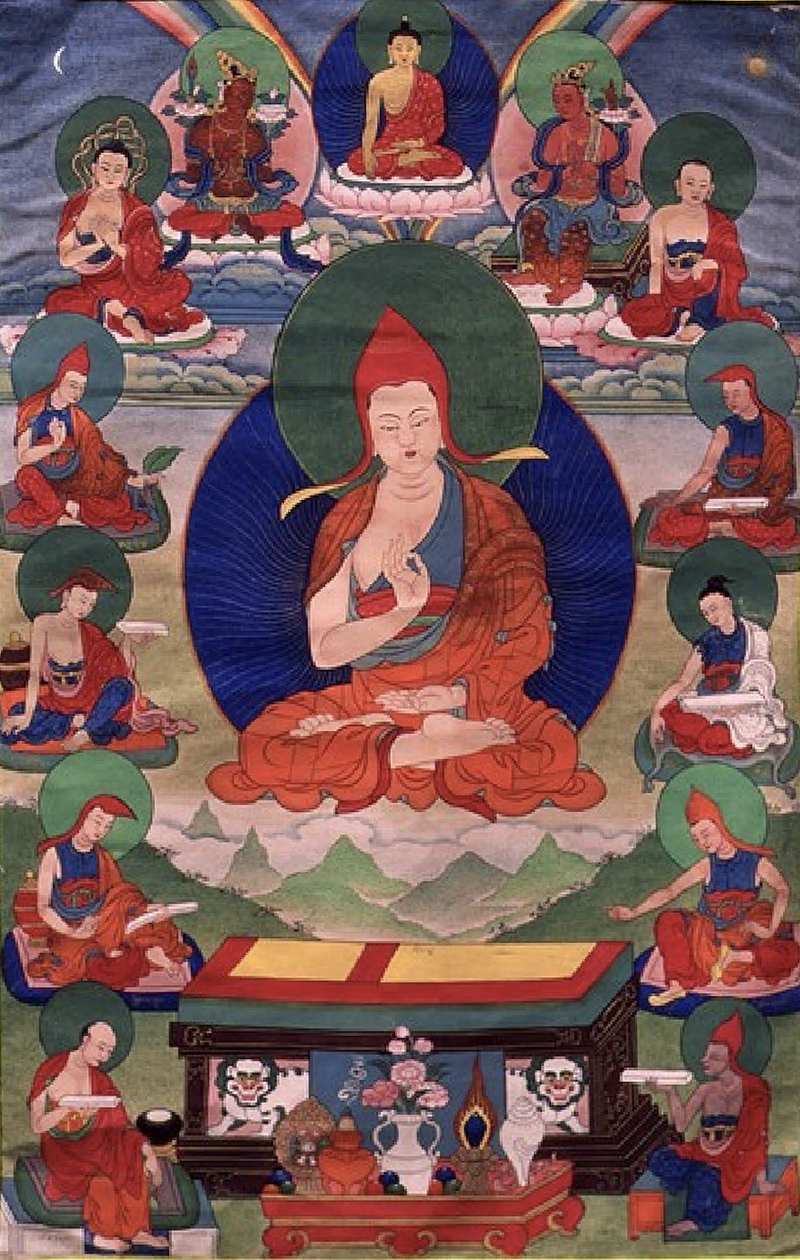
This collection presents exemplary Buddhist narratives illustrating key verses from the first chapter of Śāntideva's Bodhicaryāvatāra (The Way of the Bodhisattva). Each tale demonstrates profound Buddhist principles such as the importance of respecting all worthy beings, the rarity of human rebirth, and the transformative power of bodhicitta (the awakening mind). These morally instructive stories feature kings, merchants, animals, and divine beings to illuminate the path of the bodhisattva—one who dedicates themselves to achieving enlightenment for the benefit of all sentient beings. The tales consistently emphasize the superiority of spiritual wealth over material possessions and demonstrate how bodhisattvas transform adversity into opportunity for both their own spiritual development and that of others.
The stories presented here were translated by Gregory Forgues and Khenpo Könchok Tamphel.
The Arrogance of the Bodhisattva Daughter
To those who go in bliss,25‟Those who go in bliss” (Tib. bde gshegs, Skt. sugata): a title of the Buddhas. the dharmakāya26The word dharmakāya (Tib. chos sku, Skt. dharmakāya) means ‟dharma body.” According to the commentarial tradition, two interpretations are possible. The term may be taken to mean simply ‟the body of the Dharma of realization and transmission” (which is the interpretation of Kunzang Pelden and other authorities), with the result that the first line of the poem is a salutation to the Three Jewels of Buddha, Dharma, and Saṅgha. On the other hand, it may be understood as referring to the dharmakāya or ‟truth body,” the ultimate aspect of a Buddha, as contrasted with the rūpakāya or ‟form body” (further subdivided into the sambhogakāya and nirmānakāya). they possess, and all their heirs,27The ‟heirs” of the Buddhas are the Bodhisattvas. We have preferred this translation, which is gender-inclusive and corresponds more closely to Shāntidevaʼs obvious intention than the literal rendering of ‟sons” (Tib. sras) as this is likely to be understood by a modern Western readership. Phis interpretation is in fact supported by one of the earliest known Tibetan commentaries on the Bodhicharyāvatāra (composed by Sonam Tsemo, 1142–1182), where sras is glossed as gdung ʼtshob (inheritor, successor). In the present context, reference is actually being made to ‟noble” Bodhisattvas, so-called because their realization corresponds to the Mahāyāna path of seeing and beyond, in other words, who are abiding on the Bodhisattva bhūmis or grounds, and who are therefore sublime objects of refuge. To all those worthy of respect, I reverently bow. According to the scriptures, I shall now in brief describe The practice of the Bodhisattva discipline.
Page(s) 31
Blankleder, Helena, and Wulstan Fletcher (Padmakara Translation Group), trans. The Way of the Bodhisattva: A Translation of the Bodhicharyāvatāra. By Śāntideva. Rev. ed. Shambhala Classics. Boston: Shambhala Publications, 2006.
བདེ་གཤེགས་ཆོས་ཀྱི་སྐུ་མངའ་སྲས་བཅས་དང་། ། ཕྱག་འོས་ཀུན་ལའང་གུས་པས་ཕྱག་འཚལ་ཏེ། ། བདེ་གཤེགས་སྲས་ཀྱི་སྡོམ་ལ་འཇུག་པ་ནི། །
ལུང་བཞིན་མདོར་བསྡུས་ནས་ནི་བརྗོད་པར་བྱ། །bde gshegs chos kyi sku mnga' sras bcas dang /_/ phyag 'os kun la'ang gus pas phyag 'tshal te/_/ bde gshegs sras kyi sdom la 'jug pa ni/_/
lung bzhin mdor bsdus nas ni brjod par bya/_/The statement "To all those worthy of respect, I reverently bow" teaches us that both the hearers (śrāvakas) and solitary realizers (pratyekabuddhas) are worthy of our respect and veneration. Some might object that this contradicts certain scriptures, but such scriptures should be understood as having a deeper intention beyond their literal meaning.
This teaching is illustrated by the following tale:
For instance, in ancient times, King Ajātaśatru invited the great arhats Mahākāśyapa, Rāhula, and others to his palace for a midday meal. The king had a daughter named Gift of Without Sorrow, who was actually a bodhisattva manifesting in female form. When these arhats arrived, she remained seated on her throne, showing neither faith nor respect, refusing to pay homage to them.
Her father asked, "Why do you not pay homage to these venerable arhats?"
The daughter replied with pride, "Father, have you ever heard or seen Mount Meru, king of mountains, bowing to a mustard seed? Have you ever witnessed the sun and moon paying homage to a firefly? Have you ever seen the great ocean bowing to the water in an ox's hoofprint, or a majestic lion paying homage to a jackal?" She continued with more such comparisons.
The king remarked, "Daughter, you display great arrogance!"
"Father," she responded, "you yourself are equally arrogant!"
"Why do you say I am arrogant?" the king asked, puzzled.
"Why do you claim I am arrogant?" she countered.
"Because you refuse to pay homage to these worthy arhats," he explained.
"And you, O King, do not bow to the ordinary people of the town," she argued. "How is that different?"
The king reasoned, "You may refuse to honor others, but Rāhula is the son of the blessed Buddha; therefore, you should certainly pay homage to him."
To this, the daughter responded with a powerful metaphor: "A lioness gives birth to a lion cub, not a jackal cub. Similarly, the Buddha is like a lion, but his son is like a jackal—a hearer who works only for his own benefit, unlike a true bodhisattva son who labors for the benefit of all beings. This is why I refuse to pay homage to him."
This story should be understood as being directed at the lesser hearers, with the intention of leading them toward the Greater Vehicle (Mahāyāna). However, if we take her statements literally, a contradiction appears: it is said that after this exchange, the daughter engaged in debate with the arhats and was victorious. Yet despite her victory, she descended from her throne without a trace of arrogance and paid them homage, bowing her entire body to the ground. This shows that her earlier refusal to honor them was not meant to be taken literally but carried a deeper meaning.
The Blind Turtle and the Yoke
So hard to find the ease and wealth28In order to progress toward enlightenment, it is necessary to possess eight forms of ease or freedom, and ten forms of wealth or endowment. The former are the freedoms of not being born (1) in one of the hells; (2) as a preta or hungry ghost; (3) as an animal; (4) in the realms of the gods; (5) among barbarians who are ignorant of the teachings and practices of the Buddhadharma; (6) as one with wrong views concerning karma and so forth; (7) in a time and place where a Buddha has not appeared; and (8) as mentally or physically handicapped. The ten forms of wealth or endowment are subdivided into five considered intrinsic and five considered extrinsic to the personality. The five intrinsic endowments are (1) to be born a human being; (2) to inhabit a ‟central land,”i.e., where the Dharma is proclaimed; (3) to be in possession of normal faculties; (4) to be one who is not karmically inclined to great negativity; and (5) to have faith in the Dharma. The five extrinsic endowments are the facts that (1) a Buddha has appeared in the universe in which one is living, and at an accessible time; (2) that he has expounded the Doctrine; (3) that his Doctrine still persists; (4) that it is practiced; and (5) that one has been accepted as a disciple by a spiritual master.
Whereby the aims of beings may be gained.
If now I fail to turn it to my profit,
How could such a chance be mine again?[p.32]The Way of the Bodhisattva (2006)
Blankleder, Helena, and Wulstan Fletcher (Padmakara Translation Group), trans. The Way of the Bodhisattva: A Translation of the Bodhicharyāvatāra. By Śāntideva. Rev. ed. Shambhala Classics. Boston: Shambhala Publications, 2006.
Page(s) 31
Blankleder, Helena, and Wulstan Fletcher (Padmakara Translation Group), trans. The Way of the Bodhisattva: A Translation of the Bodhicharyāvatāra. By Śāntideva. Rev. ed. Shambhala Classics. Boston: Shambhala Publications, 2006.
དལ་འབྱོར་འདི་ནི་རྙེད་པར་ཤིན་ཏུ་དཀའ། །
སྐྱེས་བུའི་དོན་སྒྲུབ་ཐོབ་པར་གྱུར་པ་ལ། ། གལ་ཏེ་འདི་ལ་ཕན་པ་མ་བསྒྲུབས་ན། །
ཕྱིས་འདི་ཡང་[p.4]Byang chub sems dpa'i spyod pa la 'jug pa rtsa ba dang 'grel pa (1990)Slob dpon zhi ba lha and Mkhan po kun dpal. Byang chub sems dpa'i spyod pa la 'jug pa rtsa ba dang 'grel pa. Khreng tu'u: Si khron mi rigs dpe skrun khang, 1990.

dal 'byor 'di ni rnyed par shin tu dka'/_/
skyes bu'i don sgrub thob par gyur pa la/_/ gal te 'di la phan pa ma bsgrubs na/_/
phyis 'di yang [p.4]Byang chub sems dpa'i spyod pa la 'jug pa rtsa ba dang 'grel pa (1990)Slob dpon zhi ba lha and Mkhan po kun dpal. Byang chub sems dpa'i spyod pa la 'jug pa rtsa ba dang 'grel pa. Khreng tu'u: Si khron mi rigs dpe skrun khang, 1990.
The following short analogy illustrates the statement from the Bodhicaryāvatāra: "So hard to find the ease and wealth." It demonstrates just how difficult it is to attain a precious human rebirth:
Imagine the entire world transformed into a vast ocean. At its depths dwells a blind turtle who rises to the surface only once every hundred years. Upon this great ocean floats a single wooden yoke with one hole. This yoke is constantly in motion—pushed westward by eastern winds, eastward by western winds, southward by northern winds, and northward by southern winds—never remaining in one place.
Consider how extraordinarily difficult it would be for the blind turtle, surfacing so rarely, to chance upon the ever-moving yoke and have its neck pass through the hole. The Buddha taught that obtaining a human rebirth with all its freedoms and advantages after being in the lower realms is even more difficult than this remarkable occurrence.
The Awakening Mind and the Thief
Should bodhichitta come to birth In those who suffer, chained in prisons of saṃsāra, In that instant they are called the children of the Blissful One, Revered by all the world, by gods and humankind.
Page(s) 32
Blankleder, Helena, and Wulstan Fletcher (Padmakara Translation Group), trans. The Way of the Bodhisattva: A Translation of the Bodhicharyāvatāra. By Śāntideva. Rev. ed. Shambhala Classics. Boston: Shambhala Publications, 2006.
བྱང་ཆུབ་སེམས་སྐྱེས་གྱུར་ན་སྐད་ཅིག་གིས། །
འཁོར་བའི་བཙོན་རར་བསྡམས་པའི་ཉམ་ཐག་རྣམས། ། བདེ་གཤེགས་རྣམས་ཀྱི་སྲས་ཞེས་བརྗོད་བྱ་ཞིང་། །
འཇིག་རྟེན་ལྷ་མིར་བཅས་པས་ཕྱག་བྱར་འགྱུར། །byang chub sems skyes gyur na skad cig gis/_/
'khor ba'i btson rar bsdams pa'i nyam thag rnams/_/ bde gshegs rnams kyi sras zhes brjod bya zhing /_/
'jig rten lha mir bcas pas phyag byar 'gyur/_/[The following short tale illustrates the statement from the Bodhicaryāvatāra that says] "Should bodhichitta come to birth . . . in that instant . . . ": This tale illustrates that one who generates the awakening mind (bodhicitta) will, even in this very life, be freed from suffering and become worthy of others' respect.
Long ago, a group of merchants journeyed to the ocean to collect precious jewels. During their voyage, they suffered a terrible shipwreck in which all perished except for one man who had previously generated the awakening mind. Clinging desperately to a wooden plank, he managed to survive and eventually reached the shore.
In India at that time, wealthy people customarily carried a small talisman on their person to ward off enemies, and this merchant had three ounces of gold with him. As night fell, he sought shelter in an empty guesthouse called the House of Virtue. While he rested there, a thief entered, and finding no other valuables, confronted the merchant.
"Hand over your wealth!" demanded the thief.
The merchant, whose mind was imbued with bodhicitta, gave the thief his three ounces of gold without hesitation.
The thief, thinking, "If he gives me so much so readily, he must possess even greater wealth," demanded, "Give me more!"
"I have nothing else," replied the merchant.
"Then I will kill you!" threatened the thief.
"Even if you kill me, I truly have nothing more to give," the merchant responded calmly.
Unmoved by these words, the thief pressed a large stone against the merchant's chest and pointed a weapon at his eye. "I will gouge out your eye!" he threatened.
"You may gouge out my eye if you wish," said the merchant, "but I have no more wealth. And even if you take my eye despite my lack of wealth, I will feel no displeasure. Go ahead if you must."
Astonished by this response, the thief asked, "What qualities do you possess that allow you to remain so calm in the face of death?"
"I have no special qualities," replied the merchant, "except that I have generated the awakening mind."
Upon hearing these words, the thief was deeply moved. Filled with devotion, he returned the gold to the merchant, became his disciple, and requested instruction on generating bodhicitta himself. From that day forward, he served the merchant with unwavering devotion through body, speech, and mind.
The Son Who Harmed His Mother
If with kindly generosity One merely has the wish to soothe The aching heads of other beings, Such merit knows no bounds.
Page(s) 34
Blankleder, Helena, and Wulstan Fletcher (Padmakara Translation Group), trans. The Way of the Bodhisattva: A Translation of the Bodhicharyāvatāra. By Śāntideva. Rev. ed. Shambhala Classics. Boston: Shambhala Publications, 2006.
སེམས་ཅན་རྣམས་ཀྱི་ཀླད་ནད་ཙམ། །
བསལ་ལོ་སྙམ་དུ་བསམས་ན་ཡང་། ། ཕན་འདོགས་བསམ་པ་དང་ལྡན་ཏེ། །
བསོད་ནམས་དཔག་མེད་ལྡན་གྱུར་ན། །sems can rnams kyi klad nad tsam/_/
bsal lo snyam du bsams na yang /_/ phan 'dogs bsam pa dang ldan te/_/
bsod nams dpag med ldan 'gyur na/_/The statement "The aching heads of other beings . . . " means that the benefits of generating even a momentary thought of benefiting others are immeasurable. The following short story illustrates this teaching:
In ancient times, there was a ship captain named Beloved, who was unable to have a son that survived. Seeking guidance, he consulted a diviner who revealed, "Beloved's son will survive if he is given a girl's name." So, when a son was born, he named him "Beloved's Daughter." Not long after, the father passed away.
The son then asked his mother, "What was my father's occupation?" Fearing the dangers of shipwreck, his mother concealed the truth about his father's jewel-collecting business and replied, "He was a merchant." So, the son began trading in coins and earned a profit of three cowries, which he gave to his mother to support their livelihood.
Later, he traded in incense and gave four coins in profit to his mother. Then he traded in the city, and he gave six coins and more to his mother. He continued trading in the surrounding areas, his principal growing to eight cowries, which he again gave to his mother for their support.
At that time, local people told him, "Your father's occupation was not what you have pursued thus far. He was a ship captain who gathered precious jewels from the ocean."
Hearing this, he prepared to collect jewels himself. His mother tried to dissuade him, but he would not listen. Having no other options, she lay down across the doorway to block his path, but he stepped on her head and left.
He entered the ocean and set sail. When the ship was wrecked, the passengers were carried away by the water, but Beloved's Daughter remained stranded on an island, with no idea where the passengers had gone. There, two, four, six, and eight goddesses appeared to him, and he enjoyed pleasures with them for many years as they lived together in four celestial regions called Brahma's Lord, Delight Maker, Permanent Intoxication, and Beautiful Light.
After this, the good karma from serving his mother was exhausted, and he found himself trapped in a terrifying, doorless iron house within a temporary hell realm. Eventually, he reached a door that opened on its own and encountered a hell being with an iron wheel spinning on his head, enduring immeasurable suffering.
He asked, "What caused your suffering?" The hell being replied, "It came from harming my mother."
"When will you be free from this?" Beloved's Daughter inquired.
The hell being answered, "When someone from Jambudvīpa who has harmed their mother arrives here, then I will be free."[1]
At that moment, a voice from the sky declared, "May those who are bound be freed, and may those who are not bound be bound!" Because of this pronouncement, the karma of harming his mother ripened, and the wheel began to spin on his own head.
Through the power of his spiritual potential, the seed of compassion truly awakened in him. Reflecting on his own suffering, he generated the thought, "May all the suffering of all sentient beings who are afflicted with even a headache ripen upon me!" After generating this thought, he passed away from that life and was reborn as a god in the higher realms.
The god welcoming him in the gods' heaven where he was reborn explained:
- Fleeing successfully the four cities:
Delight Maker Garden, Brahma's Lord,
Permanent Intoxication, and Beautiful Light—
It is karma's power that has drawn you here.
The King Who Subdued with Bodhicitta
What need is there to speak of those Who long bestow on countless multitudes The peerless joy of blissful Buddhahood, The ultimate fulfillment of their hopes?
Page(s) 36
Blankleder, Helena, and Wulstan Fletcher (Padmakara Translation Group), trans. The Way of the Bodhisattva: A Translation of the Bodhicharyāvatāra. By Śāntideva. Rev. ed. Shambhala Classics. Boston: Shambhala Publications, 2006.
སེམས་ཅན་གྲངས་མཐའ་ཡས་ལ་དུས་རིང་དུ། །
བདེ་བར་གཤེགས་ཀྱི་བདེ་བ་བླ་ན་མེད། ། ཡིད་ལ་བསམ་པ་མཐའ་དག་རྫོགས་བྱེད་པ། །
རྟག་ཏུ་སྦྱིན་པ་ལྟ་ཞིག་སྨོས་ཅི་དགོས། །sems can grangs mtha' yas la dus ring du/_/
bde bar gshegs kyi bde ba bla na med/_/ yid la bsam pa mtha' dag rdzogs byed pa'i/_/
rtag tu sbyin pa lta zhig smos ci dgos/_/The statement "Who long bestow on countless multitudes . . ." refers to how it is excellent wealth for bodhisattvas when they are able to connect others with the Dharma.
In the past, there was a universal monarch named Sky, who possessed the seven kinds of precious jewels.[2] He conquered the four continents and established their inhabitants in the Dharma, specifically in the practice of the ten virtuous actions. Although the people remained peaceful for some years, they eventually fell back into their nonvirtuous ways.
This made King Sky reflect, "Perhaps this has happened because I subdued them physically while my mind was distracted." With this insight, he seated himself on the steps of Mount Meru and practiced generating a completely pure awakening mind. As a result of this practice, he was able to truly subdue all four continents.
The gods, astonished by this achievement, recited these verses:
- The great king, possessing the seven jewels,
Could not subdue them with his body.
Yet with a completely pure awakening mind,
He subdued them. How astonishing!
Transformation through Compassion
But joyous and devoted thoughts Will yield abundant fruits in greater strength. Even in great trouble, Bodhisattvas Never bring forth wrong; their virtues naturally increase.
Page(s) 36
Blankleder, Helena, and Wulstan Fletcher (Padmakara Translation Group), trans. The Way of the Bodhisattva: A Translation of the Bodhicharyāvatāra. By Śāntideva. Rev. ed. Shambhala Classics. Boston: Shambhala Publications, 2006.
འོན་ཏེ་གང་ཞིག་ཡིད་རབ་དང་བྱེད་ན། །
དེ་ཡི་འབྲས་བུ་དེ་བས་ལྷག་པར་འཕེལ། ། རྒྱལ་སྲས་རྣམས་ལ་དོ་གལ་ཆེན་པོས་ཀྱང་། །
སྡིག་པ་མི་འབྱུང་དགེ་བ་ངང་གིས་འཕེལ། །on te gang zhig yid rab dwang byed na/_/
de yi 'bras bu de bas lhag par 'phel/_/ rgyal sras rnams la do gal chen pos kyang /_/
sdig pa mi 'byung dge ba ngang gis 'phel/_/The statement "But joyous and devoted thoughts . . ." refers to the great virtue that comes from regarding bodhisattvas with a completely pure mind.
When the Venerable Śāriputra went into a city to collect alms, a dog bit his leg. To prevent this from happening again, he gave the dog some rice. The dog became extremely pleased and would run to greet him whenever it saw him. This dog was destined to be reborn as a dog for five hundred lifetimes, but due to the pure mind it developed toward Śāriputra, after its death it was reborn as a being named Inconceivable Illumination. He became a monk and attained arhatship. If generating a pure mind toward a hearer (śrāvaka) brings such great benefits, what need is there to speak of developing such a mind toward bodhisattvas?
This is similar to what happened to a bodhisattva named Bestower of Bliss in the past. He was a monk who had an excellent physical appearance. Once, when he went to a city to collect alms, he met a girl named Most Excellent Glorious Quality. She was beautiful, pleasing to behold, and adorned with various ornaments. Upon seeing the monk, she became passionately attached to him and asked him to engage in sensual pleasures with her, but he refused. As a result, overwhelmed by her attachment, her body began to sweat, and she collapsed on the ground and died.
The bodhisattva then made this aspiration prayer:
- I, Bestower of Bliss, make this aspiration prayer:
May any woman who looks upon me with attachment
Completely abandon the body of a woman
And become a being free from desire for men.
In the meantime, the girl's father thought, "This monk has assaulted my daughter," and he became enraged. However, due to the power of the girl's pure thoughts and the bodhisattva's aspiration prayer, she was reborn in the realm of the Thirty-Three Gods.
With her divine eye, she looked into the cause of her rebirth and understood what had happened. She then gathered divine flowers and other offerings, traveled to Jambudvīpa to present them to the Blessed One and the bodhisattva Bestower of Bliss. She also shared her story with her father, dispelling his misunderstanding and anger.
The Monkey's Compassionate Act
But joyous and devoted thoughts Will yield abundant fruits in greater strength. Even in great trouble, Bodhisattvas Never bring forth wrong; their virtues naturally increase.
Page(s) 36
Blankleder, Helena, and Wulstan Fletcher (Padmakara Translation Group), trans. The Way of the Bodhisattva: A Translation of the Bodhicharyāvatāra. By Śāntideva. Rev. ed. Shambhala Classics. Boston: Shambhala Publications, 2006.
འོན་ཏེ་གང་ཞིག་ཡིད་རབ་དང་བྱེད་ན། །
དེ་ཡི་འབྲས་བུ་དེ་བས་ལྷག་པར་འཕེལ། ། རྒྱལ་སྲས་རྣམས་ལ་དོ་གལ་ཆེན་པོས་ཀྱང་། །
སྡིག་པ་མི་འབྱུང་དགེ་བ་ངང་གིས་འཕེལ། །on te gang zhig yid rab dwang byed na/_/
de yi 'bras bu de bas lhag par 'phel/_/ rgyal sras rnams la do gal chen pos kyang /_/
sdig pa mi 'byung dge ba ngang gis 'phel/_/The statement "Even in great trouble, Bodhisattvas . . ." means that even when great harm is done to bodhisattvas, they do not become angry, and their virtue increases even more.
This teaching is illustrated by the following tale:
Once, a man lost his cow and set out to find it, eventually reaching a distant and desolate wilderness. Weakened by hunger and exhaustion, he arrived at the edge of a precipice where he saw a magnificent tree called Upwards, its branches, leaves, and fruits flourishing abundantly. Driven by need, he ate some of its fruit. Then, grasping a branch, he attempted to climb down, but the branch snapped, and he plunged into the great river below.
At that time, our present Buddha Śākyamuni, while still on the bodhisattva path in a previous life as a monkey, was dwelling in that same wilderness. Startled by the incident and the snapping of the tree branch, he moved away from his dwelling. As he did, he noticed the man and felt a powerful surge of compassion for him.
He wanted to rescue the man, but realizing he lacked the strength, he trained himself by carrying small stones, gradually increasing the weight until he could lift one the size of a man. Then, he said to the man, "I will rescue you. Hold on to my back!" Carrying the man, he climbed up until they reached solid ground. The monkey was exhausted, so he said to the man, "I'm really tired. I'm going to take a nap. Watch out for big monkeys, beasts, and any other creatures that might harm me." With that, he lay down.
The man thought, "It is the habit of people in Jambudvīpa to repay kindness with harm. This monkey has shown me great kindness, but I am afflicted by hunger. I will kill him and eat his flesh." So, he attempted to strike the monkey on the head. Unable to bear this, the monkey woke up, felt compassion for the man, and thought to himself, "Alas! What kind of rebirth will this being, with such twisted thinking, have?" Despite this concern, moved by compassion, the monkey guided the man safely back to his village.
The man later became afflicted with leprosy and experienced the ripening of his actions within this very life. His body, once admired by his relatives and the people in the area as most beautiful, was now in a state of suffering. A king, who was out for recreation, saw him and asked, "Why do you look like a nonhuman being?" The man replied:
- For cruelty toward the loving,
I now bear this flowering pain.
Yet far harsher fruits than this
Await me still to be claimed.
He then recounted his past deeds and died, and whoever wishes to know the results of his next life must rely on oral teachings.
The King's Selflessness
To them in whom this precious jewel of mind
Is born—to them I bow!
I go for refuge to those springs of happiness
Who bring their very enemies to perfect bliss.[p.37]The Way of the Bodhisattva (2006)
Blankleder, Helena, and Wulstan Fletcher (Padmakara Translation Group), trans. The Way of the Bodhisattva: A Translation of the Bodhicharyāvatāra. By Śāntideva. Rev. ed. Shambhala Classics. Boston: Shambhala Publications, 2006.
Page(s) 36
Blankleder, Helena, and Wulstan Fletcher (Padmakara Translation Group), trans. The Way of the Bodhisattva: A Translation of the Bodhicharyāvatāra. By Śāntideva. Rev. ed. Shambhala Classics. Boston: Shambhala Publications, 2006.
གང་ལ་སེམས་ཀྱི་དམ་པ་རིན་ཆེན་དེ། །
སྐྱེས་པ་དེ་ཡི་སྐུ་ལ་ཕྱག་འཚལ་ཞིང་། ། གང་ལ་གནོད་པ་བྱས་ཀྱང་བདེ་འབྲེལ་བ། །
བདེ་བའི་འབྱུང་གནས་དེ་ལ་སྐྱབས་སུ་མཆི། །gang la sems kyi dam pa rin chen de/_/
skyes pa de yi sku la phyag 'tshal zhing /_/ gang la gnod pa byas kyang bde 'brel ba/_/
bde ba'i 'byung gnas de la skyabs su mchi/_/The statement "Who bring their very enemies to perfect bliss . . ." means that even when noble beings are harmed, it leads to the cultivation of virtues.
Once upon a time, there was a king named Loving Strength, a great bodhisattva. In the forest surrounding his kingdom, a cowherd had his battle-ax and sandals hanging at his right side. As he tended his cattle, spinning yarn and singing, five terrifying yakṣas—supernatural beings who had been punished by the lord of their realm for their offenses—came wandering before him. Noticing that the cowherd showed no fear, the yakṣas said:
- Even those blessed with the bliss of mantra and asceticism
Remain within a circle of companions around them.
We are those from whom escape is difficult,
Even for the brave and fearless among humans.
How is it that you show no fear before the children of yakṣas,
Whose food is human flesh and human fat,
Here in this terrifying, desolate forest,
With no one by your side?
The cowherd replied to them:
- My king possesses limitless qualities,
Therefore, I declare I have no fear.
He protects all beings completely,
Granting great well-being and happiness.
When even the god-kings fail to suppress them,
How could the flesh-eaters succeed?
Thus, I feel at home even in the forest,
As though it were day, even in the night,
And as though surrounded by friends, even when alone.
The yakṣas, curious to know if the king truly possessed such qualities, went to see him. Upon encountering him, they found him even more extraordinary than they had been told. Hence, they praised the king:
- Your chest is broad like a rock upon a mountain of gold,
Your flawless face as beautiful as the autumn moon,
Your hair spreads like that of a golden tree,
And your eyes, like those of a bull, are mesmerizing.
The king asked, "What do you desire?" They replied that they desired food and drink. The king then instructed his ministers, "Provide these beings with food and drink." When an array of extremely delicious, fresh, and varied foods was offered, they refused to eat, much like offering grass to a tiger or leopard.
The king asked, "Then what would you like?" They replied:
- Warm human flesh,
And the blood of man,
Are the yakṣas' food and drink.
O lotus-eyed one, unwavering in ascetic discipline!
Saying this, each one of them revealed their terrifying forms, and the king, realizing that they were not human, decided to offer his own flesh and blood. But his ministers pleaded, "O great king, we do not recall ever disobeying your command. If we have, please forgive us. Let us offer flesh and blood to these beings. Please do not let us, who hold love for you in our hearts, fall into wrongdoing."
The king replied, "These beings are not asking you; they are asking me. If I did not have flesh and blood, then you should give yours. But since I have it, I will give it."
He summoned a physician and had his veins opened. The blood, resembling the juice of red sandalwood, was offered to the yakṣas, who cupped their hands and drank. With a sword the color of a blue utpala flower, he cut flesh from his thighs and arms, offering it to them, thus satisfying their hunger.
They were extremely pleased and, having enjoyed themselves, they said:
- Having renounced even the splendor of kingship,
Through such deeds as you have just performed,
What marvelous reward do you seek
Through these austerities?
Is it to rule the entire earth,
To gain great wealth, to become Indra,
To become Brahma, or attain complete liberation?
Seeing the fearless way you give,
The fulfillment of your wish is surely not far.
If you deem us worthy to hear it,
May you give us your command.
Thus, they asked what he desired for his kindness.
The king replied:
- I do not seek the joys of the world,
So hard to gain, so easily lost,
Lacking true delight, devoid of ultimate peace.
Not even the splendor of the gods do I desire—
What need is there to speak of lesser things?
The mere cessation of my own suffering
Could never bring my heart true contentment.
Seeing unprotected beings all around,
Tormented by endless pain and illness,
I vow to attain omniscience through this merit,
To vanquish the enemy of misdeeds,
And deliver all from the ocean of existence,
Churned by the waves of age, sickness, and death.
Overjoyed, their body hair standing on end, they prostrated before the king and said, "With such unwavering diligence, you will surely attain enlightenment swiftly. When that time comes, please remember us."
Thus, they begged forgiveness for having caused him distress, admitting their past ignorance of his true qualities. Then, once more, they spoke:
- All these deeds of yours
Are for the benefit of the world,
But we understand our own needs.
Therefore, please pardon us.
Through our ignorance,
Failing even to recognize our own benefit,
We caused you distress,
For which we now seek your forgiveness.
May you grant us your command
Without hesitation, just as you do to your ministers.
To this the king said:
- You have been such a support on the path of Dharma,
How could I forget you after attaining awakening?
From the nectar of the pure Dharma,
You will be the first to receive instructions.
Knowing that I am delighted by this,
Abandon killing as you would poison.
Also, abandon attachment to others' wealth and spouses,
False speech, and the misdeed of drinking alcohol.
Saying this, the king gave them the precepts of the lay practitioners (upāsaka). They vowed to follow his instructions, circumambulated him, prostrated before him, and then vanished.
Afterward, that king became the Blessed One, and the five yakṣas became the group of the five perfect bhikṣus, the Buddha's first disciples to receive his teaching. Thus, in the great city of Varanasi, at the Deer Park in Ṛṣipatana (where the sages fell), he turned the wheel of Dharma, teaching the four noble truths, benefiting them, and thereby bestowing his results upon others.

