- [[<span class="smw-highlighter" data-type="4" data-state="inline" data-title="Warning" title="Some use of "|]]
- "
- In your query was not closed by a matching "
- "
- [[.">Some use of "" in your query was not closed by a matching "".|]]
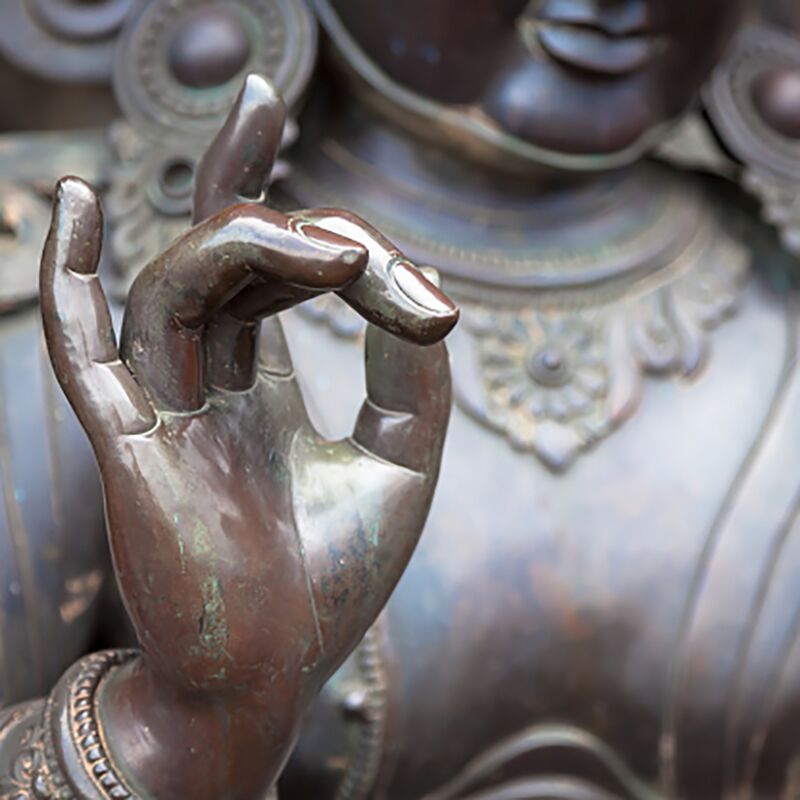
In order for bodhisattvas to give of their body, possessions, and virtues for the sake of all sentient beings, they must learn to guard and protect them. Chapter 2–7 discusses the various practices bodhisattvas can engage in to accomplish this. Such practices include finding and following a suitable teacher, studying the sūtras and following the precepts and ethical discipline taught therein, protecting the body from harm, upholding one's virtue by avoiding transgressions, etc.
Concise Summary of Essential Points
"One must engage in good works and know how to be content, and one who follows such a principle," Śāntideva asserts in his opening statement, "will not find it difficult to protect possessions."[1] When one can fulfill one's needs even with meager and simple possessions, one would not certainly disregard good and abundant resources being laid to waste by oneself or others. A bodhisattva who is a householder must neither give nor stop giving if such an action hinders progress on the path to enlightenment for oneself or others or obstructs the rise of virtue. In this respect, the bodhisattva who is a renunciate must not engage in giving material possessions but shall engage in giving teachings. In terms of material gifts, a monk can share food with fellow monks and give away extra robes. Other than that, if a bodhisattva focuses on giving material gifts to a few sentient beings, such work can distract him from teaching many beings and bringing greater benefit.
Having explained what a bodhisattva cannot give away, Śāntideva next explains what a bodhisattva can give up. The Questions of Ugraḥ Sūtra sums this up: "Take up the work for others and completely give up working for oneself."[2] This is further supported by citations from The Teachings of Vimalakīrti Sūtra (Skt. Vimalakīrtinirdeśasūtra), The Compendium of Dharma Sūtra (Skt. Dharmasaṃgītisūtra) and The Jewel Heap Sūtra, all of which underscore the essential point of working for the benefit of others.
On the topic of protecting merit, Śāntideva states that merit can be constantly protected by abandoning any selfish wish for results. For instance, a bodhisattva must not observe discipline in order to be born in a happy realm, to be born as a king, to be born as Indra, Brahmā, or Śiva, or to be born rich, handsome, famous, and so forth. Neither should he observe discipline out of fear of suffering and birth in unhappy realms. A bodhisattva must observe discipline with an intention to benefit all sentient beings, and in doing so he will not degenerate in his existential status and moral standing but be venerated by the different beings in the world. He will not take the four types of unfortunate rebirths: rebirth in a state where one is not free to practice Dharma, in a realm without a buddha, as an individual with wrong views, and rebirth in the unhappy realms.
Someone wishing to protect merit must not have regrets, for regret of a meritorious action can reduce it just as regret of a bad action can reduce or erase its impact. Regret and outspoken confessions are recommended for sinful actions, not for meritorious ones. The Buddha, Śāntideva remarks, advised at several occasions to not boast about meritorious actions but confess sinful ones.
Other vices to watch out for in order to protect merits are conceit and love for material gain and veneration. The Jewel Heap Sūtra warns that four things will erode the virtues which have already been cultivated and not let them increase. The four are: pursuing a materialistic view through self-conceit, holding householders in high regard for the sake of gain and veneration, hating and criticizing bodhisattvas, and disregarding sūtras which one has not heard or learned before. Among the four, the act of hating others and expressing anger is said to be the most destructive act, for it can erase merits so much so that a single instance of anger, Śāntideva says, can wipe out merits accumulated for hundreds of eons. He makes this statement at the beginning of the sixth chapter of his Way of the Bodhisattva based on the The Play of Mañjuśrī Sūtra (Skt. Mañjuśrīvikrīḍitasūtra), which he cites in The Compendium of Training. As anger often arises from conceit and arrogance, a bodhisattva must eschew self-importance and arrogance and engage like an outcast in the world. Citing The Chapter on Transcending the World (Skt. Lokottaraparivarta), Śāntideva lists ten types of arrogant and self-aggrandizing acts a bodhisattva can engage in through haughtiness, pride, jealousy, self-conceit, superciliousness, hatred, attachment to offering and veneration, contempt, and presumptuousness.
Instead of treating others with arrogance and hatred, a bodhisattva must view sentient beings as the field from which one can grow the qualities of the Buddha and thus approach them with ten types of thought or mind: a benevolent mind, a delightful mind, an affectionate mind, a tender mind, a pleasant mind, a helpful mind, a protective mind, an equanimous mind, a master's mind, and a teacher's mind. A bodhisattva must see oneself as a student of all sentient beings and cherish all sentient beings just like cherishing the Buddha. In order to highlight how a bodhisattva must serve all sentient beings like a servant, Śāntideva cites The Extensive Actions of a Monk (Skt. Bhikṣuprakīrnaka) to tell the story of the Buddha and Ānanda serving and nursing a sick monk and washing his clothes.
Śāntideva quotes verses from the sixth chapter of his own Way of the Bodhisattva and also adds some verses to compare pleasing sentient beings to a wish-fulfilling gem and wish-granting vase, show it is the best way to please the buddhas, and so forth. Practicing loving-kindness toward sentient beings is far more meritorious than making limitless offerings to countless buddhas. Thus, it is wrong to treat such sentient beings with arrogance.
Finally, Śāntideva claims that the essential way to protect merit is to dedicate the merit toward the enlightenment of all beings. He cites The Teachings of Akṣayamati (Skt. Akṣayamatinirdeśasūtra) to claim that a merit properly dedicated to enlightenment will not be exhausted, just as a drop of water which mingles with the ocean will not dry up until the end of existence.
Additional resources
Here we need to think about what would be particularly useful to the student/reader at this point. Link to key terms found in chapter one? Any thoughts?
The Way of the Bodhisattva
The Compendium of Training
