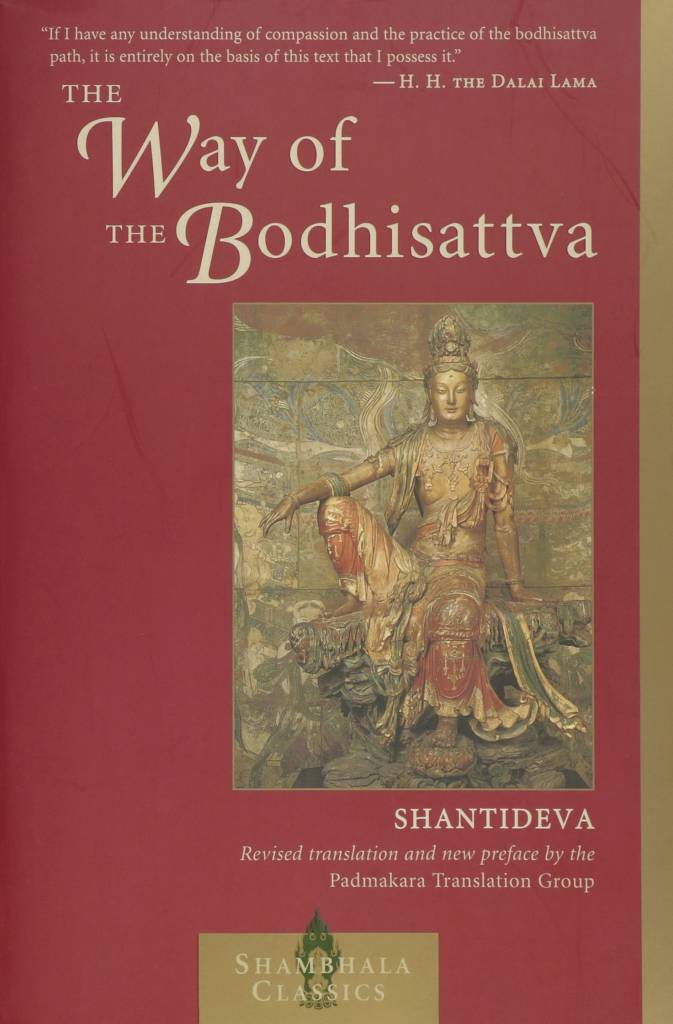
The Way of the Bodhisattva (2006)

From Bodhicitta
LibraryBooksThe Way of the Bodhisattva (2006)
< Books
Books/The Way of the Bodhisattva (2006)

The Way of the Bodhisattva (2006)
Book


Please note that many items in our library are simply pages that represent a detailed library catalog entry and citation of someone else's work, presentation, or performance. Read our General Disclaimer for more information. You can find more information about this item on the publisher website.
The Way of the Bodhisattva (2006)-front.jpg

Description

Treasured by Buddhists of all traditions, The Way of the Bodhisattva (Bodhicharyavatara) is a guide to cultivating the mind of enlightenment, and to generating the qualities of love, compassion, generosity, and patience. This text has been studied, practiced, and expounded upon in an unbroken tradition for centuries, first in India, and later in Tibet. Presented in the form of a personal meditation in verse, it outlines the path of the Bodhisattvas—those who renounce the peace of individual enlightenment and vow to work for the liberation of all beings and to attain buddhahood for their sake.

This version, translated from the Tibetan, is a revision by the translators of the 1997 edition. Included are a foreword by His Holiness the Dalai Lama, a new translator's preface, a thorough introduction, a note on the translation, and three appendices of commentary by the Nyingma master Kunzang Pelden. (Source: Shambhala Publications)

Citation
Blankleder, Helena, and Wulstan Fletcher (Padmakara Translation Group), trans. The Way of the Bodhisattva: A Translation of the Bodhicharyāvatāra. By Śāntideva. Rev. ed. Shambhala Classics. Boston: Shambhala Publications, 2006.
Publisher Link
Texts Translated
  1. Śāntideva (zhi ba lha). Bodhicaryāvatāra (Byang chub sems dpa'i spyod pa la 'jug pa). Padmakara used the 1990 edition printed by si khron mi rigs dpe skrun khang: Byang chub sems dpa'i spyod pa la 'jug pa rtsa ba dang 'grel pa (1990). Also found in Derge Tengyur D3871, dbu ma, vol. 105, la 1b1–40a7. See rKTs etexts, Columbia AIBS, ACIP etexts, Buda by BDRC Logo.jpg.


Full translations

 
La Práctica del Bodisatva
This translation was completed by María Jesús Hervás of the Spanish branch of Padmakara Translation Group in 2008. It mirrors the English book in form and content, reproducing the table of contents in the same order with notes and all.

Description from Ediciones Dharma:

La práctica del bodisatva (o Bodisatvacharyavatara, literalmente «La aplicación de la práctica del bodisatva») es uno de los grandes clásicos del budismo mahayana.

Presentada en la forma de una meditación personal en verso, expone el camino de los bodisatvas, esos seres que, habiéndose alejado de la futilidad del samsara y sus sufrimientos, renuncian sin embargo a la paz de una liberación individual y se comprometen a trabajar para la liberación de todos los seres y a obtener la Iluminación suprema para su beneficio.

Shantideva, uno de los autores budistas indios más influyentes de la tradición mahayana, empieza su obra elogiando la mente de la Iluminación y explica en detalle cómo se cultiva. Hay capítulos sobre las perfecciones transcendentales de la paciencia, la diligencia, la meditación y la sabiduría.

Las enseñanzas sobre la meditación culminan con la profunda práctica de igualarse y cambiarse uno mismo por los demás. El célebre capítulo noveno expone las enseñanzas sobre la vacuidad, la perfección de la sabiduría, tal como se explican en el Madyamaka, o tradición del “Camino medio”. Mediante los versos de este texto, Shantideva ha sido capaz de inspirar a generación tras generación de practicantes.

Este texto, escrito originalmente en India en sánscrito, apareció por primera vez traducido al tibetano poco después de su composición en el siglo VIII y ha sido explicado, estudiado y practicado en Tíbet en una tradición ininterrumpida hasta nuestros días. En la actualidad sigue teniendo plena vigencia y es enormemente apreciado por los budistas de todas las tradiciones. (Ediciones Dharma. Source Accessed May 13, 2025)
Book

Translation of

 
An "Introduction to Bodhisattva Practice," the Bodhisattvacaryāvatāra is a poem about the path of a bodhisattva, in ten chapters, written by the Indian Buddhist Śāntideva (fl. c. 685–763). One of the masterpieces of world literature, it is a core text of Mahāyāna Buddhism and continues to be taught, studied, and commented upon in many languages and by many traditions around the world. The main subject of the text is bodhicitta, the altruistic aspiration for enlightenment, and the path and practices of the bodhisattva, the six perfections (pāramitās). The text forms the basis of many contemporary discussions of Buddhist ethics and philosophy.
Text

Other editions

 
The Way of the Bodhisattva (2008)
THIS IS MERELY A REPRINT OF THE 2006 version in SMALL hardbound format.

Treasured by Buddhists of all traditions, The Way of the Bodhisattva (Bodhicharyavatara) is a guide to cultivating the mind of enlightenment, and to generating the qualities of love, compassion, generosity, and patience. This text has been studied, practiced, and expounded upon in an unbroken tradition for centuries, first in India, and later in Tibet. Presented in the form of a personal meditation in verse, it outlines the path of the Bodhisattvas—those who renounce the peace of individual enlightenment and vow to work for the liberation of all beings and to attain buddhahood for their sake.

This version, translated from the Tibetan, is a revision by the translators of the 1997 edition. Included are a foreword by His Holiness the Dalai Lama, a new translator's preface, a thorough introduction, a note on the translation, and three appendices of commentary by the Nyingma master Kunzang Pelden. (Source: Shambhala Publications)
Book
 
The Way of the Bodhisattva (1997)
The English translation of Śāntideva's classic the Bodhicaryāvatāra by the Padmakara Translation Group. This first edition was published by Shambhala Publications in 1997.
Book

Contains chapter or part

 
The Wisdom Chapter: A Brief Overview
The following excerpt from the introduction to the Padmakara Translation Committee's translation of the Bodhicaryāvatāra, The Way of the Bodhisattva, provides an overview of the ninth chapter, commonly referred to as the "Wisdom Chapter." This chapter is crucial for understanding the bodhisattva path and its direct realization of emptiness. Although Śāntideva states that ultimate truth transcends intellectual comprehension, with all conceptual formulations being inherently flawed, he explains through dialectical criticism why all philosophical positions are in fact inconsistent. Śāntideva's work demonstrates how the wisdom of emptiness is both a theoretical concept and an essential, practical aspect of the bodhisattva path, ultimately illustrating its profound impact on alleviating suffering. For those delving into Buddhist philosophy, particularly the Madhyamaka school and Śāntideva's teachings, this overview bridges the gap between abstract philosophy and lived experience. It offers insights into the historical development of Buddhist ideas and their continued relevance, serving as an excellent starting point for further inquiry into the concepts of emptiness and ultimate truth.
Article

Reviews

 
The Way of the Translators: Three Recent Translations of Śāntideva's Bodhicaryāvatāra
Luis Gómez discusses three translations of the Bodhicaryāvatāra: Crosby and Skilton (1996), the Padmakara Translation Group (1997), and Wallace and Wallace (1997).
Article

Related

 
Words of a Gentle Sage - Vol. 2 (Appey 2022)
Volume Two of this collection expands on Volume One with a series of longer, in-depth teachings by Khenchen Appey Rinpoche on five essential subjects:

1) A commentary to inspire faith, based on verses in praise of the Buddha’s immeasurable qualities from Sakya Paṇḍita's Clarifying the Sage's Intent.

2) Oral instructions based on Candrakīrti's Entering the Middle Way, offering a practical understanding of the Mahāyāna path as a whole.

3) A commentary on the first three chapters of Śāntideva's Way of the Bodhisattva, which includes an explanation of the ritual for the bodhicitta vow.

4) A rarely given explanation of Gorampa's profound teaching on dependent arising according to the four philosophical schools of Indian Buddhism, entitled Illumination of Saṃsāra and Nirvāṇa.

5) A detailed commentary on Samantabhadra's Noble Aspirations to Sublime Conduct, as the supreme means of dedication.

(Source: Chödung Karmo Translation Group)


Book

  • Forewordix
  • Preface to the Revised Editionxi
  • Introduction1
  • The Text and the Translation25
  • THE WAY OF THE BODHISATTVA
  • 1. The Excellence of Bodhichitta31
  • 2. Confession37
  • 3. Taking Hold of Bodhichitta47
  • 4. Carefulness53
  • 5. Vigilant Introspection61
  • 6. Patience77
  • 7. Diligence97
  • 8. Meditative Concentration109
  • 9. Wisdom137
  • 10. Dedication163
  • APPENDIXES
  • 1. The Life of Shāntideva175
  • 2. Equalizing Self and Other182
  • 3. Exchanging Self and Other189
  • Notes195
  • Bibliography215