- [[<span class="smw-highlighter" data-type="4" data-state="inline" data-title="Warning" title="Some use of "|]]
- "
- In your query was not closed by a matching "
- "
- [[.">Some use of "" in your query was not closed by a matching "".|]]
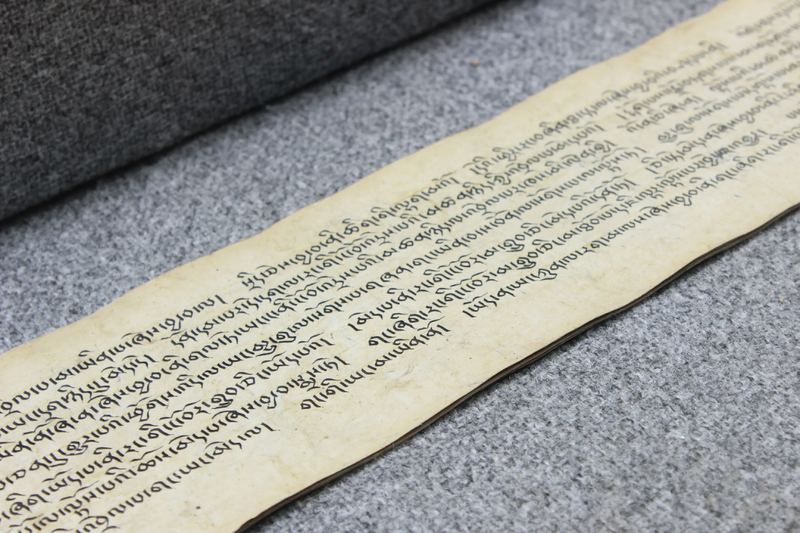
The Bodhicaryāvatāra and the Śikṣāsamuccaya both discuss the generation of the mind of enlightenment for the benefit of sentient beings and prescribe practices one must perform in order to attain buddhahood. As such, both texts are designed to elicit a transformation in the reader. While they are stylistically and structurally unique, the two texts are thought to be mutually illuminating, and for this reason it is often recommended that they be studied together.
The two main texts attributed to Śāntideva are the Bodhicaryāvatāra (often translated into English as Entering the Path of the Bodhisattva and abbreviated as BCA) and the Śikṣāsamuccaya (An Anthology of Teachings/Trainings, abbreviated on this site as SSC). Both works are believed to have been composed by Śāntideva during his time at the Buddhist University of Nālandā near Bihar in Northern India, between the seventh and eighth centuries. Śāntideva’s works have made an indelible contribution to Mahāyāna Buddhism, laying out the practical steps one must take to cultivate the altruistic mind of enlightenment (bodhicitta) and to become a bodhisattva in order to attain buddhahood for the sake of all beings. As such, they are celebrated as extraordinary exemplars of the Mahāyāna path and are especially beloved by Tibetan Buddhists as representative of the pinnacle of Buddhist ethical thought. A third work, the Sūtrasamuccaya (Anthology of Sūtras), purported to have been found in Śāntideva’s cell at Nālandā after he recited the Bodhicaryāvatāra to the monastic assembly, is sometimes attributed to Śāntideva in traditional biographies, such as those by Tāranātha and Bu ston. But the Tibetan tradition generally attributes this text to Nāgārjuna, the second-century father of Madhyamaka (Middle Way) philosophy.[1] This page will include a short introduction to Śāntideva's works (the BCA and SSC), providing a brief overview of these texts in terms of their general content, structure, and purpose. There are several other texts attributed to Śāntideva in the Tibetan Canon, but one is a ritual text consisting primarily of chapter 10 of the BCA, which circulated separately and is still practiced today, and the three others are thought to be by other authors with the same name, and so we are not focusing on these in this website.[2].
Bodhicaryāvatāra
The Bodhicaryāvatāra (Byang chub sems dpa'i spyod pa la 'jug pa) is considered a masterpiece of Mahāyāna Buddhist literature not only for the beauty and eloquence of the Sanskrit poetry in which it is composed but for its content and rhetorical power, the compelling way in which it clearly lays out the steps one must take to engage in bodhisattva training and reach the ultimate goal of buddhahood. Scholars have often argued for its deserved place among the great pieces of spiritual literature of the world. According to Francis Brassard, for example, who has written extensively on the text, the Bodhicaryāvatāra
is comparable to similar works of other religious traditions, for example, Thomas à Kempis' De imitatione Christi. Consequently, the BCA, in addition to exposing the main philosophical points of one of the most important schools of Buddhism, is also a practical guide that can serve as a basis of comparison between the major spiritual traditions of the world and even be a source of inspiration for all spiritual seekers, no matter their religious or philosophical affiliation.[3]
Toward achieving its goal of training would-be bodhisattvas, those who forgo the goal of individual liberation and instead seek to attain the enlightenment of buddhahood for the sake of liberating others from saṃsāra, the text guides the aspirant through gradual steps over the course of ten chapters and 913 verses,[4] emphasizing the cultivation, maintenance, and strengthening of bodhicitta as well as the cultivation of the six perfections (pāramitā): (1) generosity (2) moral discipline (3) patience (4) diligence (5) meditation and (6) wisdom. Written in the form of a personal reflection, and while Śāntideva claims at the outset to offer nothing new that hasn’t been said before, it is at once a uniquely compelling rational argument for engaging in such virtuous practices and a manual for leading the interested and motivated individual toward full and complete awakening. As such, the text is celebrated by all of the schools of Tibetan Buddhism and is included among the so-called "thirteen great texts" which form the core of the curriculum in most traditional Tibetan shedras.[5] According to the Padmakara Translation Committee, the Bodhicaryāvatāra "is an overwhelming demonstration of how concern for others, in a love that wholly transcends desire and concern for self, lies at the core of all true spiritual endeavor and is the very heart of enlightened wisdom."[6]
The ten chapters of the BCA include (1) The benefits of bodhicitta (bodhicittānuśaṃsa) (2) Confession of faults (pāpadeśanā) (3) Embracing the thought of awakening (bodhicittaparigrahaḥ) (4) Carefulness in the thought of awakening (bodhicittāpramādaḥ) (5) Guarding alertness, or vigilant introspection (saṃprajanyakṣaṇam) (6) Perfection of patience (kṣāntipāramitā) (7) Perfection of diligence (vīryapāramitā), (8) Perfection of concentration (dhyānapāramitā), (9) Perfection of wisdom (prajñāpāramitā), and (10) Dedication (pariṇamanā).
Chapter 1 begins by familiarizing the aspirant with the subject of bodhicitta itself. It is a praise to bodhicitta and speaks of the basis for generating bodhicitta (the human body and mind), the benefits of bodhicitta, and the greatness of the one who has bodhicitta. Overall, Śāntideva's task is to generate great enthusiasm in the individual for the cultivation of such an attitude, the greatest of all virtues.
In chapter 2, Śāntideva demonstrates the importance of making offerings—material and nonmaterial—paying homage through veneration (prostrations), going for refuge, and, in particular, confessing one’s evil deeds. Confession, according to Śāntideva, and as understood in the Tibetan Buddhist tradition more generally, is crucial. By openly acknowledging one's past negative behaviors and tendencies, only then can one begin to move in a different direction.[7] As such, it creates a clean state from which to transform oneself.
Chapter 3, sometimes referred to as "taking hold of bodhicitta" or "embracing bodhicitta," Śāntideva lays out the preparatory practices, involving the accumulation of merit and mind training (blo sbyong), that are required in order to generate bodhicitta. In addition, he presents the actual bodhisattva vow, the firm commitment that one makes to liberate all sentient beings from suffering. Here, in short, Śāntideva presents the necessity of the thorough adoption of bodhicitta and instructs the aspirant on how to actually generate it and maintain it.[8]
In chapter 4, referred to as the chapter on carefulness, Śāntideva urges his readers not to let this precious bodhicitta slip away. Instead, one must guard it, move toward it, embrace it, and actually put it into practice. Here, in order to guard this precious bodhicitta, Śāntideva urges his readers to reflect on the trainings to be accomplished, to reflect on the freedoms and advantages of a human rebirth so inconceivably rare, and to reflect on the disturbing emotions (kleśas) to be abandoned and thoroughly conquered, emotions of lust, anger, pride, etc., that constantly threaten to diminish this altruistic attitude. The alternative, Śāntideva reminds us with urgency, is wandering in saṃsāra, more specifically, the hell realms. He implores us to remember that now is the chance, the chance to train in virtue, to remember that the solution is right in front of us, writing,
This is how I should reflect and labor, That I might apply the precepts thus set forth. What invalids in need of medicine Ignored their doctor’s words and gained their health?
Page(s) 60
Blankleder, Helena, and Wulstan Fletcher (Padmakara Translation Group), trans. The Way of the Bodhisattva: A Translation of the Bodhicharyāvatāra. By Śāntideva. Rev. ed. Shambhala Classics. Boston: Shambhala Publications, 2006.
དེ་ལྟར་རྣམས་བསམས་ཇི་སྐད་བཤད་པ་ཡི། །
བསླབ་པ་[p.31]Byang chub sems dpa'i spyod pa la 'jug pa rtsa ba dang 'grel pa (1990)
Slob dpon zhi ba lha and Mkhan po kun dpal. Byang chub sems dpa'i spyod pa la 'jug pa rtsa ba dang 'grel pa. Khreng tu'u: Si khron mi rigs dpe skrun khang, 1990. 
de ltar rnams bsams ji skad bshad pa yi/_/
bslab pa [p.31]Byang chub sems dpa'i spyod pa la 'jug pa rtsa ba dang 'grel pa (1990)
Slob dpon zhi ba lha and Mkhan po kun dpal. Byang chub sems dpa'i spyod pa la 'jug pa rtsa ba dang 'grel pa. Khreng tu'u: Si khron mi rigs dpe skrun khang, 1990.
Chapter 5, on guarding alertness or vigilant introspection, is a continuation of Ṡāntideva's theme of protecting the attitude of bodhicitta. Here, such vigilance requires the constant guarding of the mind from negative emotions through mindfulness, the discipline of refraining from negative conduct, the discipline of practicing virtuous dharmas, and the discipline of working for the benefit of beings. According to Śāntideva, we should "guard our minds with the same care with which we would protect a broken or wounded arm while moving through an unruly crowd."[9] Śāntideva suggests that every act must be scrutinized, and should the impulse of unwholesome thoughts and actions enter our minds, he urges us to meet it with a kind of stoicism, remaining unmoved, as if "like a log."
In chapter 6, Śāntideva moves his discussion to focus on the topic of patience, the antidote to the most destructive emotion of anger. The chapter consists of verses on overcoming anger, cultivating patience, and respecting all sentient beings. Anger, according to Śāntideva, as within the Tibetan Buddhist tradition more broadly, is never justified, and is an emotion wholly destructive of positively accumulated karma. As this is the case, Śāntideva instructs through rational argument why the spiritual aspirant should see enemies, for example, those who would do one harm, not as objects worthy of anger or retaliation, but rather as beings caught in the grips of their own afflictive emotions. He argues that being angry at one's enemy is akin to being angry at fire for being hot, or at the sky for being filled with smoke. And thus the cultivation of the practice of patience toward others is to be sought and cultivated. Moreover, Śāntideva suggests, enemies or the objects of our anger, provide opportunities to practice patience and to overcome our own ego-clinging and thus assist in one's training on the bodhisattva path.[10]
In chapter 7 on diligence, Śāntideva provides a detailed explanation of diligence, identifying the essence of diligence, explaining why one must eliminate whatever prevents it and cultivate whatever is conducive to or favorable for it. What does Śāntideva mean by diligence? He writes,
Diligence means joy in virtuous ways.83The Tibetan word translated here as ‟diligence” is brtson ʼgrus, a rendering of the Sanskrit vīrya. While expressing a sense of strong endeavor, the Tibetan, according to Shāntideva, suggests a sense of joy and enthusiasm, features that are brought out powerfully in the course of the present chapter. The Sanskrit term carries with it a sense of indomitable strength and courage, and is connected with our words ‟virile,” ‟virago,” as well as ‟virtue.‚”The general sense is one of great courage and perseverance: fearlessness in the face of adversity. Its contraries have been defined as laziness, An inclination for unwholesomeness, Defeatism and self-contempt.
Page(s) 97
Blankleder, Helena, and Wulstan Fletcher (Padmakara Translation Group), trans. The Way of the Bodhisattva: A Translation of the Bodhicharyāvatāra. By Śāntideva. Rev. ed. Shambhala Classics. Boston: Shambhala Publications, 2006.
Here Śāntideva encourages us not to remain at ease, not to become prideful in one's accomplishments thus far achieved, for death comes for us all, unannounced. Thus, complacency is to be shunned. Rather, he encourages the aspirant to take advantage of this rare opportunity, "this human boat," to have courage, and to never give up, again, reminding the reader that the alternative is far too costly.
In chapter 8 on concentration, Śāntideva then moves on to discuss the real heart of what is required for spiritual transformation—that is, the ability to see and experience the suffering of others as one's own suffering. Such a goal requires the cultivation of meditative concentration and the conditions conducive to achieving such a goal. He first describes the environment that is conducive for the meditation and then the meditation itself.[11] He begins by encouraging aspirants to abandon worldly pursuits, such as physical desire and the desire for property, as such aims only lead to attachment and the continuation of suffering, and he praises the benefits of solitary life, a life which is more supportive of practice. He then turns to a discussion of the practice of cultivating the equality of self and others and cultivating the exchange of self and others (gtong len). Here, drawing on the concept of emptiness (śūnyatā), the Buddhist concept that there is, in fact, no substantial reality to the self or phenomena, Śāntideva explains that through the realization that the barrier that exists between self and others is illusory, one begins to understand and experience others' suffering as one's own, naturally leading to the desire to alleviate that suffering, the true activity of a bodhisattva.
Finally, in chapter 9, referred to as the chapter on wisdom, Śāntideva more explicitly discusses the subject of the wisdom of emptiness. Widely thought of as the most difficult chapter, it is, however, the key to understanding Santideva's overall project. For without a correct understanding and direct realization of emptiness, the practice of true compassion that is the activity of bodhisattvas is impossible, and perfect compassion can never be possible without the realization of the wisdom of emptiness.[12] Śāntideva, therefore, spends a considerable amount of time in this chapter discussing the cultivation and experience of (the correct view of) wisdom, expounding upon topics including (1) the two truths; (2) the experience of wisdom through meditating on the path (that is, meditating on the selflessness of the person and the selflessness of phenomena); (3) refuting the views of various Buddhist and non-Buddhist schools with respect to notions of the self and phenomena; and (4) the function of the realization of emptiness. Śāntideva's philosophical stance, it is revealed, follows the Prāsaṅgika-Madhyamaka viewpoint of Candrakīrti, and it is such a view that Śāntideva heralds as the one to be adopted, practiced, and, eventually, directly realized. Chapter 10 then ends the text with a concluding prayer, in which Śāntideva makes a dedication for the benefit of others, a dedication for the benefit of oneself, and a dedication for the flourishing of the teachings.
Structurally-speaking, according to traditional commentators such as Patrül Rinpoche, the text can be divided into three parts according to the following prayer for bodhicitta:
O precious, sublime bodhichitta May it arise in those in whom it has not arisen; May it never decline where it has arisen; May it go on increasing, further and further![13]
The first three chapters on bodhicitta, confession, and embracing bodhicitta are meant to arouse bodhicitta in the mind. The next three chapters on carefulness, vigilant introspection, and patience provide instructions on how to protect and uphold this attitude. And the final chapters on diligence, meditative concentration, and wisdom, are instructions on ways in which bodhicitta may be increasingly intensified.
Due to its practicality and usefulness, philosophical profundity, and inspiring nature, the Bodhicaryāvatāra generated many commentaries throughout the centuries and it has continued to do so into the modern period.[14]
Of the Bodhicaryāvatāra the 14th Dalai Lama, Tenzin Gyatso, is often quoted as saying, "If I have any understanding of compassion and the bodhisattva path, it all comes from studying this text." Such is the high praise for and revered status of Śāntideva's poem in the Tibetan tradition.
Śikṣāsamuccaya
Whereas the Bodhicaryāvatāra is a relatively short text, containing ten chapters, all in verse, the Śikṣāsamuccaya (Bslab pa kun las btus pa) contains a combination of twenty-seven root verses (kārikās) around which we find explanatory prose and is quite a bit longer, containing nineteen chapters. Not as celebrated as the Bodhicaryāvātara, it is, nevertheless, like the BCA, a complete summary of the Mahāyāna path aimed at instructing its readers in ethical training all toward the achievement of buddhahood. Thus, the work is, in essence, a practical handbook or manual of bodhisattva practice, instructing bodhisattvas on how they should live.[15] A true compendium or anthology, the text contains quotations of over 100 sūtras (or parts thereof), almost all of them canonical, but not all of them Mahāyāna. The nature of the text as an anthology, however, has led to it being dismissed by some as a largely unoriginal work, as more of an encyclopedia of sorts, with only brief explanations by Śāntideva. Recent scholarship, however, has asserted that much of the final chapter is in fact the original composition of Śāntideva himself, prompting an inquiry into what other chapters may contain Śāntideva's own words.[16] Regardless of how much of the text is the work of Śāntideva or not, there is growing agreement within more recent scholarship that the SSC offers a unique and valuable presentation of Buddhist ethics and the bodhisattva ideal and is a text that should be studied in its own right.[17]
The primary focus of the text is on the practices that must be adopted and on the virtues that must be developed by a bodhisattva, actions and virtues that of course entail the abandonment of nonvirtuous behaviors. The text as a whole can be divided into four main themes reflecting practices with respect to: giving (chap 1), protecting (chaps. 2–7), purifying (chaps. 8–15), and increasing or enhancing (chaps. 16–19). It is the scholarly consensus that the structure of the Śikṣāsamuccaya as a whole is revealed in the fourth root verse of chapter 1, the "Perfection of Generosity," which states,
Giving away to all sentient beings Your body, your possessions, and your good Gained in the past, present, and future, And protecting, purifying, and enhancing these[18]
Thus, following this stanza as a model, chapter 1 focuses on the giving of one's person (i.e., one's body), giving of one's enjoyments or possessions, and the giving of one's merits. What does Śāntideva mean by the giving of one's body? Quoting from the Akṣayamatisūtra, Śāntideva suggests that bodhisattvas must be prepared to do just that:
I must cast away this very body [kāya] in doing whatever needs to be done for all living beings. Just as the four great outer elements—the element of earth, the element of water, the element of fire, and the element of wind—turn into various forms of enjoyment for living beings in various ways, in various manners, with various objects, various necessities, and various enjoyments, in the same way I will make this body, which is an accumulation of the four great elements, something for the enjoyment of all living beings in various ways, in various manners, with various objects, various necessities, and various enjoyments, etc. Seeing it is subject to this aim, [the bodhisattva] observes bodily suffering, but is not exhausted by bodily suffering since he has regard for living beings.[19]
Thus not only must bodhisattvas-in-training practice the giving up of their possessions and merits, they must be ready to engage in self-sacrifice for the benefit of others, even if that results in bodily harm. The following chapters then go on to discuss the remaining practices of protecting, purifying and increasing one's body, possessions/enjoyments, and good/merit respectively, which is, of course, all meant for the sake of benefitting sentient beings. The following outline by Suzanne Mrozik represents the vital points of the bodhisattva discipline by chapter:
- Chapter 1 giving away bodied being, goods, and merit
Chapter 2 protecting bodied being
Chapter 3 protecting bodied being
Chapter 4 protecting bodied being
Chapter 5 protecting bodied being
Chapter 6 protecting bodied being
Chapter 7 protecting goods and merit
Chapter 8 purifying bodied being
Chapter 9 purifying bodied being
Chapter 10 purifying bodied being
Chapter 11 purifying bodied being
Chapter 12 purifying bodied being
Chapter 13 purifying bodied being
Chapter 14 purifying bodied being
Chapter 15 purifying goods and merit
Chapter 16 increasing bodied being, goods, and merit
Chapter 17 increasing merit
Chapter 18 increasing merit
Chapter 19 increasing merit[20]
Chapter 2 "Upholding the Holy Dharma," begins a discussion on protection in general and instructs the aspirant to preserve one's person/body in order to give of one's person/body, to not forsake one’s spiritual friend (kalyanamitra), to study the sūtras, and to accept the Dharma. Chapters 3–5 discuss how to give up harmful activity, with chapter 3 beginning a discussion of, among other things, how to forsake what is unprofitable, how to give up evil friends, and how to engage in the work of service. Employing a strategy we also observe throughout the BCA, Śāntideva, again, motivates his readers not only through encouragement and through praising the Dharma but also through fear, as chapter 3 in particular contains graphic depictions of the sufferings of the hell realms that await those who would continue to perform negative actions and who do not embrace the trainings. Already, we can see parallels between the themes discussed in the BCA and that of the SSC, parallels that continue throughout the text, albeit in the SSC, the presentation is somewhat more detailed and reads more directly prescriptive. Chapter 4 on "Giving Up What Is Harmful" goes on to implore aspirants to confess their fundamental faults, to avoid nonvirtuous actions and desires, to support bodhisattvas, to embrace devotion, and to not reject the Dharma and the Dharma teacher. Chapter 5 on "Giving Up What Is Harmful Through the Perfection of Discipline," directs would-be bodhisattvas to commit to the path by accepting the bodhisattva vows, practicing the noble eightfold path, and working solely for the benefit of others. Chapter 6, "Protecting One's Person," discusses further, more explicit prescriptions for the protection of one's body, including the cultivation of practices such as: the twelve forms of mindfulness for giving up fruitless activities, devotion, calm-abiding (śamatha) meditation, protecting the body with everyday medicine (i.e., food) and the use of actual medicine, clothes, and so on, the avoidance of eating fish and flesh, and protection by employing various dhāraṇīs. Chapter 7 then concludes the discussion on protecting by speaking of how one engages in the protection of one’s enjoyments/possessions through such things as acting with circumspection, being altruistic, not regretting one's generosity, and not becoming prideful or arrogant. The protection of one's merit, Śāntideva writes, results from dedicating the merits of virtuous actions to awakening.[21]
Next, chapters 8 through 15 can all be understood as explanations of various aspects of purification, the bulk of which (chaps. 8–14) deal with the purification of the self. Chapter 8 begins with a discussion of purifying one's evil actions, followed by a discussion of the perfection of patience (chap. 9), and the perfection of diligence (chap. 10). Chapter 11, "Praise of the Wilderness," similar to the call in chapter 8 of the BCA on meditative concentration for solitude, discusses the faults of the householder's life and the advantages of seclusion in the wilderness. While it is true, as Wulstan Fletcher and Helena Blankleder point out in the introduction to their translation of the Bodhicaryāvatāra, that "Shāntideva delineates principles of universal validity that are in fact mandatory for everyone wishing to follow a path of profound and effective spiritual transformation,"[22] such an admonishment of the householder here suggests that the SSC in particular was primarily directed toward monks and their discipline as opposed to the laity. Having achieved this more conducive environment of solitude, Śāntideva, like in the BCA, then directs the aspirant in chapters 12–13 in the business of meditative concentration. Chapter 12, "Preparing the Mind," advises that one meditate on impermanence to attain tranquility, meditate on impurity to counter the passions, practice patience, act with benevolence to counter hatred, and reflect on the twelve-fold chain of dependent arising (pratītyasamutpāda) to counter delusion. Chapter 13 then prescribes that one practices the four applications of mindfulness, meditating on (1) the impurity of the body, (2) the feelings of suffering, (3) the impermanence of consciousness, and (4) the fact that phenomena lack inherent existence.[23] Chapters 14 and 15 then directly address the topic of purification, with chapter 14, "Purifying One's Person," largely discussing the topic of emptiness of self and phenomena, and conveying the notion that complete self-purification comes from the full realization of emptiness.[24] On this, drawing on the Tathāgataguhyasūtra, Śāntideva asserts, "Just as when a tree is cut at the root, all the twigs and leaves wither away; so Śantamati, all impurities (kleśa) are quelled (upaśāmyanti) when one ceases to have a false view of the self (satkāyadṛṣṭi)."[25] Chapter 15, the concluding chapter on purification, discusses the purification of one's enjoyments/possessions and one's merit. Here Śāntideva argues that to cleanse the objects of enjoyment one must rid oneself of the desire to hoard them and must have acquired them through right livelihood.[26] The purification of one's merit he explains in terms of the purity of (1) giving (dāna) and (2) discipline or virtuous conduct (śīla). As Barbra Clayton points out, these activities are what contribute to positive karma or merit.[27] Thus a focus on the purification of these—through giving with a pure motivation, for example, without regard for the self, and conduct that exemplifies generosity, skillful means, equanimity, sympathetic joy, lovingkindness, and so forth—Śāntideva tells us, gives rise to the purification of merit (puṇya).[28]
The remaining chapters of the SSC focus on increasing or enhancing the person/body, enjoyments, and merit. According to Śāntideva, this act of increasing is necessary since purification alone cannot bring "great satisfaction" (i.e., buddhahood) to sentient beings, and as such bodhisattvas must cultivate or increase these.[29] Thus this discussion begins with the first part of chapter 16 "The Bhadracaryā Ritual," or "Ritual of Good Conduct," which addresses how aspirants are to enhance the body and possessions, and continues from the second part of chapter 16 and in the following three chapters, which address various ways of enhancing merit/goodness.[30]
What does Śāntideva mean by increasing the body? He answers this question directly, stating that this refers to "the enhancement of power and diligence."[31] According to the SSC, a bodhisattva attains power if one acquires the ten powers as spoken by the Buddha in the Tathāgataguhyasūtra. Here, the Buddha himself states that a bodhisattva acquires power if he/she (1) does not give up the holy Dharma even at the cost of one's body and life, (2) bows down to all sentient beings and is not prideful, (3) is patient toward weak sentient beings and is not hostile, (4) gives the best food to hungry sentient beings and provides comfort to frightened sentient beings, (5) is eager to heal the sick, (6) satisfies the poor with possessions; (7) makes repairs to a stūpa of the Tathāgata; (8) speaks beautiful words; (9) shares possessions with those who are impoverished; and (10) assumes the load for weary sentient beings.[32] Diligence, as we have already observed within the BCA, refers to having courage, not giving up, and not being lazy with respect to one’s aims. Thus a bodhisattva is expected to increase his person/body through the development of strength through these activities, without becoming idle or complacent. With respect to enhancing one’s enjoyments or possessions, Śāntideva, again, is quite clear:
Possessions are enhanced through generosity, Whose nature is emptiness and compassion.[33]
Śāntideva instructs his readers, quoting from the Vajracchedikāprajñāpāramitāsūtra, or Diamond Sūtra, that possessions are increased when one gives without attachment and when one practices generosity coupled with wisdom and compassion.[34]
From the latter half of the sixteenth chapter on, Śāntideva then turns his attention to the final part of his discussion, that of increasing one's merit, a process that involves a number of practices and which takes up a considerable amount of space in his text. To accomplish this, according to Śāntideva, one must first establish the proper mindset, which is accomplished "through effort, intention, and compassion, which stabilize each other."[35] Having established a firm intention and a compassionate resolve, he then prescribes practices which are those that increase one's merit. And here Śāntideva prescribes a version of what is known as "the Supreme Worship," a ritual that is found in the Bhadracaryāpraṇidhānarājasūtra (The Prayer of Good Conduct), a popular Mahāyāna liturgical text that forms part of the Gaṇḍavyūhyasūtra. In Śāntideva's exposition of the ritual, this involves (1) paying reverence (homage) to all buddhas, (2) making offerings to the buddhas, (3) confession of vile actions, (4) rejoicing in goodness, (5) asking the Buddhas to teach or requesting teachings, and (6) dedicating whatever merit results from the ritual to one's own and others' awakening.[36] Also prescribed is the practice of making the ten great vows, or "ardent wishes for the upholding of the Dharma, the worship of the Buddhas, and the welfare, happiness, and awakening of all forms of sentient beings,"[37] as proclaimed in the Sūtra on the Ten Stages (Daśabhūmikasūtra).[38] Having performed such actions, one dedicates the merit that accrues from this good conduct to the benefit of all sentient beings.[39]
Having unpacked the first half of the twenty-fifth kārikā, which states, "You should perform the ritual of Good Conduct / Performing the reverence and so on with respect,"[40] chapter 17, the "Benefits of Reverential Actions,"[41] then goes on to discuss the benefits of worship, drawing upon the Avalokanāsūtra (for example, the benefits accrued from offering gifts, repairing stūpas, bowing reverentially before a stūpa of the Buddha, and similar actions) for increasing one's merit. Also discussed here are practices that can be performed so as to enable one to meet with buddhas, practices that are said to be eight in number and which derive from the The Sūtra of the Questions of the Nāga King Sāgara (Sāgaranāgarājaparipṛcchāsūtra). These include "encouraging sentient beings by showing them images of a Buddha; making statues of the Tathāgata; frequently speaking in praise of the Tathāgata; encouraging all sentient beings by showing them the Tathāgata; in whatever Buddha-field the fame of the Tathāgata is heard, making an aspiration prayer in that Buddha-field; having a personality that is not lazy; with lofty personality, longing for the pristine awareness of the Buddhas."[42] Śāntideva also explains here via the Perfection of Wisdom Sūtra how one also increases merit by rejoicing in acts that arouse bodhicitta, the benefits of which are immeasurable.[43]
In chapter 18, "Recollection of the Three Jewels," Śāntideva then covers the second half of kārikā 25. Here, he advances the practice of faith, as well as other related virtues (respect, humility, and perseverance) as yet another method for increasing goodness. As a supplement to this, he draws upon another list of virtues from the Akṣayamatisūtra, that being the five faculties: the faculty of faith, perseverance, mindfulness, stable attention, and wisdom.[44] These faculties, he explains, support the powers of a bodhisattva, and contribute to bodhisattvas remaining firm in their commitments on the path to buddhahood.[45] In addition to this, Śāntideva also prescribes the practice of lovingkindness, the mere thought of which, he implies through quoting the Candrapradīpasūtra (a.k.a the Samādhirājasūtra), is far more superior and conducive to the increasing of merit than innumerable offerings presented to the highest of human beings.[46] Śāntideva concludes this chapter with a teaching on how one may also increase one's goodness with the practice of recollecting the qualities, benefits, and greatness of the buddhas, the Dharma, and the Saṅgha.
In the concluding chapter, chapter 19, "Increasing Goodness," Śāntideva then lays out his final thoughts on increasing one's merit, a discussion which subsumes the last two kārikās in the text, 26–27. Here Śāntideva's prescriptions begin with a discussion of how in every action a bodhisattva performs, not only acts which are those of worship but even the more seemingly mundane acts of walking, sitting, opening doors, and the like, one should have the benefit of others foremost in one's mind. For example, quoting the Mahāmeghasūtra, Śāntideva asserts,
While closing the door, they think, 'May I close for all sentient beings all the doors to the lower realms.' When sitting down, they think, 'May I place all sentient beings on the seat of Awakening.' When lying down on the right side, they think: 'May I cause all sentient beings to enter Nirvāṇa.' When standing up again, they think, 'May I help all sentient beings to rise above being overwhelmed by reactive emotions.'[47]
The bodhisattva is thus to maintain this disposition toward other sentient beings in all circumstances, including when in the wilderness and under threat of bodily danger. He then also teaches that in order to increase merit, one should give the Dharma with no ulterior motive,[48] a practice that produces twenty benefits, and he describes how the bodhisattva is to give the gift of Dharma, instructions which include both how bodhisattvas should comport themselves—wearing clean robes, having washed feet, and warding off laziness, for example—and how and what they should teach—that one should radiate lovingkindness and praise practices such as generosity and moral discipline. All of these practices, Śāntideva reminds his readers, are to be carried out in the spirit of the awakening mind, that is, bodhicitta, which he describes as the very cause of increasing merit.[49]
From here, Śāntideva concludes his discussion with some additional remaining teachings. He tells his readers that one should strive with perseverance and generate the motivation to prevent unwholesome behaviors from arising (leading to protection), generate the motivation to overcome those which have arisen (leading to purification), and generate the motivation for the arising of wholesome states that have not yet arisen (leading to increasing or enhancement), all of which should be accomplished with what he calls "heedfulness," a quality of carefulness or concern.[50] He then ends the text in his own words, advising that one should meditate on the practice of equality of self and others in order to stabilize the awakening mind, launching into a critique of the Sāṃkhya school's view of reality, and closing the text by paying homage to Mañjuśrī.
While the Bodhicaryāvatāra and the Śikṣāsamuccaya are stylistically and structurally unique, with the BCA being entirely composed by one author and arranged in stanzas throughout, and the SSC being primarily composed of other works, a factor that may account for the discrepancy in the interest in the texts historically, as we can observe, the two texts indeed share significant commonalities. For example, while they occur in different places and appear more organized in the BCA and less so in the SSC, as Goodman points out, the discussion of the six perfections is indeed "a thread that unites the two works."[51] Both texts also deal with the motivation and training of bodhisattvas, discussing the generation of the mind of enlightenment for the benefit of sentient beings and the practices one must perform in order to attain buddhahood. As such, both texts are designed to elicit a transformation in the reader.[52] A rather useful way to think about the relationship between Śāntideva's two texts has been discussed by Paul Harrison. While the BCA contains teachings and evocative poetic language that appeals to its reader in a uniquely compelling way, much of the text can only be fully understood when one knows the context, especially the textual context, in which the work is embedded. The SSC, Harrison suggests, provides that necessary context, serving to clarify the content of the BCA.[53] Building on an analogy first put forth by Jay Garfield, he suggests that the BCA may, on the one hand, be thought of as the lecture notes of a professor, while the SSC, on the other hand, may be thought of as the required course readings. Both are necessary in order to come to a deeper understanding of the content at hand.[54] Because the two texts are thought to be mutually illuminating in this way, the 14th Dalai Lama has recommended that the two texts be studied together.[55]
Notes
- ↑ For an interesting discussion on the authorship of the Sūtrasamuccaya, see Barbra Clayton, Moral Theory in Śāntideva's Śikṣāsamuccaya: Cultivating the Fruits of Virtue (New York: Routledge, 2006), 36–37.
- ↑ These texts are the Tathāgatahṛdayapādadeśanāvidhisahitaśatākṣararakṣā (RKTST 3282), Atyayajñānanāmamahāyānasūtravṛtti (RKTST 3344), and Kevalī (RKTST 3930), while chapter 10 is titled Bodhisattvacaryāvatārodbhavapraṇidhāna (RKTST 3717).
- ↑ Francis Brassard, "A Short Presentation of Śāntideva's Bodhicaryāvatāra," RIThink 8 (2019): 1, http://www.rithink.hr/archive/2019/1_Brassard_(RIThink).pdf.
- ↑ There are indeed different versions of the Bodhicaryāvatāra. Another version discovered at Dunhuang is believed to be earlier, contains 9 chapters and 701.5 verses, and is attributed to one ācarya Ākṣayamati. The ten-chapter version described here is recognized by the Tibetan tradition as the standard version. For more on the nine-chapter BCA and its associated manuscripts, see the work of Akira Saito.
- ↑ "Bodhicharyavatara," Rigpa Shedra Wiki, last modified on January 27, 2022, https://www.rigpawiki.org/index.php?title=Bodhicharyavatara. Shedras are schools or educational programs where monks and nuns study the most important Buddhist scriptures.
- ↑ Helena Blankleder and Wulstan Fletcher (Padmakara Translation Group), trans., The Way of the Bodhisattva: A Translation of the Bodhicharyāvatāra (Boston: Shambhala Publications, 2006), 1.
- ↑ Blankleder and Fletcher, Way of the Bodhisattva, 8.
- ↑ Thupten Jinpa, "Bodhicaryāvatāra and Tibetan Mind Training (Lojong)," in Readings of Śāntideva's Guide to Bodhisattva Practice, ed. Jonathan C. Gold and Douglas S. Duckworth (New York: Columbia University Press, 2019), 150.
- ↑ Blankleder and Fletcher, Way of the Bodhisattva, 11.
- ↑ Blankleder and Fletcher, Way of the Bodhisattva, 14–15.
- ↑ Blankleder and Fletcher, Way of the Bodhisattva, 16.
- ↑ Blankleder and Fletcher, Way of the Bodhisattva, 3.
- ↑ "Bodhicharyavatara," Rigpa Shedra Wiki, last modified on 27 January 2022, https://www.rigpawiki.org/index.php?title=Bodhicharyavatara.
- ↑ Paul Harrison, "The Case of the Vanishing Poet: New Light on Śāntideva and the Śikṣā-samuccaya," in Indica et Tibetica: Festschrift für Michael Hahn, Zum 65 (Vienna: Arbeitskreis für Tibetische und Buddhistische Studien Universität Wien, 2007), 215.
- ↑ Susanne Mrozik, Virtuous Bodies: The Physical Dimensions of Morality in Buddhist Ethics (New York: Oxford University Press, 2007), 12.
- ↑ Harrison, "Case of the Vanishing Poet," 220–21.
- ↑ Susanne Mrozik, Virtuous Bodies, 16.
- ↑ Goodman, Training Anthology, 20. This is Goodman's translation. As Goodman indicates, insight into this structure was initiated by Bendall and has been upheld by Clayton and Mrozik.
- ↑ Mrozik, Virtuous Bodies, 19. This is Mrozik's translation.
- ↑ Mrozik, Virtuous Bodies, 22.
- ↑ Goodman, Training Anthology, 154.
- ↑ Blankleder and Fletcher, Way of the Bodhisattva, 16.
- ↑ "Four Applications on Mindfulness," Rigpa Shedra Wiki, last modified on January 20, 2022, https://www.rigpawiki.org/index.php?title=Four_applications_of_mindfulness.
- ↑ Barbra Clayton, Moral Theory in Śāntdeva's Śikṣāsamuccaya: Cultivating the Fruits of Virtue (New York: Routledge, 2006), 56.
- ↑ Clayton, Moral Theory, 56.
- ↑ Clayton, Moral Theory, 57–58.
- ↑ Clayton, Moral Theory, 57.
- ↑ Clayton, Moral Theory, 58.
- ↑ Clayton, Moral Theory, 59.
- ↑ Goodman, Training Anthology, xxviii.
- ↑ Goodman, Training Anthology, 261
- ↑ Goodman, Training Anthology, 261–62.
- ↑ Goodman, Training Anthology, lxxvi; 262. This is Goodman's translation.
- ↑ Clayton, Moral Theory, 59.
- ↑ Goodman, Training Anthology, 273.
- ↑ Goodman, Training Anthology, xxviii–xxx.
- ↑ Clayton, Moral Theory, 61.
- ↑ Goodman, Training Anthology, 273. This is Goodman's translation.
- ↑ Clayton, Moral Theory, 61.
- ↑ Goodman, Training Anthology, lxxvi.
- ↑ Goodman, Training Anthology, 279. This is Goodman's translation of the chapter title.
- ↑ Goodman, Training Anthology, 287. This is Goodman's translation.
- ↑ Goodman, Training Anthology, 291–292.
- ↑ Goodman, Training Anthology, 294.
- ↑ Goodman, Training Anthology, 296.
- ↑ Goodman, Training Anthology, 296.
- ↑ Goodman, Training Anthology, 323.
- ↑ Goodman, Training Anthology, 326. This is Goodman’s translation.
- ↑ Goodman, Training Anthology, 326–29.
- ↑ Goodman, Training Anthology, 330. See also Clayton, Moral Theory, 63.
- ↑ Goodman, Training Anthology, xxviii.
- ↑ Goodman, Training Anthology, xxxv. As Amber Carpenter points out, such texts may be said to be comparable to the Greek genre of the protreptic. Such literature is meant to "turn us toward reality, or reorient us toward a comprehension of reality." See Carpenter, "Reason and Knowledge on the Path: A Protreptic Reading of the Guide," in Readings of Śāntideva's Guide to Bodhisattva Practice (Bodhicaryāvatāra), ed. Jonathan C. Gold and Douglas S. Duckworth (New York: Columbia University Press, 2019), 46.
- ↑ Paul Harrison, "Śāntideva: The Author and His Project," in Readings of Śāntideva's Guide to Bodhisattva Practice, ed. Jonathan C. Gold and Douglas S. Duckworth (New York: Columbia University Press, 2019), 40.
- ↑ Paul Harrison, "Śāntideva: The Author and His Project," 41.
- ↑ Goodman, Training Anthology, xxxi.

