Sarvadharmasvabhāvasamatāvipañcitasamādhirājasūtra
Texts/Sarvadharmasvabhāvasamatāvipañcitasamādhirājasūtra
| 🤓 Admin Zone 🛠️ hidden to non-admins | |


Description

It has been long demonstrated that a number of Mahāyāna sūtra are preserved in two or more recensions. Chinese translations of Mahāyāna sūtra in some cases record a succession of recensions of an individual text The diversity of the Prajñāpāramitā corpus is especially well known through the work of Conze on the whole body, that of Lancaster on the Aṣṭasāhasrikāprajñāpāramitā, and Lethcoe on the Pañcaviṃśatisāhasrikā-prajñāpāramitā.[1] We need only look to the work of Bechert, Regamey, and von Hinüber, concerning the Saddharmapuṇḍarīkasūtra, the Kāraṇḍavyūhasūtra and the Saṅghāṭasūtra respectively, for discussions of distinct recensions of individual titles that are witnessed directly in the Sanskrit language.[2] Especially in the last of these three cases, the manuscripts from the Gilgit collection have played a crucial part in uncovering this textual diversity – the eight mss. that we possess of the Saṅghāṭasūtra, recording distinct recensions, were all recovered from Gilgit.[3]
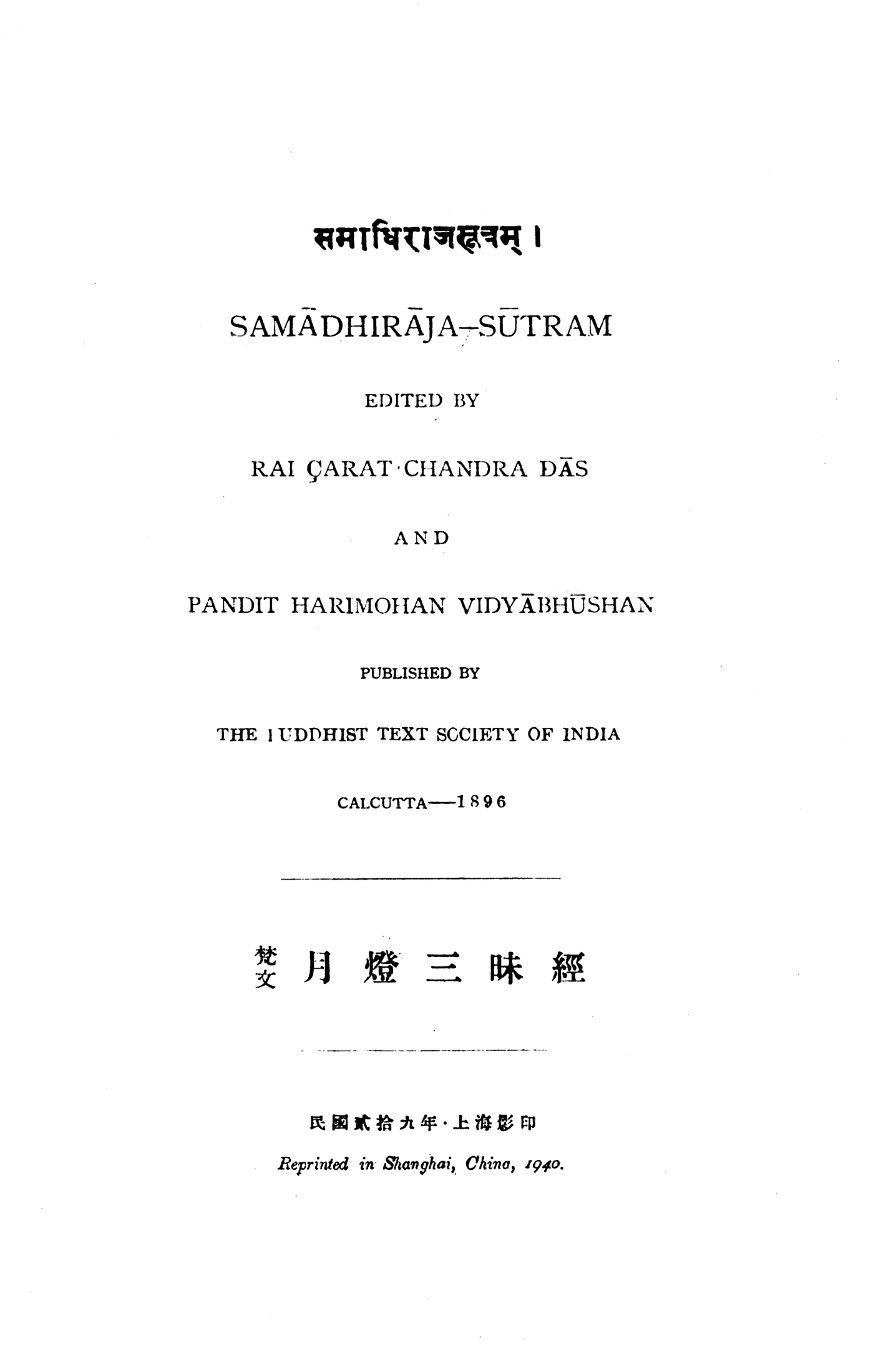
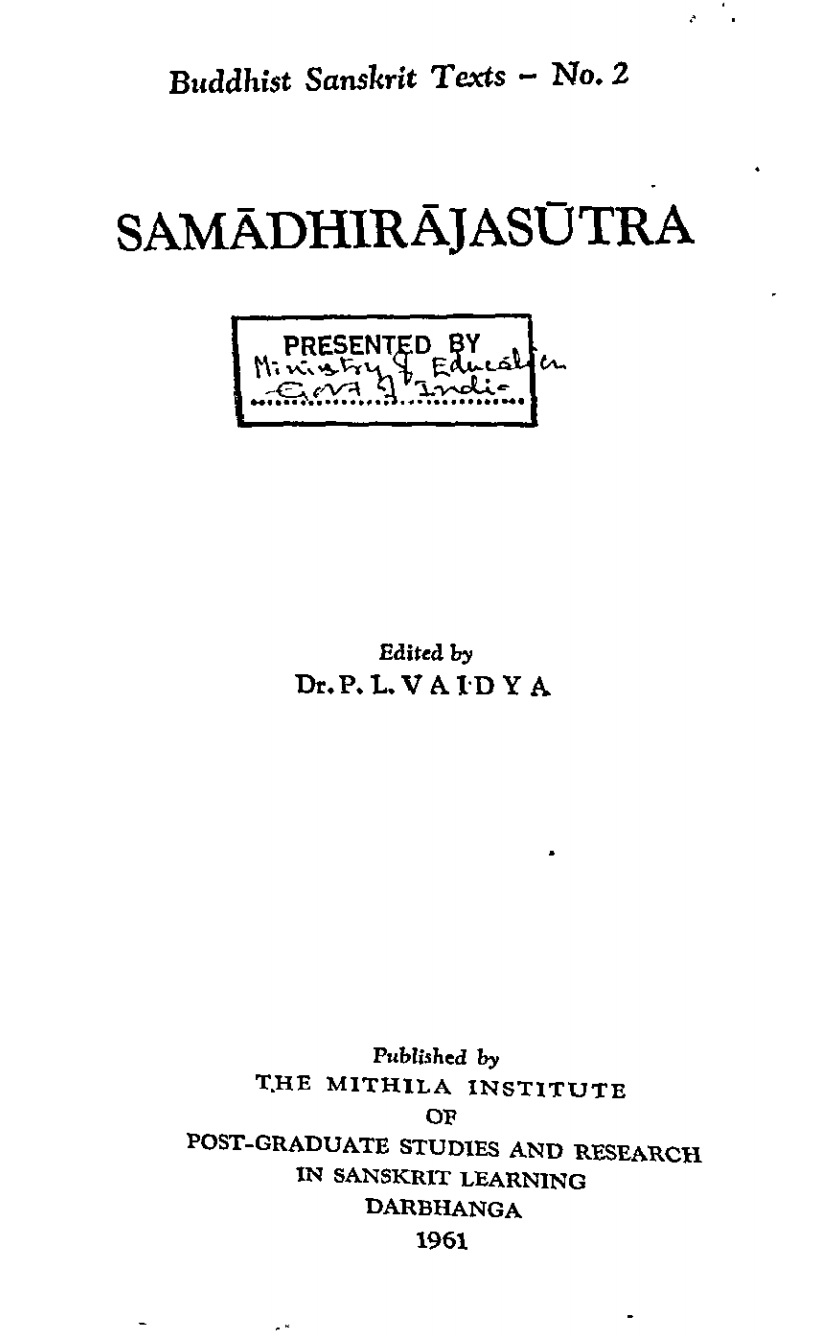
The Samādhirājasūtra, as it is commonly called in modem scholarship (hereafter SRS4), is a large Mahāyāna Buddhist scripture. It is a miscellaneous and probably composite work that bears certain affinities with the Prajñāpāramitā literature and other early Mahāyāna scriptures. It is known to modem scholarship through the pioneering edition of the complete text by Dutt, [5] and the re-edition, based on Dutt's, by Vaidya.[6] These two editions present us with a work that consists of some 40 chapters, although the text is found in manuscript sources in 40 chapters in an important group of Nepalese mss.,[7] 42 chapters in another important group of Nepalese mss. and a very different arrangement of at least 42 chapters in the Gilgit ms., 39 chapters in the Tibetan translation, and with no chapter divisions at all in the Chinese translation of Narendrayaśas. Whlle Dutt's edition purports to present the text of the Gilgit ms., he also records for us passages which only occur in the Nepalese mss. and Tibetan translation.[8] To confuse matters more, this text goes under at least four names: the colophons of the Nepalese manuscripts give us samādhirājaṃ nāma mahayānasūtram, but in various medieval Indian treatises it is referred to as the Candrapradīpa, the Candrapradīpasamādhi and also as the Mahākaruṇāvatāra.
It is the purpose of the present article to clarify the number and nature of distinct recensions of our text and to co-ordinate these conclusions, so far as seems possible, with the known titles.[9] To avoid ambiguity, in the following discussion I shall take the term recension to refer to a consciously rewritten version of a text. In other words, I understand a recension to be a distinct version of a text intentionally produced by an editor or redactor, thus excluding by my definition variations produced by the many accidental changes wrought over centuries by scribal error of one kind or another. Of course, it remains the case that even the accidental variants that modify and disfigure so many manuscripts of texts in this genre (primarily mss. from Nepal) can in tum become a part of the transmissional history of a given text, so that they too are, as Regamey puts it, 'an historical actuality', [10]
Notes
- E. Conze. The Prajñāpāramitā Literature, 's Gravenhage (1960): L. Lancaster, 'An Analysis of the Aṣṭasāhasrika Prajñāpāramitā Sūtra', dissertation, Madison (1968); N. Lethcoe, 'Some Notes on the Relationship between the Abhisamāyalaṅkāra, the Revised Pañcaviṃśatisāhasrikā, and the Chinese Translations of the Unrevised Pañcaviṃśatisāhasrikā', Journal of the American Oriental Society 96 (1976) pp. 499-511.
- H. Bechert, 'Remarks on the Textual History of the Saddharmapuṇḍarīka' in Studies in lndo-Asian Art and Culture, vol. 2 (= Acharya Raghu Vira Commemoration Volume, Śata-piṭaka, 96), New Delhi 1973, pp. 21-27; C. Regamey, 'Randbemerkungen zur Sprache und Textüberlieferung des Kāraṇḍavyūha' in ASIATICA. Festschrift Friedrich Weller, Leipzig 1954, pp. 514-527; O. von Hinüber 'Buddhism in Gilgit Between India and Central Asia', in The Countries of South Asia: Boundaries, Extensions, and lnterrelations. ed. P. Gaeffke and D. A. Utz, Philadelphia 1988, pp. 40-48. On the Kāraṇḍavyūhasūtra, more recently, A. Mette, Die Gilgitfragmente des Kāraṇḍavyūha, Swisttal-Odendorf 1997.
- von Hinüber. op. cit. It is regrettable that the edition of this text promised here has not and apparently will not see the light of day.
- l use this qualified abbreviation (SRS) throughout, without reference to any specific recension, but when as SRS l or SRS Il, l use it to refer to two specific recensions which I shall define in this article.
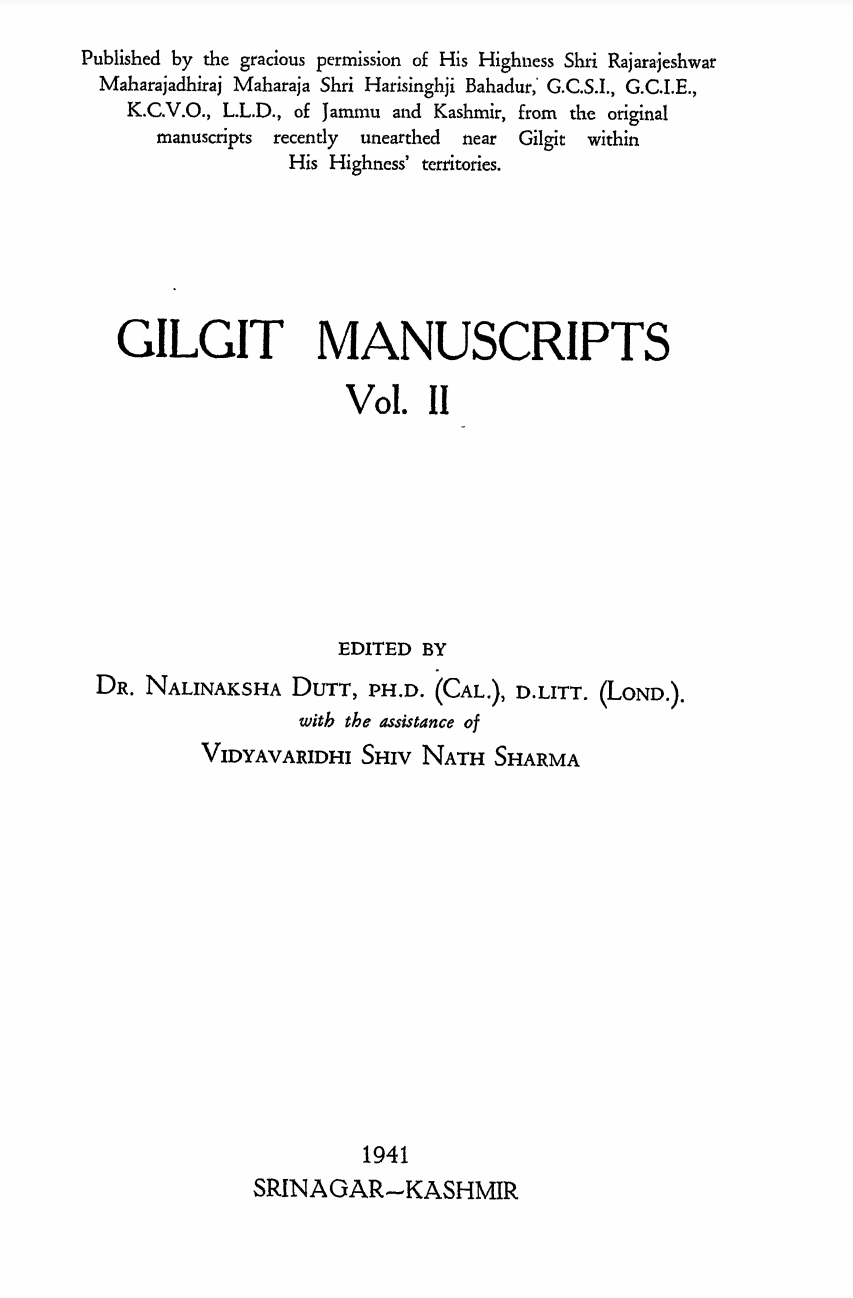
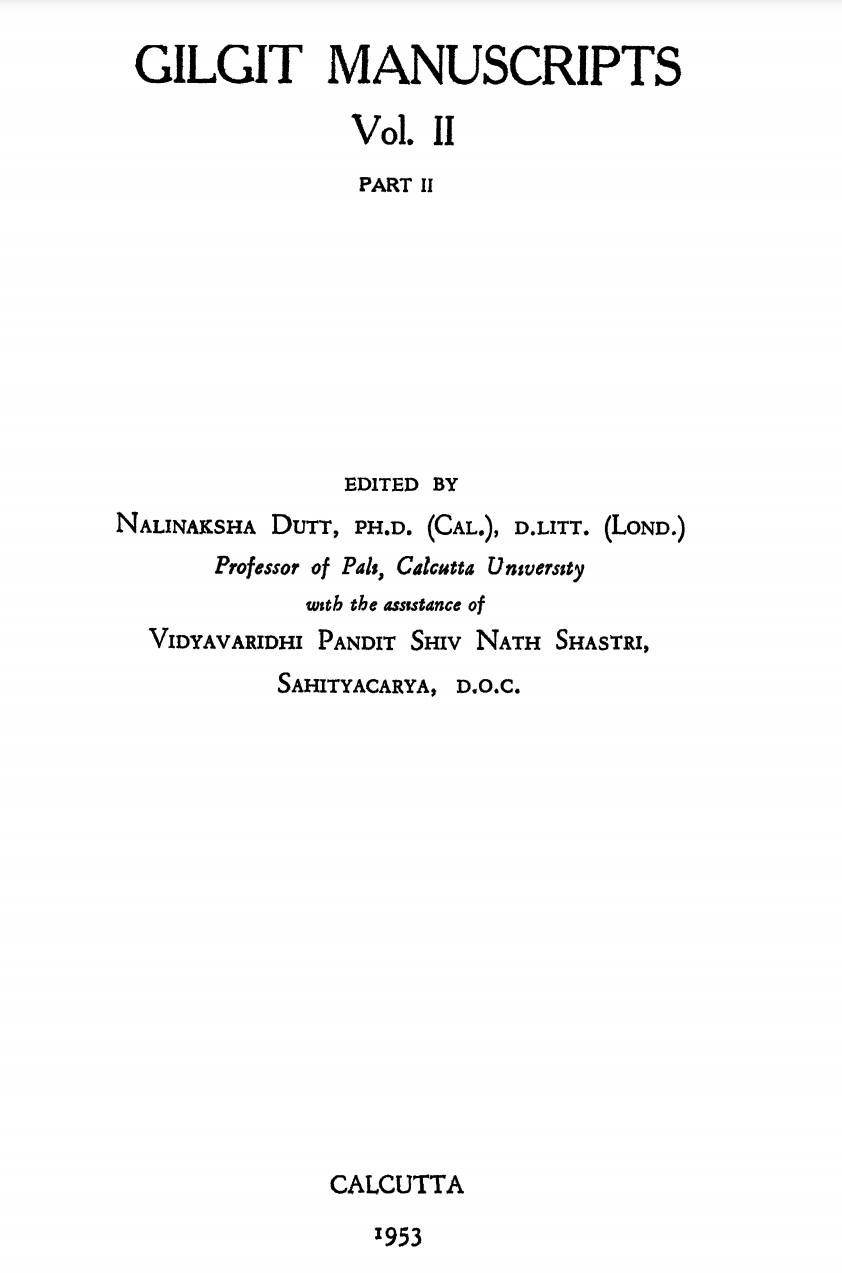
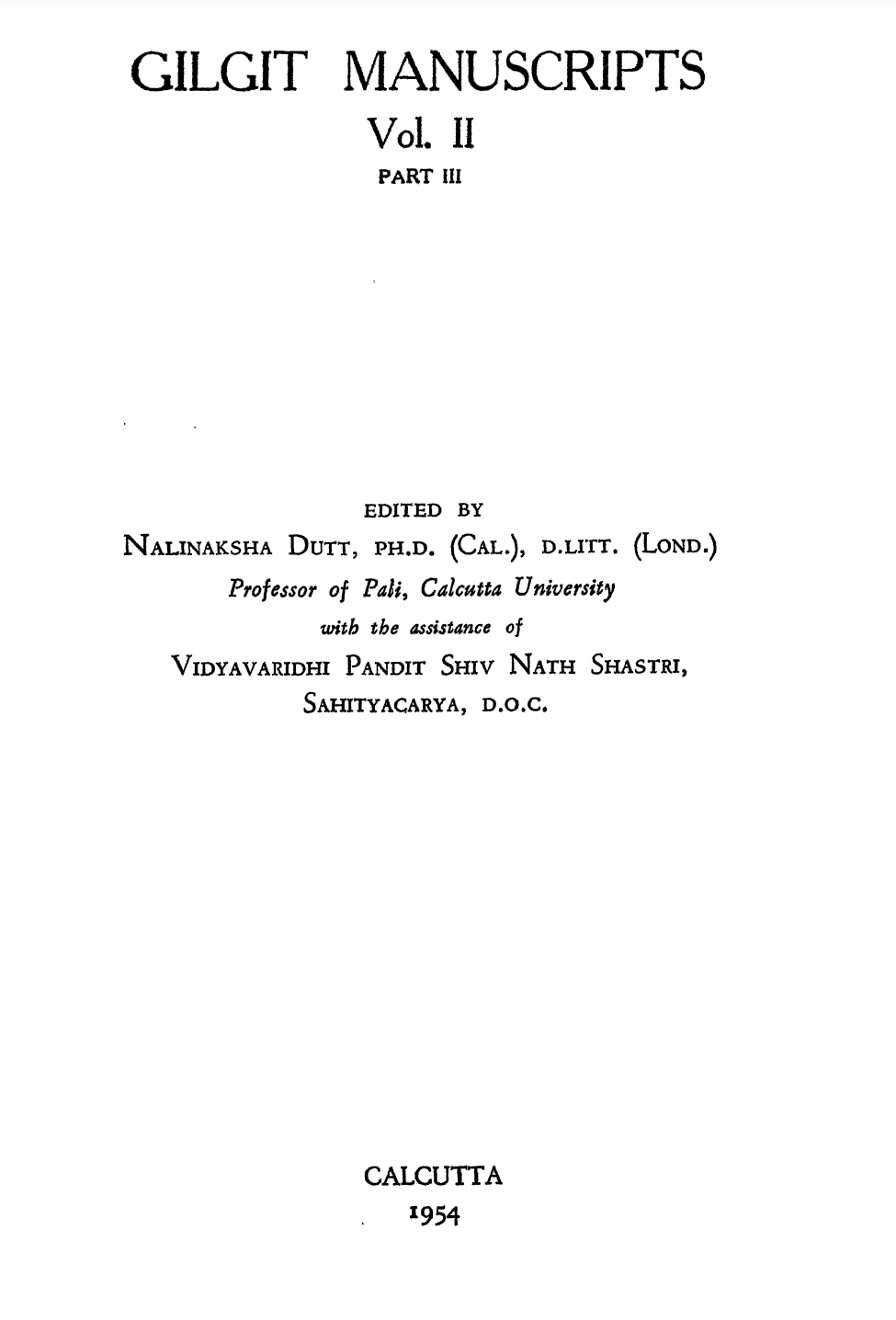
- N. Dutt and V.S.N. Sharma eds., Gilgit Manuscripts. vol. II, part 1 Shrinagar 1941, parts 2-3 Calcutta 1953 and 1954. This was predated by the 'edition' of Das and Vidyābhūshan, 1896, which is, however, a mere transcription of chapters 1-12 and 15-19 of a single highly faulty Nepalese ms. held in Calcutta by the Asiatic Society of Bengal. The omitted chapters represent a lacunae in the exemplar from which this ms. was itself copied, and since the editors did not understand this, the chapters of the printed text are numbered consecutively 1-17.
- P.L. Vaidya. Samādhirājasūtra, Darbbanga (1961). For ease of reference, I follow the chapter divisions and numbering of the printed editions of Dutt and Vaidya.
- ms. groups ABC. See below.
- The shortcomings of Dutt's editions are well known and will not be rehearsed here. For a detailed demonstration of the unreliability of Dutt's work, see G. Schopen, 'Sukhāvatī as a Generalised Religious Goal in Sanskrit Mahāyāna Sūtra Literature', Indo-Iranian Journal 19 (1977) pp. 177-210; Appendix III. 'Dutt's edition of the Bhaiṣajyaguru-Sūtra'; and L. Gomez and A. Silk, eds., Studies in the Literature of the Great Vehicle -Three Mahayana Buddhist Texts, Ann Arbor 1989, pp. 41–42, for comments on his edition of the SRS. On the Gilgit ms. itself, see A. Skilton, 'The Gilgit manuscript of the Samādhirāja Sūtra', forthcoming.
- The chapter divisions and chapter titles are addressed in A. Skilton, 'The Chapter Divisions and Titles of the Samādhirāja Sūtra', forthcoming.
- "Man kann natürlich erwidern, dass die typischen Sanskritisierungsfehler auch eine historische Tatsache sind." Regamey op. cit., p. 515. Quite where this leaves the critical editor is, of course, a matter of some debate.


A work of the class called Vyákarana, or narrative, in which various forms of meditations are described at length, pre-eminence being given to a meditation or Samádhi called 'the king of Samádhis'. Its object is to show the process by which a votary of Buddha may rise to the highest eminence, each chapter showing a step in the gradual progress of the human mind in its moral condition, and reciting one or more stories on moral excellence in illustration of the different stages of that progress.
The principal interlocutors are Buddha and Chandraprabha, and the scene is laid on the Gṛidhrakúṭa hill where Buddha expounded the principles of a religion which showers its blessings at all its stages, at the beginning, at the middle, and at the end. (Mitra, preliminary remarks, 207-8)


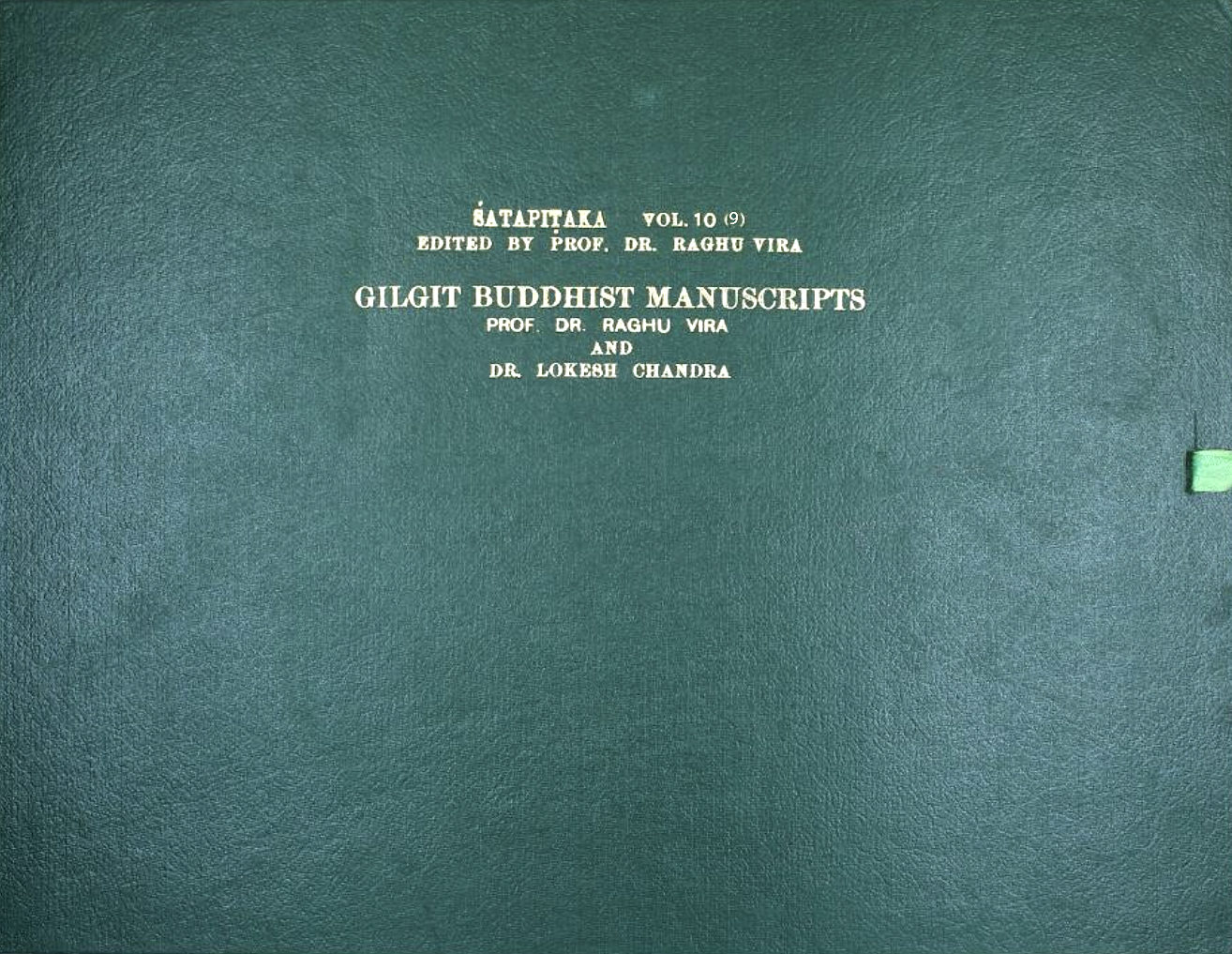
In 1931 a local inhabitant of Gilgit made a discovery of great moment for the discipline of Buddhist textual studies. Casual foraging for firewood or, according to some, for birch-bark folios to use as roof caulking, from a series of ancient mounds that had
already been plundered for the same purpose, was a common way for local cowherds grazing their cattle in the area to spend their time.[1] Eventually, under the larger central mound, one such forager chanced upon well preserved remains of what was probably a small Buddhist monastic library. The manuscripts filled a box, which was quickly removed for safekeeping and very likely for profit. News of this truly exceptional find soon spread, the British explorer Aurel Stein being the first European on the scene, and the major part of the manuscripts were eventually acquired, by a variety of avenues and parties, to be preserved for posterity. Although folios from this collection are deposited in a number of institutions around the world, the great bulk are now held by the National Archive in New Delhi.[2] Collectively manuscripts from this source are known as 'the Gilgit manuscripts' and for present purposes references to the Gilgit 'manuscripts' or 'collection' are to the total body of materials recovered from this original source.[3]
The Gilgit manuscripts have inevitably been the subject of considerable attention, not least because they preserve texts in some cases either known only from relatively late Nepalese sources or known only from Tibetan and Chinese translations. A terminus ante quern of 630 C.E. for the collection has been suggested on palaeographic grounds by von Hinüber, who argues that one of the scripts employed in the collection became obsolete in the Gilgit region by this date.[4] Gilgit manuscripts thus give us insights into these texts as circulated in the 6th century C.E.. Our interest is further enhanced when a Gilgit ms. records a distinct recension
of a given text, as is the case with the Samādhirāja Sūtra. The collection in its entirety is not catalogued, although the latest and most thorough description of the larger part was published by von Hinüber in 1979.[5] The same author, almost ten years later, declined to offer an exact figure for the number of texts preserved, even in the Delhi holding alone. Remarking upon recent progress in the identification of Gilgit material, he suggests that there are something in the region of 50 titles represented in the collection, if one treats all the avadāna stories as a single title.[6]
The ms. of the Samādhirāja Sūtra from Gilgit has been discussed in a variety of ways and circumstances. The first description, and we should be entitled to assume the most reliable, is that given by N. Dutt in his edition of the Samādhirāja Sūtra.[7] Unfortunately this description is inadequate, and has been supplemented by descriptions from Schopen and Matsumura.[8] The purpose of the present article is to present a comprehensive and detailed account of the Gilgit ms. of the Samādhirāja Sūtra, thereby clarifying the nature and extent of this particular manuscript and correcting a miscellaneous sprinkling of incorrect data that has been already published in connection with it. This attention is further justified by virtue of the manuscript being sole witness of a distinct recension of the text, and also of great antiquity. (Skilton, preliminary remarks, 1–3)
Notes
- The alarming roof-caulking motive is recounted in K. Jettmar, 'The Gilgit Manuscripts: Discovery by Instalments', Journal of Central Asia 4 (1981), pp. 1-18. (The substance of the present article is derived from A. Skilton, doctoral thesis: 'The Samādhirāja Sūtra :a study incorporating a critical edition and translation of Chapter 17', Oxford 1997.)
- Gilgit Materials are also held in Bombay, London, Fans, Foona, Kome, Srinagar and Ujjain. See O. von Hinüber, 'Die Bedeutung des Handschriftenfundes bei Gilgit', in F. Steppat, ed., XXL Deutscher Orientalistentag: Ausgewählte Vorträge, (Zeitschrift der Deutschen Morgenländischen Gesellschaft: Supplement, 5), Wiesbaden 1983, pp. 48-49 for a brief summary of this disposition.
- Although the full story of this process, in so far as it is known, has not been related in any one place, it is not the purpose of the present article to do so. The reader is referred to the following for the circumstances of the initial discovery: S. Lévi, 'Notes sur les manuscrits Sanscrits provenant de Bamiyan (Afghanistan) et de Gilgit (Cachemire)', Journal Asiatique 220 (1932) pp. 1-45.
- Von Hinüber, 1983, pp. 47-66.
- O. von Hinüber, Die Erforschung der Gilgit-Handschriften, Nachrichten der Akademie der Wissenschaften in Göttingen, I. Phil.-hist. Kl. Jg. 1979, Nr. 12 pp. 327-360; supplements: Zeitschrift der Deutschen Morgenländischen Gesellschaft Band 130, Heft 2 (1980) pp. *25* -*26*, Zeitschrift der Deutschen Morgenländischen Gesellschaft Band 131, Heft 2 (1981) pp. *9* -*11*. These publications cover the New Delhi and Srinagar holdings only. Earlier handlists of the New Delhi holdings are given in: L. Chandra, 'A Note on the Gilgit Manuscripts', Journal of the Oriental Institute (Baroda), 9 (1960) pp. 135-140, and L. Chandra, 'Unpublished Gilgit Fragment of the Prātimoksasūtra', Wiener Zeitschrift für die Kunde Süd- und Ost-asiens 4 (1960) pp. 1-13; and P. V. Bapat, 'Gilgit Manuscripts and Numerical Symbols', Journal of the Oriental Institute Baroda) 11 (1961-1962) pp. 127-131.
- 'Buddhism in Gilgit Between India and Central Asia', in The Countries of South Asia: Boundaries , Extensions , and Interrelations, ed. P. Gaeffke and D. A. Utz, Philadelphia 1988, pp. 40-48.

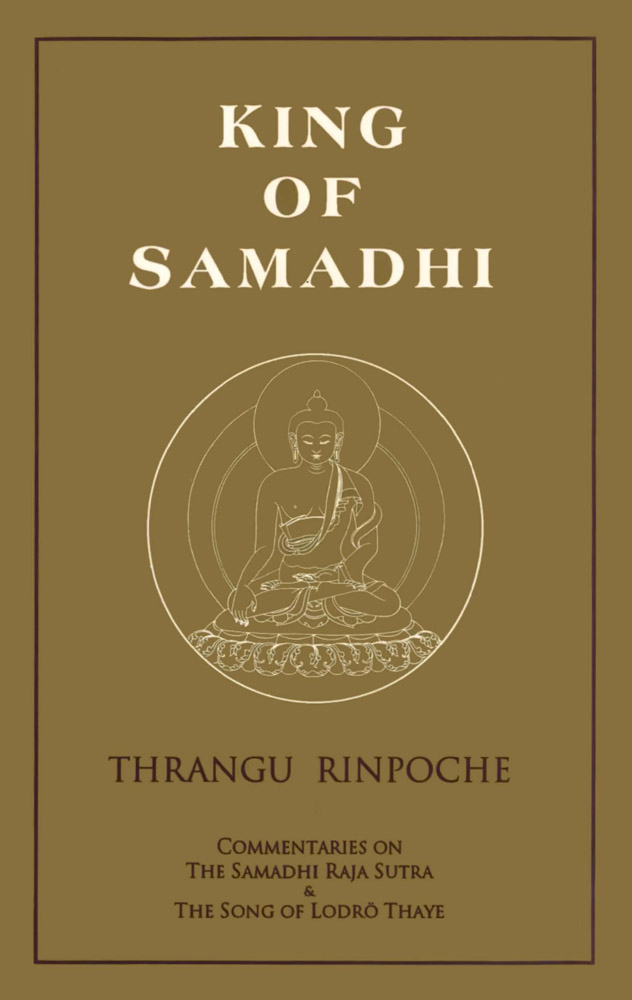
- "Khenchen Thrangu Rinpoche is a sublime being whose eminent character never departs from loving kindness and compassion. He is a great Buddhist teacher possessing the three qualities of learning, pure conduct and noble-mindedness. He is also an expert in exposition, debate and composition. Given in the style of pith instructions, these profound lectures contain the key points of the Samadhi Raja Sutra, the words of our compassionate Buddha. This is accompanied by an explanation by the lord of the Dharma, Jamgon Lodro Thaye’s song of experience in Mahamudra. It is therefore my request that all Dharma practitioners take the meaning of these extremely precious teachings to heart and make it a personal experience through correct practice. Please treasure this Dharma book with great care and appreciation."
–Chokyi Nyima Rinpoche
Khenchen Thrangu Rinpoche, a realized teacher of Tibetan Buddhism’s Kagyu lineage, has been the abbot of Rumtek monastery in Sikkim and currently directs numerous monasteries and retreat centers. On his frequent world tours he teaches all levels of Buddhist philosophy and practice. (Source: Rangjung Yeshe Publications)

A notable feature of the commentary is philological: Nagtso's Tibetan translation of the Kīrtimālā incorporates the earlier Tibetan translation of the sūtra itself, indicating that Mañjuśrīkīrti's original commentary was composed for the same Sanskrit recension of the sūtra already rendered into Tibetan, rather than the longer version quoted by Candrakīrti. The commentary also proved useful in modern translation work: Mañjuśrīkīrti's commentary defines the list of qualities of the samādhi given in chapter 1 of the sūtra, and—despite discrepancies between its definitions and those in chapter 40 and the Sanskrit versions—was useful in ascertaining the intended meaning of these terms. Roberts notes, however, that in China the sūtra never achieved the prominence of texts like the White Lotus of the Good Dharma, and unlike there, no commentary [on the sūtra] was translated [into Chinese].
Source: Peter Alan Roberts, trans., The King of Samādhis Sūtra (Toh 127), 84000: Translating the Words of the Buddha, Introduction, §i.19 and §i.33. https://www.tilogaard.dk/english/King_of_Samadhis_Sutra_translated_by_Peter_Alan_Roberts_84000_translating_the_words_of_the_Buddha.pdf
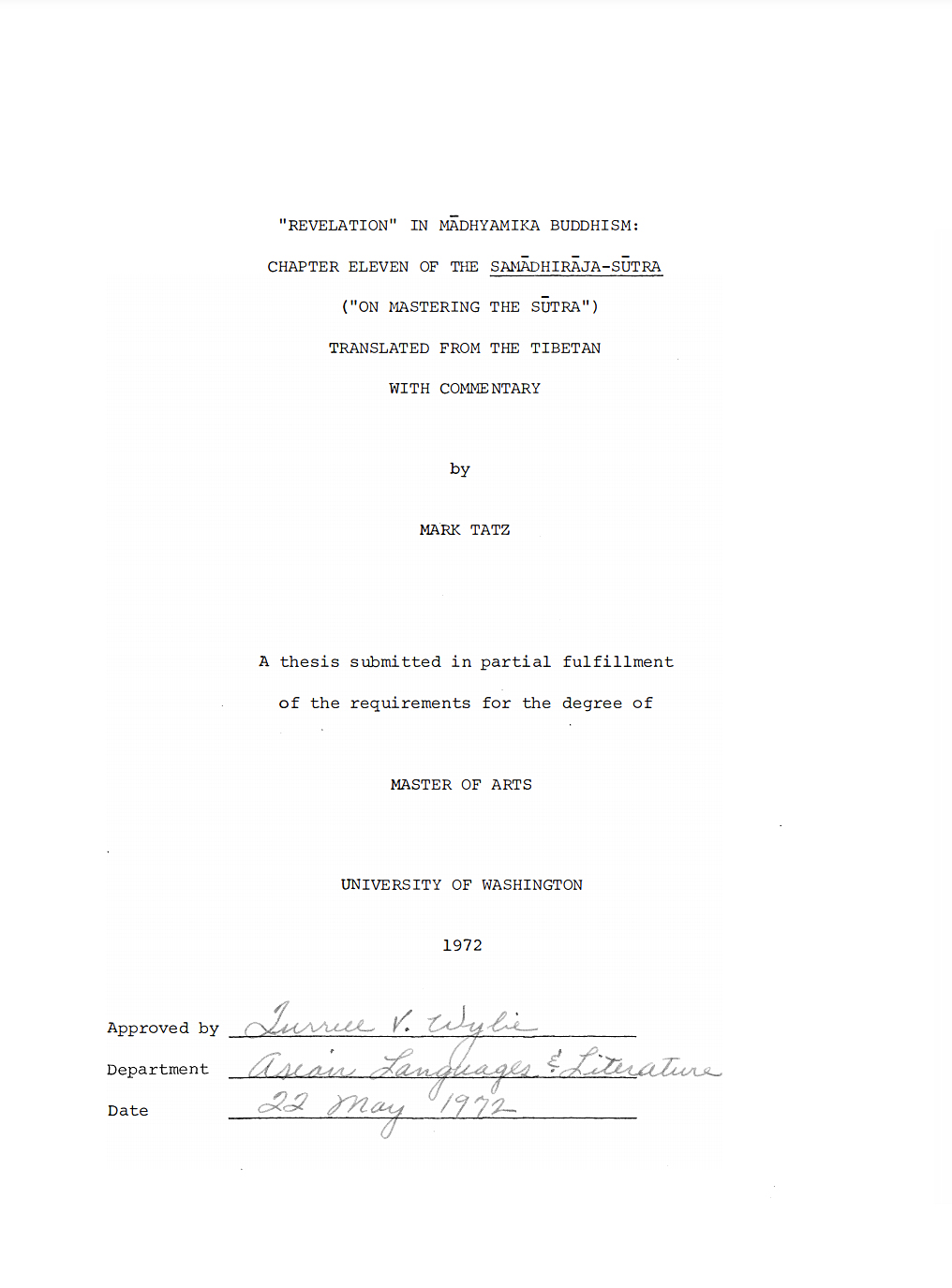
The chapter presented here is the eleventh, "On Mastering the Sūtra" (mdo sde 'dzin pa'i le'u). It is of interest for its discussion of the Bodhisattva's function in the world.
The full title of the sutra, as it appears in the Bka'-' gyur, is the Arya-sarvadharma-svabhāva-samatā-vipañcita-samādhirāja-mahāyāna-sūtra, "the noble sūtra of the greater vehicle, known as the King of Samādhis, which explains in detail the similarity of all dharmas in their own-being." It is also known as the Candrapradīpa after its principal interlocutor, the Bodhisattva Candraprabha. It is an expansive (vaipulya) sūtra, surviving in its entirety in Sanskrit and Tibetan, which elaborates in great detail the doctrines and practices of the early Mādhyamika. It is a source-work for the philosophy of the leaders of the Mahāyāna in India, from Candrakīrti to Atīśa. Its translation and that of the major commentary were done during the two "great spreads" of the Doctrine in Tibet, and in that country tooit has been a fundamental text. (Tatz, introduction, 1–2)


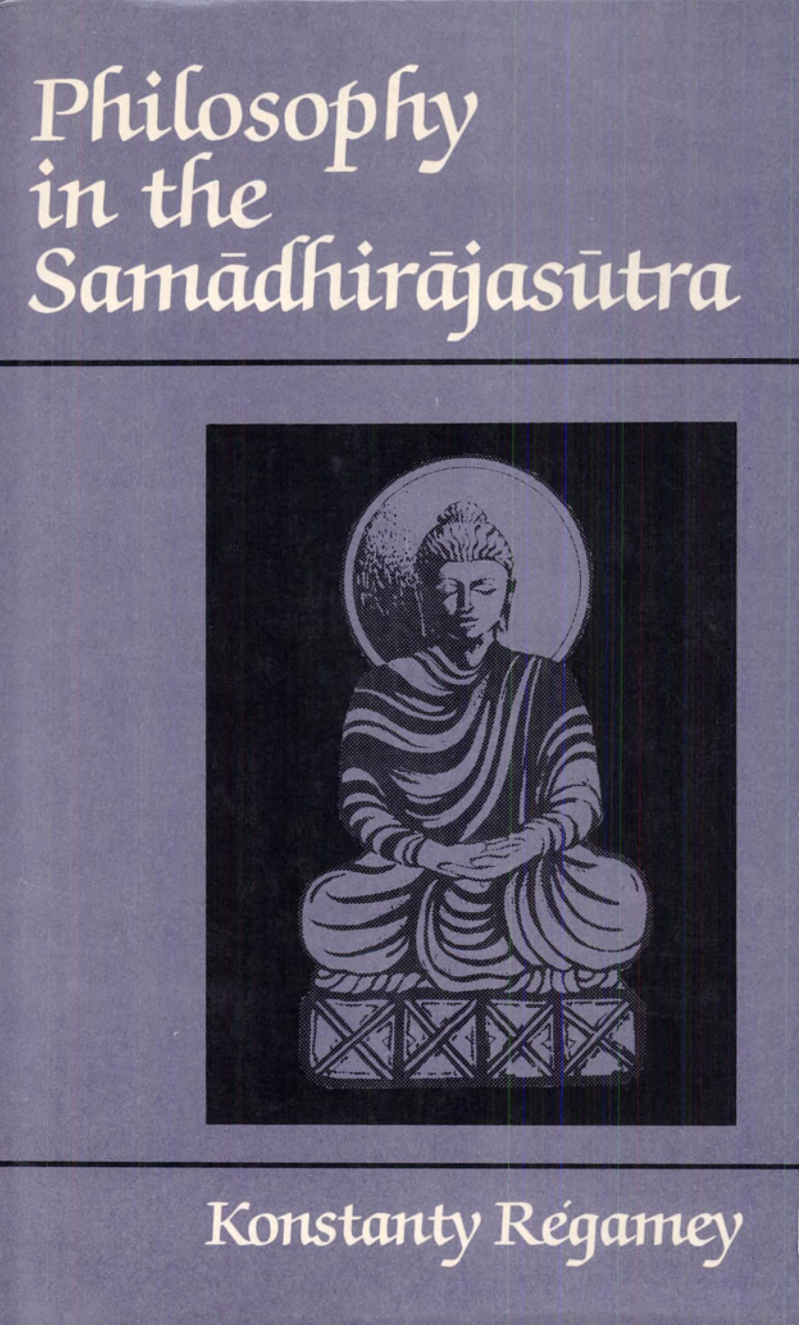
The present work contains three philosophical chapters of the Sutra, viz. VIII, XIX and XXII, giving an approximate idea of the doctrinal standpoint of the Sutra. These three chapters have not been selected arbitrarily. Chapter VIII treats of the inexistence of dharmas; Chapter XIX of the identity of their essence; Chapter XXII treats of the nature of the bodies of the Buddha. These are all essential themes of the philosophy of the Great Vehicle and sunyavada.
This is a reprint of the 1938 Warsaw edition comprising an Introduction, Sanskrit and Tibetan Texts and the English Translation by K. Regamey, which was almost wholly lost to the public in Warsaw's destruction during the Second World War. (Source: Motilal Banarsidass)

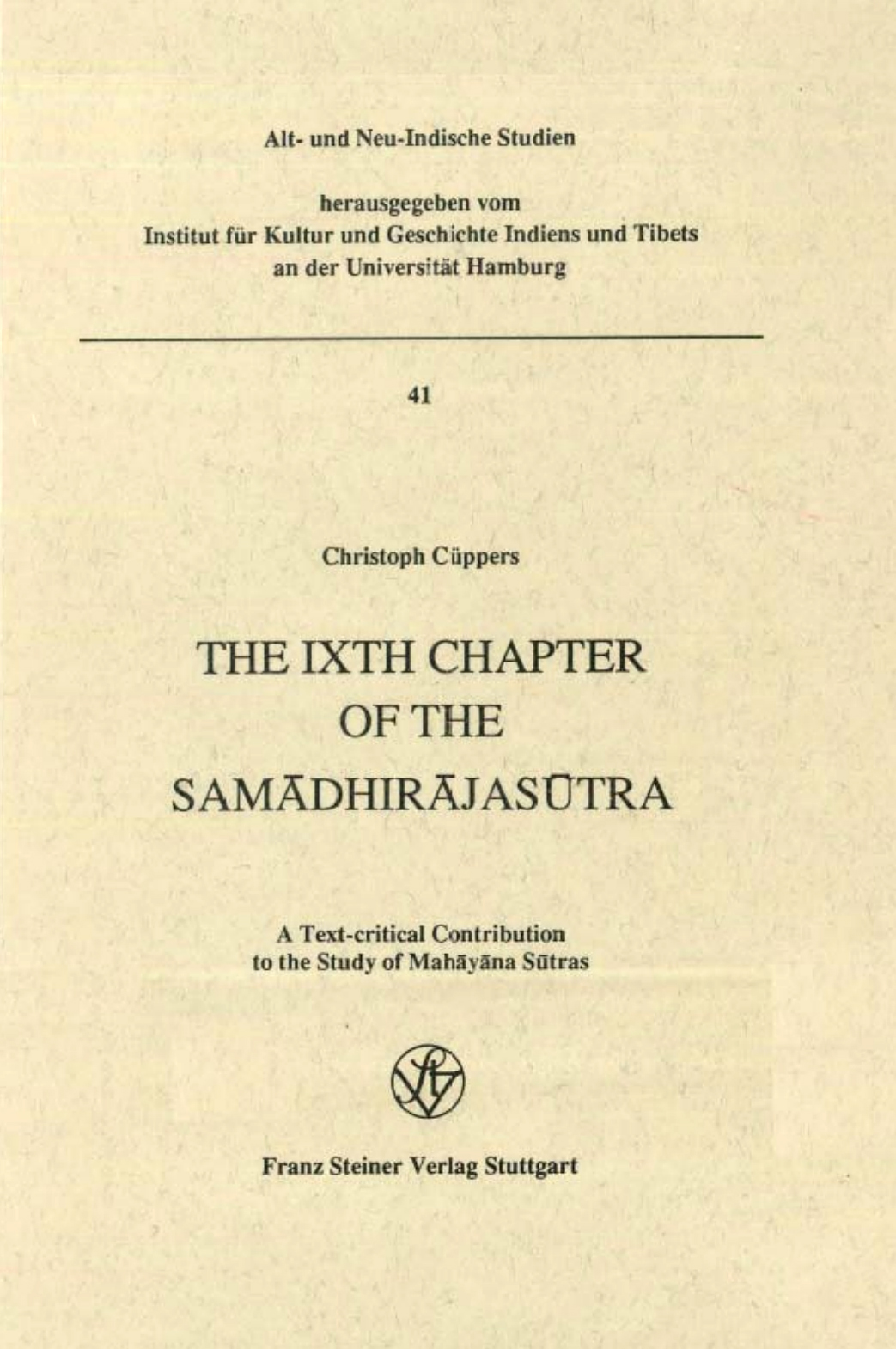
This edition of the IXth chapter is based on a collection of twelve manuscripts from Nepal, to which is added, separately, the older version of a different redaction, as preserved in a Gilgit manuscript. The Sanskrit text is compared with the Tibetan, which in part, from Pāda IX, 28d to Pāda IX, 53, exists in two completely different translations, the canonical and a Tun Huang version. The Chinese translation by Narendrayaśas has also been taken into account, and its deviations from other versions marked in the English translation.
Appendix A contains an edition and translation of the IXth chapter of Mañjuśrīkīrti's commentary on the SR, called Kīrtimālā, which is preserved in Tibetan translation only. In Appendix B I have given a Sanskrit and Tibetan Pāda Index of all pādas, and in Appendix C a list of the Prakrit forms occurring in the chapter and the transliteration of the colophons of the Nepalese manuscripts. (Cüppers, preface, vii)
Beyond the edition itself, the thesis laid the groundwork for the recensional and chronological framework Skilton went on to develop across a series of journal articles in the years following, including:
- "Dating the Samādhirāja Sūtra" (Journal of Indian Philosophy 27, 1999), which cites the thesis directly for supporting textual and manuscript detail;
- "Four Recensions of the Samādhirāja Sūtra" (Indo-Iranian Journal 42, 1999), presenting in full the argument that the SRS circulated in four distinct textual recensions;
- "The Gilgit Manuscript of the Samādhirāja Sūtra" (Central Asiatic Journal 44, 2000);
- "State or Statement? Samādhi in Some Early Mahāyāna Sūtras" (The Eastern Buddhist 34.2, 2002), which develops the argument that the term samādhi in texts like the SRS often denotes the scriptural text itself rather than a meditative state or practice.

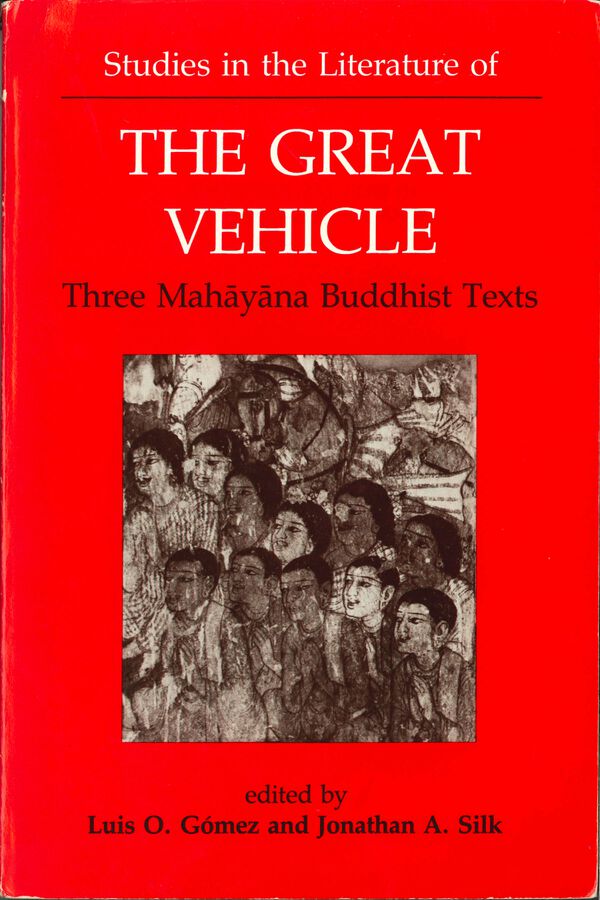
The first paper in the volume contains a lengthy introduction to the Samādhirāja-sūtra and a translation of its first four chapters. This translation of the King of Samādhis is the result of an experiment in group translation, the members of the group consisting of faculty, visiting scholars, and advanced graduate students at the University of Michigan from 1982 to 1983. An effort was made throughout the introduction and translation to make the presentation of these materials accessible to the interested nonspecialist, while still maintaining rigorous scholarly standards. The introduction contains detailed bibliographic information about the sūtra, its classical versions and its modern editions, translations and studies. A text of capital importance for the Mahāyāna philosophical school called Mādhyamika, this sūtra is quoted extensively in śāstric literature. These quotations are documented in detail. Furthermore, an outline summary of the whole sūtra is given, chapter by chapter. It is hoped that the availability of some portions of the sūtra in English translation might prompt others to undertake translations of the remaining chapters in the near future.
For reasons explained in detail in Part I, the text taken as a basis for
the translation is the version preserved in the Buddhist Sanskrit manuscripts of Nepal. Since many Mahayana sūtras do not survive in their Indian-language originals, Tibetan and Chinese translations provide us with valuable textual materials for the study of Indian Mahāyāna Buddhism. Even in cases like that of the King of Samādhis, for which we still possess a Sanskrit version, careful and judicious use of the Tibetan and Chinese translations can aid our reading of the text. It is important, however, for modern scholars to avoid creating their own new, conflated text of a sūtra. Often scholars will fail to adequately distinguish the various recensions of a given text, using translations not to shed light on one version but to actually rewrite the text. The study in Part I cautions against such a method, and shows in the notes to its translation one
- "Khenchen Thrangu Rinpoche is a sublime being whose eminent character never departs from loving kindness and compassion. He is a great Buddhist teacher possessing the three qualities of learning, pure conduct and noble-mindedness. He is also an expert in exposition, debate and composition. Given in the style of pith instructions, these profound lectures contain the key points of the Samadhi Raja Sutra, the words of our compassionate Buddha. This is accompanied by an explanation by the lord of the Dharma, Jamgon Lodro Thaye’s song of experience in Mahamudra. It is therefore my request that all Dharma practitioners take the meaning of these extremely precious teachings to heart and make it a personal experience through correct practice. Please treasure this Dharma book with great care and appreciation."
–Chokyi Nyima Rinpoche
Khenchen Thrangu Rinpoche, a realized teacher of Tibetan Buddhism’s Kagyu lineage, has been the abbot of Rumtek monastery in Sikkim and currently directs numerous monasteries and retreat centers. On his frequent world tours he teaches all levels of Buddhist philosophy and practice. (Source: Rangjung Yeshe Publications)The chapter presented here is the eleventh, "On Mastering the Sūtra" (mdo sde 'dzin pa'i le'u). It is of interest for its discussion of the Bodhisattva's function in the world.
The full title of the sutra, as it appears in the Bka'-' gyur, is the Arya-sarvadharma-svabhāva-samatā-vipañcita-samādhirāja-mahāyāna-sūtra, "the noble sūtra of the greater vehicle, known as the King of Samādhis, which explains in detail the similarity of all dharmas in their own-being." It is also known as the Candrapradīpa after its principal interlocutor, the Bodhisattva Candraprabha. It is an expansive (vaipulya) sūtra, surviving in its entirety in Sanskrit and Tibetan, which elaborates in great detail the doctrines and practices of the early Mādhyamika. It is a source-work for the philosophy of the leaders of the Mahāyāna in India, from Candrakīrti to Atīśa. Its translation and that of the major commentary were done during the two "great spreads" of the Doctrine in Tibet, and in that country tooit has been a fundamental text. (Tatz, introduction, 1–2)

Working from datable Chinese translations (5th–6th century) as a baseline, Skilton then marshals a series of textual citations and allusions to push the evidence further back: quotations of the SRS in Nāgārjuna's Sūtrasamuccaya (if authentic, pointing to a 2nd-century terminus), an allusion in Nāgārjuna's Acintyastava, borrowing from the SRS's "samādhi list" in a 7th-century sūtra (the Prasāntaviniścayaprātihāryasamādhisūtra), and—his most original contribution—a previously unrecognized reference to the Samādhirājasūtra by name in Asaṅga's Mahāyānasaṃgraha (c. 310–390 C.E.), which he argues has been mistranslated by Lamotte as referring to meditative states rather than scriptural titles.
Skilton concludes that at least three recensions were circulating contemporaneously by the 6th century C.E., with the "long" recension (SRS I) attested by Candrakīrti's citations and confirmed by the 7th-century Prasāntaviniścayaprātihāryasamādhisūtra's borrowings. If Asaṅga's reference specifically denotes the recension known as the Samādhirājasūtra (as opposed to the Candrapradīpasamādhisūtra), the date for that recension could be pushed back to the 4th century C.E.—considerably earlier than the 11th–12th century dates of the earliest surviving Sanskrit manuscripts (SRS I and SRS II respectively).It has been long demonstrated that a number of Mahāyāna sūtra are preserved in two or more recensions. Chinese translations of Mahāyāna sūtra in some cases record a succession of recensions of an individual text The diversity of the Prajñāpāramitā corpus is especially well known through the work of Conze on the whole body, that of Lancaster on the Aṣṭasāhasrikāprajñāpāramitā, and Lethcoe on the Pañcaviṃśatisāhasrikā-prajñāpāramitā.[1] We need only look to the work of Bechert, Regamey, and von Hinüber, concerning the Saddharmapuṇḍarīkasūtra, the Kāraṇḍavyūhasūtra and the Saṅghāṭasūtra respectively, for discussions of distinct recensions of individual titles that are witnessed directly in the Sanskrit language.[2] Especially in the last of these three cases, the manuscripts from the Gilgit collection have played a crucial part in uncovering this textual diversity – the eight mss. that we possess of the Saṅghāṭasūtra, recording distinct recensions, were all recovered from Gilgit.[3]
The Samādhirājasūtra, as it is commonly called in modem scholarship (hereafter SRS4), is a large Mahāyāna Buddhist scripture. It is a miscellaneous and probably composite work that bears certain affinities with the Prajñāpāramitā literature and other early Mahāyāna scriptures. It is known to modem scholarship through the pioneering edition of the complete text by Dutt, [5] and the re-edition, based on Dutt's, by Vaidya.[6] These two editions present us with a work that consists of some 40 chapters, although the text is found in manuscript sources in 40 chapters in an important group of Nepalese mss.,[7] 42 chapters in another important group of Nepalese mss. and a very different arrangement of at least 42 chapters in the Gilgit ms., 39 chapters in the Tibetan translation, and with no chapter divisions at all in the Chinese translation of Narendrayaśas. Whlle Dutt's edition purports to present the text of the Gilgit ms., he also records for us passages which only occur in the Nepalese mss. and Tibetan translation.[8] To confuse matters more, this text goes under at least four names: the colophons of the Nepalese manuscripts give us samādhirājaṃ nāma mahayānasūtram, but in various medieval Indian treatises it is referred to as the Candrapradīpa, the Candrapradīpasamādhi and also as the Mahākaruṇāvatāra.
It is the purpose of the present article to clarify the number and nature of distinct recensions of our text and to co-ordinate these conclusions, so far as seems possible, with the known titles.[9] To avoid ambiguity, in the following discussion I shall take the term recension to refer to a consciously rewritten version of a text. In other words, I understand a recension to be a distinct version of a text intentionally produced by an editor or redactor, thus excluding by my definition variations produced by the many accidental changes wrought over centuries by scribal error of one kind or another. Of course, it remains the case that even the accidental variants that modify and disfigure so many manuscripts of texts in this genre (primarily mss. from Nepal) can in tum become a part of the transmissional history of a given text, so that they too are, as Regamey puts it, 'an historical actuality', [10]
Notes
- E. Conze. The Prajñāpāramitā Literature, 's Gravenhage (1960): L. Lancaster, 'An Analysis of the Aṣṭasāhasrika Prajñāpāramitā Sūtra', dissertation, Madison (1968); N. Lethcoe, 'Some Notes on the Relationship between the Abhisamāyalaṅkāra, the Revised Pañcaviṃśatisāhasrikā, and the Chinese Translations of the Unrevised Pañcaviṃśatisāhasrikā', Journal of the American Oriental Society 96 (1976) pp. 499-511.
- H. Bechert, 'Remarks on the Textual History of the Saddharmapuṇḍarīka' in Studies in lndo-Asian Art and Culture, vol. 2 (= Acharya Raghu Vira Commemoration Volume, Śata-piṭaka, 96), New Delhi 1973, pp. 21-27; C. Regamey, 'Randbemerkungen zur Sprache und Textüberlieferung des Kāraṇḍavyūha' in ASIATICA. Festschrift Friedrich Weller, Leipzig 1954, pp. 514-527; O. von Hinüber 'Buddhism in Gilgit Between India and Central Asia', in The Countries of South Asia: Boundaries, Extensions, and lnterrelations. ed. P. Gaeffke and D. A. Utz, Philadelphia 1988, pp. 40-48. On the Kāraṇḍavyūhasūtra, more recently, A. Mette, Die Gilgitfragmente des Kāraṇḍavyūha, Swisttal-Odendorf 1997.
- von Hinüber. op. cit. It is regrettable that the edition of this text promised here has not and apparently will not see the light of day.
- l use this qualified abbreviation (SRS) throughout, without reference to any specific recension, but when as SRS l or SRS Il, l use it to refer to two specific recensions which I shall define in this article.
- N. Dutt and V.S.N. Sharma eds., Gilgit Manuscripts. vol. II, part 1 Shrinagar 1941, parts 2-3 Calcutta 1953 and 1954. This was predated by the 'edition' of Das and Vidyābhūshan, 1896, which is, however, a mere transcription of chapters 1-12 and 15-19 of a single highly faulty Nepalese ms. held in Calcutta by the Asiatic Society of Bengal. The omitted chapters represent a lacunae in the exemplar from which this ms. was itself copied, and since the editors did not understand this, the chapters of the printed text are numbered consecutively 1-17.
- P.L. Vaidya. Samādhirājasūtra, Darbbanga (1961). For ease of reference, I follow the chapter divisions and numbering of the printed editions of Dutt and Vaidya.
- ms. groups ABC. See below.
- The shortcomings of Dutt's editions are well known and will not be rehearsed here. For a detailed demonstration of the unreliability of Dutt's work, see G. Schopen, 'Sukhāvatī as a Generalised Religious Goal in Sanskrit Mahāyāna Sūtra Literature', Indo-Iranian Journal 19 (1977) pp. 177-210; Appendix III. 'Dutt's edition of the Bhaiṣajyaguru-Sūtra'; and L. Gomez and A. Silk, eds., Studies in the Literature of the Great Vehicle -Three Mahayana Buddhist Texts, Ann Arbor 1989, pp. 41–42, for comments on his edition of the SRS. On the Gilgit ms. itself, see A. Skilton, 'The Gilgit manuscript of the Samādhirāja Sūtra', forthcoming.
- The chapter divisions and chapter titles are addressed in A. Skilton, 'The Chapter Divisions and Titles of the Samādhirāja Sūtra', forthcoming.
- "Man kann natürlich erwidern, dass die typischen Sanskritisierungsfehler auch eine historische Tatsache sind." Regamey op. cit., p. 515. Quite where this leaves the critical editor is, of course, a matter of some debate.
The present work contains three philosophical chapters of the Sutra, viz. VIII, XIX and XXII, giving an approximate idea of the doctrinal standpoint of the Sutra. These three chapters have not been selected arbitrarily. Chapter VIII treats of the inexistence of dharmas; Chapter XIX of the identity of their essence; Chapter XXII treats of the nature of the bodies of the Buddha. These are all essential themes of the philosophy of the Great Vehicle and sunyavada.
This is a reprint of the 1938 Warsaw edition comprising an Introduction, Sanskrit and Tibetan Texts and the English Translation by K. Regamey, which was almost wholly lost to the public in Warsaw's destruction during the Second World War. (Source: Motilal Banarsidass)A work of the class called Vyákarana, or narrative, in which various forms of meditations are described at length, pre-eminence being given to a meditation or Samádhi called 'the king of Samádhis'. Its object is to show the process by which a votary of Buddha may rise to the highest eminence, each chapter showing a step in the gradual progress of the human mind in its moral condition, and reciting one or more stories on moral excellence in illustration of the different stages of that progress.
The principal interlocutors are Buddha and Chandraprabha, and the scene is laid on the Gṛidhrakúṭa hill where Buddha expounded the principles of a religion which showers its blessings at all its stages, at the beginning, at the middle, and at the end. (Mitra, preliminary remarks, 207-8)
If we proceed from the premise that an act of reading always approaches the text from a particular vantage point—that reading cannot truly occur in the abstract or encompass the text fully—we will expect to encounter particular or even idiosyncratic instances of reading. In such particular acts of reading, questions of who the readers are, the assumptions and points of view that they bring to the text, and how they interpret the text all become relevant.
When we turn to Indian Buddhist sūtras, even while much of the corpus appears to consist of texts without recorded histories of use from the land of their origin, instances of reading can still be recovered from several kinds of sources. In this connection, Jonathan Z. Smith has warned historians of religion against what he calls "ultimate acts of imperialism," which he describes as religion scholars' "removal of all rights to interpretation from the native,
and the arrogation of all such rights to themselves."[2] In the same influential essay, Smith emphasizes the utility of traditional exegeses in aiding religion scholars' work of interpreting canonical texts and charting their creative uses.
Dozens of sūtra commentaries in Tibetan and Chinese translation and the Pāli exegeses of the Sutta Piṭaka have preserved for us readings of the sūtras from South Asia. Further traces of reading can be recovered from sūtra citations, scriptural anthologies, and
even occasional incorporation of isolated verses and sentences from sūtras into ritual texts. Some of these sources—especially citations and anthologies—require careful analysis before we can obtain usable information about reading practices. Many of these texts also show that readings discernible in them have been filtered through particular perspectives. The interpretations of sūtras in the commentaries are normative and thus sometimes not truly indicative of typical acts of reading; śāstras' uses of sūtras in the form of citation may reveal more of the former texts' own interest. Scriptural anthologies arrange sūtra passages according to their own organizing principles or for purposes of religious programs. However, as elitist or less than transparent as they might be, these sources still contain some of the best evidence we have of how sūtras were read in premodern South Asia.
This paper will focus on sūtra citation in the śāstras as a source for the study of reading practices in premodern South Asia. Immediately, the situation of sūtra passages in the context of śāstras and their commentaries brings the relationship between sūtras and śāstric texts into focus.[3] The setting of a citation presumes at least some degree of śāstric mediation in the reading of the sūtra passages. While it is necessary to be particularly conscious about this śāstric angle of vision and its implications, one can still detect reading habits that lie beyond śāstras' doctrinal concerns. As the selected sūtra passages are brought to bear on the contents of a śāstra or a śāstra commentary, the features of the sūtra's language also become particularly visible (arguably in the eyes of both writers and readers), set in relief against the environment of the śāstric texts. For our purposes, the language of sūtras encompasses not only their linguistic peculiarities but their rhetorical and literary features as well.
A further factor that could contribute to a Buddhist's sūtra-reading experience is his or her view on the nature of language. In the specific case that I have selected for this study, a Madhyamaka articulation of the philosophy of language addresses both the nature of a buddha's enlightenment and the intimate connection between language and conventional truth (saṃvṛtisatya), or the world as it is experienced by ordinary beings. Using examples of citation by the Madhyamaka writer Candrakīrti, this paper will demonstrate that it is the cumulative effect of the sūtras' language that emerges most distinctively in the environment of the śāstric text, although selected contents from the sūtras also contribute to the formation of new philosophical and theological ideas. (Li, preliminary remarks, 231–33)
Notes
- I would like to thank the Mangalam Research Center for hosting me during "The Language of the Sūtras" conference in June 2015, when the initial version of this essay was discussed. Professor Luis O. Gómez nurtured and supported me around the time I finished my dissertation and began a career as a junior scholar. This study on the citations from the Samādhirāja-sūtra is a tribute to him, who contributed himself to an earlier fine work on the first four chapters of the sūtra. Natalie Gummer's editorial assistance has significantly improved the presentation of the materials. The revision of this essay was also supported by the Major Program of National Social Science Foundation of China (Grant No. 17ZDA235).
- Jonathan Z. Smith, "Sacred Persistence: Toward a Redescription of Canon," in Imagining Religion: From Babylon to Jonestown (Chicago: The University of Chicago Press, 1982), 43.
- I use the phrase "śāstric texts" to refer to both śāstras and their commentaries. The similarities between these two groups of texts in contents and methods warrant placing them in the same category. One may argue that sūtra commentaries also share many features with śāstras and their commentaries, at least in methods, but they are excluded here because they are primarily concerned with the contents of the sūtras that they comment on.
In 1931 a local inhabitant of Gilgit made a discovery of great moment for the discipline of Buddhist textual studies. Casual foraging for firewood or, according to some, for birch-bark folios to use as roof caulking, from a series of ancient mounds that had
already been plundered for the same purpose, was a common way for local cowherds grazing their cattle in the area to spend their time.[1] Eventually, under the larger central mound, one such forager chanced upon well preserved remains of what was probably a small Buddhist monastic library. The manuscripts filled a box, which was quickly removed for safekeeping and very likely for profit. News of this truly exceptional find soon spread, the British explorer Aurel Stein being the first European on the scene, and the major part of the manuscripts were eventually acquired, by a variety of avenues and parties, to be preserved for posterity. Although folios from this collection are deposited in a number of institutions around the world, the great bulk are now held by the National Archive in New Delhi.[2] Collectively manuscripts from this source are known as 'the Gilgit manuscripts' and for present purposes references to the Gilgit 'manuscripts' or 'collection' are to the total body of materials recovered from this original source.[3]
The Gilgit manuscripts have inevitably been the subject of considerable attention, not least because they preserve texts in some cases either known only from relatively late Nepalese sources or known only from Tibetan and Chinese translations. A terminus ante quern of 630 C.E. for the collection has been suggested on palaeographic grounds by von Hinüber, who argues that one of the scripts employed in the collection became obsolete in the Gilgit region by this date.[4] Gilgit manuscripts thus give us insights into these texts as circulated in the 6th century C.E.. Our interest is further enhanced when a Gilgit ms. records a distinct recension
of a given text, as is the case with the Samādhirāja Sūtra. The collection in its entirety is not catalogued, although the latest and most thorough description of the larger part was published by von Hinüber in 1979.[5] The same author, almost ten years later, declined to offer an exact figure for the number of texts preserved, even in the Delhi holding alone. Remarking upon recent progress in the identification of Gilgit material, he suggests that there are something in the region of 50 titles represented in the collection, if one treats all the avadāna stories as a single title.[6]
The ms. of the Samādhirāja Sūtra from Gilgit has been discussed in a variety of ways and circumstances. The first description, and we should be entitled to assume the most reliable, is that given by N. Dutt in his edition of the Samādhirāja Sūtra.[7] Unfortunately this description is inadequate, and has been supplemented by descriptions from Schopen and Matsumura.[8] The purpose of the present article is to present a comprehensive and detailed account of the Gilgit ms. of the Samādhirāja Sūtra, thereby clarifying the nature and extent of this particular manuscript and correcting a miscellaneous sprinkling of incorrect data that has been already published in connection with it. This attention is further justified by virtue of the manuscript being sole witness of a distinct recension of the text, and also of great antiquity. (Skilton, preliminary remarks, 1–3)
Notes
- The alarming roof-caulking motive is recounted in K. Jettmar, 'The Gilgit Manuscripts: Discovery by Instalments', Journal of Central Asia 4 (1981), pp. 1-18. (The substance of the present article is derived from A. Skilton, doctoral thesis: 'The Samādhirāja Sūtra :a study incorporating a critical edition and translation of Chapter 17', Oxford 1997.)
- Gilgit Materials are also held in Bombay, London, Fans, Foona, Kome, Srinagar and Ujjain. See O. von Hinüber, 'Die Bedeutung des Handschriftenfundes bei Gilgit', in F. Steppat, ed., XXL Deutscher Orientalistentag: Ausgewählte Vorträge, (Zeitschrift der Deutschen Morgenländischen Gesellschaft: Supplement, 5), Wiesbaden 1983, pp. 48-49 for a brief summary of this disposition.
- Although the full story of this process, in so far as it is known, has not been related in any one place, it is not the purpose of the present article to do so. The reader is referred to the following for the circumstances of the initial discovery: S. Lévi, 'Notes sur les manuscrits Sanscrits provenant de Bamiyan (Afghanistan) et de Gilgit (Cachemire)', Journal Asiatique 220 (1932) pp. 1-45.
- Von Hinüber, 1983, pp. 47-66.
- O. von Hinüber, Die Erforschung der Gilgit-Handschriften, Nachrichten der Akademie der Wissenschaften in Göttingen, I. Phil.-hist. Kl. Jg. 1979, Nr. 12 pp. 327-360; supplements: Zeitschrift der Deutschen Morgenländischen Gesellschaft Band 130, Heft 2 (1980) pp. *25* -*26*, Zeitschrift der Deutschen Morgenländischen Gesellschaft Band 131, Heft 2 (1981) pp. *9* -*11*. These publications cover the New Delhi and Srinagar holdings only. Earlier handlists of the New Delhi holdings are given in: L. Chandra, 'A Note on the Gilgit Manuscripts', Journal of the Oriental Institute (Baroda), 9 (1960) pp. 135-140, and L. Chandra, 'Unpublished Gilgit Fragment of the Prātimoksasūtra', Wiener Zeitschrift für die Kunde Süd- und Ost-asiens 4 (1960) pp. 1-13; and P. V. Bapat, 'Gilgit Manuscripts and Numerical Symbols', Journal of the Oriental Institute Baroda) 11 (1961-1962) pp. 127-131.
- 'Buddhism in Gilgit Between India and Central Asia', in The Countries of South Asia: Boundaries , Extensions , and Interrelations, ed. P. Gaeffke and D. A. Utz, Philadelphia 1988, pp. 40-48.
Beyond the edition itself, the thesis laid the groundwork for the recensional and chronological framework Skilton went on to develop across a series of journal articles in the years following, including:
- "Dating the Samādhirāja Sūtra" (Journal of Indian Philosophy 27, 1999), which cites the thesis directly for supporting textual and manuscript detail;
- "Four Recensions of the Samādhirāja Sūtra" (Indo-Iranian Journal 42, 1999), presenting in full the argument that the SRS circulated in four distinct textual recensions;
- "The Gilgit Manuscript of the Samādhirāja Sūtra" (Central Asiatic Journal 44, 2000);
- "State or Statement? Samādhi in Some Early Mahāyāna Sūtras" (The Eastern Buddhist 34.2, 2002), which develops the argument that the term samādhi in texts like the SRS often denotes the scriptural text itself rather than a meditative state or practice.
The first paper in the volume contains a lengthy introduction to the Samādhirāja-sūtra and a translation of its first four chapters. This translation of the King of Samādhis is the result of an experiment in group translation, the members of the group consisting of faculty, visiting scholars, and advanced graduate students at the University of Michigan from 1982 to 1983. An effort was made throughout the introduction and translation to make the presentation of these materials accessible to the interested nonspecialist, while still maintaining rigorous scholarly standards. The introduction contains detailed bibliographic information about the sūtra, its classical versions and its modern editions, translations and studies. A text of capital importance for the Mahāyāna philosophical school called Mādhyamika, this sūtra is quoted extensively in śāstric literature. These quotations are documented in detail. Furthermore, an outline summary of the whole sūtra is given, chapter by chapter. It is hoped that the availability of some portions of the sūtra in English translation might prompt others to undertake translations of the remaining chapters in the near future.
For reasons explained in detail in Part I, the text taken as a basis for
the translation is the version preserved in the Buddhist Sanskrit manuscripts of Nepal. Since many Mahayana sūtras do not survive in their Indian-language originals, Tibetan and Chinese translations provide us with valuable textual materials for the study of Indian Mahāyāna Buddhism. Even in cases like that of the King of Samādhis, for which we still possess a Sanskrit version, careful and judicious use of the Tibetan and Chinese translations can aid our reading of the text. It is important, however, for modern scholars to avoid creating their own new, conflated text of a sūtra. Often scholars will fail to adequately distinguish the various recensions of a given text, using translations not to shed light on one version but to actually rewrite the text. The study in Part I cautions against such a method, and shows in the notes to its translation one
The chapter presented here is the eleventh, "On Mastering the Sūtra" (mdo sde 'dzin pa'i le'u). It is of interest for its discussion of the Bodhisattva's function in the world.
The full title of the sutra, as it appears in the Bka'-' gyur, is the Arya-sarvadharma-svabhāva-samatā-vipañcita-samādhirāja-mahāyāna-sūtra, "the noble sūtra of the greater vehicle, known as the King of Samādhis, which explains in detail the similarity of all dharmas in their own-being." It is also known as the Candrapradīpa after its principal interlocutor, the Bodhisattva Candraprabha. It is an expansive (vaipulya) sūtra, surviving in its entirety in Sanskrit and Tibetan, which elaborates in great detail the doctrines and practices of the early Mādhyamika. It is a source-work for the philosophy of the leaders of the Mahāyāna in India, from Candrakīrti to Atīśa. Its translation and that of the major commentary were done during the two "great spreads" of the Doctrine in Tibet, and in that country tooit has been a fundamental text. (Tatz, introduction, 1–2)
Working from datable Chinese translations (5th–6th century) as a baseline, Skilton then marshals a series of textual citations and allusions to push the evidence further back: quotations of the SRS in Nāgārjuna's Sūtrasamuccaya (if authentic, pointing to a 2nd-century terminus), an allusion in Nāgārjuna's Acintyastava, borrowing from the SRS's "samādhi list" in a 7th-century sūtra (the Prasāntaviniścayaprātihāryasamādhisūtra), and—his most original contribution—a previously unrecognized reference to the Samādhirājasūtra by name in Asaṅga's Mahāyānasaṃgraha (c. 310–390 C.E.), which he argues has been mistranslated by Lamotte as referring to meditative states rather than scriptural titles.
Skilton concludes that at least three recensions were circulating contemporaneously by the 6th century C.E., with the "long" recension (SRS I) attested by Candrakīrti's citations and confirmed by the 7th-century Prasāntaviniścayaprātihāryasamādhisūtra's borrowings. If Asaṅga's reference specifically denotes the recension known as the Samādhirājasūtra (as opposed to the Candrapradīpasamādhisūtra), the date for that recension could be pushed back to the 4th century C.E.—considerably earlier than the 11th–12th century dates of the earliest surviving Sanskrit manuscripts (SRS I and SRS II respectively).It has been long demonstrated that a number of Mahāyāna sūtra are preserved in two or more recensions. Chinese translations of Mahāyāna sūtra in some cases record a succession of recensions of an individual text The diversity of the Prajñāpāramitā corpus is especially well known through the work of Conze on the whole body, that of Lancaster on the Aṣṭasāhasrikāprajñāpāramitā, and Lethcoe on the Pañcaviṃśatisāhasrikā-prajñāpāramitā.[1] We need only look to the work of Bechert, Regamey, and von Hinüber, concerning the Saddharmapuṇḍarīkasūtra, the Kāraṇḍavyūhasūtra and the Saṅghāṭasūtra respectively, for discussions of distinct recensions of individual titles that are witnessed directly in the Sanskrit language.[2] Especially in the last of these three cases, the manuscripts from the Gilgit collection have played a crucial part in uncovering this textual diversity – the eight mss. that we possess of the Saṅghāṭasūtra, recording distinct recensions, were all recovered from Gilgit.[3]
The Samādhirājasūtra, as it is commonly called in modem scholarship (hereafter SRS4), is a large Mahāyāna Buddhist scripture. It is a miscellaneous and probably composite work that bears certain affinities with the Prajñāpāramitā literature and other early Mahāyāna scriptures. It is known to modem scholarship through the pioneering edition of the complete text by Dutt, [5] and the re-edition, based on Dutt's, by Vaidya.[6] These two editions present us with a work that consists of some 40 chapters, although the text is found in manuscript sources in 40 chapters in an important group of Nepalese mss.,[7] 42 chapters in another important group of Nepalese mss. and a very different arrangement of at least 42 chapters in the Gilgit ms., 39 chapters in the Tibetan translation, and with no chapter divisions at all in the Chinese translation of Narendrayaśas. Whlle Dutt's edition purports to present the text of the Gilgit ms., he also records for us passages which only occur in the Nepalese mss. and Tibetan translation.[8] To confuse matters more, this text goes under at least four names: the colophons of the Nepalese manuscripts give us samādhirājaṃ nāma mahayānasūtram, but in various medieval Indian treatises it is referred to as the Candrapradīpa, the Candrapradīpasamādhi and also as the Mahākaruṇāvatāra.
It is the purpose of the present article to clarify the number and nature of distinct recensions of our text and to co-ordinate these conclusions, so far as seems possible, with the known titles.[9] To avoid ambiguity, in the following discussion I shall take the term recension to refer to a consciously rewritten version of a text. In other words, I understand a recension to be a distinct version of a text intentionally produced by an editor or redactor, thus excluding by my definition variations produced by the many accidental changes wrought over centuries by scribal error of one kind or another. Of course, it remains the case that even the accidental variants that modify and disfigure so many manuscripts of texts in this genre (primarily mss. from Nepal) can in tum become a part of the transmissional history of a given text, so that they too are, as Regamey puts it, 'an historical actuality', [10]
Notes
- E. Conze. The Prajñāpāramitā Literature, 's Gravenhage (1960): L. Lancaster, 'An Analysis of the Aṣṭasāhasrika Prajñāpāramitā Sūtra', dissertation, Madison (1968); N. Lethcoe, 'Some Notes on the Relationship between the Abhisamāyalaṅkāra, the Revised Pañcaviṃśatisāhasrikā, and the Chinese Translations of the Unrevised Pañcaviṃśatisāhasrikā', Journal of the American Oriental Society 96 (1976) pp. 499-511.
- H. Bechert, 'Remarks on the Textual History of the Saddharmapuṇḍarīka' in Studies in lndo-Asian Art and Culture, vol. 2 (= Acharya Raghu Vira Commemoration Volume, Śata-piṭaka, 96), New Delhi 1973, pp. 21-27; C. Regamey, 'Randbemerkungen zur Sprache und Textüberlieferung des Kāraṇḍavyūha' in ASIATICA. Festschrift Friedrich Weller, Leipzig 1954, pp. 514-527; O. von Hinüber 'Buddhism in Gilgit Between India and Central Asia', in The Countries of South Asia: Boundaries, Extensions, and lnterrelations. ed. P. Gaeffke and D. A. Utz, Philadelphia 1988, pp. 40-48. On the Kāraṇḍavyūhasūtra, more recently, A. Mette, Die Gilgitfragmente des Kāraṇḍavyūha, Swisttal-Odendorf 1997.
- von Hinüber. op. cit. It is regrettable that the edition of this text promised here has not and apparently will not see the light of day.
- l use this qualified abbreviation (SRS) throughout, without reference to any specific recension, but when as SRS l or SRS Il, l use it to refer to two specific recensions which I shall define in this article.
- N. Dutt and V.S.N. Sharma eds., Gilgit Manuscripts. vol. II, part 1 Shrinagar 1941, parts 2-3 Calcutta 1953 and 1954. This was predated by the 'edition' of Das and Vidyābhūshan, 1896, which is, however, a mere transcription of chapters 1-12 and 15-19 of a single highly faulty Nepalese ms. held in Calcutta by the Asiatic Society of Bengal. The omitted chapters represent a lacunae in the exemplar from which this ms. was itself copied, and since the editors did not understand this, the chapters of the printed text are numbered consecutively 1-17.
- P.L. Vaidya. Samādhirājasūtra, Darbbanga (1961). For ease of reference, I follow the chapter divisions and numbering of the printed editions of Dutt and Vaidya.
- ms. groups ABC. See below.
- The shortcomings of Dutt's editions are well known and will not be rehearsed here. For a detailed demonstration of the unreliability of Dutt's work, see G. Schopen, 'Sukhāvatī as a Generalised Religious Goal in Sanskrit Mahāyāna Sūtra Literature', Indo-Iranian Journal 19 (1977) pp. 177-210; Appendix III. 'Dutt's edition of the Bhaiṣajyaguru-Sūtra'; and L. Gomez and A. Silk, eds., Studies in the Literature of the Great Vehicle -Three Mahayana Buddhist Texts, Ann Arbor 1989, pp. 41–42, for comments on his edition of the SRS. On the Gilgit ms. itself, see A. Skilton, 'The Gilgit manuscript of the Samādhirāja Sūtra', forthcoming.
- The chapter divisions and chapter titles are addressed in A. Skilton, 'The Chapter Divisions and Titles of the Samādhirāja Sūtra', forthcoming.
- "Man kann natürlich erwidern, dass die typischen Sanskritisierungsfehler auch eine historische Tatsache sind." Regamey op. cit., p. 515. Quite where this leaves the critical editor is, of course, a matter of some debate.
- "Khenchen Thrangu Rinpoche is a sublime being whose eminent character never departs from loving kindness and compassion. He is a great Buddhist teacher possessing the three qualities of learning, pure conduct and noble-mindedness. He is also an expert in exposition, debate and composition. Given in the style of pith instructions, these profound lectures contain the key points of the Samadhi Raja Sutra, the words of our compassionate Buddha. This is accompanied by an explanation by the lord of the Dharma, Jamgon Lodro Thaye’s song of experience in Mahamudra. It is therefore my request that all Dharma practitioners take the meaning of these extremely precious teachings to heart and make it a personal experience through correct practice. Please treasure this Dharma book with great care and appreciation."
–Chokyi Nyima Rinpoche
Khenchen Thrangu Rinpoche, a realized teacher of Tibetan Buddhism’s Kagyu lineage, has been the abbot of Rumtek monastery in Sikkim and currently directs numerous monasteries and retreat centers. On his frequent world tours he teaches all levels of Buddhist philosophy and practice. (Source: Rangjung Yeshe Publications)The present work contains three philosophical chapters of the Sutra, viz. VIII, XIX and XXII, giving an approximate idea of the doctrinal standpoint of the Sutra. These three chapters have not been selected arbitrarily. Chapter VIII treats of the inexistence of dharmas; Chapter XIX of the identity of their essence; Chapter XXII treats of the nature of the bodies of the Buddha. These are all essential themes of the philosophy of the Great Vehicle and sunyavada.
This is a reprint of the 1938 Warsaw edition comprising an Introduction, Sanskrit and Tibetan Texts and the English Translation by K. Regamey, which was almost wholly lost to the public in Warsaw's destruction during the Second World War. (Source: Motilal Banarsidass)A work of the class called Vyákarana, or narrative, in which various forms of meditations are described at length, pre-eminence being given to a meditation or Samádhi called 'the king of Samádhis'. Its object is to show the process by which a votary of Buddha may rise to the highest eminence, each chapter showing a step in the gradual progress of the human mind in its moral condition, and reciting one or more stories on moral excellence in illustration of the different stages of that progress.
The principal interlocutors are Buddha and Chandraprabha, and the scene is laid on the Gṛidhrakúṭa hill where Buddha expounded the principles of a religion which showers its blessings at all its stages, at the beginning, at the middle, and at the end. (Mitra, preliminary remarks, 207-8)A notable feature of the commentary is philological: Nagtso's Tibetan translation of the Kīrtimālā incorporates the earlier Tibetan translation of the sūtra itself, indicating that Mañjuśrīkīrti's original commentary was composed for the same Sanskrit recension of the sūtra already rendered into Tibetan, rather than the longer version quoted by Candrakīrti. The commentary also proved useful in modern translation work: Mañjuśrīkīrti's commentary defines the list of qualities of the samādhi given in chapter 1 of the sūtra, and—despite discrepancies between its definitions and those in chapter 40 and the Sanskrit versions—was useful in ascertaining the intended meaning of these terms. Roberts notes, however, that in China the sūtra never achieved the prominence of texts like the White Lotus of the Good Dharma, and unlike there, no commentary [on the sūtra] was translated [into Chinese].
Source: Peter Alan Roberts, trans., The King of Samādhis Sūtra (Toh 127), 84000: Translating the Words of the Buddha, Introduction, §i.19 and §i.33. https://www.tilogaard.dk/english/King_of_Samadhis_Sutra_translated_by_Peter_Alan_Roberts_84000_translating_the_words_of_the_Buddha.pdfIf we proceed from the premise that an act of reading always approaches the text from a particular vantage point—that reading cannot truly occur in the abstract or encompass the text fully—we will expect to encounter particular or even idiosyncratic instances of reading. In such particular acts of reading, questions of who the readers are, the assumptions and points of view that they bring to the text, and how they interpret the text all become relevant.
When we turn to Indian Buddhist sūtras, even while much of the corpus appears to consist of texts without recorded histories of use from the land of their origin, instances of reading can still be recovered from several kinds of sources. In this connection, Jonathan Z. Smith has warned historians of religion against what he calls "ultimate acts of imperialism," which he describes as religion scholars' "removal of all rights to interpretation from the native,
and the arrogation of all such rights to themselves."[2] In the same influential essay, Smith emphasizes the utility of traditional exegeses in aiding religion scholars' work of interpreting canonical texts and charting their creative uses.
Dozens of sūtra commentaries in Tibetan and Chinese translation and the Pāli exegeses of the Sutta Piṭaka have preserved for us readings of the sūtras from South Asia. Further traces of reading can be recovered from sūtra citations, scriptural anthologies, and
even occasional incorporation of isolated verses and sentences from sūtras into ritual texts. Some of these sources—especially citations and anthologies—require careful analysis before we can obtain usable information about reading practices. Many of these texts also show that readings discernible in them have been filtered through particular perspectives. The interpretations of sūtras in the commentaries are normative and thus sometimes not truly indicative of typical acts of reading; śāstras' uses of sūtras in the form of citation may reveal more of the former texts' own interest. Scriptural anthologies arrange sūtra passages according to their own organizing principles or for purposes of religious programs. However, as elitist or less than transparent as they might be, these sources still contain some of the best evidence we have of how sūtras were read in premodern South Asia.
This paper will focus on sūtra citation in the śāstras as a source for the study of reading practices in premodern South Asia. Immediately, the situation of sūtra passages in the context of śāstras and their commentaries brings the relationship between sūtras and śāstric texts into focus.[3] The setting of a citation presumes at least some degree of śāstric mediation in the reading of the sūtra passages. While it is necessary to be particularly conscious about this śāstric angle of vision and its implications, one can still detect reading habits that lie beyond śāstras' doctrinal concerns. As the selected sūtra passages are brought to bear on the contents of a śāstra or a śāstra commentary, the features of the sūtra's language also become particularly visible (arguably in the eyes of both writers and readers), set in relief against the environment of the śāstric texts. For our purposes, the language of sūtras encompasses not only their linguistic peculiarities but their rhetorical and literary features as well.
A further factor that could contribute to a Buddhist's sūtra-reading experience is his or her view on the nature of language. In the specific case that I have selected for this study, a Madhyamaka articulation of the philosophy of language addresses both the nature of a buddha's enlightenment and the intimate connection between language and conventional truth (saṃvṛtisatya), or the world as it is experienced by ordinary beings. Using examples of citation by the Madhyamaka writer Candrakīrti, this paper will demonstrate that it is the cumulative effect of the sūtras' language that emerges most distinctively in the environment of the śāstric text, although selected contents from the sūtras also contribute to the formation of new philosophical and theological ideas. (Li, preliminary remarks, 231–33)
Notes
- I would like to thank the Mangalam Research Center for hosting me during "The Language of the Sūtras" conference in June 2015, when the initial version of this essay was discussed. Professor Luis O. Gómez nurtured and supported me around the time I finished my dissertation and began a career as a junior scholar. This study on the citations from the Samādhirāja-sūtra is a tribute to him, who contributed himself to an earlier fine work on the first four chapters of the sūtra. Natalie Gummer's editorial assistance has significantly improved the presentation of the materials. The revision of this essay was also supported by the Major Program of National Social Science Foundation of China (Grant No. 17ZDA235).
- Jonathan Z. Smith, "Sacred Persistence: Toward a Redescription of Canon," in Imagining Religion: From Babylon to Jonestown (Chicago: The University of Chicago Press, 1982), 43.
- I use the phrase "śāstric texts" to refer to both śāstras and their commentaries. The similarities between these two groups of texts in contents and methods warrant placing them in the same category. One may argue that sūtra commentaries also share many features with śāstras and their commentaries, at least in methods, but they are excluded here because they are primarily concerned with the contents of the sūtras that they comment on.
In 1931 a local inhabitant of Gilgit made a discovery of great moment for the discipline of Buddhist textual studies. Casual foraging for firewood or, according to some, for birch-bark folios to use as roof caulking, from a series of ancient mounds that had
already been plundered for the same purpose, was a common way for local cowherds grazing their cattle in the area to spend their time.[1] Eventually, under the larger central mound, one such forager chanced upon well preserved remains of what was probably a small Buddhist monastic library. The manuscripts filled a box, which was quickly removed for safekeeping and very likely for profit. News of this truly exceptional find soon spread, the British explorer Aurel Stein being the first European on the scene, and the major part of the manuscripts were eventually acquired, by a variety of avenues and parties, to be preserved for posterity. Although folios from this collection are deposited in a number of institutions around the world, the great bulk are now held by the National Archive in New Delhi.[2] Collectively manuscripts from this source are known as 'the Gilgit manuscripts' and for present purposes references to the Gilgit 'manuscripts' or 'collection' are to the total body of materials recovered from this original source.[3]
The Gilgit manuscripts have inevitably been the subject of considerable attention, not least because they preserve texts in some cases either known only from relatively late Nepalese sources or known only from Tibetan and Chinese translations. A terminus ante quern of 630 C.E. for the collection has been suggested on palaeographic grounds by von Hinüber, who argues that one of the scripts employed in the collection became obsolete in the Gilgit region by this date.[4] Gilgit manuscripts thus give us insights into these texts as circulated in the 6th century C.E.. Our interest is further enhanced when a Gilgit ms. records a distinct recension
of a given text, as is the case with the Samādhirāja Sūtra. The collection in its entirety is not catalogued, although the latest and most thorough description of the larger part was published by von Hinüber in 1979.[5] The same author, almost ten years later, declined to offer an exact figure for the number of texts preserved, even in the Delhi holding alone. Remarking upon recent progress in the identification of Gilgit material, he suggests that there are something in the region of 50 titles represented in the collection, if one treats all the avadāna stories as a single title.[6]
The ms. of the Samādhirāja Sūtra from Gilgit has been discussed in a variety of ways and circumstances. The first description, and we should be entitled to assume the most reliable, is that given by N. Dutt in his edition of the Samādhirāja Sūtra.[7] Unfortunately this description is inadequate, and has been supplemented by descriptions from Schopen and Matsumura.[8] The purpose of the present article is to present a comprehensive and detailed account of the Gilgit ms. of the Samādhirāja Sūtra, thereby clarifying the nature and extent of this particular manuscript and correcting a miscellaneous sprinkling of incorrect data that has been already published in connection with it. This attention is further justified by virtue of the manuscript being sole witness of a distinct recension of the text, and also of great antiquity. (Skilton, preliminary remarks, 1–3)
Notes
- The alarming roof-caulking motive is recounted in K. Jettmar, 'The Gilgit Manuscripts: Discovery by Instalments', Journal of Central Asia 4 (1981), pp. 1-18. (The substance of the present article is derived from A. Skilton, doctoral thesis: 'The Samādhirāja Sūtra :a study incorporating a critical edition and translation of Chapter 17', Oxford 1997.)
- Gilgit Materials are also held in Bombay, London, Fans, Foona, Kome, Srinagar and Ujjain. See O. von Hinüber, 'Die Bedeutung des Handschriftenfundes bei Gilgit', in F. Steppat, ed., XXL Deutscher Orientalistentag: Ausgewählte Vorträge, (Zeitschrift der Deutschen Morgenländischen Gesellschaft: Supplement, 5), Wiesbaden 1983, pp. 48-49 for a brief summary of this disposition.
- Although the full story of this process, in so far as it is known, has not been related in any one place, it is not the purpose of the present article to do so. The reader is referred to the following for the circumstances of the initial discovery: S. Lévi, 'Notes sur les manuscrits Sanscrits provenant de Bamiyan (Afghanistan) et de Gilgit (Cachemire)', Journal Asiatique 220 (1932) pp. 1-45.
- Von Hinüber, 1983, pp. 47-66.
- O. von Hinüber, Die Erforschung der Gilgit-Handschriften, Nachrichten der Akademie der Wissenschaften in Göttingen, I. Phil.-hist. Kl. Jg. 1979, Nr. 12 pp. 327-360; supplements: Zeitschrift der Deutschen Morgenländischen Gesellschaft Band 130, Heft 2 (1980) pp. *25* -*26*, Zeitschrift der Deutschen Morgenländischen Gesellschaft Band 131, Heft 2 (1981) pp. *9* -*11*. These publications cover the New Delhi and Srinagar holdings only. Earlier handlists of the New Delhi holdings are given in: L. Chandra, 'A Note on the Gilgit Manuscripts', Journal of the Oriental Institute (Baroda), 9 (1960) pp. 135-140, and L. Chandra, 'Unpublished Gilgit Fragment of the Prātimoksasūtra', Wiener Zeitschrift für die Kunde Süd- und Ost-asiens 4 (1960) pp. 1-13; and P. V. Bapat, 'Gilgit Manuscripts and Numerical Symbols', Journal of the Oriental Institute Baroda) 11 (1961-1962) pp. 127-131.
- 'Buddhism in Gilgit Between India and Central Asia', in The Countries of South Asia: Boundaries , Extensions , and Interrelations, ed. P. Gaeffke and D. A. Utz, Philadelphia 1988, pp. 40-48.
This edition of the IXth chapter is based on a collection of twelve manuscripts from Nepal, to which is added, separately, the older version of a different redaction, as preserved in a Gilgit manuscript. The Sanskrit text is compared with the Tibetan, which in part, from Pāda IX, 28d to Pāda IX, 53, exists in two completely different translations, the canonical and a Tun Huang version. The Chinese translation by Narendrayaśas has also been taken into account, and its deviations from other versions marked in the English translation.
Appendix A contains an edition and translation of the IXth chapter of Mañjuśrīkīrti's commentary on the SR, called Kīrtimālā, which is preserved in Tibetan translation only. In Appendix B I have given a Sanskrit and Tibetan Pāda Index of all pādas, and in Appendix C a list of the Prakrit forms occurring in the chapter and the transliteration of the colophons of the Nepalese manuscripts. (Cüppers, preface, vii)
Beyond the edition itself, the thesis laid the groundwork for the recensional and chronological framework Skilton went on to develop across a series of journal articles in the years following, including:
- "Dating the Samādhirāja Sūtra" (Journal of Indian Philosophy 27, 1999), which cites the thesis directly for supporting textual and manuscript detail;
- "Four Recensions of the Samādhirāja Sūtra" (Indo-Iranian Journal 42, 1999), presenting in full the argument that the SRS circulated in four distinct textual recensions;
- "The Gilgit Manuscript of the Samādhirāja Sūtra" (Central Asiatic Journal 44, 2000);
- "State or Statement? Samādhi in Some Early Mahāyāna Sūtras" (The Eastern Buddhist 34.2, 2002), which develops the argument that the term samādhi in texts like the SRS often denotes the scriptural text itself rather than a meditative state or practice.
The first paper in the volume contains a lengthy introduction to the Samādhirāja-sūtra and a translation of its first four chapters. This translation of the King of Samādhis is the result of an experiment in group translation, the members of the group consisting of faculty, visiting scholars, and advanced graduate students at the University of Michigan from 1982 to 1983. An effort was made throughout the introduction and translation to make the presentation of these materials accessible to the interested nonspecialist, while still maintaining rigorous scholarly standards. The introduction contains detailed bibliographic information about the sūtra, its classical versions and its modern editions, translations and studies. A text of capital importance for the Mahāyāna philosophical school called Mādhyamika, this sūtra is quoted extensively in śāstric literature. These quotations are documented in detail. Furthermore, an outline summary of the whole sūtra is given, chapter by chapter. It is hoped that the availability of some portions of the sūtra in English translation might prompt others to undertake translations of the remaining chapters in the near future.
For reasons explained in detail in Part I, the text taken as a basis for
the translation is the version preserved in the Buddhist Sanskrit manuscripts of Nepal. Since many Mahayana sūtras do not survive in their Indian-language originals, Tibetan and Chinese translations provide us with valuable textual materials for the study of Indian Mahāyāna Buddhism. Even in cases like that of the King of Samādhis, for which we still possess a Sanskrit version, careful and judicious use of the Tibetan and Chinese translations can aid our reading of the text. It is important, however, for modern scholars to avoid creating their own new, conflated text of a sūtra. Often scholars will fail to adequately distinguish the various recensions of a given text, using translations not to shed light on one version but to actually rewrite the text. The study in Part I cautions against such a method, and shows in the notes to its translation one