| 🤓 Admin Zone 🛠️ hidden to non-admins | |
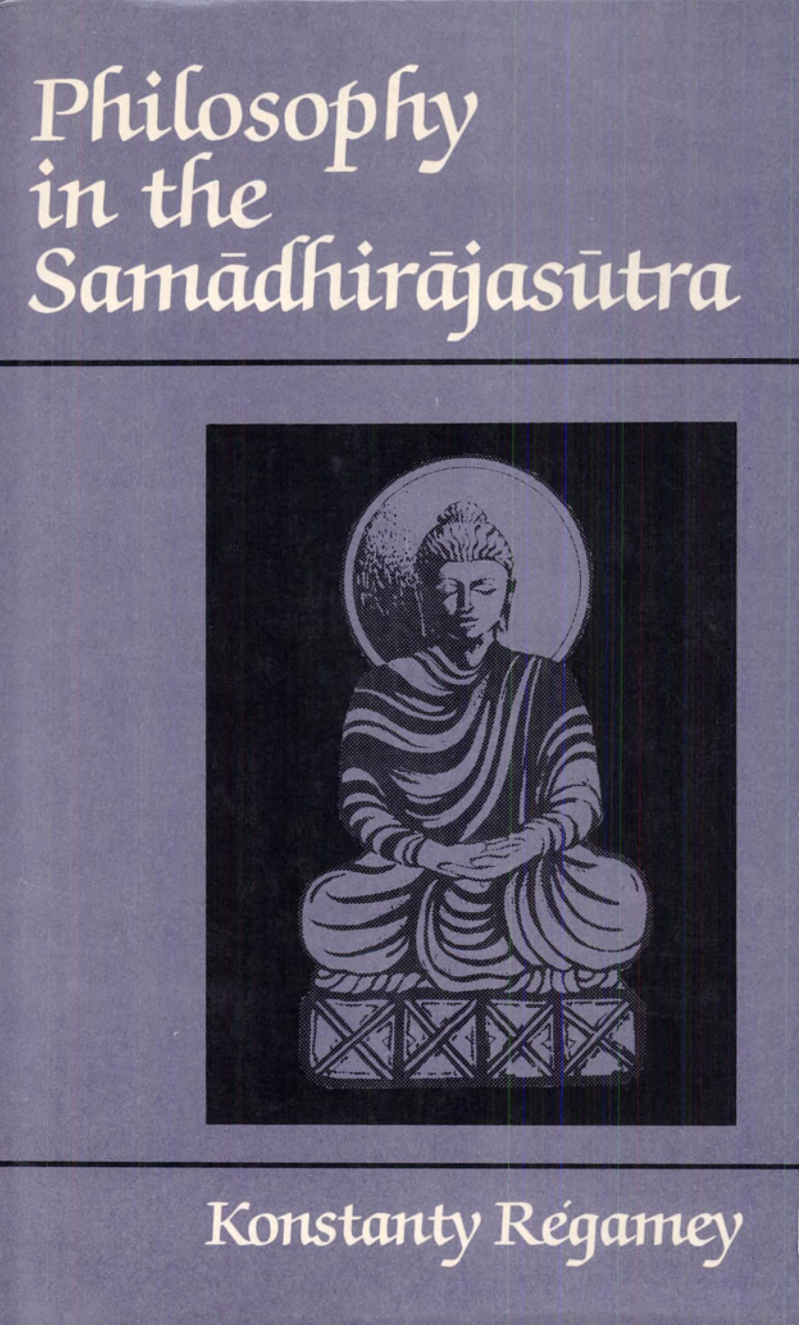
Philosophy in the Samādhirājasūtra: Three Chapters from the Samādhirājasūtra
Book
Please note that many items in our library are simply pages that represent a detailed library catalog entry and citation of someone else's work, presentation, or performance. Read our General Disclaimer for more information. You can find more information about this item on the publisher website.

Description
The Samādhirājasūtra is one of the essential canonical texts of the Mahāyāna Buddhism. Dating from perhaps the second century it presents and early form of the doctrine of the void (śūnyavāda) one of the principal philosophical doctrines of the Mahāyāna. In this respect the Sūtra is of fundamental philosophical importance; it is notably of major authority for the Madhyamaka school which is śūnyavāda par excellence.
The present work contains three philosophical chapters of the Sutra, viz. VIII, XIX and XXII, giving an approximate idea of the doctrinal standpoint of the Sutra. These three chapters have not been selected arbitrarily. Chapter VIII treats of the inexistence of dharmas; Chapter XIX of the identity of their essence; Chapter XXII treats of the nature of the bodies of the Buddha. These are all essential themes of the philosophy of the Great Vehicle and sunyavada.
This is a reprint of the 1938 Warsaw edition comprising an Introduction, Sanskrit and Tibetan Texts and the English Translation by K. Regamey, which was almost wholly lost to the public in Warsaw's destruction during the Second World War. (Source: Motilal Banarsidass)
Citation
Régamey, Konstanty. Philosophy in the Samādhirājasūtra: Three Chapters from the Samādhirājasūtra. Delhi: Motilal Banarsidass, 1990.
Publisher Link
Table of contents
- Preface3-4
- List of Abbreviations5-6
- Introduction7-26
- Sanskrit and Tibetan Texts27-59
- Translation61-97
- Trzy Rozdzialy Z Samadhirajasutry98-100
- Index101-107
- List of Chinese Words Occurring in the Text108-112
Interconnections
1 Partial translation of

This sūtra, much quoted in later Buddhist writings for its profound statements especially on the nature of emptiness, relates a long teaching given by the Buddha mainly in response to questions put by a young layman, Candraprabha. The samādhi that is the subject of the sūtra, in spite of its name, primarily consists of various aspects of conduct, motivation, and the understanding of emptiness; it is also a way of referring to the sūtra itself. The teaching given in the sūtra is the instruction to be dedicated to the possession and promulgation of the samādhi, and to the necessary conduct of a bodhisattva, which is exemplified by a number of accounts from the Buddha's previous lives. Most of the teaching takes place on Vulture Peak Mountain, with an interlude recounting the Buddha's invitation and visit to Candraprabha's home in Rājagṛha, where he continues to teach Candraprabha before returning to Vulture Peak Mountain. In one subsequent chapter the Buddha responds to a request by Ānanda, and the text concludes with a commitment by Ānanda to maintain this teaching in the future. (Source: 84000)
1 Scholarship on
This sūtra, much quoted in later Buddhist writings for its profound statements especially on the nature of emptiness, relates a long teaching given by the Buddha mainly in response to questions put by a young layman, Candraprabha. The samādhi that is the subject of the sūtra, in spite of its name, primarily consists of various aspects of conduct, motivation, and the understanding of emptiness; it is also a way of referring to the sūtra itself. The teaching given in the sūtra is the instruction to be dedicated to the possession and promulgation of the samādhi, and to the necessary conduct of a bodhisattva, which is exemplified by a number of accounts from the Buddha's previous lives. Most of the teaching takes place on Vulture Peak Mountain, with an interlude recounting the Buddha's invitation and visit to Candraprabha's home in Rājagṛha, where he continues to teach Candraprabha before returning to Vulture Peak Mountain. In one subsequent chapter the Buddha responds to a request by Ānanda, and the text concludes with a commitment by Ānanda to maintain this teaching in the future. (Source: 84000)