| 🤓 Admin Zone 🛠️ hidden to non-admins | |
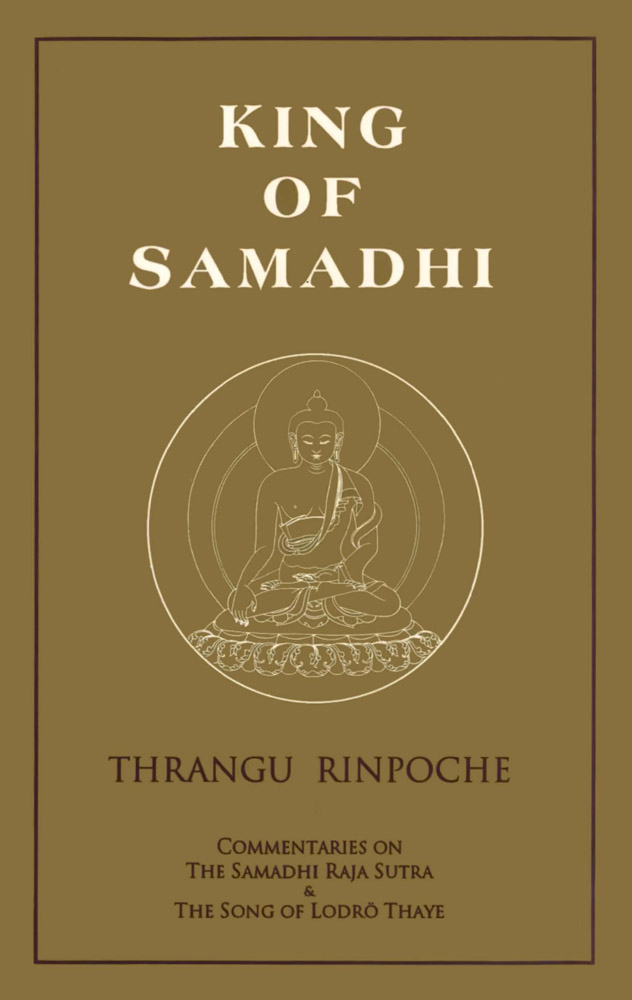
King of Samadhi: Commentaries on The Samadhi Raja Sutra & The Song of Lodrö Thaye
Book
Please note that many items in our library are simply pages that represent a detailed library catalog entry and citation of someone else's work, presentation, or performance. Read our General Disclaimer for more information. You can find more information about this item on the publisher website.

Description
The Samadhi Raja Sutra forms the perfect link between the Mahayana training of a bodhisattva and the most profound tradition of Buddhist meditation practice known as Mahamudra.
- "Khenchen Thrangu Rinpoche is a sublime being whose eminent character never departs from loving kindness and compassion. He is a great Buddhist teacher possessing the three qualities of learning, pure conduct and noble-mindedness. He is also an expert in exposition, debate and composition. Given in the style of pith instructions, these profound lectures contain the key points of the Samadhi Raja Sutra, the words of our compassionate Buddha. This is accompanied by an explanation by the lord of the Dharma, Jamgon Lodro Thaye’s song of experience in Mahamudra. It is therefore my request that all Dharma practitioners take the meaning of these extremely precious teachings to heart and make it a personal experience through correct practice. Please treasure this Dharma book with great care and appreciation."
–Chokyi Nyima Rinpoche
Khenchen Thrangu Rinpoche, a realized teacher of Tibetan Buddhism’s Kagyu lineage, has been the abbot of Rumtek monastery in Sikkim and currently directs numerous monasteries and retreat centers. On his frequent world tours he teaches all levels of Buddhist philosophy and practice. (Source: Rangjung Yeshe Publications)
Citation
Thrangu Rinpoche. King of Samadhi: Commentaries on The Samadhi Raja Sutra & The Song of Lodrö Thaye. Kathmandu: Rangjung Yeshe Publications, 1994.
Publisher Link
Table of contents
- Preface6
- Foreword7
- KING OF SAMADHI
- Introduction11
- The Equal Nature of All Things13
- Definite Realization23
- The Nature of Samadhi36
- The Insubstantial Identity of All Things50
- Applying the Essential62
- Utterly Fearless73
- Inconceivable Qualities84
- Embodying Dharmakaya92
- An Attitude of Connectedness101
- Polishing Our Understanding113
- Entering the Great Compassion127
- Conclusion134
- SONG OF LODRO THAYE
- Within Nonconcept, Wisdom Dawned138
- Knowing One Liberates All145
- A Garuda Fathoming Space153
- The Center of a Cloudless Sky162
- The Exhaustion of Conceptual Mind175
Interconnections
1 Full translation of

This sūtra, much quoted in later Buddhist writings for its profound statements especially on the nature of emptiness, relates a long teaching given by the Buddha mainly in response to questions put by a young layman, Candraprabha. The samādhi that is the subject of the sūtra, in spite of its name, primarily consists of various aspects of conduct, motivation, and the understanding of emptiness; it is also a way of referring to the sūtra itself. The teaching given in the sūtra is the instruction to be dedicated to the possession and promulgation of the samādhi, and to the necessary conduct of a bodhisattva, which is exemplified by a number of accounts from the Buddha's previous lives. Most of the teaching takes place on Vulture Peak Mountain, with an interlude recounting the Buddha's invitation and visit to Candraprabha's home in Rājagṛha, where he continues to teach Candraprabha before returning to Vulture Peak Mountain. In one subsequent chapter the Buddha responds to a request by Ānanda, and the text concludes with a commitment by Ānanda to maintain this teaching in the future. (Source: 84000)
1 Teaching based on
This sūtra, much quoted in later Buddhist writings for its profound statements especially on the nature of emptiness, relates a long teaching given by the Buddha mainly in response to questions put by a young layman, Candraprabha. The samādhi that is the subject of the sūtra, in spite of its name, primarily consists of various aspects of conduct, motivation, and the understanding of emptiness; it is also a way of referring to the sūtra itself. The teaching given in the sūtra is the instruction to be dedicated to the possession and promulgation of the samādhi, and to the necessary conduct of a bodhisattva, which is exemplified by a number of accounts from the Buddha's previous lives. Most of the teaching takes place on Vulture Peak Mountain, with an interlude recounting the Buddha's invitation and visit to Candraprabha's home in Rājagṛha, where he continues to teach Candraprabha before returning to Vulture Peak Mountain. In one subsequent chapter the Buddha responds to a request by Ānanda, and the text concludes with a commitment by Ānanda to maintain this teaching in the future. (Source: 84000)