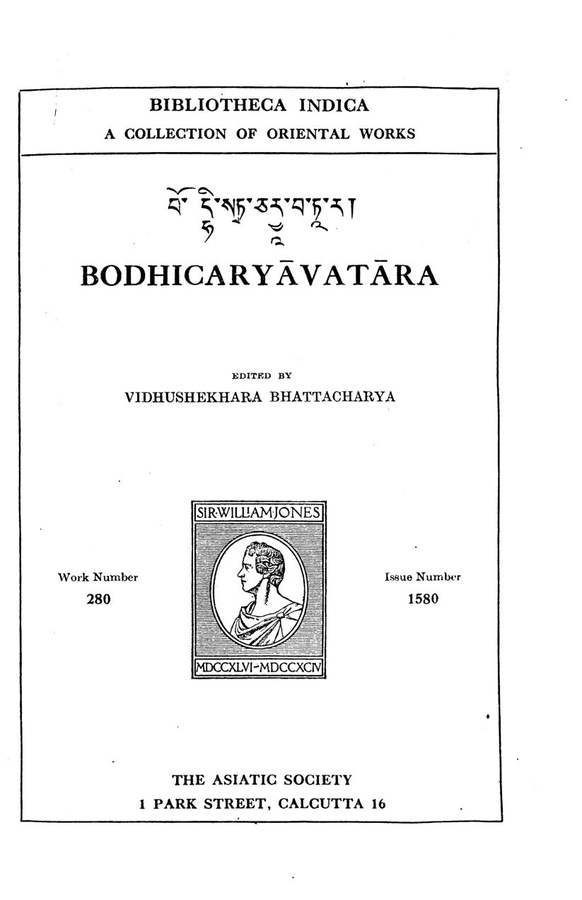
Bodhicaryāvatāra of Śāntideva (Bhattacharya)
From Bodhicitta
< Books
Books/Bodhicaryāvatāra of Śāntideva (Bhattacharya)| 🤓 Admin Zone 🛠️ hidden to non-admins | |
Bodhicaryāvatāra of Śāntideva
Book
- A Comparative of Sanskrit, Tibetan and Mongolian on Prajñāpāramitā Chapter of Śāntideva's Bodhicaryāvatāra (2) (The Commemoration Number Published on the Occasion of the Seventieth Birthday of Professor Ryojun Fuyo)
- A Descriptive Catalogue and Restoration of the Tibetan Language Text of Bodhicaryavatara from Dunhuang Documents
- A Descriptive Catalogue of Sanscrit Manuscripts in the Government Collection
- A Preliminary Survey of Sanskrit Manuscripts of Madhyamaka Texts Preserved in the Tibet Autonomous Region
- A Study of Akṣayamati (Śāntideva)'s Bodhisattvacaryāvatāra as Found in the Tibetan Manuscripts From Tun-huang
- A Study of the Dūn-huáng Recension of the Bodhisattvacaryāvatāra
- A Study of the Wisdom Chapter (Prajñāpāramitā Pariccheda) of the Bodhicaryāvatārapañjikā of Prajñākaramati
- Action and Its Result in the Bodhicaryāvatāra
- Akṣayamati's Bodhisattvacaryāvatāra as Found in the Tibetan Manuscripts from Dūn-huáng
- An Index to the Bodhicaryāvatāra Pañjikā, Chapter IX
- An Inquiry into the Relationship between the Śikṣāsamuccaya and the Bodhi(sattva)caryāvatāra
- Bodhicaryāvatāra (Minaev)
- Bodhicaryāvatāra of Śāntideva (Bhattacharya)
- Bodhicaryāvatāra of Śāntideva with the Commentary Pañjikā of Prajñākaramati (1960)
- Bodhicaryāvatāra of Śāntideva with the Commentary Pañjikā of Prajñākaramati (1988)
- Bodhicaryāvatāra-pañjikā VIII.90-103 by Prajñākaramati, Commenting on Śāntideva
- Bodhicaryāvatārapañjikā: Prajñākaramati's Commentary to the Bodhicaryāvatāra of Çāntideva
- Bouddhisme, études et matériaux: Ādikarmapradīpa, Bodhicaryāvatāraṭīkā (La Vallée Poussin 1898)
- Byang chub sems dpa'i spyod pa 'jug pa (2007, mtsho sngon)
- Byang chub sems dpa'i spyod pa la 'jug pa rtsa ba dang 'grel pa (si khron mi rigs dpe skrun khang)
- Catalogue of Buddhist Sanskrit Manuscripts in the Possession of the Royal Asiatic Society (Hodgson Collection)
- Catalogue of the Tibetan Manuscripts from Tun-huang in the India Office Library
- Critique of Self in the Early and Later Versions of the Bodhi(sattva)caryāvatāra
- Der Mahāyāna-Buddhismus nach Sanskrit und Prākrittexten
- Die Aufnahme des Erleuchtungsgeistes: Eine Übersetzung von Prajñākaramatis Bodhicaryāvatārapañjikā 3.1-19
- Die lHan kar ma
- Iti als Adverbialbilder
- Jitāri, Śāntideva and Prabhākarakīrti
- Notes on the Deśanā-ritual in the Bodhicaryāvatāra: Evidence of Its Revision
- Notes on the Interpretation of Bodhi(sattva)caryāvatāra V.104–106
- On Agama and Yukti in Bu ston's Byang chub sems dpa'i spyod pa la 'jug pa'i 'grel pa
- On Akṣayamati's Bodhisattvacaryāvatāra
- On Philosophical View of the Bodhisattvacaryāvatāra
- On the Role of Vairocanarakṣita in the Later Transmission Period: A Cross-section of the "Bodhisattva theory" Tradition
- On the Sanskrit Manuscript of the Śikṣāsamuccaya
- On the Textual Problems of Śāntideva's Bodhi(sattva)caryāvatāra: With Special Reference to Chapter 9 Entitled "Perfection of Wisdom (Prajñāpāramitā)"
- Polemics in Indo-Tibetan Scholasticism - A Late 19th-Century Debate Between 'Ju Mi pham and Dpa' ris Rab gsal
- Preliminary Survey of Sanskrit Manuscripts of the Bodhicaryāvatāra
- Relocation of the Verses on "The Equality of Self and Others" in the Bodhicaryāvatāra
- Remarks on Akṣayamati (Blo gros mi zad pa), Being the Author of the Earlier Version of the Bodhisattvacaryāvatāra
- Remarks on the Tabo Manuscript of the Bodhisattvacaryāvatāra
- Santideva (Indian Antiquary, Vol. 42, 1913)
- Some New Remarks on the Bodhicaryāvatāra Chapter V
- Studies in the Philosophy of the Bodhicaryāvatāra (2000)
- Testi Buddhisti in Sanscrito
- Textcritical Notes on Sanskrit Texts: I. Bodhi(sattva)caryāvatāra
- The Original Bodhicaryāvatāra
- The Sanskrit Buddhist Literature of Nepal (1882)
- The Sanskrit Buddhist Literature of Nepal (1971)
- The Transmission of the Bodhicaryāvatāra: The History, Diffusion, and Influence of a Mahāyāna Buddhist Text
- Tibetisch-Sanskritischer Index zum Bodhicaryāvatāra (Weller 1952)
- Ācārya Śāntideva kā Bodhicaryāvatāra
- Śāntideva in the History of Mādhyamika Philosophy
- Śāntideva's Critique of 'I' or Self in the Early and Later Recensions of the Bodhi(sattva)caryāvatāra
- Śāntideva's Philosophy as Expressed in the Early Version of His Bodhisattvacaryāvatāra, Chapter 8
- Śāntidēva's Bodhicharyāvatāra
Please note that many items in our library are simply pages that represent a detailed library catalog entry and citation of someone else's work, presentation, or performance. Read our General Disclaimer for more information.

Description
The Asiatic Society, which can claim to be the pioneer in the introduction of Indo-Tibetan studies in India, has added to its publications, one more useful work, the Sanskrit and Tibetan versions of Śāntideva’s Bodhicaryāvatāra, edited by an eminent Tibeto-Sanskritist late MM. Vidhusekhar Sastri, who unfortunately did not live to see the end of the publication of his book. The last nine formes were revised by his two able students, Prof. A. C. Banerjee and Shri Bhajagobinda Parampanthi.
The earliest edition of the Sanskrit text was published by the Russian savant I. P. Minayeff in the Zapiski IV in 1889. It was followed by another edition made by the late MM. H. P. Sastri in the Journal of the Buddhist Text Society in 1894. A masterly edition of this text with Prajnakaramati’s commentary, which greatly enhanced the value of the original text, was prepared by the distinguished Tibeto-Chinese-Sanskrit scholar the late Prof. Louis de la Vallée Poussin and published by our Society in 1902. This edition is widely used by the world of Buddhist scholars but it is a matter of regret that the edition is long out of print.
The great importance and popularity of the text can be gauged from the fact that it was translated into three foreign languages by famous orientalists like La Vallée Poussin in French (1907), L. D. Barnett in English (1909), L. Finot in French (1920) and R. Schmidt in German (1923).
The present text is a bilingual edition in Sanskrit and Tibetan and is very critically and accurately edited by MM. V. S. Sastri. It contains the stanzas (Ch. Ill, 23-33, Ch. IV, 1-45, Ch. VIII, 109-86 and Ch. X, whole), which were missing in the MSS. used in the previous edition of the Society. The Tibetan version has not only its linguistic value but also throws much light on the interpretation of the original verses. It will also be an excellent textbook for the Tibetans to study Sanskrit and the Sanskritists to learn Tibetan. In order to facilitate such studies a Sanskrit-Tibetan and TibetanSanskrit vocabulary was prepared by Shri Suniti Kumar Pathak at the instance of the learned Editor. It has been taken up by the Society for publication. In this connection it may be mentioned that in 1952 the great German orientalist Prof. Friedrich Weller published his TibetischSanskritischer Index zuin Bodhicaryāvatāra, which can be profitably used by the readers of the present text.
Apart from its linguistic importance, the text offers in charming poetic diction and in elegant Sanskrit the ethical ideals and philosophy of Mahāyāna Buddhism. It depicts the career of a Mahāyānic adept, i.e., a Bodhisattva, e.g., taking the vow of Bodhicitta, performing formal initiatory ceremonies; acquiring perfection in perseverance (kṣāntiparamitā), in application of energy (vīryapāramitā), in meditational exercises (dhyānapāramitā) and lastly in the highest knowledge (prajñāpāramitā) along with the realization of śūnyatā as envisaged in the Mādhyamika School of thought.
The author of this treatise is Śāntideva, who expressed the author’s humility in stanzas 1-3 of Ch. I, saying that he was merely attempting to set forth briefly in accordance with Holy Writ the way whereby the sons of the Blessed Ones enter the godly life. Nothing new will be told here, nor have I skill in writing of books; therefore I have done this work to hallow my own thoughts, not designing it for the welfare of others. By it the holy impulse within me to frame righteousness is strengthened; but if a fellow-creature should see it, this my book will fulfil another end likewise’ (translated by L. D. Barnett in The Path of Light, p. 37). The author has not mentioned his sources but Prajñākaramati traced most of them in his commentary. In the text the author offers a clear and accurate answer to the question: What is Mahāyāna Buddhism?
Śāntideva lived in the seventh century A.D. and is said to be the son of a king of Surāṣṭra, called Mañjuvarmā. MM. H. P. Sastri identified Śāntideva with the Tantrik poet Bhusuku and regarded him as an inhabitant of Bengal. It may be there were two Śāntidevas, the earlier being of Surāṣṭra, and the later of Bengal, because the earlier Śāntideva, the author of the Bodhicaryāvatāra and other works, does not show any trace of Tantrik leanings.
Śāntideva, according to Tāranātha, was a devotee of Mañjuśrī and that he renounced the prospect of becoming a king on seeing a dream, in which the goddess Tārā appeared in the form of his own mother and pointed out to him that the kingly life was a hotbed of sufferings and advised him to go to the Madhyadeśa to become a monk in order to follow the Mahāyānic path of salvation. He resided at Nālandā and is described by Tāranathā as an idler and a voracious eater but one day he sprang a surprise on his fellow-brethren by reciting the whole of the Bodhicaryāvatāra, containing, as it does, the gist of several Mahāyāna texts. From that day he became a highly respected monk of Nālandā and was ultimately made a Dvārapaṇḍita, an honour conferred on very learned monks of Nālandā. This story shows how vast was his erudition! (Dutt, preface, v–v1)
The earliest edition of the Sanskrit text was published by the Russian savant I. P. Minayeff in the Zapiski IV in 1889. It was followed by another edition made by the late MM. H. P. Sastri in the Journal of the Buddhist Text Society in 1894. A masterly edition of this text with Prajnakaramati’s commentary, which greatly enhanced the value of the original text, was prepared by the distinguished Tibeto-Chinese-Sanskrit scholar the late Prof. Louis de la Vallée Poussin and published by our Society in 1902. This edition is widely used by the world of Buddhist scholars but it is a matter of regret that the edition is long out of print.
The great importance and popularity of the text can be gauged from the fact that it was translated into three foreign languages by famous orientalists like La Vallée Poussin in French (1907), L. D. Barnett in English (1909), L. Finot in French (1920) and R. Schmidt in German (1923).
The present text is a bilingual edition in Sanskrit and Tibetan and is very critically and accurately edited by MM. V. S. Sastri. It contains the stanzas (Ch. Ill, 23-33, Ch. IV, 1-45, Ch. VIII, 109-86 and Ch. X, whole), which were missing in the MSS. used in the previous edition of the Society. The Tibetan version has not only its linguistic value but also throws much light on the interpretation of the original verses. It will also be an excellent textbook for the Tibetans to study Sanskrit and the Sanskritists to learn Tibetan. In order to facilitate such studies a Sanskrit-Tibetan and TibetanSanskrit vocabulary was prepared by Shri Suniti Kumar Pathak at the instance of the learned Editor. It has been taken up by the Society for publication. In this connection it may be mentioned that in 1952 the great German orientalist Prof. Friedrich Weller published his TibetischSanskritischer Index zuin Bodhicaryāvatāra, which can be profitably used by the readers of the present text.
Apart from its linguistic importance, the text offers in charming poetic diction and in elegant Sanskrit the ethical ideals and philosophy of Mahāyāna Buddhism. It depicts the career of a Mahāyānic adept, i.e., a Bodhisattva, e.g., taking the vow of Bodhicitta, performing formal initiatory ceremonies; acquiring perfection in perseverance (kṣāntiparamitā), in application of energy (vīryapāramitā), in meditational exercises (dhyānapāramitā) and lastly in the highest knowledge (prajñāpāramitā) along with the realization of śūnyatā as envisaged in the Mādhyamika School of thought.
The author of this treatise is Śāntideva, who expressed the author’s humility in stanzas 1-3 of Ch. I, saying that he was merely attempting to set forth briefly in accordance with Holy Writ the way whereby the sons of the Blessed Ones enter the godly life. Nothing new will be told here, nor have I skill in writing of books; therefore I have done this work to hallow my own thoughts, not designing it for the welfare of others. By it the holy impulse within me to frame righteousness is strengthened; but if a fellow-creature should see it, this my book will fulfil another end likewise’ (translated by L. D. Barnett in The Path of Light, p. 37). The author has not mentioned his sources but Prajñākaramati traced most of them in his commentary. In the text the author offers a clear and accurate answer to the question: What is Mahāyāna Buddhism?
Śāntideva lived in the seventh century A.D. and is said to be the son of a king of Surāṣṭra, called Mañjuvarmā. MM. H. P. Sastri identified Śāntideva with the Tantrik poet Bhusuku and regarded him as an inhabitant of Bengal. It may be there were two Śāntidevas, the earlier being of Surāṣṭra, and the later of Bengal, because the earlier Śāntideva, the author of the Bodhicaryāvatāra and other works, does not show any trace of Tantrik leanings.
Śāntideva, according to Tāranātha, was a devotee of Mañjuśrī and that he renounced the prospect of becoming a king on seeing a dream, in which the goddess Tārā appeared in the form of his own mother and pointed out to him that the kingly life was a hotbed of sufferings and advised him to go to the Madhyadeśa to become a monk in order to follow the Mahāyānic path of salvation. He resided at Nālandā and is described by Tāranathā as an idler and a voracious eater but one day he sprang a surprise on his fellow-brethren by reciting the whole of the Bodhicaryāvatāra, containing, as it does, the gist of several Mahāyāna texts. From that day he became a highly respected monk of Nālandā and was ultimately made a Dvārapaṇḍita, an honour conferred on very learned monks of Nālandā. This story shows how vast was his erudition! (Dutt, preface, v–v1)
Citation
Bhattacharya, Vidhushekhara, ed. Bodhicaryāvatāra of Śāntideva. Bibliotheca Indica 280. Calcutta: Asiatic Society, 1960. https://ia800200.us.archive.org/34/items/Bibliotheca_Indica_Series/BodhicaryavataraSanskritTibetan-VidhusekharaBhattacharya1960bis.pdf.
Table of contents
- Prefacev–vi
- Chapter I1
- Chapter II12
- Chapter III30
- Chapter IV39
- Chapter V52
- Chapter VI80
- Chapter VII115
- Chapter VIII135
- Chapter IX185
- Chapter X229
Interconnections
1 Recension of

An "Introduction to Bodhisattva Practice," the Bodhisattvacaryāvatāra is a poem about the path of a bodhisattva, in ten chapters, written by the Indian Buddhist Śāntideva (fl. c. 685–763). One of the masterpieces of world literature, it is a core text of Mahāyāna Buddhism and continues to be taught, studied, and commented upon in many languages and by many traditions around the world. The main subject of the text is bodhicitta, the altruistic aspiration for enlightenment, and the path and practices of the bodhisattva, the six perfections (pāramitās). The text forms the basis of many contemporary discussions of Buddhist ethics and philosophy.