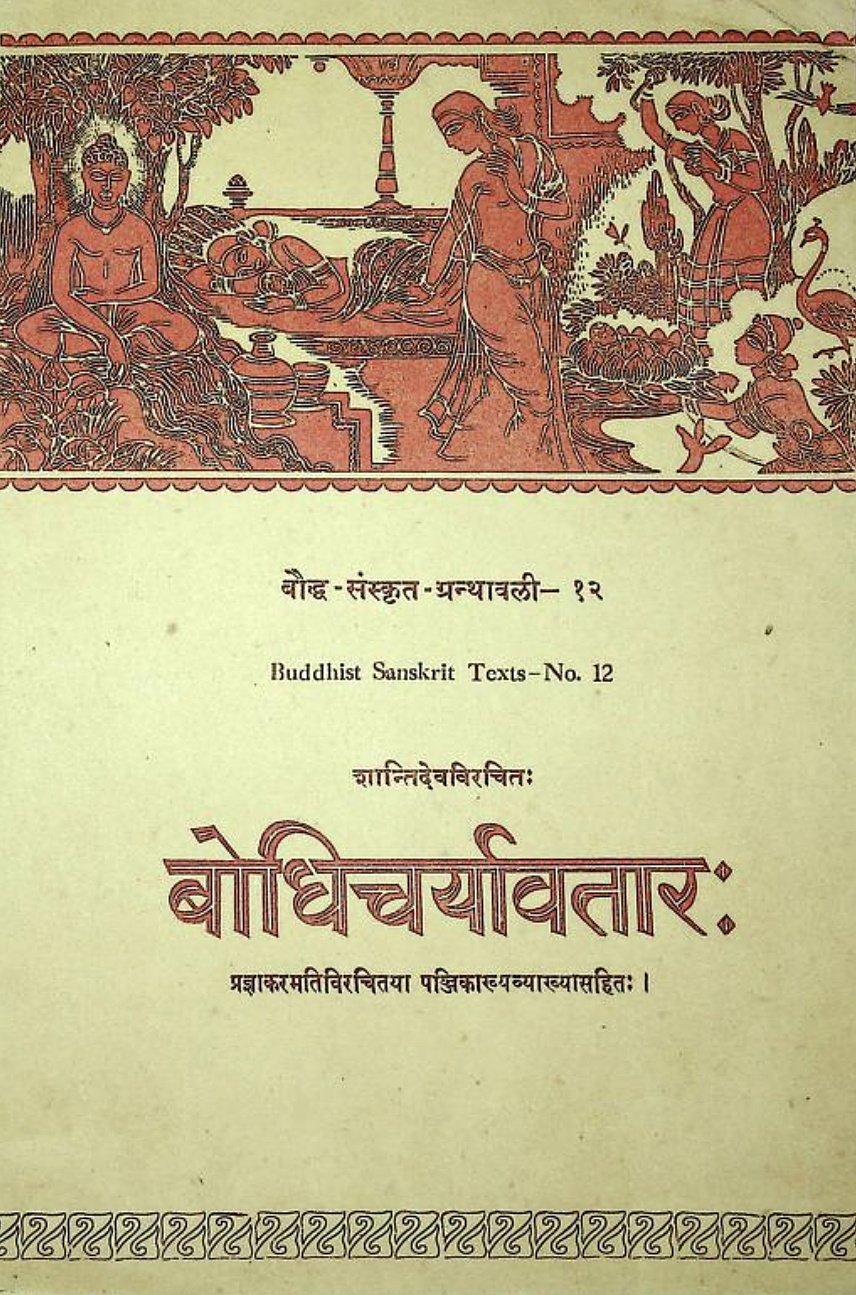
Bodhicaryāvatāra of Śāntideva with the Commentary Pañjikā of Prajñākaramati (1960)
From Bodhicitta
< Books
(Redirected from Bodhicaryāvatāra of Śāntideva with the Commentary Pañjikā of Prajñākaramati (1960))Books/Bodhicaryāvatāra of Śāntideva with the Commentary Pañjikā of Prajñākaramati (1960)
| 🤓 Admin Zone 🛠️ hidden to non-admins | |
Bodhicaryāvatāra of Śāntideva with the Commentary Pañjikā of Prajñākaramati
Book
- A Comparative of Sanskrit, Tibetan and Mongolian on Prajñāpāramitā Chapter of Śāntideva's Bodhicaryāvatāra (2) (The Commemoration Number Published on the Occasion of the Seventieth Birthday of Professor Ryojun Fuyo)
- A Descriptive Catalogue of Sanscrit Manuscripts in the Government Collection
- A Preliminary Survey of Sanskrit Manuscripts of Madhyamaka Texts Preserved in the Tibet Autonomous Region
- A Study of Akṣayamati (Śāntideva)'s Bodhisattvacaryāvatāra as Found in the Tibetan Manuscripts From Tun-huang
- A Study of the Wisdom Chapter (Prajñāpāramitā Pariccheda) of the Bodhicaryāvatārapañjikā of Prajñākaramati
- An Index to the Bodhicaryāvatāra Pañjikā, Chapter IX
- Bodhicaryāvatāra (Minaev)
- Bodhicaryāvatāra of Śāntideva (Bhattacharya)
- Bodhicaryāvatāra of Śāntideva with the Commentary Pañjikā of Prajñākaramati (1960)
- Bodhicaryāvatāra of Śāntideva with the Commentary Pañjikā of Prajñākaramati (1988)
- Bodhicaryāvatāra-pañjikā VIII.90-103 by Prajñākaramati, Commenting on Śāntideva
- Bodhicaryāvatārapañjikā: Prajñākaramati's Commentary to the Bodhicaryāvatāra of Çāntideva
- Bouddhisme, études et matériaux: Ādikarmapradīpa, Bodhicaryāvatāraṭīkā (La Vallée Poussin 1898)
- Catalogue of Buddhist Sanskrit Manuscripts in the Possession of the Royal Asiatic Society (Hodgson Collection)
- Der Mahāyāna-Buddhismus nach Sanskrit und Prākrittexten
- Die Aufnahme des Erleuchtungsgeistes: Eine Übersetzung von Prajñākaramatis Bodhicaryāvatārapañjikā 3.1-19
- Epitome of the Bodhicaryāvatāra with Its Pañjikā, Chap. IX
- Iti als Adverbialbilder
- Jitāri, Śāntideva and Prabhākarakīrti
- On Prakṛtinirvāṇa-Prakṛtinirvṛta in the Bodhicaryāvatāra: A Study in the Indo-Tibetan Commentarial Tradition
- On the Role of Vairocanarakṣita in the Later Transmission Period: A Cross-section of the "Bodhisattva theory" Tradition
- On the Sanskrit Manuscript of the Śikṣāsamuccaya
- Preliminary Survey of Sanskrit Manuscripts of the Bodhicaryāvatāra
- Santideva (Indian Antiquary, Vol. 42, 1913)
- Studies in the Philosophy of the Bodhicaryāvatāra (2000)
- Testi Buddhisti in Sanscrito
- The Meaning of Sugata in the Bodhicaryāvatārapañjikā
- The Sanskrit Buddhist Literature of Nepal (1882)
- The Sanskrit Buddhist Literature of Nepal (1971)
- The Transmission of the Bodhicaryāvatāra: The History, Diffusion, and Influence of a Mahāyāna Buddhist Text
- Tibetisch-Sanskritischer Index zum Bodhicaryāvatāra (Weller 1952)
- Two Kinds of Saṃvṛtis in the Bodhicaryāvatārapañjikā IX 3-8
- Ācārya Śāntideva kā Bodhicaryāvatāra
- Śāntidevas Bodhicaryāvatāra: Das Weiterwirken des Werkes dargestellt anhand der Überlieferungsgeschichte des Textes und seiner Kommentare
- Śāntidēva's Bodhicharyāvatāra
Please note that many items in our library are simply pages that represent a detailed library catalog entry and citation of someone else's work, presentation, or performance. Read our General Disclaimer for more information. You can find more information about this item on the publisher website.

Description
The bare text of Śāntideva's Bodhicaryāvatāra (BCA) was first brought to the notice of scholars by the Russian Scholar Minayef in an edition published in the Russian Oriental Journal Zapiski, IV, 1889. It was based on three independent Mss. which were available in Russia to the editor. Two more Mss. of the bare text were subsequently noticed in the Bibliotheque Nationale, Paris, Devanagari 78, and Burnouf 98. They were used by Louis de la Vallée Poussin) first in his edition in Roman script of the 9th chapter of the text as well as the text and commentary of Prajñākaramati's Pañjikā in his work: Bouddhisme, Études et Materiaux Vol. I, Bruxelles, Academie, and Luzac, London, 1898; he also published the text and Pañjikā in Devanagari script of the first nine chapters, in the Bibliotheca Indica, Calcutta, 1902-14, (P in the margin), but the edition is still incomplete because the promised appendix containing missing portions of the text of Bodhicaryāvatāra and the Tibetan Translation of Pañjikā as well as other useful and usual indexes which are characteristics of this author's editions of Buddhist works, have not yet seen the light of the day, and we do not expect them any longer.
When, therefore, it was decided to include the Bodhicaryāvatāra and Pañjikā in the present series, I thought I should put the missing portions of the text at least in their proper place, but leave out completing the missing portion of the Pañjikā either in its Tibetan translation or in its Sanskrit restoration. I have, however, added the usual indexes of verses, of quotations in verse and prose in the commentary traced to their sources as far as possible uptodate, and a list of Buddhist Sūtras from which extracts are taken as are required to make the edition complete and more useful to the reader. It was also decided to publish earlier a new edition of Śāntideva's Śikṣāsamuccaya and give references to this new edition in the present work, which is now published as BST. No. 11.
The text of the Pañjikā on the first eight chapters is based on a single Ms. in Nepalese script, many folia of which are missing. It ends with the 9th chapter, and does not contain commentary on the 10th chapter. For the 9th chapter which philosophically is very important, another Ms. in Maithili script was available and has been used by Poussin. As one Ms. of the work was found in Maithili script, I tried my best, since I came to Darbhanga, to find out by search either in the country-side or in the Raj Library, if a second Ms. in the same script could be traced in Mithila, but in vain. I am, therefore, bringing out a fresh edition of this important work, filling gaps in the text of Bodhicaryāvatāra, and adding useful indices. I have not attempted to give the Tibetan translation of Pañjikā on verses of the text where it was missing, because the text by itself is very lucid and simple, and stands in no need of a commentary, and also because a full text of the commentary is available on the 9th chapter where need of a commentary is felt most. In Appendix V, I have given references to Tibetan translations in Tanjur and Kanjur of those Mahāyāna texts cited in Pañjikā from "A Complete Catalogue of Tibetan Buddhist Canon" published by Tohoku Imperial University, Sendai, Japan, 1934, as in the case of similar texts cited in Śikṣāsamuccaya. Some of the sūtras cited in Śikṣāsamuccaya and Pañjikā are planned to be restored in Sanskrit and included in a volume entitled Mahāyānasūtrasaṁgraha, Vol. II in this Series. (Vaidya, introduction, vii–viii)
When, therefore, it was decided to include the Bodhicaryāvatāra and Pañjikā in the present series, I thought I should put the missing portions of the text at least in their proper place, but leave out completing the missing portion of the Pañjikā either in its Tibetan translation or in its Sanskrit restoration. I have, however, added the usual indexes of verses, of quotations in verse and prose in the commentary traced to their sources as far as possible uptodate, and a list of Buddhist Sūtras from which extracts are taken as are required to make the edition complete and more useful to the reader. It was also decided to publish earlier a new edition of Śāntideva's Śikṣāsamuccaya and give references to this new edition in the present work, which is now published as BST. No. 11.
The text of the Pañjikā on the first eight chapters is based on a single Ms. in Nepalese script, many folia of which are missing. It ends with the 9th chapter, and does not contain commentary on the 10th chapter. For the 9th chapter which philosophically is very important, another Ms. in Maithili script was available and has been used by Poussin. As one Ms. of the work was found in Maithili script, I tried my best, since I came to Darbhanga, to find out by search either in the country-side or in the Raj Library, if a second Ms. in the same script could be traced in Mithila, but in vain. I am, therefore, bringing out a fresh edition of this important work, filling gaps in the text of Bodhicaryāvatāra, and adding useful indices. I have not attempted to give the Tibetan translation of Pañjikā on verses of the text where it was missing, because the text by itself is very lucid and simple, and stands in no need of a commentary, and also because a full text of the commentary is available on the 9th chapter where need of a commentary is felt most. In Appendix V, I have given references to Tibetan translations in Tanjur and Kanjur of those Mahāyāna texts cited in Pañjikā from "A Complete Catalogue of Tibetan Buddhist Canon" published by Tohoku Imperial University, Sendai, Japan, 1934, as in the case of similar texts cited in Śikṣāsamuccaya. Some of the sūtras cited in Śikṣāsamuccaya and Pañjikā are planned to be restored in Sanskrit and included in a volume entitled Mahāyānasūtrasaṁgraha, Vol. II in this Series. (Vaidya, introduction, vii–viii)
Citation
Vaidya, P. L., ed. Bodhicaryāvatāra of Śāntideva with the Commentary Pañjikā of Prajñākaramati. Buddhist Sanskrit Texts 12. Darbhanga, Bihar, India: Mithila Institute of Post-Graduate Studies and Research in Sanskrit Learning, 1960. https://archive.org/details/bTkp_bodhicharya-avatara-of-shantideva-bauddha-sanskrit-granthamala-12-mithila-institute-darbhanga/mode/2up.
Publisher Link
Table of contents
- Introduction in English and Hindivii
- Abbreviationsxvii
- १ बोधिचित्तानुशंसः१
- २ पापदेशना२२
- ३ बोधिचित्तपरिग्रहः३७
- ४ बोधिचित्ताप्रमादः४४
- ५ संप्रजन्यलक्षणम्५०
- ६ क्षान्तिपारमिता८१
- ७ वीर्यपारमिता११६
- ८ ध्यानपारमिता१३६
- ९ प्रज्ञापारमिता१६७
- १० परिणामना२८३
- प्रथमं परिशिष्टम्—
- श्लोकसूची२८९
- द्वितीयं परिशिष्टम्—
- टीकाकारोद्धतानां पघ्यानां सूची३०१
- तृतीयं परिशिष्टम्—
- अनिर्दिष्टग्रन्थ-ग्रन्थकर्तृनामकानां गघांशानां सूची३०४
- चतुर्थं परिशिष्टम्—
- आचार्य-ग्रन्थ-शास्त्रादिसूची३०४
- पञ्चमं परिशिष्टम्—
- टीकाकारनिर्दिष्टानां महायानसूत्रोद्धरणानां सूची३०५
Interconnections
2 Recension of

An "Introduction to Bodhisattva Practice," the Bodhisattvacaryāvatāra is a poem about the path of a bodhisattva, in ten chapters, written by the Indian Buddhist Śāntideva (fl. c. 685–763). One of the masterpieces of world literature, it is a core text of Mahāyāna Buddhism and continues to be taught, studied, and commented upon in many languages and by many traditions around the world. The main subject of the text is bodhicitta, the altruistic aspiration for enlightenment, and the path and practices of the bodhisattva, the six perfections (pāramitās). The text forms the basis of many contemporary discussions of Buddhist ethics and philosophy.

Written by Prajñākaramati (950–1030), the Bodhicaryāvatārapañjikā is considered to be the most important Indian commentary on the Bodhicaryāvatāraby Śāntideva. This commentary explains the words in the verses (tshig 'grel), with additional commentaries on difficult points. Excluding The Dedication Chapter, it has only nine chapters.