Buddhāvataṃsakamahāvaipūlyasūtra

From Bodhicitta
< Texts(Redirected from Avataṃsakasūtra)
Texts/Buddhāvataṃsakamahāvaipūlyasūtra

🤓 Admin Zone 🛠️ hidden to non-admins
बुद्धावतंसकसूत्र
Buddhāvataṃsakamahāvaipūlyasūtra
སངས་རྒྱས་ཕལ་པོ་ཆེ་ཞེས་བྱ་བ་ཤིན་ཏུ་རྒྱས་པ་ཆེན་པོའི་མདོ།
sangs rgyas phal po che zhes bya ba shin tu rgyas pa chen po'i mdo
The Sūtra of the Ornament of the Buddhas (84000)
Text


Please note that many items in our library are simply pages that represent a detailed library catalog entry and citation of someone else's work, presentation, or performance. Read our General Disclaimer for more information.

Description

One of the longest works in the entire Buddhist canon, the Buddhāvataṃsakasūtra is widely considered to be a compilation of independent scriptures, which was expanded upon over the course of time. It was extremely influential in East Asia, where it was preserved in an eighty-scroll recension. The Tibetan translation of this work fills four volumes in the Derge Kangyur. Though only two sections—namely, the Gaṇḍavyūhasūtra and the Daśabhūmikasūtra—have survived in Sanskrit, both of which have also circulated as independent works.
Quoted in the aligned translations
Reference
Buddhāvataṃsakamahāvaipūlyasūtra [बुद्धावतंसकसूत्र]. sangs rgyas phal po che zhes bya ba shin tu rgyas pa chen po'i mdo [སངས་རྒྱས་ཕལ་པོ་ཆེ་ཞེས་བྱ་བ་ཤིན་ཏུ་རྒྱས་པ་ཆེན་པོའི་མདོ།]. [The Sūtra of the Ornament of the Buddhas (84000)]. Translated by Bai ro tsa na, Buddhabhadra, Jinamitra, Surendrabodhi, Ye shes sde, Śikṣānanda. Kangyur, RKTSK 44 http://www.rkts.org/cat.php?id=44&typ=1.

Citations of Related Scholarship

Interconnections
All 18Books 4Articles 2Classical Works 12
1 Full translations
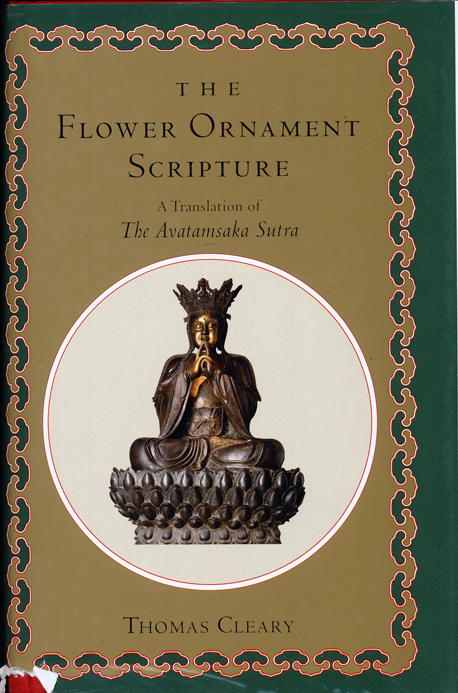
FloweOrnament-front.jpg
Books1993About this item
This one-volume edition contains Thomas Cleary's definitive translation of all thirty-nine books of the Buddhāvataṃsakasūtra.
8 Contains members
Jinamitra translator.jpg
Classical WorksAbout this item
The Avalokiteśvaravimokṣa is chapter 30 of the Gaṇḍavyūhasūtra, in which the bodhisattva Avalokiteśvara, teaching Sudhana on Mount Potalaka, describes his attainment of the bodhisattva liberation called "the unimpeded gateway to great compassion," through which he frees beings from a wide range of fears—including fear of heights, bondage, danger, hunger, disgrace, death, unfortunate rebirth, separation from loved ones, and bodily and mental torment. This passage is quoted at length by Śāntideva in the Śikṣāsamuccaya (Bendall ed., p. 296) under the title Avalokiteśvaravimokṣa, where it illustrates the dedication of merit toward the protection of all beings. The text is not preserved independently in the Tibetan Kangyur; it survives only as this chapter within the Gaṇḍavyūhasūtra (Toh 44–45).
Jinamitra translator.jpg
Classical WorksAbout this item
༄༅། །འཕགས་པ་བཟང་པོ་སྤྱོད་པའི་སྨོན་ལམ་གྱི་རྒྱལ་པོ་བཞུགས།

The King of Aspiration Prayers: Samantabhadra’s “Aspiration to Good Actions” (Zangchö Mönlam) from the Gaṇḍavyūha chapter of the Avataṃsaka Sūtra. Many translations of this text exist as it is regularly chanted around the world in many different traditions. For an example, see Lotsawa House.

Bhadracarīpranidhāna. (T. Bzang po spyod pa'i smon lam; C. Puxian pusa xingyuan zan; J. Fugen bosatsu gyōgansan; K. Pohyǒn posal haengwǒn ch'an 普賢菩薩行願讚). In Sanskrit, "Vows of Good Conduct," the last section of the Gaṇḍavyūha in the Avataṃsakasūtra and one of the most beloved texts in all of Mahāyāna Buddhism; also known as the Samantabhadracarīpraṇidhānarāja. The Bhadracarīpraṇidhāna focuses on the ten great vows (praṇidhāna) taken by Samantabhadra to realize and gain access to the dharmadhātu, which thereby enable him to benefit sentient beings. The ten vows are: (1) to pay homage to all the buddhas, (2) to praise the tathāgatas, (3) to make unlimited offerings, (4) to repent from one's transgressions in order to remove karmic hindrances (cf. karmāvaraṇa), (5) to take delight in others' merit, (6) to request the buddhas to turn the wheel of dharma (dharmacakrapravartana), (7) to request the buddhas to continue living in the world, (8) always to follow the teachings of the Buddha, (9) always to comply with the needs of sentient beings, and (10) to transfer all merit to sentient beings for their spiritual edification. The text ends with a stanza wishing that sentient beings still immersed in evil be reborn in the Pure Land of Amitābha. The text was translated into Chinese in 754 by Amoghavajra (705–774). Other Chinese recensions appear in the Wenshushili fayuan jing ("Scripture on the Vows made by Mañjuśrī"), translated in 420 by Buddhabhadra (359–429), which corresponds to the verse section from Ru busiyi jietuo jingjie Puxian xingyuan pin, the last roll of the forty-roll recension of the Huayan jing translated by Prajña in 798. (There is no corresponding version in either the sixty- or the eighty-roll translations of the

Huajan jing.) The verses are also called the "Précis of the Huayan jing (Lüe Huayan jing), because they are believed to constitute the core teachings of the Avataṃsakasūtra. In the main Chinese recension by Amoghavajra, the text consists of sixty-two stanzas, each consisting of quatrains with lines seven Sinographs in length, thus giving a total number of 1,736 Sinographs. In addition to the sixty-two core stanzas, Amoghavajra's version adds ten more stanzas of the Bada pusa zan ("Eulogy to the Eight Great Bodhisattvas") from the Badapusa mantuluo jing ("Scripture of the Maṇḍalas of the Eight Great Bodhisattvas") . . . Buddhabhadra's version consists of forty-four stanzas with 880 Sinographs, each stanza consisting of a quatrain with lines five Sinographs in length. Prajña's version contains fifty-two stanzas with each quatrain consisting of lines seven Sinographs in length. There are five commentaries on the text attributed to eminent Indian exegetes, including Nāgārjuna, Dignāga, and Vasubandhu, which are extant only in Tibetan translation. In the Tibetan tradition, the prayer is called the "king of prayers" (smon lam gyi rgyal po). It is incorporated into many liturgies; the opening verses of the prayer are commonly incorporated into a Tibetan's daily recitation. (Source: "Bhadracarīpraṇidhāna." In The Princeton Dictionary of Buddhism, 106. Princeton University Press, 2014. http://www.jstor.org/stable/j.ctt46n41q.27.)
Jinamitra translator.jpg
Classical WorksAbout this item
After his attainment of buddhahood, the Buddha Śākyamuni is present in many locations simultaneously. The Ten Bhūmis takes place two weeks after his enlightenment, while he is sitting silently in meditation in the central palace in the highest paradise of the desire realm. Countless bodhisattvas have assembled there. Through the power of the Buddha, the bodhisattva Vajragarbha enters samādhi and is blessed by countless buddhas, also named Vajragarbha, to give a Dharma teaching to the bodhisattvas. In response to the questions of the bodhisattva Vimukticandra, Vajragarbha describes successively the ten bhūmis of a bodhisattva. Countless bodhisattvas arrive and report that this same event is occurring simultaneously in the highest paradises of all other worlds. The Buddha is pleased by Vajragarbha’s teaching. (Source: 84000)
Jinamitra translator.jpg
Classical WorksAbout this item
In this lengthy final chapter of the Avataṃsaka Sūtra, while the Buddha Śākyamuni is in meditation in Śrāvastī, Mañjuśrī leaves for South India, where he meets the young layman Sudhana and instructs him to go to a certain kalyāṇamitra or "good friend," who then directs Sudhana to another such friend. In this way, Sudhana successively meets and receives teachings from fifty male and female, child and adult, human and divine, and monastic and lay kalyāṇamitras, including night goddesses surrounding the Buddha and the Buddha’s wife and mother. The final three in the succession of kalyāṇamitras are the three bodhisattvas Maitreya, Mañjuśrī, and Samantabhadra. Samantabhadra’s recitation of the Samantabhadracaryāpraṇidhāna ("The Prayer for Completely Good Conduct") concludes the sūtra. (Source: 84000)
Jinamitra translator.jpg
Classical WorksAbout this item
The Gocarapariśuddhisūtra ("Sūtra on Purifying the Domain") is cited by Śāntideva in chapter 19 of the Śikṣāsamuccaya, "Enhancing Goodness," in his commentary on the first line of kārikā 26—"In all postures, for the benefit of sentient beings." After illustrating this line with quotations from the Ratnameghasūtra and the Prajñāpāramitā, Śāntideva directs the reader to the Gocarapariśuddhisūtra for its detailed explanation, without quoting from it directly. The Gocarapariśuddhisūtra does not appear as an independently titled text in the Tibetan Kangyur. It corresponds to the "Pure Practice" chapter of the Buddhāvataṃsakasūtra. The title it is also cited by Vasubandhu in his Mahāyānasūtrālaṃkārabhāṣya and by Asvabhāva in his Mahāyānasaṃgrahopanibandhana. This pattern—an Avataṃsaka chapter circulating and being cited independently under its own Sanskrit title—parallels other chapter-sūtras of the Avataṃsaka cited by Śāntideva, such as the Vajradhvajasūtra and the Ratnolkādhāraṇī.
Jinamitra translator.jpg
Classical WorksAbout this item
Lokottaraparivarta (Tib. 'jig rten las 'das pa'i le'u, "Chapter on Transcending the World") is chapter 44 of 45 in the Buddhāvataṃsakasūtra (Toh 44, Dege Kangyur vol. 37, phal chen, ga). One of only five chapters in the Avataṃsaka with its own introductory narrative (nidāna), it presents a teaching by the bodhisattva Samantabhadra delivered after he enters a samādhi called sangs rgyas phal po che ("Multitude of Buddhas"). It immediately precedes the sūtra's final and longest chapter, the Gaṇḍavyūha.
Jinamitra translator.jpg
Classical WorksAbout this item
According to Paul Harrison in his essay "Śāntideva: The Author and His Project" in Readings of Santideva's Guide to Bodhisattva Practice (2019), the Maitreyavimokṣa is chapter 54 of the Gaṇḍavyūhasūtra (see page 39). He explains that verse 1.14 of the Guide makes mention of Maitreya's commendation of the aspiration to awakening to Sudhana, which is a reference to a sequence of verses in chapter 54 (Maitreyavimokṣa) of the Gaṇḍavyūha. The relevant verses are given in full in the Anthology (See B101-104:G103-106; cf. also B9:G11).
Jinamitra translator.jpg
Classical WorksAbout this item
Chapter 30 [of the Buddhāvataṃsakamahāvaipūlyasūtra] is considered by the Degé Catalog to represent a section on its own called rdo rje rgyal mtshan gyi le'u ("the Vajradhvaja chapter," *Vajradhvajaparivarta), but . . . Pekar Zangpo includes chapters 28 and 29 as well under a similar name. Whichever grouping one takes, this section presumably corresponds to the Denkarma's byang chub sems dpa' rdo rje rgyal mtshan gyis yongs su bsngo ba'i le'u ("the chapter on the bodhisattva Vajradhvaja's dedications," *Bodhisattvavajradhvajapariṇāmaparivarta). Tashi Wangchuk uses the same name but does not state whether he includes all three chapters 28–30 or only 30.
Chapter 30: Vajradhvaja's Dedications (rdo rje rgyal mtshan gyi yongs su bsngo ba, Toh 44-30)
— this chapter may be the same work as a sūtra so named that is cited in several Indian treatises and is probably the Vajradhvajasūtra mentioned by Śāntideva in the Bodhicaryāvatāra (VII.46). A work in the Tengyur (Toh 3965) summarizes its contents. (Source: 84000).
2 Scholarship
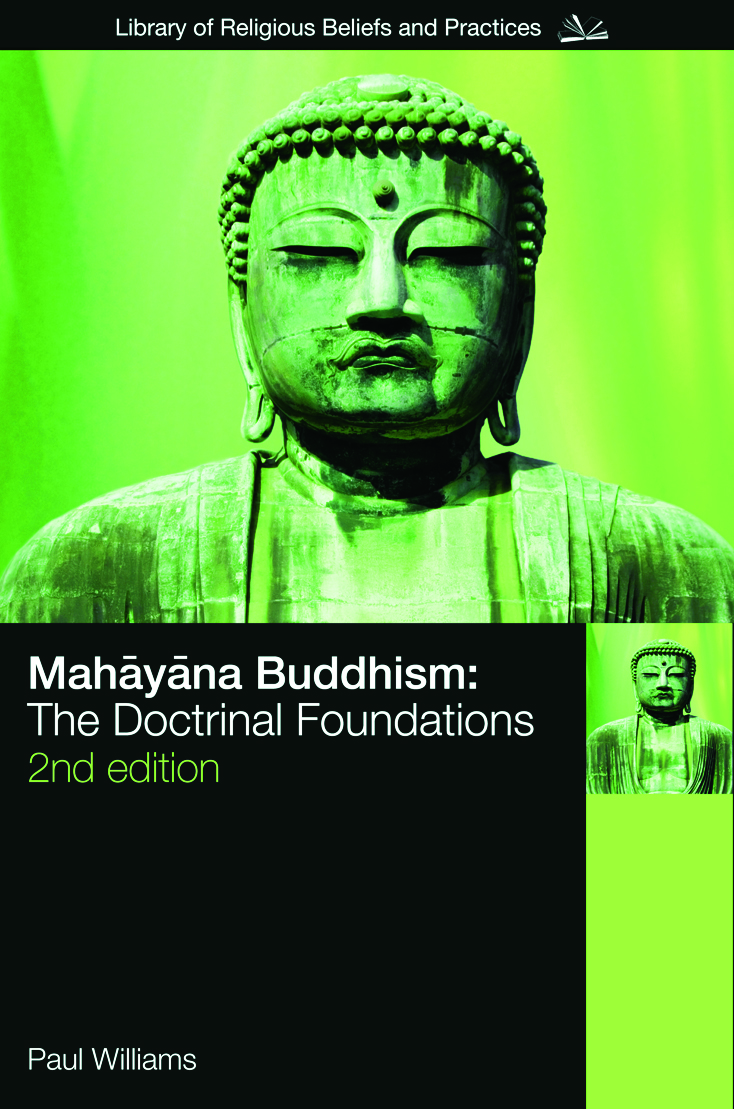
Mahāyāna Buddhism The Doctrinal Foundations 2nd ed -front.jpg
Books2009About this item
Originating in India, Mahayana Buddhism spread across Asia, becoming the prevalent form of Buddhism in Tibet and East Asia. Over the last twenty-five years Western interest in Mahayana has increased considerably, reflected both in the quantity of scholarly material produced and in the attraction of Westerners towards Tibetan Buddhism and Zen. Paul Williams’ Mahayana Buddhism is widely regarded as the standard introduction to the field, used internationally for teaching and research and has been translated into several European and Asian languages. This new edition has been fully revised throughout in the light of the wealth of new studies and focuses on the religion’s diversity and richness. It includes much more material on China and Japan, with appropriate reference to Nepal, and for students who wish to carry their study further there is a much-expanded bibliography and extensive footnotes and cross-referencing. Everyone studying this important tradition will find Williams’ book the ideal companion to their studies. (Source: Routledge)
Zapart Jarowslaw Jagiellonian.jpg
Articles2012About this item
This article aims at providing an outlook on the possible origin of tathāgatagarbha theory with a special reference to its relation to the soteriological and formal solutions found in the Saddharmapuṇḍarīka-sūtra and Avataṃsaka-sūtra. Through comparative textual analysis, the first work of this tradition, Tathāgatagarbha-sūtra, is shown as a text providing a metaphysical foundation for the postulate of universal Buddhahood posited by the Lotus Sutra. The realization of this postulate was possible through the implementation of 'Buddha-wisdom' (tathāgatajñāna) — a quality intrinsic to all living beings, which comes from the Tathāgata's all-encompassing compassion — taken from the "Manifestation of the Tathāgata" chapter of Avataṃsaka. By combining these influences the Tathāgatagarbha-sūtra is presented as a culmination of an important soteriological trend of the early Mahāyāna, and at the same time the starting point for an influential 'buddha-nature' tradition. (Source accessed June 26, 2020)
7 A topic of
Jinamitra translator.jpg
Classical WorksAbout this item
The Avalokiteśvaravimokṣa is chapter 30 of the Gaṇḍavyūhasūtra, in which the bodhisattva Avalokiteśvara, teaching Sudhana on Mount Potalaka, describes his attainment of the bodhisattva liberation called "the unimpeded gateway to great compassion," through which he frees beings from a wide range of fears—including fear of heights, bondage, danger, hunger, disgrace, death, unfortunate rebirth, separation from loved ones, and bodily and mental torment. This passage is quoted at length by Śāntideva in the Śikṣāsamuccaya (Bendall ed., p. 296) under the title Avalokiteśvaravimokṣa, where it illustrates the dedication of merit toward the protection of all beings. The text is not preserved independently in the Tibetan Kangyur; it survives only as this chapter within the Gaṇḍavyūhasūtra (Toh 44–45).
Jinamitra translator.jpg
Classical WorksAbout this item
༄༅། །འཕགས་པ་བཟང་པོ་སྤྱོད་པའི་སྨོན་ལམ་གྱི་རྒྱལ་པོ་བཞུགས།

The King of Aspiration Prayers: Samantabhadra’s “Aspiration to Good Actions” (Zangchö Mönlam) from the Gaṇḍavyūha chapter of the Avataṃsaka Sūtra. Many translations of this text exist as it is regularly chanted around the world in many different traditions. For an example, see Lotsawa House.

Bhadracarīpranidhāna. (T. Bzang po spyod pa'i smon lam; C. Puxian pusa xingyuan zan; J. Fugen bosatsu gyōgansan; K. Pohyǒn posal haengwǒn ch'an 普賢菩薩行願讚). In Sanskrit, "Vows of Good Conduct," the last section of the Gaṇḍavyūha in the Avataṃsakasūtra and one of the most beloved texts in all of Mahāyāna Buddhism; also known as the Samantabhadracarīpraṇidhānarāja. The Bhadracarīpraṇidhāna focuses on the ten great vows (praṇidhāna) taken by Samantabhadra to realize and gain access to the dharmadhātu, which thereby enable him to benefit sentient beings. The ten vows are: (1) to pay homage to all the buddhas, (2) to praise the tathāgatas, (3) to make unlimited offerings, (4) to repent from one's transgressions in order to remove karmic hindrances (cf. karmāvaraṇa), (5) to take delight in others' merit, (6) to request the buddhas to turn the wheel of dharma (dharmacakrapravartana), (7) to request the buddhas to continue living in the world, (8) always to follow the teachings of the Buddha, (9) always to comply with the needs of sentient beings, and (10) to transfer all merit to sentient beings for their spiritual edification. The text ends with a stanza wishing that sentient beings still immersed in evil be reborn in the Pure Land of Amitābha. The text was translated into Chinese in 754 by Amoghavajra (705–774). Other Chinese recensions appear in the Wenshushili fayuan jing ("Scripture on the Vows made by Mañjuśrī"), translated in 420 by Buddhabhadra (359–429), which corresponds to the verse section from Ru busiyi jietuo jingjie Puxian xingyuan pin, the last roll of the forty-roll recension of the Huayan jing translated by Prajña in 798. (There is no corresponding version in either the sixty- or the eighty-roll translations of the

Huajan jing.) The verses are also called the "Précis of the Huayan jing (Lüe Huayan jing), because they are believed to constitute the core teachings of the Avataṃsakasūtra. In the main Chinese recension by Amoghavajra, the text consists of sixty-two stanzas, each consisting of quatrains with lines seven Sinographs in length, thus giving a total number of 1,736 Sinographs. In addition to the sixty-two core stanzas, Amoghavajra's version adds ten more stanzas of the Bada pusa zan ("Eulogy to the Eight Great Bodhisattvas") from the Badapusa mantuluo jing ("Scripture of the Maṇḍalas of the Eight Great Bodhisattvas") . . . Buddhabhadra's version consists of forty-four stanzas with 880 Sinographs, each stanza consisting of a quatrain with lines five Sinographs in length. Prajña's version contains fifty-two stanzas with each quatrain consisting of lines seven Sinographs in length. There are five commentaries on the text attributed to eminent Indian exegetes, including Nāgārjuna, Dignāga, and Vasubandhu, which are extant only in Tibetan translation. In the Tibetan tradition, the prayer is called the "king of prayers" (smon lam gyi rgyal po). It is incorporated into many liturgies; the opening verses of the prayer are commonly incorporated into a Tibetan's daily recitation. (Source: "Bhadracarīpraṇidhāna." In The Princeton Dictionary of Buddhism, 106. Princeton University Press, 2014. http://www.jstor.org/stable/j.ctt46n41q.27.)

Jinamitra translator.jpg
Classical WorksAbout this item
Lokottaraparivarta (Tib. 'jig rten las 'das pa'i le'u, "Chapter on Transcending the World") is chapter 44 of 45 in the Buddhāvataṃsakasūtra (Toh 44, Dege Kangyur vol. 37, phal chen, ga). One of only five chapters in the Avataṃsaka with its own introductory narrative (nidāna), it presents a teaching by the bodhisattva Samantabhadra delivered after he enters a samādhi called sangs rgyas phal po che ("Multitude of Buddhas"). It immediately precedes the sūtra's final and longest chapter, the Gaṇḍavyūha.
Mahāyāna Buddhism The Doctrinal Foundations 2nd ed -front.jpg
Books2009About this item
Originating in India, Mahayana Buddhism spread across Asia, becoming the prevalent form of Buddhism in Tibet and East Asia. Over the last twenty-five years Western interest in Mahayana has increased considerably, reflected both in the quantity of scholarly material produced and in the attraction of Westerners towards Tibetan Buddhism and Zen. Paul Williams’ Mahayana Buddhism is widely regarded as the standard introduction to the field, used internationally for teaching and research and has been translated into several European and Asian languages. This new edition has been fully revised throughout in the light of the wealth of new studies and focuses on the religion’s diversity and richness. It includes much more material on China and Japan, with appropriate reference to Nepal, and for students who wish to carry their study further there is a much-expanded bibliography and extensive footnotes and cross-referencing. Everyone studying this important tradition will find Williams’ book the ideal companion to their studies. (Source: Routledge)
Jinamitra translator.jpg
Classical WorksAbout this item
According to Paul Harrison in his essay "Śāntideva: The Author and His Project" in Readings of Santideva's Guide to Bodhisattva Practice (2019), the Maitreyavimokṣa is chapter 54 of the Gaṇḍavyūhasūtra (see page 39). He explains that verse 1.14 of the Guide makes mention of Maitreya's commendation of the aspiration to awakening to Sudhana, which is a reference to a sequence of verses in chapter 54 (Maitreyavimokṣa) of the Gaṇḍavyūha. The relevant verses are given in full in the Anthology (See B101-104:G103-106; cf. also B9:G11).
FloweOrnament-front.jpg
Books1993About this item
This one-volume edition contains Thomas Cleary's definitive translation of all thirty-nine books of the Buddhāvataṃsakasūtra.
Forgues-Gregory-Darthmouth-2026.png
Articles2025About this item
Bodhicitta, the "mind of awakening," constitutes the foundational principle of Mahāyāna Buddhism. This essay traces the concept's historical and doctrinal genesis from its pre-Mahāyāna antecedents to its full articulation in the Indian and Tibetan traditions. It explores the main scriptural and scholastic sources in India, the two great Indian lineages of practice—the "Profound View" of Nāgārjuna and the "Vast Conduct" of Asaṅga—and the pivotal role of Atiśa Dīpaṃkara Śrījñāna in transmitting and systematizing these teachings in Tibet. The article further details how Atiśa's Kadam school and its core mind training (lojong) teachings influenced the subsequent development of bodhicitta cultivation in the Nyingma, Kagyu, Sakya, and Geluk schools. Bodhicitta is not a static concept but a dynamic, multifaceted principle that functions as the soteriological core of the Mahāyāna path, embodying the indivisible union of universal compassion and the profound wisdom that realizes emptiness.