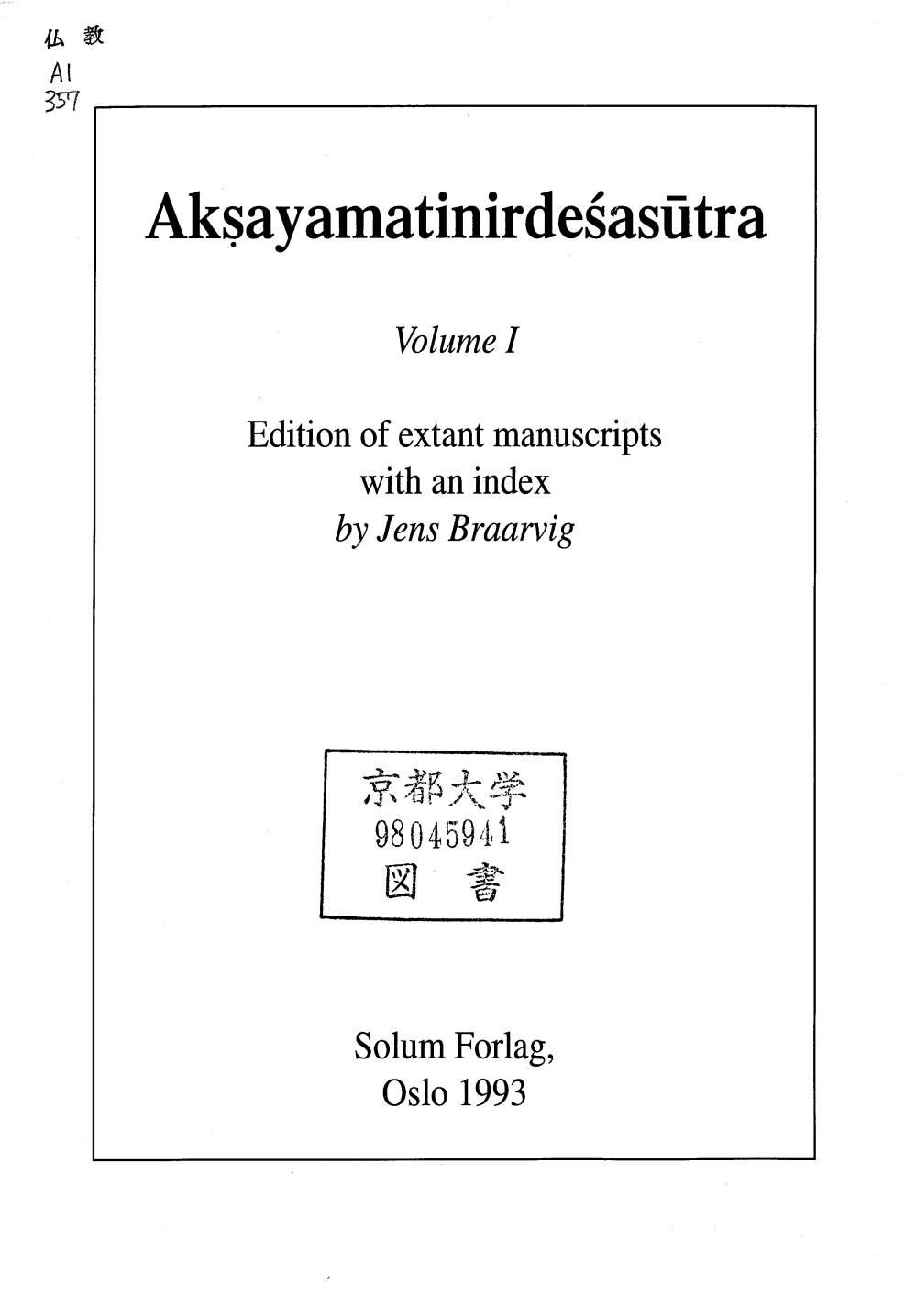
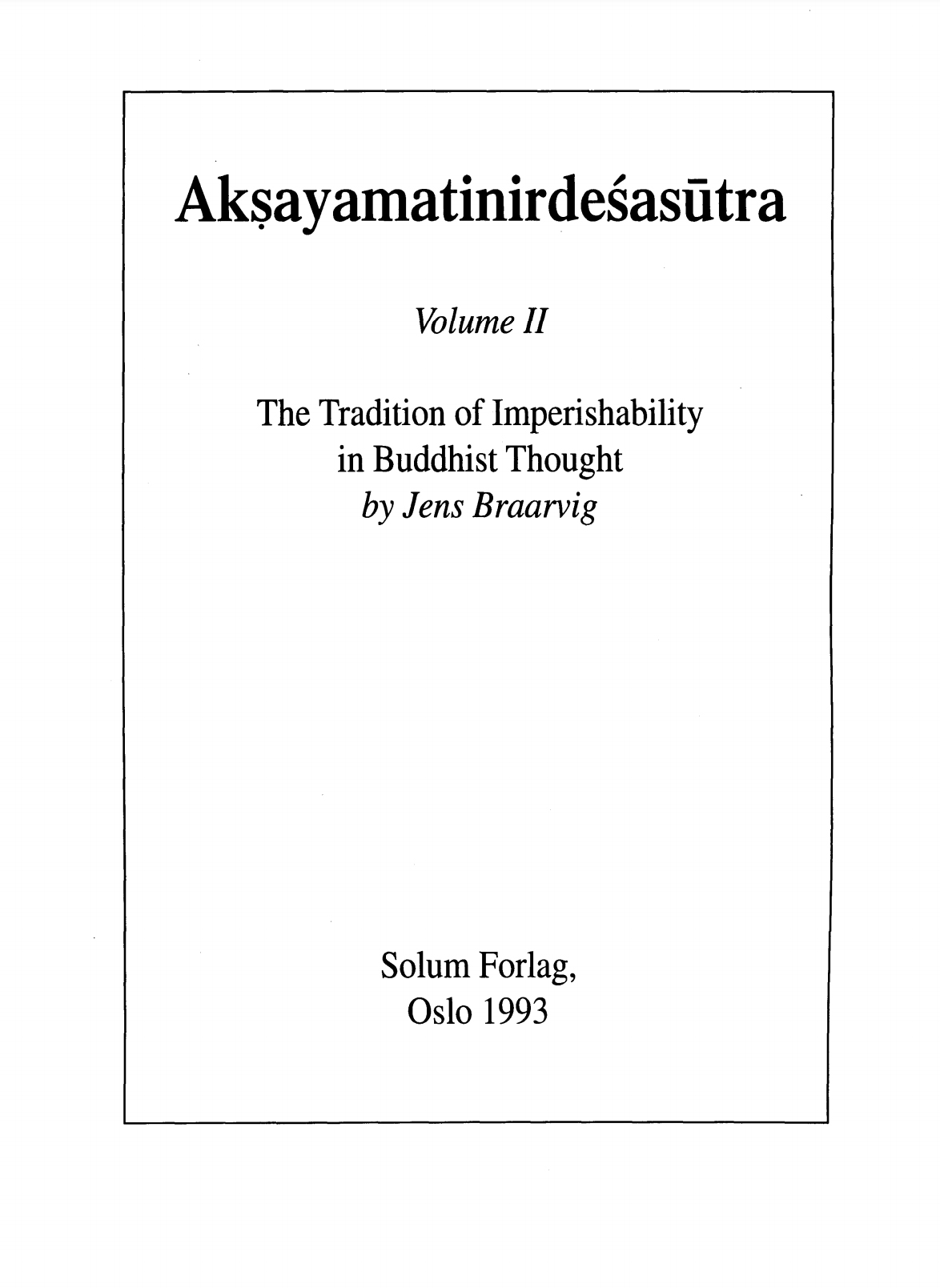
Akṣayamatinirdeśasūtra
| 🤓 Admin Zone 🛠️ hidden to non-admins | |


Description


1. In defence of dichotomies
Dichotomies are rather out of fashion at the moment. The traditional divisions into sacred and profane, religious and secular, mystical and scientific and so on are being dismantled: carving up the world in this way is no longer thought to be very helpful methodologically (or ontologically for that matter) and approaches are being adopted which stress either the non-difference of things previously presented as different, or the multiplication of categories to provide a much more complex scheme than that afforded by the old binary oppositions. This process undoubtedly has some value in Religious studies especially where the divisions of the investigator (the etic side) have imposed a structure on the investigated (the emic side) which, in failing to take into account the divisions consciously made within the investigated itself, is unfaithful to it. If this process is taken too far, however, the baby is in danger of being thrown out with the bathwater. This is certainly the case with the Buddhism of the great Mahāyāna sūtras and their commentaries and in the following investigations the dichotomy will once more take centre stage.
The reason for this is simply that such dual divisions are to be found as elements of the inner presentations, or self-descriptions, both of the canonical literature of the Mahāyāna and of its hermeneutical tradition. They are not only to be found but are of central importance as heuristic or soteriological devices. Indeed, it may not be too much of an exaggeration to claim that the entire system of philosphical speculation combined with spiritual practice (not intended as a dichotomy) of the Mahāyāna rests, in the final analysis, upon one crucial fundamental opposition: the distinction between saṃvṛti, the conventional, and paramārtha, the ultimate. Or, more specifically, between saṃvṛtisatya, conventional truth; and paramārthasatya, ultimate truth.
This distinction is already made in the Hīnayāna schools. The Vaibhāṣikas, for example, distinguish between conventional truths as those entities, such as pots etc., which are capable of being broken up, either physically or by a mental operation, and ultimate truths as those which cannot be so treated, such as space, form and so on.[1] This rather narrow, scholastic usage, and the failure of the śrāvakas to realise the profound implications of these ideas mark them out, according to Vasubandhu wearing his Mahāyāna hat, as inferior in understanding. For the Mahāyānanists, who invest the notions with much deeper soteriological meaning, saṃvṛtisatya, very roughly speaking, refers to the relative world of appearances—things not seen directly as they are but mediated through language and obscured by dualistic and ‘realistic’ thinking;[2] and paramārthasatya is the emptiness of all dharmas of inherent, or independent, existence.
While there is reasonable agreement among the various philosophical schools—Yogācāra, Mādhyamika, Svātantrika etc.—on the subject of paramārthasatya discord arises over the exact sense of saṃvṛtisatya, in what way the concept may properly be applied, and its relationship to paramārtha. Vasubandhu makes an interesting contribution to this debate in the Akṣayamatinirdeśa-ṭīkā, the gist of which will be given in Part 2. (Freeman, introductory remarks, 97–98)
relate to each other in the classification of the Mahāyāna doctrine.
In composing his mKhas 'jug, Mi pham begins with the usual verses of veneration and intention and then divides his text into three major discussions:[3]
- 1 mkhas par bya ba'i gnas bcu (daśavidhaṃ kauśalyam: the ten kinds of expertise: 2a3-123b6),
- 2. chos kyi sdom bźi (dharmoddāna-catuṣṭaya: four synoptic statements concerning the doctrine: 123b6-140b5), and
- 3. so so yaṅ dag par rig pa bźi (catvāri pratisaṃvidaḥ: four detailed and accurate knowledges: 140b5-161b4).
He concludes the treatise with a short discussion on the import of the text.
In this paper, I wish to focus my attention on the eighty inexhaustible topics (mi zad pa brgyad cu) that substantiate Mi pham's discussion on what constitutes a Mahāyāna path. However, before becoming involved with that topic, I believe that the eighty inexhaustible topics should be put into their proper context, and therefore, I shall deal first with the ten kinds of expertise (mkhas par bya ba'i gnas bcu, daśavidhaṃ kauśalyam). (Kawamura, introductory remarks, 131-32)
In this paper, I intend to present a series of observations concerning the relationship between the Bodhisattvapiṭaka and Akṣayamatinirdeśa.[1] Analysis of these sūtras has shown that the Akṣayamatinirdeśa is greatly indebted to the Bodhisattvapiṭaka for its material, often to the extent of reproducing entire passages from the Bodhisattvapiṭaka verbatim. Presumably in response to changes in current Buddhist thinking, the Akṣayamatinirdeśa deliberately introduced also a number of unambiguous doctrinal and editorial adjustments. On the whole, they are rather minor and are well blended into the wider context of the exposition, affecting only selected aspects of the Bodhisattva career. In several instances, modifications indicate doctrinal development and allow us to establish the chronology of the two works beyond reasonable doubt.[2] The main body of the Akṣayamatinirdeśa consists of an exposition of eighty inexhaustible (akṣaya) faculties and attributes of a Bodhisattva. Here, many of the more important practices of the Bodhisattva-training are discussed and set into an early Mahāyāna context.[3] Significantly, only the first ten of the eighty akṣayas bear unmistakable marks of Mahāyāna thought. Virtually all other practices fall within the scope of pre-Mahāyāna Buddhism and figured, in one way or another, already in the sūtras of early Buddhism. (Pagel, introductory remarks, 333–34)
Notes
- All references, unless stated otherwise, refer to the Peking Edition of the Tibetan Tripiṭaka (ed., D.T. Suzuki, Kyoto, 1958); vols. 22/23 for the Bodhisattvapiṭaka, vol. 34 for the Akṣayamatinirdeśa and vol. 104 for the Akṣayamatinirdeśaṭīkā. However, since I have produced elsewhere a critical edition of chapter eleven of the Bodhisattvapiṭaka, utilising the sNar-thang, sDe-dge, Peking and sTog-Palace editions as well as two manuscript fragments from Tun-huang, I have occasionally incorporated data from this critical edition included in my doctoral dissertation "The Bodhisattvapiṭaka: Its Doctrines and Practices and their Position in Mahāyāna Literature”, London, SOAS, 1992. When translating quotations from the Akṣayamatinirdeśa and Bodhisattvapiṭaka, I follow as a rule the Peking reading. Only where the Peking text deviates considerably from the other four editions I adopt the reading of my own edition. In these instances I provide the Peking reading in round brackets. Square brackets in the Tibetan text point to those passages in my quotations that I left untranslated because of the need for brevity. In my translations, they are indicated by the insertion of three ellipsis points in the appropriate lacuna.
- Except for a few Sanskrit quotations of the Akṣayamatinirdeśa that are extant in the Śikṣāsamuccaya, Mūlamadhyamakavṛtti and Arthaviniścayasūtra, my comparison is wholly based on Tibetan sources. For an array of references to Sanskrit quotations from the Akṣayamatinirdeśa, see Jens Braarvig, "The Akṣayamatinirdeśasūtra and the Tradition of Imperishability in Buddhist Thought", Ph.D. dissertation, University of Oslo, 1989, Ivi-lxi. Confirmed Bodhisattvapitaka quotations are much rarer and do not appear in surviving Sanskrit works. But compare the following sections: Śiks, 316.13–317.13, Akn, TTP, 69.4.2-5.6, Bdp, TTP, 86.3.2-4.5; Śiks, 233.6-8, Akn, TTP, 67.2.3-3.3, Bdp, TTP, 83.1.4-2.3; Śikṣ, 278.4-14, Akn, TTP, 72.2.2-3.2, Bdp, TTP, 87.1.4-2.3; Śikṣ, 117.13-16, Akn, TTP, 69.1.1-2, Bdp, TTP, 86.1.4-5; Śiks, 236.6-13, Akn, TTP, 68.3.5-4.1, Bdp, TTP, 84.2.1-5; Arthav, 320-322, Akn, TTP, 70.4.4-71.2.1, Bdp, TTP, 85.1.1-3.4.
- As Wayman has demonstrated in his article on the samādhi-list in the Akṣayamatinirdeśa ("The Samādhi Lists of the Aksayamatinirdeśasūtra and the Mahāvyutpatti", AOH, 34, 1980, 305-12), it is this enumeration of eighty akṣayas that was taken as a basis in the Sūtrālaṃkāra where the Aksayamatinirdeśa is cited as authority for the twenty-two forms of generating the thought of enlightenment (S. Lévi, ed., Mahāyānasūtrālaṃkāra, Paris, 1907, iv.15-20). Cast into twenty-two similes in the Sūtrālaṃkāra, they correspond in content and sequence to the eighty aksayas listed in the Aksayamatinirdeśa. The similes themselves, however, did not originate in the Aksayamatinirdeśa, but appear to have been derived from a number of sources, including passages in the early Prajñāpāramitā literature. The list of the similes is, for instance, contained in three Kārikās of the Abhisamayālaṃkāra (Th. Stcherbatsky, ed., Abhisamayālaṃkāra, St. Petersburg, 1929, 4, vv.18-20).
1. In defence of dichotomies
Dichotomies are rather out of fashion at the moment. The traditional divisions into sacred and profane, religious and secular, mystical and scientific and so on are being dismantled: carving up the world in this way is no longer thought to be very helpful methodologically (or ontologically for that matter) and approaches are being adopted which stress either the non-difference of things previously presented as different, or the multiplication of categories to provide a much more complex scheme than that afforded by the old binary oppositions. This process undoubtedly has some value in Religious studies especially where the divisions of the investigator (the etic side) have imposed a structure on the investigated (the emic side) which, in failing to take into account the divisions consciously made within the investigated itself, is unfaithful to it. If this process is taken too far, however, the baby is in danger of being thrown out with the bathwater. This is certainly the case with the Buddhism of the great Mahāyāna sūtras and their commentaries and in the following investigations the dichotomy will once more take centre stage.
The reason for this is simply that such dual divisions are to be found as elements of the inner presentations, or self-descriptions, both of the canonical literature of the Mahāyāna and of its hermeneutical tradition. They are not only to be found but are of central importance as heuristic or soteriological devices. Indeed, it may not be too much of an exaggeration to claim that the entire system of philosphical speculation combined with spiritual practice (not intended as a dichotomy) of the Mahāyāna rests, in the final analysis, upon one crucial fundamental opposition: the distinction between saṃvṛti, the conventional, and paramārtha, the ultimate. Or, more specifically, between saṃvṛtisatya, conventional truth; and paramārthasatya, ultimate truth.
This distinction is already made in the Hīnayāna schools. The Vaibhāṣikas, for example, distinguish between conventional truths as those entities, such as pots etc., which are capable of being broken up, either physically or by a mental operation, and ultimate truths as those which cannot be so treated, such as space, form and so on.[1] This rather narrow, scholastic usage, and the failure of the śrāvakas to realise the profound implications of these ideas mark them out, according to Vasubandhu wearing his Mahāyāna hat, as inferior in understanding. For the Mahāyānanists, who invest the notions with much deeper soteriological meaning, saṃvṛtisatya, very roughly speaking, refers to the relative world of appearances—things not seen directly as they are but mediated through language and obscured by dualistic and ‘realistic’ thinking;[2] and paramārthasatya is the emptiness of all dharmas of inherent, or independent, existence.
While there is reasonable agreement among the various philosophical schools—Yogācāra, Mādhyamika, Svātantrika etc.—on the subject of paramārthasatya discord arises over the exact sense of saṃvṛtisatya, in what way the concept may properly be applied, and its relationship to paramārtha. Vasubandhu makes an interesting contribution to this debate in the Akṣayamatinirdeśa-ṭīkā, the gist of which will be given in Part 2. (Freeman, introductory remarks, 97–98)relate to each other in the classification of the Mahāyāna doctrine.
In composing his mKhas 'jug, Mi pham begins with the usual verses of veneration and intention and then divides his text into three major discussions:[3]
- 1 mkhas par bya ba'i gnas bcu (daśavidhaṃ kauśalyam: the ten kinds of expertise: 2a3-123b6),
- 2. chos kyi sdom bźi (dharmoddāna-catuṣṭaya: four synoptic statements concerning the doctrine: 123b6-140b5), and
- 3. so so yaṅ dag par rig pa bźi (catvāri pratisaṃvidaḥ: four detailed and accurate knowledges: 140b5-161b4).
He concludes the treatise with a short discussion on the import of the text.
In this paper, I wish to focus my attention on the eighty inexhaustible topics (mi zad pa brgyad cu) that substantiate Mi pham's discussion on what constitutes a Mahāyāna path. However, before becoming involved with that topic, I believe that the eighty inexhaustible topics should be put into their proper context, and therefore, I shall deal first with the ten kinds of expertise (mkhas par bya ba'i gnas bcu, daśavidhaṃ kauśalyam). (Kawamura, introductory remarks, 131-32)In this paper, I intend to present a series of observations concerning the relationship between the Bodhisattvapiṭaka and Akṣayamatinirdeśa.[1] Analysis of these sūtras has shown that the Akṣayamatinirdeśa is greatly indebted to the Bodhisattvapiṭaka for its material, often to the extent of reproducing entire passages from the Bodhisattvapiṭaka verbatim. Presumably in response to changes in current Buddhist thinking, the Akṣayamatinirdeśa deliberately introduced also a number of unambiguous doctrinal and editorial adjustments. On the whole, they are rather minor and are well blended into the wider context of the exposition, affecting only selected aspects of the Bodhisattva career. In several instances, modifications indicate doctrinal development and allow us to establish the chronology of the two works beyond reasonable doubt.[2] The main body of the Akṣayamatinirdeśa consists of an exposition of eighty inexhaustible (akṣaya) faculties and attributes of a Bodhisattva. Here, many of the more important practices of the Bodhisattva-training are discussed and set into an early Mahāyāna context.[3] Significantly, only the first ten of the eighty akṣayas bear unmistakable marks of Mahāyāna thought. Virtually all other practices fall within the scope of pre-Mahāyāna Buddhism and figured, in one way or another, already in the sūtras of early Buddhism. (Pagel, introductory remarks, 333–34)
Notes
- All references, unless stated otherwise, refer to the Peking Edition of the Tibetan Tripiṭaka (ed., D.T. Suzuki, Kyoto, 1958); vols. 22/23 for the Bodhisattvapiṭaka, vol. 34 for the Akṣayamatinirdeśa and vol. 104 for the Akṣayamatinirdeśaṭīkā. However, since I have produced elsewhere a critical edition of chapter eleven of the Bodhisattvapiṭaka, utilising the sNar-thang, sDe-dge, Peking and sTog-Palace editions as well as two manuscript fragments from Tun-huang, I have occasionally incorporated data from this critical edition included in my doctoral dissertation "The Bodhisattvapiṭaka: Its Doctrines and Practices and their Position in Mahāyāna Literature”, London, SOAS, 1992. When translating quotations from the Akṣayamatinirdeśa and Bodhisattvapiṭaka, I follow as a rule the Peking reading. Only where the Peking text deviates considerably from the other four editions I adopt the reading of my own edition. In these instances I provide the Peking reading in round brackets. Square brackets in the Tibetan text point to those passages in my quotations that I left untranslated because of the need for brevity. In my translations, they are indicated by the insertion of three ellipsis points in the appropriate lacuna.
- Except for a few Sanskrit quotations of the Akṣayamatinirdeśa that are extant in the Śikṣāsamuccaya, Mūlamadhyamakavṛtti and Arthaviniścayasūtra, my comparison is wholly based on Tibetan sources. For an array of references to Sanskrit quotations from the Akṣayamatinirdeśa, see Jens Braarvig, "The Akṣayamatinirdeśasūtra and the Tradition of Imperishability in Buddhist Thought", Ph.D. dissertation, University of Oslo, 1989, Ivi-lxi. Confirmed Bodhisattvapitaka quotations are much rarer and do not appear in surviving Sanskrit works. But compare the following sections: Śiks, 316.13–317.13, Akn, TTP, 69.4.2-5.6, Bdp, TTP, 86.3.2-4.5; Śiks, 233.6-8, Akn, TTP, 67.2.3-3.3, Bdp, TTP, 83.1.4-2.3; Śikṣ, 278.4-14, Akn, TTP, 72.2.2-3.2, Bdp, TTP, 87.1.4-2.3; Śikṣ, 117.13-16, Akn, TTP, 69.1.1-2, Bdp, TTP, 86.1.4-5; Śiks, 236.6-13, Akn, TTP, 68.3.5-4.1, Bdp, TTP, 84.2.1-5; Arthav, 320-322, Akn, TTP, 70.4.4-71.2.1, Bdp, TTP, 85.1.1-3.4.
- As Wayman has demonstrated in his article on the samādhi-list in the Akṣayamatinirdeśa ("The Samādhi Lists of the Aksayamatinirdeśasūtra and the Mahāvyutpatti", AOH, 34, 1980, 305-12), it is this enumeration of eighty akṣayas that was taken as a basis in the Sūtrālaṃkāra where the Aksayamatinirdeśa is cited as authority for the twenty-two forms of generating the thought of enlightenment (S. Lévi, ed., Mahāyānasūtrālaṃkāra, Paris, 1907, iv.15-20). Cast into twenty-two similes in the Sūtrālaṃkāra, they correspond in content and sequence to the eighty aksayas listed in the Aksayamatinirdeśa. The similes themselves, however, did not originate in the Aksayamatinirdeśa, but appear to have been derived from a number of sources, including passages in the early Prajñāpāramitā literature. The list of the similes is, for instance, contained in three Kārikās of the Abhisamayālaṃkāra (Th. Stcherbatsky, ed., Abhisamayālaṃkāra, St. Petersburg, 1929, 4, vv.18-20).