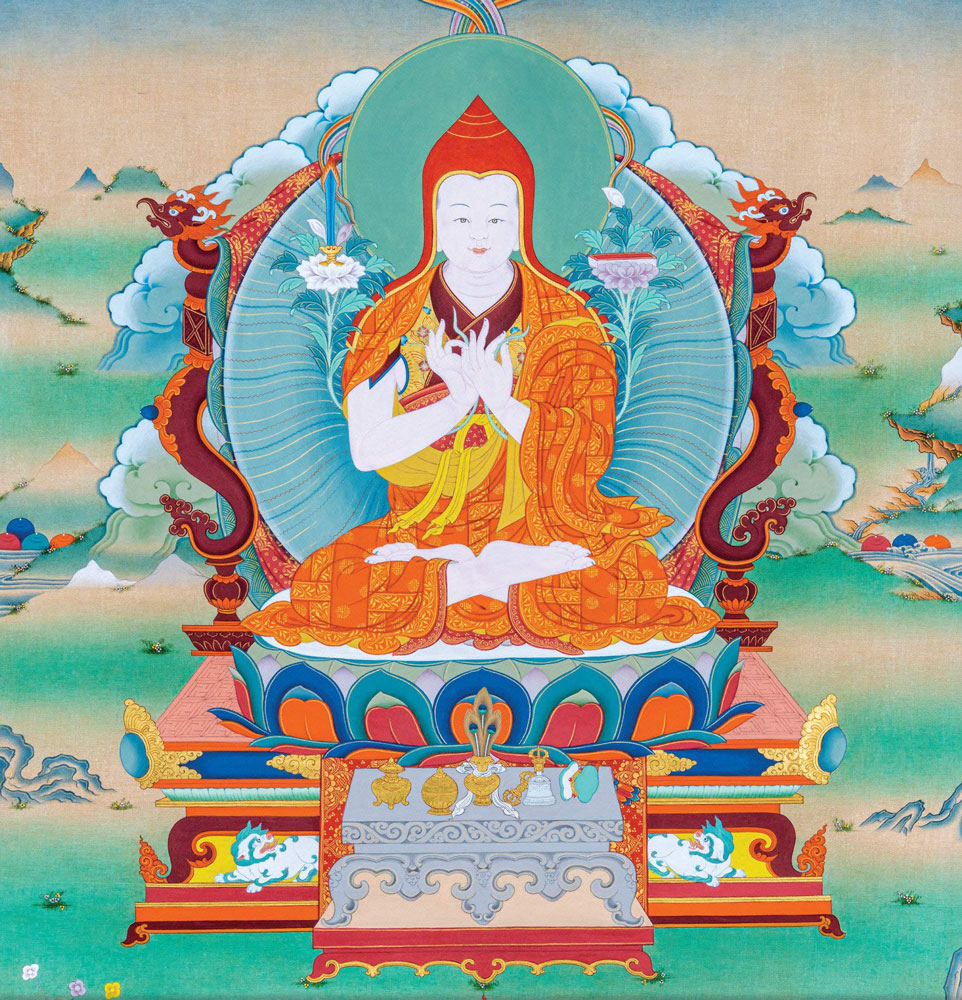
The Akṣayamatinirdeśasūtra and Mi pham's mKhas 'jug

From Bodhicitta
Articles/The Akṣayamatinirdeśasūtra and Mi pham's mKhas 'jug

🤓 Admin Zone 🛠️ hidden to non-admins
The Akṣayamatinirdeśasūtra and Mi pham's mKhas 'jug
Chapter in a Book


Please note that many items in our library are simply pages that represent a detailed library catalog entry and citation of someone else's work, presentation, or performance. Read our General Disclaimer for more information.

Description

A most prolific and comprehensive scholar, Mi ph am 'jam dbyaṅs rnam rgyal rgya mtsho (1846-1912 [hereafter: Mi pham]) wrote many works concerning not only his own indigenous Tibetan Buddhist tradition but also the Mahāyāna tradition of India.[1] Among his many commentaries on the Indian Buddhist śāstra tradition, he has one called mKhas pa'i tshul la 'jug pa'i sgo źes bya ba'i bstan bcos (paṇḍitasya nayam avatāramukhanama śāstram [hereafter: mKhas 'jug]).[2] This work consisting of 164 Tibetan folia systematizes the major philosophical, psychological, and religious systems that constitute the basic ideas underlying Mahāyāna developments in India. Therefore, this text is indispensable for those who wish to sift out, from the vast array of Buddhist literature, those topics that

relate to each other in the classification of the Mahāyāna doctrine.

In composing his mKhas 'jug, Mi pham begins with the usual verses of veneration and intention and then divides his text into three major discussions:[3]

1 mkhas par bya ba'i gnas bcu (daśavidhaṃ kauśalyam: the ten kinds of expertise: 2a3-123b6),
2. chos kyi sdom bźi (dharmoddāna-catuṣṭaya: four synoptic statements concerning the doctrine: 123b6-140b5), and
3. so so yaṅ dag par rig pa bźi (catvāri pratisaṃvidaḥ: four detailed and accurate knowledges: 140b5-161b4).

He concludes the treatise with a short discussion on the import of the text.

In this paper, I wish to focus my attention on the eighty inexhaustible topics (mi zad pa brgyad cu) that substantiate Mi pham's discussion on what constitutes a Mahāyāna path. However, before becoming involved with that topic, I believe that the eighty inexhaustible topics should be put into their proper context, and therefore, I shall deal first with the ten kinds of expertise (mkhas par bya ba'i gnas bcu, daśavidhaṃ kauśalyam). (Kawamura, introductory remarks, 131-32)

Citation
Kawamura, Leslie, S. "The Akṣayamatinirdeśasūtra and Mi pham's mKhas 'jug." In Vol. 2 of Contributions on Tibetan and Buddhist Religion and Philosophy: Proceeedings of the Csoma de Körös Symposium Held at Velm-Vienna, Austria, 13–19 September, 1981, edited by Ernst Steinkellner and Helmut Tauscher, 131–45. Wiener Studien zur Tibetologie und Buddhismuskunde 11. Motilal Banarsidass, 1995.
Interconnections
2 Scholarship on
Classical WorksAbout this item
The bodhisatva Akṣayamati arrives in our world from the buddha field of the buddha Samantabhadra. In response to Śāriputra's questions, Akṣayamati gives a discourse on the subject of imperishability. In all, Akṣayamati explains that there are eighty different aspects of the Dharma that are imperishable. When he has given this explanation, the Buddha praises it and declares it worthy of being spread by the countless bodhisatvas gathered there to listen. (Source: 84000)
Classical WorksAbout this item
Khenjuk (Tib. མཁས་འཇུག་, Wyl. mkhas 'jug) — the abbreviated title of The Entrance to the Way of the Wise or Introduction to Scholarship, an encyclopedic treatise composed by Jamgön Mipham Rinpoche at the turn of the twentieth century, which is often one of the first texts to be taught in a shedra. (Source: Rigpa Shedra)