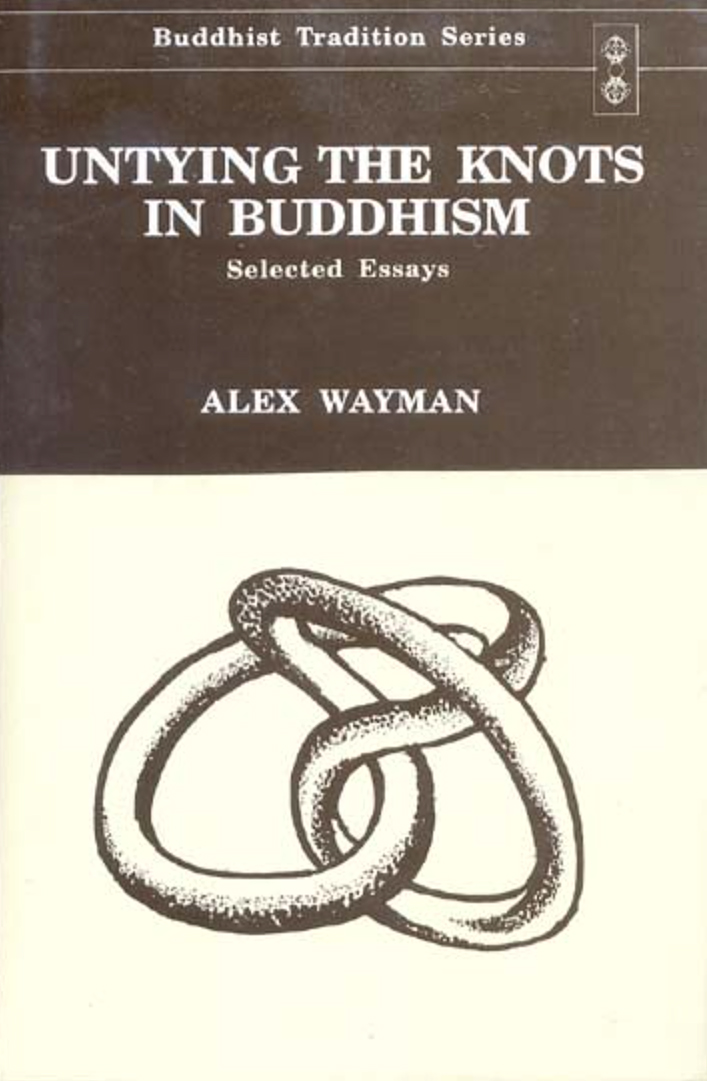
Untying the Knots in Buddhism: Selected Essays
From Bodhicitta
< BooksBooks/Untying the Knots in Buddhism: Selected Essays
| 🤓 Admin Zone 🛠️ hidden to non-admins | |
Untying the Knots in Buddhism: Selected Essays
Book
Please note that many items in our library are simply pages that represent a detailed library catalog entry and citation of someone else's work, presentation, or performance. Read our General Disclaimer for more information.

Description
The field of non-Tantric Buddhism still has many problems and debated issues. The present volume includes numerous solutions of these problems by the senior author Alex Wayman. The categories of the twenty-four essays are Heroes of the System, Theory of the Heroes, Buddhist Doctrine, Buddhist Practice, and Hindu- Buddhist Studies. Among these essays are one of his earliest, from the late 1950's "Studies in Yama and Mara," as well as examples of his recent mature writing, e.g. "The Buddha date and era" and "The 'no-self' of Buddhism within Indian cultures." Most of the essays have been previously published in whole or part. Some essays were written especially for this volume, e.g. "Core teachings." The entire corpus of essays is devoted to issues that concern present-day scholars of Buddhism in particular, but also specialists of Indian philosophy and religion in general. (Source Accessed Apr 25, 2022)
Citation
Wayman, Alex. Untying the Knots in Buddhism: Selected Essays. Buddhist Tradition Series 28. Delhi: Motilal Banarsidass, 1997.
Table of contents
- Forewordv
- Prefacevii
- Introductionxi
- SECTION I
- HEROES OF THE SYSTEM1
- 1. Śākyamuni, Founder of Buddhism3
- 2. Date and Era of the Buddha37
- 3. Nāgārjuna: Moralist Reformer of Buddhism59
- 4. Doctrinal Affiliation of the Buddhist Master Asaṅga89
- 5. Vasubandhu—Teacher Extraordinary115
- 6. Parents of the Buddhist Monks149
- SECTION ll
- THEORY OF 1HE HEROES163
- 7. Aniconic and Iconic Art of the Buddha165
- 8. The Tathāgata Chapter of Nāgārjuna's Mūla-Madhyamaka-kārikā175
- 9. Asaṅga's Three Pratyekabuddha Paths191
- 10. The Guru in Buddhism205
- 11. Prophecy for Persons in Buddhism223
- SECTION Ill
- BUDDHIST DOCTRINE241
- 12. Core Teachings: Suffering, Karma, Seed Consciousness, Dharma243
- 13. About Voidness: Two Scriptures277
- 14. Going and Not Going: the Scripture and MK, Chap. 2293
- 15. The Meaning of Death in Buddhism311
- SECTION IV
- BUDDHIST PRACTICES333
- 16. Asaṅga on Food335
- 17. The Position of Women in Buddhism369
- 18. Purification of Sin in Buddhism by Vision and Confession395
- 19. The Buddhist Theory of Virtue Consignment (Pariṇāmana)417
- SECTION V
- HINDU-BUDDHIST STUDIES445
- 20. The Three Worlds, Vedic and Buddhist447
- 21. Studies in Yama and Māra465
- 22. Vedantic and Buddhist Theory of Nāma-Rūpa505
- 23. The 'No-self' of Buddhism within Indian Culture529
- 24. Nescience and Omniscience551
- Bibliography573
- Index601
Interconnections
2 Partial translation of

The bodhisatva Akṣayamati arrives in our world from the buddha field of the buddha Samantabhadra. In response to Śāriputra's questions, Akṣayamati gives a discourse on the subject of imperishability. In all, Akṣayamati explains that there are eighty different aspects of the Dharma that are imperishable. When he has given this explanation, the Buddha praises it and declares it worthy of being spread by the countless bodhisatvas gathered there to listen. (Source: 84000)

Mūlamadhyamakakārikā. (T. Dbu ma rtsa bai tshig le'u byas pa; C. Zhong lun; J. Chüron; K. Chung non 中論). In Sanskrit, "Root Verses on the Middle Way"; the magnum opus of the second-century Indian master Nāgārjuna ; also known as the Prajñānāmamūlamadhyamakakārikā and the Madhyamakaśāstra. (The Chinese analogue of this text is the Zhong lun, which renders the title as Madhyamakaśāstra. This Chinese version was edited and translated by Kumārajīva . Kumārajīva's edition, however, includes not only Nāgārjuna's verses but also Piṅgala's commentary to the verses.) The most widely cited and commented upon of Nāgārjuna's works in India, the Mūlamadhyamakakārikā, was the subject of detailed commentaries by such figures as Buddhapālita, Bhāvaviveka, and Candrakīrti (with Candrakīrti's critique of Bhāvaviveka's criticism of a passage in Buddhapālita's commentary providing the locus classicus for the later Tibetan division of Madhyamaka into *Svātantrika and *Prāsaṅgika). In East Asia, it was one of the three basic texts of the "Three Treatises" school (C. San lun zong), and was central to Tiantai philosophy. Although lost in the original Sanskrit as an independent work, the entire work is preserved within the Sanskrit text of Candrakīrti's commentary, the Prasannapadā (serving as one reason for the influence of Candrakīrti's commentary in the European reception of the Mūlamadhyamakakārikā). The work is composed of 448 verses in twenty-seven chapters. The topics of the chapters (as provided by Candrakīrti) are the analysis of: (1) conditions (pratyaya), (2) motion, (3) the eye and the other sense faculties (indriya), (4) aggregates (skandha), (5) elements (dhātu), (6) passion and the passionate, (7) the conditioned (in the sense of production, abiding, disintegration), (8) action and agent, (9) prior existence, (10) fire and fuel, (11) the past and future limits of saṃsāra, (12) suffering, (13) the conditioned (saṃskāra), (14) contact (saṃsarga), (15) intrinsic nature (svabhāva), (16) bondage and liberation, (17) action and effect, (18) self, (19) time, (20) assemblage (sāmagrī), (21) arising and dissolving, (22) the tathāgata, (23) error, (24) the four noble truths, (25) nirvāṇa, (26), the twelve links of dependent origination (pratītyasamutpāda), and (27) views. (Source: "Mūlamadhyamakakārikā." In The Princeton Dictionary of Buddhism, 553. Princeton University Press, 2014. http://www.jstor.org/stable/j.ctt46n41q.27.)
2 Contains chapter or part

This paper deals with controversial matters, because the life of Asaṅga is shrouded in mystery. His thorough use of the Āgamas, the Sanskrit equivalent (roughly speaking) of the Pāli Nikāyas, permits some intriguing, if not fascinating considerations of the old canon. The old identification by Hsuan-tsang of Asaṅga's early school as Mahīśāsaka is here newly discussed.
The first topic is to establish Asaṅga as a brilliant author. The section "Asaṅga and the Mahīśāsakas (first approach)" aims to prove Asaṅga's reliance on the Āgamas. The section "Asaṅga and the Mahīśāsakas (second approach)" deals with specialized tenets attributed to the Mahīśāsakas. The section "Asaṅga and the Mahīśāsakas (third approach)" comes to a conclusion about the name Mahīśāsaka. Source: Untying the Knots in Buddhism: Selected Essays, 89–90.
Wayman, Alex. "Going and Not Going: The Scripture and MK, Chap. 2." In Untying the Knots in Buddhism: Selected Essays, 293–310. Buddhist Tradition Series 28. Delhi: Motilal Banarsidass, 1997.
1 Scholarship on
Mūlamadhyamakakārikā. (T. Dbu ma rtsa bai tshig le'u byas pa; C. Zhong lun; J. Chüron; K. Chung non 中論). In Sanskrit, "Root Verses on the Middle Way"; the magnum opus of the second-century Indian master Nāgārjuna ; also known as the Prajñānāmamūlamadhyamakakārikā and the Madhyamakaśāstra. (The Chinese analogue of this text is the Zhong lun, which renders the title as Madhyamakaśāstra. This Chinese version was edited and translated by Kumārajīva . Kumārajīva's edition, however, includes not only Nāgārjuna's verses but also Piṅgala's commentary to the verses.) The most widely cited and commented upon of Nāgārjuna's works in India, the Mūlamadhyamakakārikā, was the subject of detailed commentaries by such figures as Buddhapālita, Bhāvaviveka, and Candrakīrti (with Candrakīrti's critique of Bhāvaviveka's criticism of a passage in Buddhapālita's commentary providing the locus classicus for the later Tibetan division of Madhyamaka into *Svātantrika and *Prāsaṅgika). In East Asia, it was one of the three basic texts of the "Three Treatises" school (C. San lun zong), and was central to Tiantai philosophy. Although lost in the original Sanskrit as an independent work, the entire work is preserved within the Sanskrit text of Candrakīrti's commentary, the Prasannapadā (serving as one reason for the influence of Candrakīrti's commentary in the European reception of the Mūlamadhyamakakārikā). The work is composed of 448 verses in twenty-seven chapters. The topics of the chapters (as provided by Candrakīrti) are the analysis of: (1) conditions (pratyaya), (2) motion, (3) the eye and the other sense faculties (indriya), (4) aggregates (skandha), (5) elements (dhātu), (6) passion and the passionate, (7) the conditioned (in the sense of production, abiding, disintegration), (8) action and agent, (9) prior existence, (10) fire and fuel, (11) the past and future limits of saṃsāra, (12) suffering, (13) the conditioned (saṃskāra), (14) contact (saṃsarga), (15) intrinsic nature (svabhāva), (16) bondage and liberation, (17) action and effect, (18) self, (19) time, (20) assemblage (sāmagrī), (21) arising and dissolving, (22) the tathāgata, (23) error, (24) the four noble truths, (25) nirvāṇa, (26), the twelve links of dependent origination (pratītyasamutpāda), and (27) views. (Source: "Mūlamadhyamakakārikā." In The Princeton Dictionary of Buddhism, 553. Princeton University Press, 2014. http://www.jstor.org/stable/j.ctt46n41q.27.)