| 🤓 Admin Zone 🛠️ hidden to non-admins | |


Description


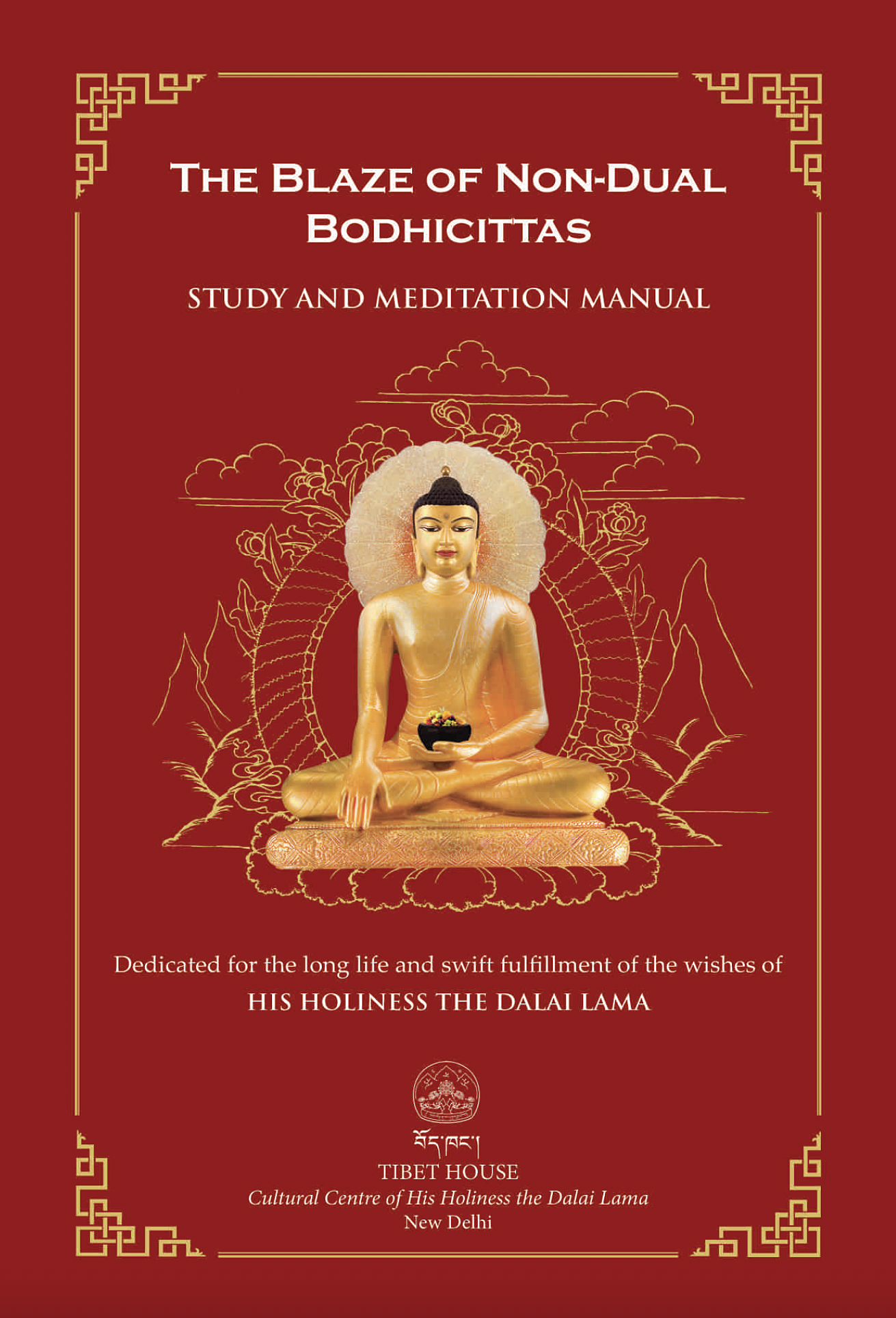
The book is divided into five parts:
I. Daily Recitation and Practice
II. Selected Texts for Study, Reflection and Meditation
III. Additional Prayers, Vows and Commitments
IV. Daily Dedication Prayers
V. Appendix
Part I and Part IV serve as a useful guide for all, who have an inclination towards dharma practice, but do not know how to start and design a daily practice session. It is also useful for those seekers who might be misguided and surmise that dharma practice comprises only of mantra recitation and so forth, thereby missing its essence.
Part II helps strengthen the practitioner’s dharma practice on the basis of selected compositions of great scholars and yogis. The actual breakthrough in the mental transformation happens through changes in the thought process, for which study and reflection are the cornerstones. Any of these profound texts and short extracts may be selected for study, reflection or meditation, on an on-going basis.
Part III reinforces and rejuvenates dharma practice and to that end, may be undertaken on a regular or occasional basis.
Part V introduces the reader to meditation practices, both shamatha (calm abiding) and vipasyana (special insight), including meditation on the breath, as well as methods to cultivate Bodhicitta and the wisdom of emptiness. While there are many texts on the wisdom of emptiness, the meditation included here is designed for all those who are not thoroughly introduced to this subject and still want to familiarise and habituate themselves with the wisdom of emptiness.
Brief notes, Endnotes and Glossary have been added to help the readers unfold the meanings of the texts with ease. (preface, xiv–xv)
The document is a transcript of teachings on “The Bodhicittavivarana” by Nagarjuna, with commentary by Dagpo Gomchen Ngawang Dragpa and oral commentary by The Venerable Khensur Kangurwa Geshe Lobsang Thubten Rinpoche, translated by Lotsawa Ilia Durovic. Here’s a detailed summary of the key teachings:
1. Good Motivation and Benefiting Others: The transcript begins by emphasizing the importance of generating a good mind and motivation, particularly one focused on benefiting others. This virtuous motivation enhances all deeds and leads to the accumulation of excellence.
2. Empathy, Love, and Bodhicitta: It stresses the generation of empathy and love towards oneself and others. This forms the basis of bodhicitta, the mind striving to benefit others, which is the path to full enlightenment. The text encourages making each day meaningful by cultivating these qualities.
3. The Path to Enlightenment and Bodhicitta: The teachings describe the path to full enlightenment as the perfection of wisdom, which includes conventional and ultimate bodhicitta. Arya Nagarjuna’s commentary on bodhicitta is highlighted as a guide for this journey.
4. Importance of Dharma Teachings and Mindful Listening: The document underscores the fortune of receiving precious human rebirth and the opportunity to attend Dharma teachings. It advises listening to teachings with a concentrated and uncontaminated mind and retaining their essence for meditation and personal growth.
5. Dharma, Virtue, and Overcoming Afflictions: Dharma is defined as the means to end desire, hatred, and ignorance. Virtuous actions and their results, such as happiness and liberation, are contrasted with non-virtuous actions leading to suffering.
6. Role of Bodhicitta in Achieving Enlightenment: Bodhicitta is portrayed as pivotal in purifying non-virtuous deeds and avoiding rebirth in lower realms. It’s described as a powerful force that, once generated, leads to the accumulation of vast virtue and propels one towards enlightenment.
7. The Mahayana Path and Compassion: The Mahayana path is introduced, with bodhicitta as its gateway. Compassion, essential for Mahayana practice, arises from contemplating the suffering of countless sentient beings and wishing to free them from it.
8. Practical Aspects of Dharma Practice: The text advises on the practicality of Dharma practice, likening it to taking medicine or eating food. It emphasizes regular practice, faith in Dharma, and the importance of understanding the teachings of Buddha.
9. Antidotes to Afflictions and Path to Enlightenment: Specific antidotes to afflictions like anger, desire, and ignorance are discussed. The path to enlightenment is described as a gradual process, requiring ethics, generosity, patience, and the realization of emptiness.
10. Continuous Practice and Progression: Finally, the transcript highlights the need for continuous practice and gradual progression on the path to enlightenment. It compares spiritual progress to walking a path with steady steps, emphasizing empathy and love as foundational practices.
This transcript offers a comprehensive overview of Buddhist teachings on bodhicitta, compassion, and the path to enlightenment, with practical advice on how to incorporate these principles into daily life for spiritual growth and the benefit of all beings.


Śākya Chokden makes clear that his purpose is to eliminate a comprehensive list of "wrong views" (log par rtog pa) that were prevalent in the understanding of the Bodhicittavivaraṇa. He presents twenty-four specific errors that he aims to correct, viewing these as significant obstacles to proper realization. Among the most critical misunderstandings he sought to rectify were: failing to recognize that the text's subject is ultimate bodhicitta and not its conventional counterpart; misinterpreting the described ritual as a standard ceremony for generating conventional bodhicitta; incorrectly asserting that ultimate bodhicitta generation rituals don't exist in the Pāramitāyāna; and fundamentally misunderstanding the nuanced relationship between the Madhyamaka and Yogācāra schools.
He specifically refutes several philosophical positions, including the assertion that appearances are merely mind (snang ba sems su khas len pa), misunderstandings about the ālayavijñāna in Madhyamaka contexts, and the view that emptiness itself is conventional (stong nyid kun rdzob pa). He argues forcefully against confining Nāgārjuna's thought to a worldly, conventional Madhyamaka, instead asserting that it encompasses the profound view of Yogācāra-Madhyamaka. To ground his corrective project, Śākya Chokden specifies that his analysis is based on the esteemed Tibetan translation of the Bodhicittavivaraṇa by Patsab Lotsāwa, though he also references other translations. Most strikingly, he makes the bold claim that his commentary is based on his own direct analysis (rang gis rnam dpyod) of the root text, independent of prior commentaries ('grel byed la ma rten pa), positioning his work as a fresh, unmediated, and authoritative reading.


- A happy mind is tranquil indeed;
- A tranquil mind is not confused;
- To have no confusion is to understand the truth;
- By understanding the truth one attains freedom.
- Nagarjuna, A Commentary On The Awakening Mind (v. 70)
The Greek word eudaimonia (literally "the state of having a good indwelling spirit") refers to a state of optimal flourishing and well-being that is independent of circumstances. From a Buddhist perspective, the components of eudaimonia encompass both: insight into the nature of reality and unbiased compassion for all beings.
With profound insight and wisdom, Geshe Dorji Damdul will guide us through Nagarjuna's Commentary on the Awakening Mind (Bodhicittavivāraṇa) so that we can cultivate tranquility and awaken (bodhi) to the actual nature of existence. Please join us for this rare opportunity to cultivate great compassion and wisdom with an exceptional scholar and practitioner.