No edit summary |
No edit summary |
||
| Line 9: | Line 9: | ||
|imageposition=50% 12% | |imageposition=50% 12% | ||
|jumbo-text=The bodhisattva vow is a personal commitment to the altruistic ideal of bodhicitta. It involves wholeheartedly giving rise to and maintaining a benevolent attitude that wishes to free all beings from suffering and help them along the path to enlightenment, as well as the responsibilities associated with dedicating this, and all future lives, to attaining buddhahood for the sake of oneself and others. The vow is traditionally bestowed in a formal ceremony that typically involves a qualified preceptor, one who has themself received the vow and maintained it accordingly, and a suitable recipient, an individual or group that is intent upon following the bodhisattva path and has prepared themselves to take up this commitment. | |jumbo-text=The bodhisattva vow is a personal commitment to the altruistic ideal of bodhicitta. It involves wholeheartedly giving rise to and maintaining a benevolent attitude that wishes to free all beings from suffering and help them along the path to enlightenment, as well as the responsibilities associated with dedicating this, and all future lives, to attaining buddhahood for the sake of oneself and others. The vow is traditionally bestowed in a formal ceremony that typically involves a qualified preceptor, one who has themself received the vow and maintained it accordingly, and a suitable recipient, an individual or group that is intent upon following the bodhisattva path and has prepared themselves to take up this commitment. | ||
|media=<div class="row tsdwiki-border-redfade justify-content-center" style="margin-top: -1rem;"><div class="col-md-6">{{YouTube|id=NDg2w-jC1Vs|caption=Dzongsar Khyentse Rinpoche: <em> Explanation on Taking Refuge and Bodhisattva Vows </em>}}</div><div class="col-md-6">{{YouTube|id=71SRMjJhPXA|caption=Chamgon Kenting Tai Situpa: <em>Granting the Bodhisattva Vow </em>}}</div><div class="col-md-6">{{YouTube|id=QkbGaq9nbqc|caption=Khenchen Thrangu Rinpoche: <em>Bodhicitta and the Bodhisattva Vow </em>}}</div><div class="col-md-6">{{YouTube|id=w8DZYIUsE6U|delay=851|caption=Jetsunma Tenzin Palmo: <em> Bodhisattva Vow Ceremony </em>}}</div><div class="col-md-6">{{YouTube|id=V5R-lWFcZE4|caption=Mingyur Rinpoche: <em> Taking the Bodhisattva Vow </em>}}</div><div class="col-md-6">{{YouTube|id=IWUkNIOTSLg|caption=Khenpo Sherab Sangpo: <em> Taking the Bodhisattva Vows </em>}}</div><div class="col-md-6">{{YouTube|id=5w9n_415WUo|caption=Khenpo Sherab Sangpo: <em> Bodhisattva Vows Part 1 </em> | |media=<div class="row tsdwiki-border-redfade justify-content-center" style="margin-top: -1rem;"><div class="col-md-6">{{YouTube|id=NDg2w-jC1Vs|caption=Dzongsar Khyentse Rinpoche: <em> Explanation on Taking Refuge and Bodhisattva Vows </em>}}</div><div class="col-md-6">{{YouTube|id=71SRMjJhPXA|caption=Chamgon Kenting Tai Situpa: <em>Granting the Bodhisattva Vow </em>}}</div><div class="col-md-6">{{YouTube|id=QkbGaq9nbqc|caption=Khenchen Thrangu Rinpoche: <em>Bodhicitta and the Bodhisattva Vow </em>}}</div><div class="col-md-6">{{YouTube|id=w8DZYIUsE6U|delay=851|caption=Jetsunma Tenzin Palmo: <em> Bodhisattva Vow Ceremony </em>}}</div><div class="col-md-6">{{YouTube|id=V5R-lWFcZE4|caption=Mingyur Rinpoche: <em> Taking the Bodhisattva Vow </em>}}</div><div class="col-md-6">{{YouTube|id=IWUkNIOTSLg|caption=Khenpo Sherab Sangpo: <em> Taking the Bodhisattva Vows </em>}}</div><div class="col-md-6">{{YouTube|id=5w9n_415WUo|caption=Khenpo Sherab Sangpo: <em> Bodhisattva Vows Part 1 </em>}}</div></div> | ||
}}</div></div> | |||
|main-text={{RewriteNeeded}} | |main-text={{RewriteNeeded}} | ||
Revision as of 19:32, 23 January 2026
- Buddha-Nature
- Compassion
- Defining Bodhicitta
- Emptiness
- Equalizing & Exchanging Self and Others
- Equanimity
- History of Bodhicitta Teachings
- How to Develop Bodhicitta
- Interdependent Origination
- Lineage of the Profound View
- Lineage of the Vast Conduct
- Mahāyāna
- Mind Training
- Non-Self
- Seven-Point Instructions of Cause and Effect
- The Bodhisattva Ideal
- The Bodhisattva Path
- The Bodhisattva Vow
- The Bodhisattva's Goal
- The Four Immeasurables
- The Six Perfections
- The Three Higher Trainings
- The Two Accumulations
- The Two Truths
- Tonglen: The Practice of Sending and Receiving
- Types of Bodhicitta
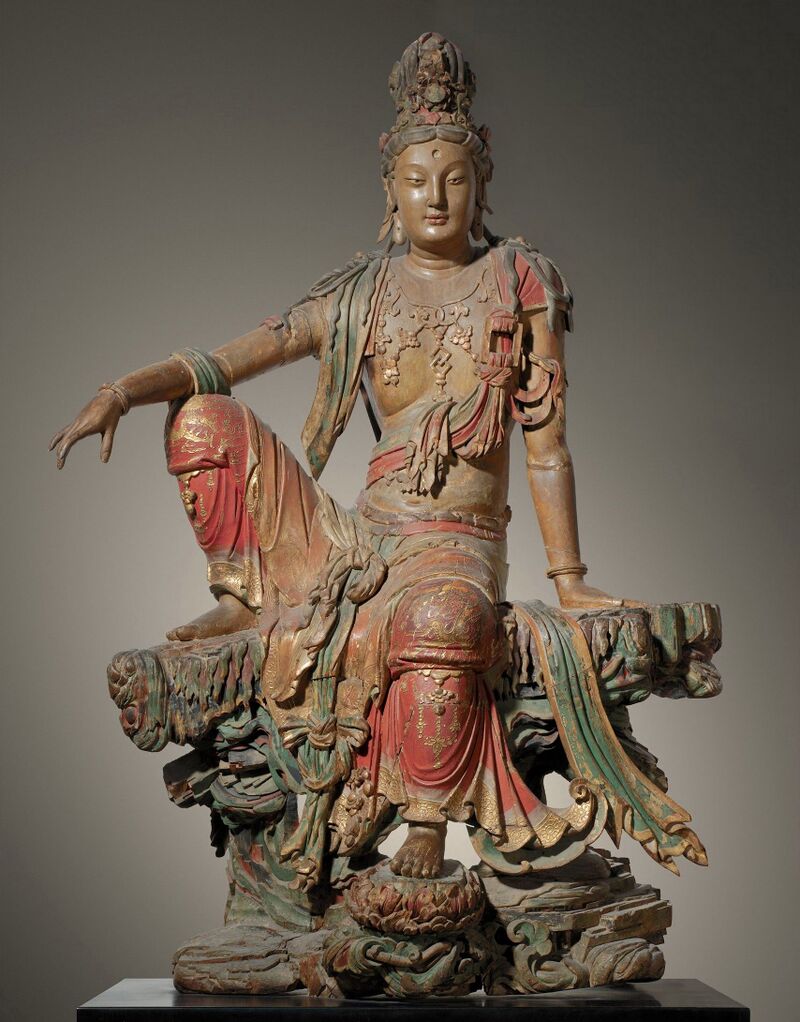
The bodhisattva vow is a personal commitment to the altruistic ideal of bodhicitta. It involves wholeheartedly giving rise to and maintaining a benevolent attitude that wishes to free all beings from suffering and help them along the path to enlightenment, as well as the responsibilities associated with dedicating this, and all future lives, to attaining buddhahood for the sake of oneself and others. The vow is traditionally bestowed in a formal ceremony that typically involves a qualified preceptor, one who has themself received the vow and maintained it accordingly, and a suitable recipient, an individual or group that is intent upon following the bodhisattva path and has prepared themselves to take up this commitment.
vow of individual liberation
The bodhisattva vow is essentially a type of precept, comparable to the sets of monastic and lay precepts found in the vinaya that are concerned with the regulation of behavior and adherence to well-defined codes of conduct. However, unlike those vows, which are correlated with individual liberation (prātimokṣa) and tend to restrict outward behavior, the bodhisattva precepts are more focused on inward motivation. In the Mahāyāna traditions, it is common for both types of vows to be observed, though they are typically presented as hierarchical, in that the vows of individual liberation are superseded by, or in some cases subsumed within, the bodhisattva vows. As Professor Dorji Wangchuk puts it,
Therefore, another way to view these two, is that the first level of precepts is primarily concerned with the avoidance of harm to others and the subsequent detrimental effects of nonvirtuous actions for oneself, while the second level of vows is primarily concerned with the performance of virtuous deeds for the benefit of others and the associated accumulation of merit (puṇya) for oneself.
The difference between the observance of these two types of vows is illustrated in the classical story of a monk who is sitting alone in the forest when a deer happens to run past him while escaping from a hunter. When the hunter in pursuit of the deer comes upon the monk, he asks him which way the deer went. If the monk were to strictly follow the monastic precepts, which prohibit lying, he would be obligated to point the hunter in the correct direction of the deer. However, if that same monk was also a bodhisattva that had vowed to benefit all beings, then he would be obligated to lie to the hunter and send him off in the wrong direction in order to protect the life of the deer.
Furthermore, taking the bodhisattva vow can also be treated as a contemplative practice. In fact, it is for the most part compulsory in the Tibetan traditions to begin any formal liturgical practice by going for refuge and arousing bodhicitta, not to mention instances where a practitioner might be required to focus solely upon generating this mind for extended periods, such as in the accumulation of the preliminary practices (sngon 'gro). Although, these instances are, by and large, regarded as arousing or generating the mind (cittotpāda or sems bskyed pa), there is also the practice of repeatedly taking the actual vow (saṃvara). John Strong explains this shift from the initial generation of bodhicitta to the disciplined maintenance of bodhicitta, stating,
For a detailed explanation of the intricacies of the ceremonial procedures for taking the vow in the Indo-Tibetan tradition, see The Bestowal of the Bodhisattva Vow in the Middle Way and the Mind Only Traditions.
