- [[<span class="smw-highlighter" data-type="4" data-state="inline" data-title="Warning" title="Some use of "|]]
- "
- In your query was not closed by a matching "
- "
- [[.">Some use of "" in your query was not closed by a matching "".|]]
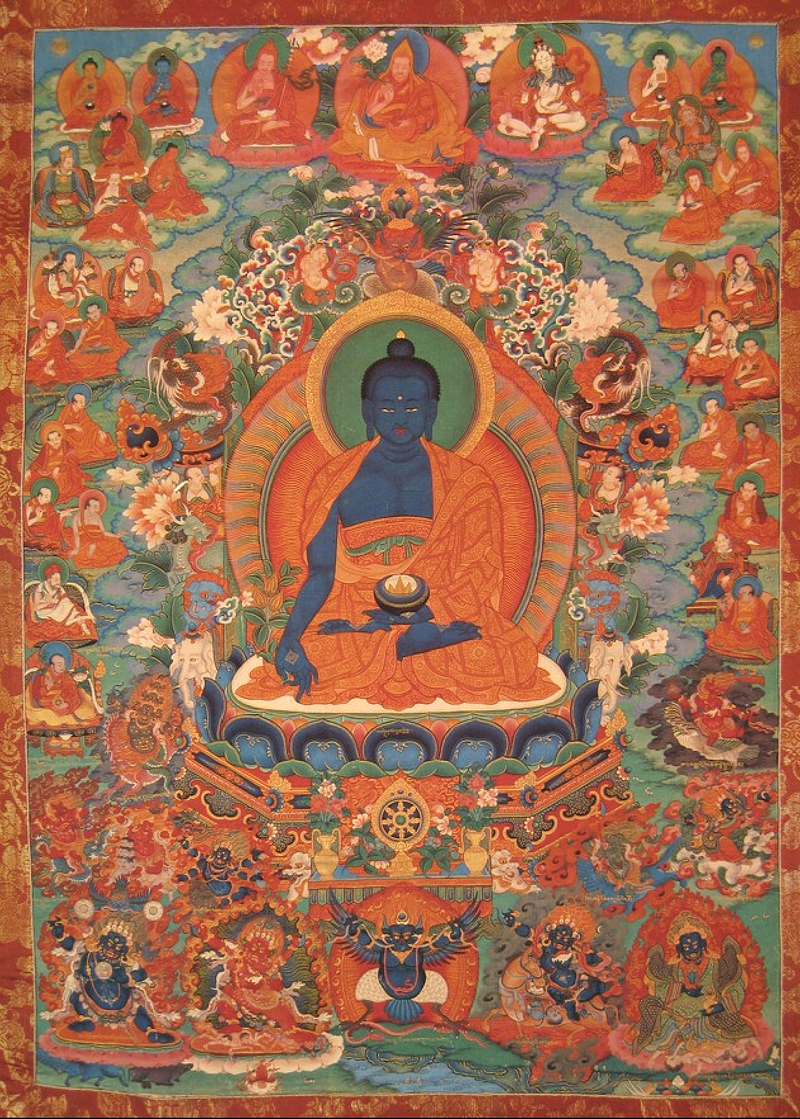
These tales which draw upon verses from chapter 3 of the Bodhicaryāvatāra illustrate the bodhisattva's complete selflessness and dedication to helping others. In "Medicine for the Suffering," a divine being transforms into a creature whose flesh heals all disease without diminishing. In "Generosity in the Face of Famine," King Great Power becomes a massive fish to feed starving people. "The Generosity of King Moonlight" portrays a king who sacrifices his own head to perfect the practice of generosity. "Becoming a Ship and a Bridge" features the nāga king Elāpatra, whose story demonstrates karmic consequences and the long path to liberation. Together, these narratives exemplify the bodhisattva ideal of offering one's body, possessions, and virtue for others' benefit without reservation.
The stories presented here were translated by Gregory Forgues and Khenpo Könchok Tamphel.
Medicine for the Suffering
For all those ailing in the world, Until their every sickness has been healed, May I myself become for them The doctor, nurse, the medicine itself.
Page(s) 48
Blankleder, Helena, and Wulstan Fletcher (Padmakara Translation Group), trans. The Way of the Bodhisattva: A Translation of the Bodhicharyāvatāra. By Śāntideva. Rev. ed. Shambhala Classics. Boston: Shambhala Publications, 2006.
འགྲོ་[p.20]Byang chub sems dpa'i spyod pa la 'jug pa rtsa ba dang 'grel pa (1990)
Slob dpon zhi ba lha and Mkhan po kun dpal. Byang chub sems dpa'i spyod pa la 'jug pa rtsa ba dang 'grel pa. Khreng tu'u: Si khron mi rigs dpe skrun khang, 1990. 
ནད་སོས་གྱུར་གྱི་བར་དུ་ནི། ། སྨན་དང་སྨན་པ་ཉིད་དག་དང་། །
དེ་ཡི་ནད་གཡོག་བྱེད་པར་ཤོག །gro [p.20]Byang chub sems dpa'i spyod pa la 'jug pa rtsa ba dang 'grel pa (1990)
Slob dpon zhi ba lha and Mkhan po kun dpal. Byang chub sems dpa'i spyod pa la 'jug pa rtsa ba dang 'grel pa. Khreng tu'u: Si khron mi rigs dpe skrun khang, 1990.
nad sos gyur gyi bar du ni/_/ sman dang sman pa nyid dag dang /_/
de yi nad g.yog byed par shog_/"For all those ailing in the world, Until their every sickness has been healed" means that those who are wise and pure in their intentions and conduct can even become medicine to heal the illnesses of others.
Once, in ancient times, throughout this realm of Jambudvīpa that stretches beneath the vast sky, there existed three hundred and thirty-six thousand cities, alongside countless towns, marketplaces, and remote hermitages—home to hundreds of millions of living beings.
During this period, a devastating epidemic swept across the land as an intermediate kalpa of great disease arose. Sentient beings were afflicted with myriad ailments: some suffered from skin eruptions, bodies covered with boils and festering wounds; others were tormented by disorders of wind, bile, and phlegm, including various types of severe illnesses. Despite the presence of many thousands of physicians throughout the land, they failed to cure these diseases. Stricken by illness, with no refuge or support, these afflicted beings cried out in desperation:
- Is there any god, nāga, gandharva, yakṣa, human, or nonhuman
Who can free us from these diseases?
To whoever delivers us from this misery,
We shall offer all our wealth entirely,
Follow their advice faithfully,
And fully repay their kindness.
At that time, Śākyamuni, who would later become the Blessed One, existed in the form of Indra, lord of the gods, known as Beautiful Eyes. With his divine vision, far surpassing that of humans, he beheld the multitudes of sentient beings afflicted with these numerous diseases. With his divine hearing, he heard their desperate cries echoing throughout the world. Great compassion arose in him for these beings, and he thought, "I shall become a refuge, a protector, and a support for these sentient beings who have no one to turn to."
With this aspiration, he took a miraculous birth as a creature called The Serene One near the great city of Kuru, at the heart of Jambudvīpa. Then, appearing in the sky above the suffering multitudes, he spoke these verses:
- Near the city of Kuru,
There lives a creature called The Serene One.
Whoever eats its flesh
Will be freed from disease.
Do not be afraid, do not be scared.
Take its flesh as you desire.
It harbors no anger, no resentment, no harmful thoughts. In this Jambudvīpa, it is medicine for all.
All the sick sentient beings in the villages, cities, towns, marketplaces, and hermitages heard these words and rushed to the great city of Kuru, where the creature Serene dwelled. They began cutting and taking flesh from Serene's body, yet remarkably, his flesh did not diminish. As they did so, Serene spoke this verse:
- By the truth through which I shall attain awakening,
And by the truth of my boundless wisdom,
May the flesh of my body here
Never be depleted at any time.
Thus, countless ailing sentient beings cut and took flesh from Serene's body, yet it neither diminished nor increased. No matter how many times they cut it, the flesh would regenerate. As soon as the sick consumed Serene's flesh, their ailments vanished instantly. They became healthy, joyful, and free from suffering. In time, all the people of Jambudvīpa were completely cured.
The men, women, boys, and girls of Jambudvīpa thought, "Serene has completely freed us from illness and restored our health. He has put an end to our suffering. Let us make an offering to him." They approached him and said:
- You are our refuge and reliance.
You are our physician and medicine.
Whatever offering we ought to make,
Please grant us your command.
Then, the creature Serene vanished and reappeared in his true form as Indra. Addressing the great assembly of people, he said:
- I have no need for wealth, food, or drink,
Gold, or the many kinds of grain.
Instead, may you all, in harmony,
Follow the path of the ten virtuous deeds.
For the benefit of all sentient beings,
Cultivate a firm aspiration for awakening.
Nurture a heart of loving-kindness for one another,
That is the only intention that is beneficial.
The sentient beings were overjoyed and wholeheartedly embraced the path of virtuous deeds. From that time onward, not a single person in Jambudvīpa harbored thoughts tainted by wrong views. Upon their deaths, they were reborn with the same good fortune as those in the realm of the Thirty-Three Gods.
Some among them awakened bodhicitta after hearing the Dharma teachings of Indra, the lord of gods. Others purified the eye of Dharma regarding phenomena, becoming entirely free from dust and stains.
As stated in the sūtra regarding this tale: "O Peaceful Intelligence, this is the secret of the bodhisattva's body—an embodiment of the complete purification of bodily actions. Thus, countless sentient beings were fully ripened, even through the offering of a single body."
Generosity in the Face of Famine
Raining down a flood of food and drink, May I dispel the ills of thirst and famine. And in the aeons marked by scarcity and want,49A reference to the antarakalpa, an age of extreme decline figuring in the ancient Indian conception of temporal sequences, in which the quality of human life is gradually reduced until the age of ten years marks the summit of growth and capacity. It is a time of extreme instability and famine. May I myself appear as drink and sustenance.
Page(s) 48
Blankleder, Helena, and Wulstan Fletcher (Padmakara Translation Group), trans. The Way of the Bodhisattva: A Translation of the Bodhicharyāvatāra. By Śāntideva. Rev. ed. Shambhala Classics. Boston: Shambhala Publications, 2006.
The statement "Raining down a flood of food and drink . . ." refers to how a bodhisattva benefits others through both intention and action.
In the past, a terrible famine arose among sentient beings. In a land called Bri To, there lived a bodhisattva king named Great Power who possessed immense wealth. For many years, he provided food and drink to sustain countless beings.
Eventually, when his stores of grain were completely exhausted, the king thought, "Since I have no other resources left, I shall take rebirth as a great fish and benefit sentient beings by offering my flesh as sustenance." He climbed a towering tree on the shore of the ocean and made this solemn aspiration: "If the Dharma of cause and effect is true, and my intention is pure, may I be reborn as a great fish to nourish suffering beings!" With this declaration, he leaped into the ocean.
Through the power of his pure intention, he was reborn as a fish called Rohita, with a body spanning five hundred yojanas.[1] He remained near the ocean shore. One day, some townspeople gathering wood spotted him and were overcome with fear and terror. But the fish spoke to them in a human voice: "Do not be afraid! I am King Great Power. I once provided food and drink to impoverished sentient beings, but when those resources were depleted, I took rebirth as this fish. Eat my flesh, and share it with others also."
Hearing this, the people were overjoyed. They not only ate the fish's flesh themselves but also distributed it widely. They loaded it onto horses, mules, and other pack animals, ensuring that many others could partake. In this way, people were freed from the suffering of famine.
The Generosity of King Moonlight
My body, thus, and all my goods besides, And all my merits gained and to be gained, I give them all and do not count the cost, To bring about the benefit of beings.
Page(s) 48
Blankleder, Helena, and Wulstan Fletcher (Padmakara Translation Group), trans. The Way of the Bodhisattva: A Translation of the Bodhicharyāvatāra. By Śāntideva. Rev. ed. Shambhala Classics. Boston: Shambhala Publications, 2006.
ལུས་དང་དེ་བཞིན་ལོངས་སྤྱོད་དང་། །
དུས་གསུམ་དགེ་བ་ཐམས་ཅད་ཀྱང་། ། སེམས་ཅན་ཀུན་གྱི་དོན་སྒྲུབ་ཕྱིར། །
ཕངས་* ཕོངས in the source text. པ་མེད་པར་བཏང་བར་བྱ། །lus dang de bzhin longs spyod dang /_/
dus gsum dge ba thams cad kyang /_/ sems can kun gyi don bsgrub phyir/_/
phangs * phongs[ in the source text.] pa med par btang bar bya/_/The statement "My body, thus, and all my goods besides . . ." refers to how one who has generated the awakening mind should give everything to others.
In the past, in this Jambudvīpa, there was a king named Moonlight who ruled over five continents, controlled eighty-four thousand minor kings, and governed eighty thousand cities across sixty thousand regions. This king had sixty thousand queens and five hundred royal sons. His palace, named Perfect Livelihood, was constructed of precious materials. His power and enjoyment were immeasurable.
King Moonlight was a bodhisattva who gave whatever the people of Jambudvīpa desired, establishing them in happiness and well-being. His qualities were renowned throughout the land.
At that time, in a remote border region, there was a king named Bimasena who thought, "If King Moonlight does not die, I will never have the opportunity to become supreme. What should I do?" With such jealous thoughts, he summoned all his retinue and subjects and said, "This King Moonlight possesses all qualities and is respected by all, but I am not so renowned. How can I eliminate him? Let us discuss this matter."
Upon hearing this command, his subjects replied, "This king cares for all sentient beings as a mother loves her only child. He is like a father and mother to all. Even if we were to die, we could not harm him." Saying this, they dispersed.
The king grew increasingly displeased and summoned a wrathful and cruel brahmin named Leudewa. The brahmin said, "O King, I will do whatever you command."
The king ordered, "Since King Moonlight makes offerings without attachment, ask him for his head. If you obtain his head, I will give you my daughter and half of my kingdom."
As the brahmin set out on his journey, various inauspicious omens occurred in King Moonlight's kingdom, such as the breaking of a precious victory banner. When the brahmin arrived at the palace gate, the gatekeeper, recognizing the brahmin's evil intentions, refused to let him enter.
At that time, King Moonlight had a dream of a brahmin asking for his head. The brahmin was unable to enter, but in the dream he said, "If you don't give me your head, your practice of generosity would not be perfected."
The king ordered his minister Great Moon, "Let anyone who comes to the palace gate enter."
The gatekeeper replied, "This man, with evil intentions, is asking for the king's head. I did not let him in. What shall we do?"
The minister offered the brahmin many heads made of gold and silver as substitutes for the king's head, but he declined them, saying, "I do not need these. I want the king's head."
The minister then offered many heads made of the seven precious jewels, but the brahmin still refused. Thinking, "If I let this person see the king, he will surely give his head. It would be better for me to die than to live after the king has died," the minister was overcome with grief and died.
The brahmin proceeded further inside, but other guards blocked his path. He called out loudly, "I have come from afar to ask for the king's head. Please grant me his head!" The king heard this and said, "Let him come before me," summoning him.
When the brahmin arrived, the king asked, "What do you desire?" He replied, "I need nothing else. I request the king's head." The king said, "I will give it in seven days."
Then a great announcement was made: "In seven days, King Moonlight will make a grand act of generosity."
The great assembly of retinue was overcome with grief and they asked the king, "O king, due to the connection of past karma, are you not thinking of us and instead fulfilling the wish of a brahmin?"
The king replied, "From beginningless samsara, I have taken countless bodies. If the bones were piled up, they would be higher than Mount Meru, and my blood would exceed the ocean. If one is reborn in the states without leisure, there is no opportunity for virtue. Now, while I have control over this body, I will give it without wasting it. So, I ask you not to hinder my virtue." Upon hearing this, the entire retinue was overcome with grief and fainted.
After seven days had passed, the king said to the brahmin, "Now the time has come to ask for my head, so take it."
The brahmin replied, "In the midst of the king's many attendants, I have no way to cut off your head. Let us go to the pleasure grove outside."
Then the king told his retinue, "If you care for me and grieve for me, do not harm this brahmin, as that would waste my virtue," and he left with the brahmin for the pleasure grove.
The brahmin said, "King, if you cannot endure the pain, you may regret it. Therefore, I shall tie your head to a tree and take your life."
The king tied his head to a tree with branches covering everything and said, "Cut off my head and place it in my hand, and take it."
Saying this, the king prayed: "By giving my head to this brahmin, may I attain the supreme state of awakening and establish many beings in the happiness of transcending sorrow."
Then, as the brahmin brandished his sword, the tree goddess, knowing that this was inappropriate, slapped the brahmin, and he fainted.
The king commanded the tree goddess, "In my previous lives as well, I have given nine hundred and ninety-nine heads at the foot of this tree. At this moment, I am once again perfecting my generosity, so do not hinder me."
The goddess revived the brahmin. Then, as the brahmin cut off the king's head, the earth shook violently, and the gods praised the king. At that moment, as King Bimasena went to the city, he heard the news that King Moonlight had given his head, thus completing the perfection of generosity. Thus, his wish of being the greatest king remained unfulfilled, and he died in a state of despondency.
As the brahmin went on his way back, the head rotted and decayed, and he discarded it in the sand. When he heard the news of King Bimasena's death, his heart burst and he died. It is said that he was born thereafter in the Avīci Hell.
Becoming a Ship and a Bridge
May I be a guard for those who are protectorless, A guide for those who journey on the road. For those who wish to cross the water, May I be a boat, a raft, a bridge.
Page(s) 49
Blankleder, Helena, and Wulstan Fletcher (Padmakara Translation Group), trans. The Way of the Bodhisattva: A Translation of the Bodhicharyāvatāra. By Śāntideva. Rev. ed. Shambhala Classics. Boston: Shambhala Publications, 2006.
བདག་ནི་མགོན་མེད་རྣམས་ཀྱི་མགོན། །
ལམ་ཞུགས་རྣམས་ཀྱི་དེད་དཔོན་དང་། ། བརྒལ་འདོད་རྣམས་ཀྱི་གྲུ་དང་ནི། །
གཟིངས་དང་ཟམ་པ་ཉིད་དུ་གྱུར། །bdag ni mgon med rnams kyi mgon/_/
lam zhugs rnams kyi ded dpon dang /_/ brgal 'dod rnams kyi gru dang ni/_/
gzings dang zam pa nyid du gyur/_/The statement "May I be a boat, a raft, a bridge . . ." refers to how a bodhisattva, through pure intention and action, serves the needs of others by becoming whatever they require. Just as a ship carries travelers across water and a bridge provides safe passage over dangerous terrain, the bodhisattva adapts to fulfill the varied needs of sentient beings.
This principle is illustrated in the tale of the nāga king Elāpatra.[2]
In the celestial realm of Tuṣita, the following questions were spoken by the Buddha:
- Which lordly king indeed,
When attached, doesn’t possess defilement?
If he has no defilement, he would be free from defilement.
In this case, for what reason is he [still] called "attached"?
How does the fool grieve?
How does the wise one rejoice?
Having been freed from possessing what,
Is one here called "accomplished" and "blissful"?
This was written down. At a time when the Buddha, the Bhagavān, had not appeared in the world, no one was able even to grasp [these questions], nor was anyone able to explain their meaning.
After some time, the yakṣa lord Vaiśravaṇa went into the Tuṣita god realm for some purpose, and he saw those questions that had been asked. Then, filled with wonder, he grasped them but was unable to comprehend their meaning. Therefore, he took them to the palace Vaijayanta and wrote them on a slate and kept them there. At that time, in a place called Stone-Placement, resided the nāga king named Elāpatra. For a long time, he had aspired with the thought, "When will I see the Buddha, the Bhagavān?" A friend of his, a yakṣa named Suvarṇaprabhāsa, went to the palace Chang lo chen of the yakṣa lord Vaiśravaṇa for some purpose. He saw those questions written on the slate. He took them, memorized them, and attempted to analyze them, but he could not comprehend their meaning. He then took them to Stone-Placement and gave them to the nāga king Elāpatra, saying:
- Friend, these questions were spoken by the Buddha, but no one understands their meaning. Take these and a hundred thousand gold [coins], travel around villages, market towns, and around royal capitals, and proclaim the following: "Whoever can explain the meaning of these questions, to them I shall give these hundred thousand gold [coins] and also pay great homage and service!" If someone is able to explain, give them the hundred thousand gold [coins]. If they are unable, announce, "This is no [true] village! This is no [true] market town!" and go elsewhere.
[Elāpatra] took them and memorized them completely. He manifested himself in the form of a brahmin youth, took the hundred thousand gold [coins], and traveled around villages, market towns, and royal capitals, eventually arriving in Varanasi. There, on the main roads, side streets, crossroads, and junctions of Varanasi, he announced: "Listen, O assembly of wise people dwelling in the city of Varanasi and people coming from various regions! I have come bearing these questions. Whoever is able to explain their meaning, to them I shall give these hundred thousand gold [coins] and also pay great homage and service!"
Upon hearing this, many hundreds of thousands of beings assembled, some proud of their wisdom, and others, filled with wonder, but no one was able to explain the meaning. When he began to proclaim, "This is no [true] city! This is no [true] market town!" the brahmins and householders residing in Varanasi said: "Do not yet proclaim 'This is no [true] village! This is no [true] market town!' Let the śramaṇas and brahmins dwelling in forest hermitages, who are certainly revered by our people, come here. Afterward, you may proclaim 'This is no [true] city! This is no [true] market town!'"
He asked, "Who are they?"
"[They are] Nārada and others."
He replied, "Excellent, I shall do so."
He waited, and after some time, Nārada arrived. He sat before him and said: "Great sage, I have come bearing these questions. Whoever is able to explain their meaning, to them I shall give these hundred thousand gold [coins] and also pay great homage and service."
Nārada read them and said: "Young brahmin, excellent. I shall indeed explain them."
[Elāpatra]: "After how long?"
[Nārada]: "[After] twelve years have passed."
[The young brahmin]: "Great sage, that is [too long]!"
[Nārada]: "[After] six [years] then."
[The young brahmin]: "That is also [too long!]"
[Nārada]: "After three [years then]."
[Elāpatra]: "That is too long!"
[Nārada]: "After one [year then]."
[Elāpatra]: "That is too long!"
[Nārada]: "After six [months then]."
[Elāpatra]: "That is too long!"
[Nārada]: "After three [months]."
[Elāpatra]: "That is too long!"
[Nārada]: "After one [month then]."
[Elāpatra]: "That is too long!"
[Nārada]: "After half a month [then]."
[Elāpatra]: "That is too long!"
[Nārada]: "After seven days have passed then."
Elāpatra said: "Great sage, excellent, please do so! I shall wait until then." He waited.
The best friends of the sage Nārada were the group of five bhikṣus.[3] So, he went to them and said: "Learned Ones, a young brahmin has come to me bearing these questions and a hundred thousand gold [coins], saying, 'Whoever can explain the meaning of these questions, to them I shall give these hundred thousand gold [coins] and also pay great homage and service.' The meaning of these questions is vast, but the words are few, making them difficult to comprehend. How should this be accomplished?"
They replied: "Nārada, go and ask the Buddha, the Bhagavān!"
"Learned Ones, has the Buddha, the Bhagavān, appeared in the world?" [Nārada asked].
"He has appeared," [the Learned Ones replied.]
"Where does he reside?" [Nārada asked.]
"In the Deer Park [Mṛgadāva] at Ṛṣipatana."[4]
Filled with joy and delight, Nārada swiftly went to where the Bhagavān was. He saw the Buddha, the Bhagavān, adorned with the thirty-two marks of a great being, beautified by the eighty minor marks, adorned with an aura extending one fathom, possessing a radiance greater than a thousand suns, like a moving mountain of jewels, excellent in every way. The bliss he experienced upon seeing the Buddha for the first time—with a mind enriched by roots of virtue—surpassed the bliss of someone who has practiced the mental state of śamatha for twelve years, or of a childless person finding a child, a poor person discovering treasure, or one delighting in kingship being consecrated to royal power.
Having seen him, he went to where the Bhagavān was. Arriving, he bowed his head to the Bhagavān's feet and sat to one side. As he sat to one side, the Bhagavān, comprehending his thoughts, latent tendencies, disposition, and intrinsic nature, delivered a Dharma teaching of such a nature that he would realize the four noble truths. Hearing this, the sage Nārada destroyed the high peaks of the twenty mountains of views of the transitory collections with the vajra of wisdom and directly realized the result of stream-enterer.
Having seen the [four] truths, he bowed at the [Buddha's] feet and supplicated: "Venerable Sir, if I might become a monk into the well-proclaimed Dharma-Vinaya and the full ordination, the state of a bhikṣu, I wish to practice the pure conduct in the presence of the Bhagavān."
The Bhagavān proclaimed: "Nārada, you made a vow to that young brahmin to explain the meaning of the questions. Therefore, go and first fulfill that prior vow. Afterward, become a monk."
He supplicated: "Venerable Sir, although I have obtained such a collection of qualities, I am nevertheless incapable of explaining the meaning of those questions. Having gone there, what shall I do?"
The Bhagavān proclaimed: "Nārada, go! Having gone, say this: 'Recite those questions now!' When he says:
- Which lordly king indeed,
When attached, doesn’t possess defilement?
If he has no defilement, he would be free from defilement.
In this case, for what reason is he [still] called "attached"?
How does the fool grieve?
How does the wise one rejoice?
Having been freed from possessing what,
Is one here called 'accomplished' and 'blissful'?
"at that time, you should reply thus:
- The sixth Lord King, indeed,
When attached, he possesses defilement.
When without defilement, he becomes free from defilement.
The childish one is here called 'attached.'
Thus does the fool grieve.
Thus does the wise one rejoice.
Having been freed from possessing this [dust],
One here is called 'accomplished' and 'blissful.'
"If he says, 'I cannot get what you are indicating!' then reply:
- Understanding the well-spoken is precious;
Understanding hearing and concentration are precious.
For a person who is agitated [and] heedless,
Cannot understand, and for them, hearing is of little benefit.
"If he says,
- Though you speak the Buddha's words,
The marks [of Buddhahood] are not visible on you.
Regarding this, as my mind is confused;
Quickly dispel my doubt!
—then, cut a blade of grass with your fingernail in front of him."
[The Buddha continued:] "If he asks, 'Has the Buddha, the Bhagavān, appeared in the world?' say, 'He has appeared.' If he asks, 'Where does he reside?' say, 'In the Deer Park at Ṛṣipatana.'"
Saying, "Venerable Sir, I shall do as you say," the noble son Nārada went to where the brahmin youth was after listening to the Bhagavān. When he arrived there, he spoke to the young brahmin: "Brahmin youth, recite those questions now!"
He recited the verses:
- Which lordly king indeed,
When attached, doesn’t possess defilement?
If he has no defilement, he would be free from defilement.
In this case, for what reason is he [still] called "attached"?
How does the fool grieve?
How does the wise one rejoice?
Having been freed from possessing what,
Is one here called "accomplished" and "blissful"?
[Nārada] replied:
- The sixth Lord King, indeed,
When attached, he possesses defilement.
When without defilement, he becomes free from defilement.
The childish one is here called "attached."
Thus does the fool grieve.
Thus does the wise one rejoice.
Having been freed from possessing this [dust],
One here is called "accomplished" and "blissful."
[Nārada] replied:
- Understanding the well-spoken is precious;
Hearing and concentration–understanding [these] is precious.
For a person who is agitated [and] heedless,
[Being] unknowing, hearing is of little benefit to them.
The young brahmin said:
- Nārada! Though you speak the Buddha's words,
The marks do not appear on you.
Regarding this, my mind is confused;
Quickly dispel my doubt!
Nārada cut a blade of grass with his fingernail in front of him.
[The youth] asked: "Nārada, has the Buddha, the Bhagavān, appeared in the world?"
[Nārada] replied: "Brahmin youth, he has appeared."
"Where does he reside?"
"Right here in the region of Varanasi."
"In which direction?"
"In the Deer Park at Ṛṣipatana."
The young brahmin thought:
- If I reveal my own kind to him, he will disdain me. However, if I go solely in the guise of a young brahmin, some of the brahmins in Varanasi endowed with the three knowledges,[5] or some brahmin youths born of high lineage, will become faithless, saying, "They went to the śramaṇa Gautama!" If I go in my own form, I have enmity with many nāgas, and some might come to harm me. Therefore, I shall manifest myself as a cakravartin (universal monarch) and go into the presence of the Bhagavān.
Then, the nāga king Elāpatra manifested himself as a cakravartin king. He was led by the seven precious emblems; surrounded by ninety-nine myriad divisions of troops; encircled by a thousand sons adorned with various precious ornaments, like the waxing moon; followed behind by a thousand supreme humans along with various non-Buddhists, śramaṇas, brahmins, the destitute, and the needy. A parasol with a thousand spokes was held above him, and illuminated by the light of a thousand suns, he outshone even the radiance of the celestial palaces adorned with the moon, constellations, and planets. Outshining [all], he went toward Ṛṣipatana.
At that time, the Bhagavān was seated before many hundreds of assemblies, teaching the Dharma. Those assemblies saw the nāga king Elāpatra from afar. Having seen him, they were amazed, their eyes widened, and various thoughts arose. Some said: "Venerable Sirs, where has this king come from?" Others replied: "Venerable Sirs, one who possesses such perfect magnificent resources is no [ordinary] king; who is this sovereign of the earth?" Still others said: "This is no king; it is Indra, king of the gods, coming here to see the Bhagavān."
Then, those who were overcome by attachment, upon seeing him, generated attachment, [thinking,] "When might I too become like this?" As they were speculating in these many ways, the nāga king Elāpatra went to where the Bhagavān was, arrived, bowed his head to the Bhagavān's feet, and sat to one side.
As he sat to one side, the Bhagavān proclaimed this to the nāga king Elāpatra: "Foolish being! Having transgressed the boundaries of the precepts [laid down by] Perfectly Enlightened Buddha Kāśyapa, you were born into the inferior existence of a nāga. Now, do you wish to deceive my assembly as well? Go! Discard the manifestation and come in your own form!"
He supplicated: "Venerable Sir, I have enmity with many nāgas; some may come to harm me."
Then the Bhagavān proclaimed to Vajrapāṇi: "Vajrapāṇi, go and protect the nāga king Elāpatra!"
"Venerable Sir, it shall be so." Vajrapāṇi listened to the Bhagavān accordingly, took upon himself the protection of the nāga king Elāpatra, and followed behind him.
Then, the nāga king Elāpatra departed from the Bhagavān's presence and manifested his own natural form. His tail remained at Stone-Placement, while his seven heads were in Varanasi. On each head grew an elā tree, established by the maturation of past karma, completely filled with many hundreds of species of worms. Swarms of flies buzzed and descended. The stench of pus and blood, pungent and intensely foul, dripped down.
Then, having transformed his body into such a state that beings averted their eyes upon seeing it, he went to where the Bhagavān was, arrived, bowed his head to the Bhagavān's feet, and sat to one side. When those assemblies saw the body of the nāga king Elāpatra—repulsive, extremely fearsome, causing fear, not free from desire, causing fear, sorrow, and distress, large, cracked, rough, dull, possessing many variations in color and shape—they saw it. Having seen it, terrified, they supplicated the Bhagavān thus: "Bhagavān! Who is this extremely fearsome being who has arrived before the Bhagavān?"
The Bhagavān proclaimed: "Bhikṣus, this is the one who came into my presence bearing the guise of a cakravartin, regarding whom you, desiring the distinctions of worldly existence, generated attachment. This current body of his is his natural form, manifestly produced by the fault of unwholesome karma with attachment. The earlier one was a manifestation."
Hearing that karma is not wasted, they became mentally distressed and remained silent.
Then, the nāga king Elāpatra supplicated the Bhagavān thus: "Bhagavān, grant me a prophecy! Sugata, grant me a prophecy!"
The Bhagavān proclaimed: "King of Nāgas, when the lifespan of humans becomes eighty thousand years, when humans live for eighty thousand years, the teacher named Maitreya, the Tathāgata, the Arhat, the Teacher of Gods and Humans, the Buddha, the Bhagavān, will appear in the world. He will give you the prophecy."
Then, the nāga king Elāpatra bowed his head to the Bhagavān's feet and vanished from that very spot.
The bhikṣus, having developed doubt, questioned the Buddha Bhagavān, the dispeller of all doubts: "Venerable Sir, what karma did the nāga king Elāpatra perform such that by the maturation of that karma, he was born into the inferior existence of a nāga and experienced suffering such that an elā tree grew on his head, completely filled with many hundreds of species of worms, swarms of flies buzzed and descended, and the pungent, intensely foul stench of pus and blood dripped down?"
The Bhagavān proclaimed:
- Bhikṣus, the karma performed and accumulated by the nāga king Elāpatra, for which the potential was obtained, the conditions fully formed, and which was present like ripening pus, inevitably arose. Who else but the nāga king Elāpatra would experience the karma performed and accumulated by the nāga king Elāpatra? Bhikṣus, karma performed and accumulated does not mature in the external earth element, not in the water element, not in the fire element, not in the wind element. Rather, virtuous and unvirtuous karma performed matures exclusively upon the appropriated aggregates, elements, and sense bases.
- Even through hundreds of eons,
Karmas are never wasted.
When the assembly [of conditions] and time converge,
They ripen as results for embodied beings.
- Even through hundreds of eons,
- Bhikṣus, formerly, during this very auspicious eon, when the lifespan of beings was twenty thousand years, the teacher named Kāśyapa, endowed with knowledge and conduct, Sugata, Knower of the World, Unsurpassed Guide for Taming Beings, Teacher of Gods and Humans, Buddha, Bhagavān, appeared in the world. He resided and stayed in the Deer Park at Ṛṣipatana in the city of Varanasi.
- In his dispensation, this [being who would in another life become Elāpatra] went forth and became a renunciant endowed with the Three Piṭakas. In a secluded place, near an elā tree, he established a walking path. As he was walking there, a leaf from the elā tree struck his forehead. He resented it. Some time later, fatigued by the exertion of meditative cultivation, while walking, its leaf struck his forehead again. Angered at it, he cut it down, broke it into pieces with both hands, threw them away, and said this: "What fault did the Bhagavān Kāśyapa see in this, which has no life, no vital principle, that he established it as a basis of training?"
- Because he, angered, broke the precepts, upon the breakup of his body, he was born amongst the nāgas. An elā tree grew on his head, filled with hundreds of species of worms, swarms of flies buzzed and descended, and the pungent, intensely foul stench of pus and blood dripped down.
- Bhikṣus, what do you think? That renunciant Tripiṭaka-master bhikṣu of that time, that period, was none other than this nāga king Elāpatra. Because he, having gone forth in the dispensation of Perfectly Enlightened Buddha Kāśyapa, became extremely angry and broke the training precept, by the maturation of that karma, he was born amongst the nāgas. An elā tree grew on his head, completely filled with hundreds of species of worms, swarms of flies buzzed and descended, and the pungent, intensely foul stench of pus and blood dripped down.
- Bhikṣus, thus, the maturation of exclusively unwholesome karma is exclusively unwholesome. That of exclusively wholesome karma is exclusively wholesome. That of mixed [karma] is also mixed. Therefore, bhikṣus, having abandoned exclusively unwholesome and mixed karma, you should strive only in exclusively wholesome karma. Bhikṣus, you should train thus!
When the Bhagavān had spoken thus, those bhikṣus rejoiced and highly praised what the Bhagavān had said.
Notes
- ↑ "Five hundred yojanas" refers to an ancient Indian unit of measurement, with one yojana being equivalent to about 8–9 miles, highlighting the enormous size of the fish and thus the scale of the bodhisattva's generosity.
- ↑ This story is found in the Vinayakṣudrakavastu ('Dul ba phran tshegs kyi gzhi), in Derge Kangyur D6, 'dul ba, vol. 10-11, bampos 24–25, BDRC: MW22084. http://purl.bdrc.io/resource/MW22084_0006.
- ↑ dge slong lnga po - the Buddha's first disciples.
- ↑ Place where sages spoke (Drang srong smra ba kyi nags).
- ↑ The three knowledges represent the Buddha's complete understanding of all temporal dimensions. The first is knowledge of past limits (atītāṃsakauśalya): This refers to the direct insight into all previous existences—not only of oneself but of all beings. This arises in the mental continuum of one who has transcended ordinary learning (aśaikṣa). It's not mere recollection but comprehensive wisdom concerning the entire fabric of past causes and conditions. The second is knowledge of future limits (anāgatāṃsakauśalya): This wisdom comprehends the future destiny of all beings, operating through the extraordinary ability to perceive death and rebirth patterns. It reveals the causal trajectories that determine future manifestations throughout samsara. The third is knowledge of present limits (pratyutpannāṃsakauśalya): This wisdom directly perceives the complete cessation of all afflictive obscurations. It encompasses perfect understanding of present phenomena and their true nature. These three knowledges function to dispel ignorance regarding all temporal dimensions. They are called "nonlearner knowledges" (aśaikṣajñāna) because they manifest fully only in those who have completed the path. While the third knowledge constitutes the essential nonlearner wisdom, the first two are designated as such because they arise within the mindstream of one who has transcended the learning stage.

