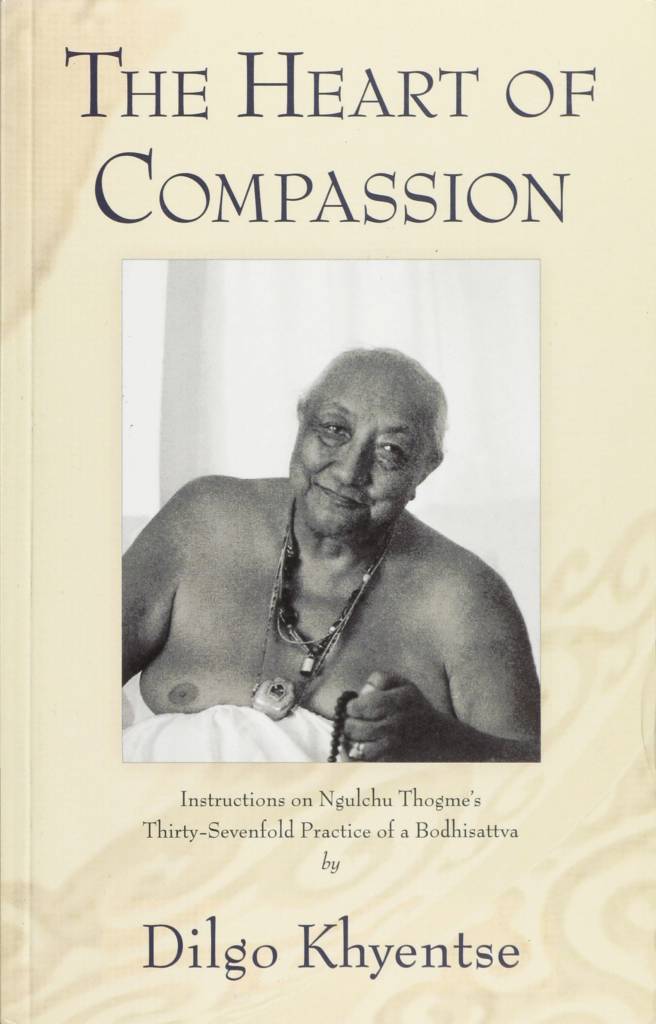
The Heart of Compassion: Instructions on Ngulchu Thogme's Thirty-Sevenfold Practice of a Bodhisattva

From Bodhicitta
LibraryBooksThe Heart of Compassion: Instructions on Ngulchu Thogme's Thirty-Sevenfold Practice of a BodhisattvaBilingual
< Books
(Redirected from The Heart of Compassion (Ricard 2006))
Books/The Heart of Compassion (Ricard 2006)

The Heart of Compassion: Instructions on Ngulchu Thogme's Thirty-Sevenfold Practice of a Bodhisattva
Book


Please note that many items in our library are simply pages that represent a detailed library catalog entry and citation of someone else's work, presentation, or performance. Read our General Disclaimer for more information. You can find more information about this item on the publisher website.
The Heart of Compassion-front.jpg

Description

What would be the practical implications of caring more about others than about yourself? This is the radical theme of this extraordinary set of instructions, a training manual composed in the fourteenth century by the Buddhist hermit Ngulchu Thogme, here explained in detail by one of the great Tibetan Buddhist masters of the twentieth century, Dilgo Khyentse. In the Mahayana tradition, those who have the courage to undertake the profound change of attitude required to develop true compassion are called bodhisattvas. Their great resolve—to consider others’ needs as paramount, and thus to attain enlightenment for the sake of all living creatures—carries them beyond the limits imposed by the illusions of “I” and “mine,” culminating in the direct realization of reality, transcending dualistic notions of self and other. This classic text presents ways that we can work with our own hearts and minds, starting wherever we find ourselves now, to unravel our small-minded preoccupations and discover our own potential for compassion, love, and wisdom. Many generations of Buddhist practitioners have been inspired by these teachings, and the great masters of all traditions have written numerous commentaries. Dilgo Khyentse’s commentary is probably his most extensive recorded teaching on Mahayana practice. (Source: Shambhala Publications)
Citation
Ricard, Matthieu, and John Canti (Padmakara Translation Group), trans. and ed. The Heart of Compassion: Instructions on Ngulchu Thogme's Thirty-Sevenfold Practice of a Bodhisattva. By Dilgo Khyentse. New Delhi: Shechen Publications, 2006.
Publisher Link
Texts Translated
  1. Khyentse, Dilgo. Oral teachings.
  2. Thogs med bzang po. rgyal sras lag len so bdun ma. Tibetan text is included on pages 101-112. See in rgyal sras thogs med kyi bka' 'bum thor bu, 106-111. Thimphu: kun bzang stobs rgyal, 1975. Buda by BDRC Logo.jpg


Translation of

 
Rgyal sras lag len so bdun ma
Gyalse Tokme Zangpo's (1295 - 1369) highly influential work on Mind Training (blo sbyong) that outlines the training of a bodhisattva in a series of thirty-seven verses is still very popular today with Buddhist practitioners around the world. The colophon states: "This was composed at the Jewel Cave of Ngulchu by the monk Tokme [Zangpo], expounder of scripture and reasoning, for the benefit of myself and others." Since he gathered together all the paths of the bodhisattvas and composed them in the form of thirty-seven verses, the title is clearly fitting.
Text

Teaching based on

 
Rgyal sras lag len so bdun ma
Gyalse Tokme Zangpo's (1295 - 1369) highly influential work on Mind Training (blo sbyong) that outlines the training of a bodhisattva in a series of thirty-seven verses is still very popular today with Buddhist practitioners around the world. The colophon states: "This was composed at the Jewel Cave of Ngulchu by the monk Tokme [Zangpo], expounder of scripture and reasoning, for the benefit of myself and others." Since he gathered together all the paths of the bodhisattvas and composed them in the form of thirty-seven verses, the title is clearly fitting.
Text

Related

 
The Heroic Heart
This is a modern commentary on The Thirty-Seven Verses on the Practice of a Bodhisattva. Each chapter of this book opens with a verse from The Thirty-Seven Verses on the Practice of a Bodhisattva. The text relied upon here was translated from the Tibetan by the Padmakara Translation Group and previously published in The Heart of Compassion by Dilgo Khyentse Rinpoche. It is followed with commentary by Jetsunma Tenzin Palmo. (Source: Book Introduction)
Book


  • Translator's introduction9
  • Gyalse Ngulchu Thogme (1295-1369)11
  • The Root Text27
  • The Commentary37
  • Introduction39
  • Opening Verses44
    • Homage44
  • Part One: The Preparation51
    • First, the need to give meaning to this human existence of yours, so rare and difficult to obtain51
    • Second, an exhortation to abandon your native land, the source of the three poisons58
    • Third, a recommendation to live in solitary places, the source of all good qualities60
    • Fourth, to reflect on impermanence, in order to give up the concerns of this life63
    • Fifth, the need to avoid unsuitable friends, being with whom creates adverse circumstances68
    • Sixth, to rely on a spiritual teacher, whose presence creates conditions favorable to your progress69
    • Seventh, to go for refuge, the entrance to the Buddhist teachings72
  • Part Two: The Main Teachings, Illuminating The Path81
    • First, the path for beings of lesser capacity81
    • Second, the path for beings of medium capacity85
    • Third, the path for beings of superior capacity90
      • 1. The bodhicitta of intention90
      • 2. The bodhicitta of application97
        • I. Relative bodhicitta97
          • A. The meditation practice of exchanging oneself and others98
          • B. The post-meditation practice of using unfavorable circumstances on the path106
            • i. Using on the path the four things that you do not want to happen106
              • a. How to use loss on the path107
              • b. How to use suffering on the path109
              • c. How to use disgrace on the path111
              • d. How to use disparagement on the path112
            • ii. Using on the path the two things that are difficult to bear115
              • a. How to use on the path being wronged in return for kindness115
              • b. How to use humiliation on the path116
            • iii. Using deprivation and prosperity on the path117
              • a. How to use deprivation on the path117
              • b. How to use prosperity on the path119
            • iv. Using hatred and desire on the path120
              • a. How to use objects of hatred on the path120
              • b. How to use objects of desire on the path123
        • II. Absolute bodhicitta125
          • A. The meditation practice of remaining in a state free of conceptual elaborations without any clinging125
          • B. The post -meditation practice of abandoning any belief in the objects of desire and aversion as truly existing132
            • i. Abandoning any belief in the objects of desire as truly existing132
            • ii. Abandoning any belief in the objects of aversion as truly existing133
      • 3. The precepts for training in those practices136
        • I. Training in the Six Transcendent Perfections136
          • A. Transcendent generosity136
          • B. Transcendent discipline139
          • C. Transcendent patience141
          • D. Transcendent diligence144
          • E. Transcendent concentration148
          • F. Transcendent wisdom152
        • II. Training in the Four Instructions taught in the Sutra157
          • A. To examine oneself for one's own defects and to give them up157
          • B. To give up speaking of a bodhisattva's faults160
          • C. To give up attachment to a sponsor's property163
          • D. To give up harsh speech165
        • III. Training in how to be rid of the negative emotions166
        • IV. Training in accomplishing others' good with mindfulness and vigilance170
        • V. Dedicating the merit to perfect enlightenment173
  • Concluding Verses177
    • 1. How and for whom this text was composed177
    • 2. The unerring nature of these practices179
    • 3. A humble prayer for forgiveness180
    • 4. Dedicating the merit of having composed this text181
    • 5. The colophon182
    • Final Advice182
  • About Kyabje Dilgo Khyentse Rinpoche (1910-1991)185
  • Appendix191
    • Appendix I: Supplementary Commentaries on the Spiritual Teacher (Verse 6)193
      • A. The right and wrong teacher193
      • B. A Practice of Guru Yoga195
    • Appendix II: Supplementary Commentary on Desire (Verse 21)199
      • The Dangers of Meat, Alcohol and Sex199
    • Appendix III: Supplementary Commentaries on Transcendent Concentration (Verse 29) 202
      • A. Sustained Calm and Profound Insight202
      • B. Concentration206
    • Appendix IV: Supplementary Commentaries on Transcendent Wisdom208
    • Appendix V: Mind-Training Prayer211
  • Notes218
  • Bibliography230