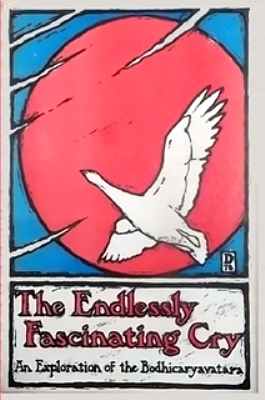
The Endlessly Fascinating Cry
From Bodhicitta
| 🤓 Admin Zone 🛠️ hidden to non-admins | |
The Endlessly Fascinating Cry: An Exploration of the Bodhicaryāvatāra
Book
- A Great Commentary on Shantideva's Guide to the Bodhisattva's Way of Life, Vol. 1
- A Guide to the Bodhisattva's Way of Life (1999)
- A Guide to the Bodhisattva's Way of Life of Shantideva (2002)
- Becoming Bodhisattvas
- Bodhicaryāvatāra para Parama Pāvana Dalāi Lāmā Jī ka viśesha pravacana
- Buddha Mind - Christ Mind
- Discourses on Bodhicharyāvatāra
- Engaging in the Bodhisattva Deeds
- Entering the Way of the Bodhisattva: A New Translation and Contemporary Guide
- For the Benefit of All Beings
- Guide to the Bodhisattva's Way of Life (Bodhicaryavatara): A Commentary by Geshe Tenzin Zopa
- Healing Anger
- No Time to Lose
- Patience: A Guide to Shantideva's Sixth Chapter (Zopa 2020)
- Peaceful Heart
- Perfecting Patience
- Perfecting Wisdom
- Practicing Wisdom
- Shantideva and Friends
- Shantideva's Guide to the Bodhisattva's Way Of Life: An Oral Explanation of Chapter 4
- Shantideva's Guide to the Bodhisattva's Way Of Life: An Oral Explanation of Chapter 5
- Shantideva's Guide to the Bodhisattva's Way Of Life: An Oral Explanation of Chapter 6
- Shantideva's Guide to the Bodhisattva's Way Of Life: An Oral Explanation of Chapter 7
- Shantideva's Guide to the Bodhisattva's Way Of Life: An Oral Explanation of Chapter 8
- Shantideva's Guide to the Bodhisattva's Way of Life: An Oral Explanation of Chapter 1
- Shantideva's Guide to the Bodhisattva's Way of Life: An Oral Explanation of Chapter 2
- Shantideva's Guide to the Bodhisattva's Way of Life: An Oral Explanation of Chapter 3
- The Beautiful Way of Life
- The Bodhisattva Guide
- The Endlessly Fascinating Cry
- The Entrance for the Children of the Conquerors
- The Transmission of the Bodhicaryāvatāra: The History, Diffusion, and Influence of a Mahāyāna Buddhist Text
- Transcendent Wisdom (1988)
- Transcendent Wisdom (2009)
Please note that many items in our library are simply pages that represent a detailed library catalog entry and citation of someone else's work, presentation, or performance. Read our General Disclaimer for more information.

Description
[A] commentary on Śāntideva's classic 8th-century text, the Bodhicaryāvatāra, based on a seminar given in 1973, in the very early days of Triratna, thus shaping the newly emerging Buddhist movement. The seminar was titled The Endlessly Fascinating Cry, echoing Śāntideva's fervent prayer: 'In order to grasp this jewel of the mind, I offer ... the endlessly fascinating cry of wild geese'. (Adapted from Source Mar 8, 2021)
Sangharakshita follows the English translation of the text by Marion Matics entitled Entering the Path of Enlightenment published in 1970.
Citation
Sangharakshita, Bhikshu. The Endlessly Fascinating Cry: An Exploration of the Bodhicaryāvatāra. Berkeley: Shambhala Publications, 1977 or 1978. https://www.freebuddhistaudio.com/texts/seminartexts/SEM063_Endlessly_Fascinating_Cry_-_Complete_Text.pdf.
Interconnections
1 Teaching based on

An "Introduction to Bodhisattva Practice," the Bodhisattvacaryāvatāra is a poem about the path of a bodhisattva, in ten chapters, written by the Indian Buddhist Śāntideva (fl. c. 685–763). One of the masterpieces of world literature, it is a core text of Mahāyāna Buddhism and continues to be taught, studied, and commented upon in many languages and by many traditions around the world. The main subject of the text is bodhicitta, the altruistic aspiration for enlightenment, and the path and practices of the bodhisattva, the six perfections (pāramitās). The text forms the basis of many contemporary discussions of Buddhist ethics and philosophy.