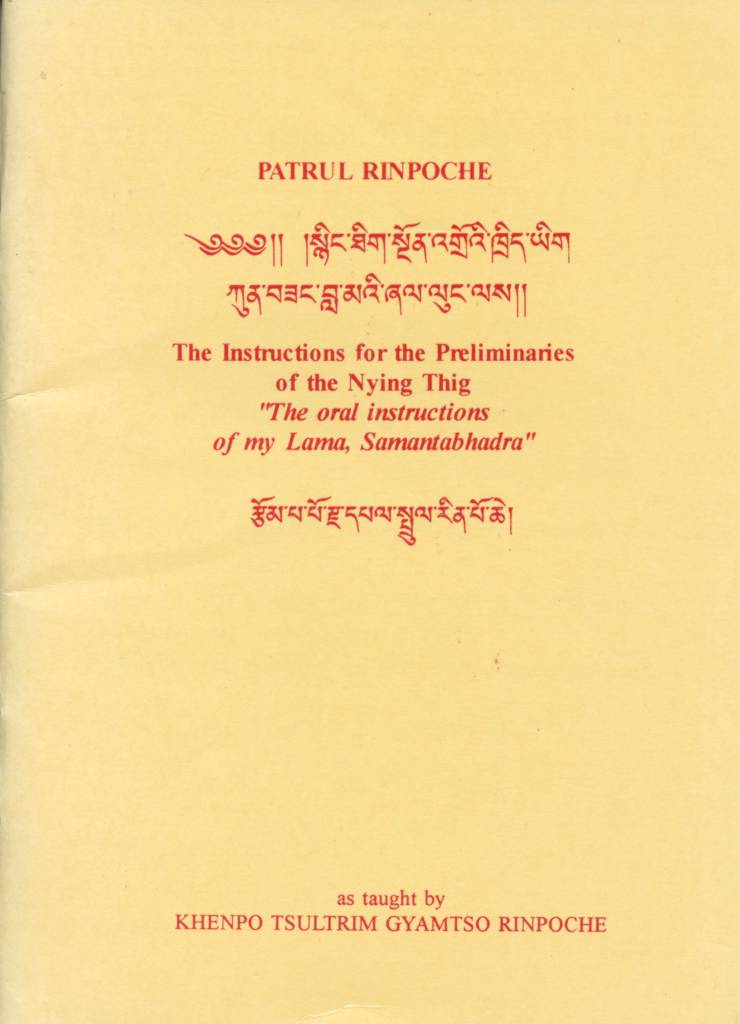
Kun bzang bla ma'i zhal lung
| 🤓 Admin Zone 🛠️ hidden to non-admins | |


Description
-front.jpg)
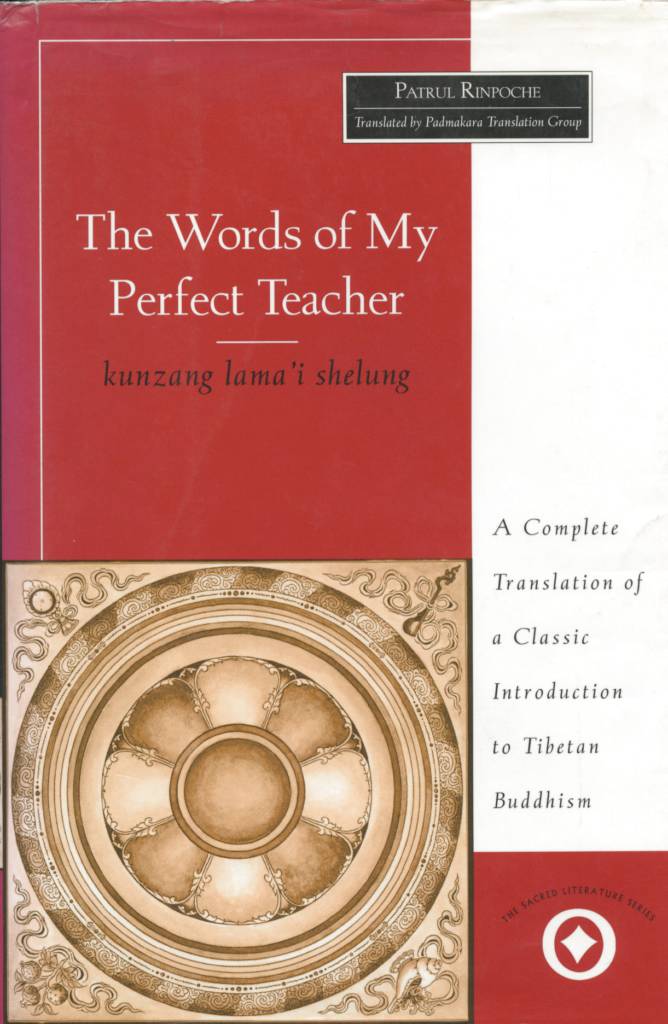
The Words of My Perfect Teacher is the classic commentary on the preliminary practices of the Longchen Nyingtig - one of the best-known cycles of teaching and a spiritual treasure of the Nyingmapa school - the oldest Tibetan Buddhist tradition.
Patrul Rinpoche makes the technicalities of his subject accessible through a wealth of stories, quotations, and references to everyday life. His style of mixing broad colloquialisms, stringent irony, and poetry has all the life and atmosphere of an oral teaching. Great care has been taken by the translators to render the precise meaning of the text in English while still reflecting the vigor and insight of the original Tibetan.
A preface by His Holiness the Dalai Lama, insightful introductory essays, explanatory notes, and classic illustrations enhance this quintessential introduction to Tibetan Buddhist practice. (Source Accessed April 18, 2025)
Patrul Rinpoche makes the technicalities of his subject accessible through a wealth of stories, quotations, and references to everyday life. His style of mixing broad colloquialisms, stringent irony, and poetry has all the life and atmosphere of an oral teaching. Great care has been taken by the translators to render the precise meaning of the text in English while still reflecting the vigor and insight of the original Tibetan.
A preface by His Holiness the Dalai Lama, insightful introductory essays, explanatory notes, and classic illustrations enhance this quintessential introduction to Tibetan Buddhist practice. This new edition includes translations of a postface to the text written a century ago (for the first printed edition in Tibetan) by the first Jamgon Kongtrul Rinpoche, and a new preface by the late Dilgo Khyentse Rinpoche. The notes, glossary and bibliography have been expanded and updated, Sanskrit names and terminology have been given their proper transliterated form, and the illustrations have been improved in quality and supplemented with new material.


- 1. The Difficulty of Obtaining a Well-endowed Human Body That Has Leisure
- 2. The Impermanence of Life
- 3. The Misery of Samsara
- 4. The Cause and Effect of Karma
- 5. The Benefit of Attaining Freedom from Worldly Miseries
- 6. Following a Spiritual Teacher

Part Two, the Unique Inner Preliminary, contains the preparatory practices that lay the foundation for the profound Vajrayana means that lead ultimately to the understanding of Dzog-ch'en. This being the highest state of the Mind, we have to be extremely careful in building the foundation for our sure success. Without this, our attempt to attain Dzog-ch'en is like jumping hopefully in the air to catch the moon.
Part Two teaches the following six profound Vajrayana techniques that instantaneously transmute one's coarse body, speech, and mind into the highest eternal body, speech, and mind of Buddhahood:
- 1. Taking Refuge
- 2. The Development of the Supreme Bodhicitta
- 3. The Visualization and Mantra of Guru Vajrasattva
- 4. The Mandala
- 5. The Simultaneous Destruction of the Four Maras: The Pauper's Method of Earning Merit
- 6. The Guru Yoga
The first chapter, “Taking Refuge,” shows how to take refuge in the never-failing Buddha, Dharma, and Sangha, which essentially refers to the realization of one's Primordial Mind. The second chapter, “The Development of the Supreme Bodhicitta,” teaches how to transcend the egoistic mind by developing the Supreme Bodhicitta—the profound, compassionate motivation to bring present happiness and the ultimate realization of Buddhahood to all sentient beings. These two chapters contain the fundamental prerequisites that have the alchemic power to change the base, ignorant mind into the most valuable Buddha Mind. The remaining four practices, contained in the four chapters that follow, are transcendent means for removing untoward obstacles towards this end.
Part Three contains instructions on p'o-wa, the method of transferring one's own or another's consciousness to a higher level. This shortcut method should only be practiced under the close guidance of a realized Guru.
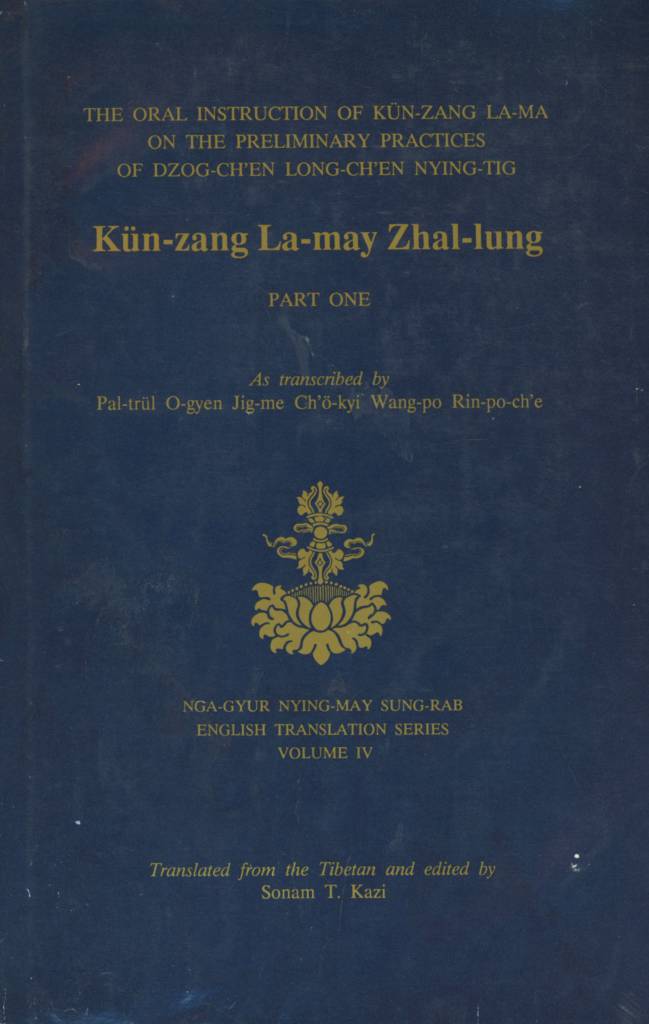
As the success of the techniques taught in Kün-zang La-may Zhal-lung depends, among other things, on one's correct meditation and visualization, an appendix of line drawings containing some important letters and figures connected with the visualizations has been provided as a guide at the back of the second volume. A second appendix provides notes on a few Tibetan terms that may require careful consideration for beginners. Important notes on xylographic errors and omissions in the main text that have hitherto been overlooked and which deserve special attention by the reader are also included. (Source Accessed April 21, 2025)
This volume, Volume VI of the Nga-gyur Nying-may Sung-rab English Translation Series, presents the common outer preliminary practices, and Volume V will present the unique inner preliminaries and the chapter on P'o-wa.
Each of the six chapters of the common outer preliminary practices consists of two sections:
- 1. the manner of listening to the teaching;
- 2. the teaching itself.
The manner of listening to the teaching consists of a set of extremely important techniques which have to be used not only as a preparation before beginning every new chapter, but also as a guiding principle in following Buddhism. Ultimate success depends on these profound secret techniques of the Pāramitāyāna and Vajrayāna. These techniques can be summed up as the development of universal compassion, called Bodhicitta, the understanding of the doctrine of Śūnyatā, and the goal of the attainment of Buddhahood by all the sentient beings.
The following are the essential teachings of the six chapters:
Chapter One explains the most valuable leisure, having eighteen endowments that are difficult to obtain, that provides us with the great opportunity to work for our freedom.
Chapter Two reminds us of the impermanence of life—the precarious nature of our existence. If we fail to take advantage of this most valuable leisure, we will be destroyed by death and miss the opportunity to liberate ourselves and others.
Chapter Three teaches us that if we fail to obtain freedom, hereafter we will again suffer in one of the six regions of saṃsāra. Knowledge of the miseries of saṃsāra should therefore prevent us from accruing the causes for reappearing in it.
Chapter Four shows us the causes for the ephemeral happines and unhappiness that shackle us forever in saṃsāra. We should stop earning such karma and earnestly look for eternal freedom.
Chapter Five explains that the only way to escape saṃsāra is to attain our innate eternal life and happiness. This will be attained the moment we realize nirvāṇa—whether it be the Hinayanic nirvāṇa or the Mahayanic nirvāṇa.
Chapter Six teaches us how ot find a real Guru, how to follow a Guru, and how to attain the ultimate goal by knowing the Guru's mind. (introduction, xxiv–xxv)_.jpg)
-front.jpg)

Words of My Perfect Teacher is the most recent of our texts in this series of teachings. The great scholar-yogi Dza Patrul Rinpoche (1808-1887 CE) composed it while on solitary retreat. The texts begin with the common preliminary teachings on impermanence, karma, and suffering – topics that lead the mind towards dharma. The topics of refuge and bodhicitta are elucidated with a rich variety of analogies and stories that inspire the mind and heart with their relevance. The second part of the text covers the uncommon preliminaries – gateways to the Vajrayāna such as mandala offerings, Vajrasattva Practice, and the Chod Severance.
This volume, Volume VI of the Nga-gyur Nying-may Sung-rab English Translation Series, presents the common outer preliminary practices, and Volume V will present the unique inner preliminaries and the chapter on P'o-wa.
Each of the six chapters of the common outer preliminary practices consists of two sections:
- 1. the manner of listening to the teaching;
- 2. the teaching itself.
The manner of listening to the teaching consists of a set of extremely important techniques which have to be used not only as a preparation before beginning every new chapter, but also as a guiding principle in following Buddhism. Ultimate success depends on these profound secret techniques of the Pāramitāyāna and Vajrayāna. These techniques can be summed up as the development of universal compassion, called Bodhicitta, the understanding of the doctrine of Śūnyatā, and the goal of the attainment of Buddhahood by all the sentient beings.
The following are the essential teachings of the six chapters:
Chapter One explains the most valuable leisure, having eighteen endowments that are difficult to obtain, that provides us with the great opportunity to work for our freedom.
Chapter Two reminds us of the impermanence of life—the precarious nature of our existence. If we fail to take advantage of this most valuable leisure, we will be destroyed by death and miss the opportunity to liberate ourselves and others.
Chapter Three teaches us that if we fail to obtain freedom, hereafter we will again suffer in one of the six regions of saṃsāra. Knowledge of the miseries of saṃsāra should therefore prevent us from accruing the causes for reappearing in it.
Chapter Four shows us the causes for the ephemeral happines and unhappiness that shackle us forever in saṃsāra. We should stop earning such karma and earnestly look for eternal freedom.
Chapter Five explains that the only way to escape saṃsāra is to attain our innate eternal life and happiness. This will be attained the moment we realize nirvāṇa—whether it be the Hinayanic nirvāṇa or the Mahayanic nirvāṇa.
Chapter Six teaches us how ot find a real Guru, how to follow a Guru, and how to attain the ultimate goal by knowing the Guru's mind. (introduction, xxiv–xxv)- 1. The Difficulty of Obtaining a Well-endowed Human Body That Has Leisure
- 2. The Impermanence of Life
- 3. The Misery of Samsara
- 4. The Cause and Effect of Karma
- 5. The Benefit of Attaining Freedom from Worldly Miseries
- 6. Following a Spiritual Teacher
Part Two, the Unique Inner Preliminary, contains the preparatory practices that lay the foundation for the profound Vajrayana means that lead ultimately to the understanding of Dzog-ch'en. This being the highest state of the Mind, we have to be extremely careful in building the foundation for our sure success. Without this, our attempt to attain Dzog-ch'en is like jumping hopefully in the air to catch the moon.
Part Two teaches the following six profound Vajrayana techniques that instantaneously transmute one's coarse body, speech, and mind into the highest eternal body, speech, and mind of Buddhahood:
- 1. Taking Refuge
- 2. The Development of the Supreme Bodhicitta
- 3. The Visualization and Mantra of Guru Vajrasattva
- 4. The Mandala
- 5. The Simultaneous Destruction of the Four Maras: The Pauper's Method of Earning Merit
- 6. The Guru Yoga
The first chapter, “Taking Refuge,” shows how to take refuge in the never-failing Buddha, Dharma, and Sangha, which essentially refers to the realization of one's Primordial Mind. The second chapter, “The Development of the Supreme Bodhicitta,” teaches how to transcend the egoistic mind by developing the Supreme Bodhicitta—the profound, compassionate motivation to bring present happiness and the ultimate realization of Buddhahood to all sentient beings. These two chapters contain the fundamental prerequisites that have the alchemic power to change the base, ignorant mind into the most valuable Buddha Mind. The remaining four practices, contained in the four chapters that follow, are transcendent means for removing untoward obstacles towards this end.
Part Three contains instructions on p'o-wa, the method of transferring one's own or another's consciousness to a higher level. This shortcut method should only be practiced under the close guidance of a realized Guru.
As the success of the techniques taught in Kün-zang La-may Zhal-lung depends, among other things, on one's correct meditation and visualization, an appendix of line drawings containing some important letters and figures connected with the visualizations has been provided as a guide at the back of the second volume. A second appendix provides notes on a few Tibetan terms that may require careful consideration for beginners. Important notes on xylographic errors and omissions in the main text that have hitherto been overlooked and which deserve special attention by the reader are also included. (Source Accessed April 21, 2025)
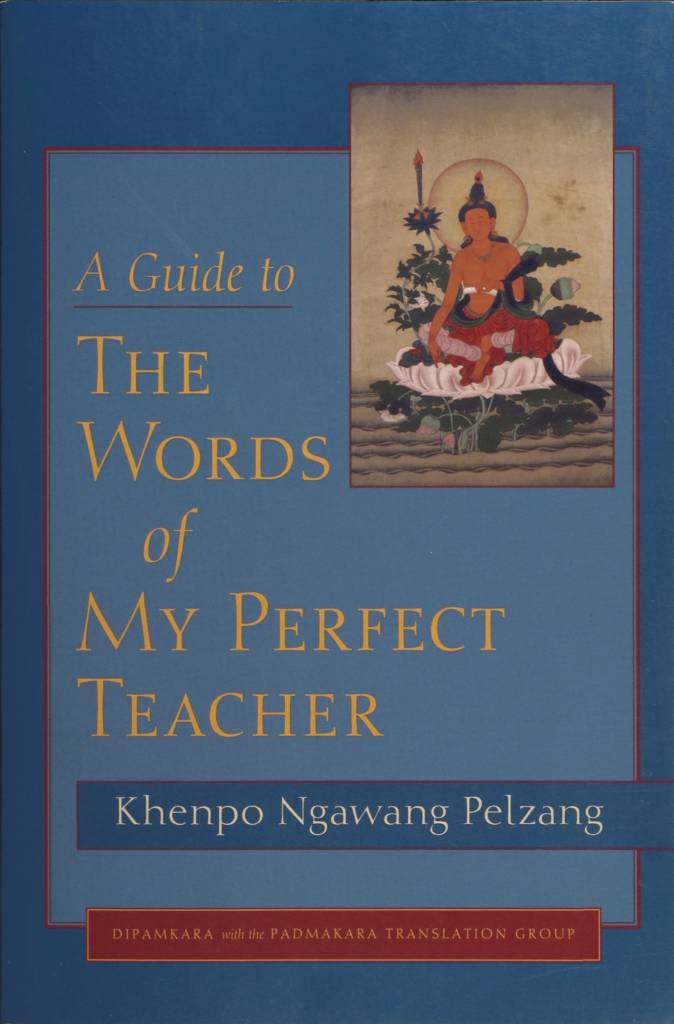
Ces Notes sont le seul commentaire de l'ouvrage de Patrul Rinpoché que l'on connaisse à ce jour. Elles en sont, par ailleurs, le complément indispensable. De façon claire et profonde, elles fournissent au pratiquant d'utiles informations sur l'arrière-plan théorique et le fondement de la pratique de la voie bouddhiste en général, mais aussi un grand nombre de conseils pratiques sur la façon de pratiquer, pendant les séances de méditation aussi bien qu'entre les séances.
Khenpo Nwawang Palzang était un être hors du commun qui, à l'âge de vint-et-un ans, avait déjà parcouru toutes les étapes de la voie jusqu'au niveau ultime de la Grande Perfection. Communément appelé Khenpo Ngagchoung ou Khenpo Ngaga, il fut l'un des maîtres tibétains de plus remarquables de son époque, à la fois par son érudition, sa réalisation et la lignée de ses réincarnations successives. Il était, en particulier, l'une de ces manifestations suprêmes de Gyalwa Longchenpa qui apparaissent une fois par siècle. (Source: Back Cover)This volume, Volume VI of the Nga-gyur Nying-may Sung-rab English Translation Series, presents the common outer preliminary practices, and Volume V will present the unique inner preliminaries and the chapter on P'o-wa.
Each of the six chapters of the common outer preliminary practices consists of two sections:
- 1. the manner of listening to the teaching;
- 2. the teaching itself.
The manner of listening to the teaching consists of a set of extremely important techniques which have to be used not only as a preparation before beginning every new chapter, but also as a guiding principle in following Buddhism. Ultimate success depends on these profound secret techniques of the Pāramitāyāna and Vajrayāna. These techniques can be summed up as the development of universal compassion, called Bodhicitta, the understanding of the doctrine of Śūnyatā, and the goal of the attainment of Buddhahood by all the sentient beings.
The following are the essential teachings of the six chapters:
Chapter One explains the most valuable leisure, having eighteen endowments that are difficult to obtain, that provides us with the great opportunity to work for our freedom.
Chapter Two reminds us of the impermanence of life—the precarious nature of our existence. If we fail to take advantage of this most valuable leisure, we will be destroyed by death and miss the opportunity to liberate ourselves and others.
Chapter Three teaches us that if we fail to obtain freedom, hereafter we will again suffer in one of the six regions of saṃsāra. Knowledge of the miseries of saṃsāra should therefore prevent us from accruing the causes for reappearing in it.
Chapter Four shows us the causes for the ephemeral happines and unhappiness that shackle us forever in saṃsāra. We should stop earning such karma and earnestly look for eternal freedom.
Chapter Five explains that the only way to escape saṃsāra is to attain our innate eternal life and happiness. This will be attained the moment we realize nirvāṇa—whether it be the Hinayanic nirvāṇa or the Mahayanic nirvāṇa.
Chapter Six teaches us how ot find a real Guru, how to follow a Guru, and how to attain the ultimate goal by knowing the Guru's mind. (introduction, xxiv–xxv)The Words of My Perfect Teacher is the classic commentary on the preliminary practices of the Longchen Nyingtig - one of the best-known cycles of teaching and a spiritual treasure of the Nyingmapa school - the oldest Tibetan Buddhist tradition.
Patrul Rinpoche makes the technicalities of his subject accessible through a wealth of stories, quotations, and references to everyday life. His style of mixing broad colloquialisms, stringent irony, and poetry has all the life and atmosphere of an oral teaching. Great care has been taken by the translators to render the precise meaning of the text in English while still reflecting the vigor and insight of the original Tibetan.
A preface by His Holiness the Dalai Lama, insightful introductory essays, explanatory notes, and classic illustrations enhance this quintessential introduction to Tibetan Buddhist practice. (Source Accessed April 18, 2025)Patrul Rinpoche makes the technicalities of his subject accessible through a wealth of stories, quotations, and references to everyday life. His style of mixing broad colloquialisms, stringent irony, and poetry has all the life and atmosphere of an oral teaching. Great care has been taken by the translators to render the precise meaning of the text in English while still reflecting the vigor and insight of the original Tibetan.
A preface by His Holiness the Dalai Lama, insightful introductory essays, explanatory notes, and classic illustrations enhance this quintessential introduction to Tibetan Buddhist practice. This new edition includes translations of a postface to the text written a century ago (for the first printed edition in Tibetan) by the first Jamgon Kongtrul Rinpoche, and a new preface by the late Dilgo Khyentse Rinpoche. The notes, glossary and bibliography have been expanded and updated, Sanskrit names and terminology have been given their proper transliterated form, and the illustrations have been improved in quality and supplemented with new material.Words of My Perfect Teacher is the most recent of our texts in this series of teachings. The great scholar-yogi Dza Patrul Rinpoche (1808-1887 CE) composed it while on solitary retreat. The texts begin with the common preliminary teachings on impermanence, karma, and suffering – topics that lead the mind towards dharma. The topics of refuge and bodhicitta are elucidated with a rich variety of analogies and stories that inspire the mind and heart with their relevance. The second part of the text covers the uncommon preliminaries – gateways to the Vajrayāna such as mandala offerings, Vajrasattva Practice, and the Chod Severance.