A Guide to The Words of My Perfect Teacher
From Bodhicitta
< BooksBooks/A Guide to The Words of My Perfect Teacher
| 🤓 Admin Zone 🛠️ hidden to non-admins | |
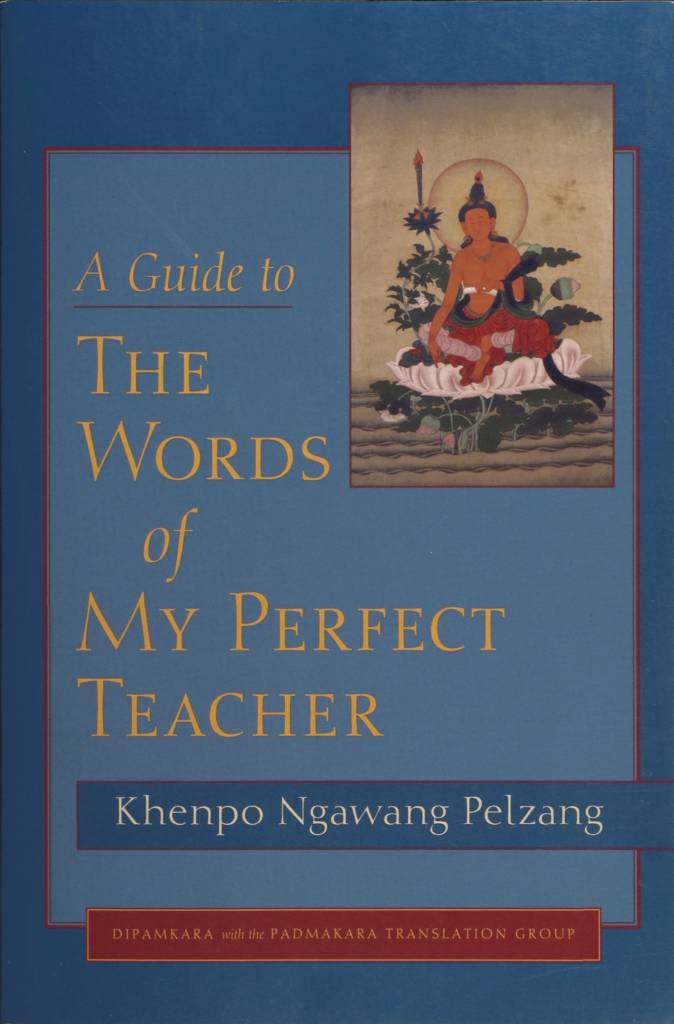
A Guide to The Words of My Perfect Teacher
Book
Please note that many items in our library are simply pages that represent a detailed library catalog entry and citation of someone else's work, presentation, or performance. Read our General Disclaimer for more information.

Description
This guide provides readers with essential background information for studying and practicing with Patrul Rinpoche's Words of My Perfect Teacher—the text that has, for more than a century, served as the reliable sourcebook to the spiritual practices common to all the major schools of Tibetan Buddhism. By offering chapter-by-chapter commentary on this renowned work, Khenpo Pelzang provides a fresh perspective on the role of the teacher; the stages of the path; the view of the Three Jewels; Madhyamika, the basis of transcendent wisdom; and much more. (Source: Shambhala Publications)
Citation
Ngawang Pelzang. A Guide to The Words of My Perfect Teacher. Translated by Dipamkara with the Padmakara Translation Group. Edited by Stephen Gethin. Boston: Shambhala Publications, 2004.
Table of contents
- List of Illustrations xvii
- Foreword by Alak Zenkar Rinpoche xix
- Translators' Introduction xxi
- A Guide to The Words of My Perfect Teacher
- Introduction 3
- PART ONE: THE ORDINARY OR OUTER PRELIMINARIES 13
- Chapter One: The Difficulty of Finding the Freedoms and Advantages 17
- I. THE PROPER WAY TO LISTEN TO SPIRITUAL TEACHING 18
- 1. Attitude 18
- 2. Conduct 35
- II. THE TEACHING ITSELF 39
- 1. Reflecting on the Nature of Freedom 44
- 2. Reflecting on the Ten Particular Advantages Related to Dharma 47
- 3. Reflecting on Images That Show How Difficult It Is to Find the Freedoms and Advantages 50
- I. THE PROPER WAY TO LISTEN TO SPIRITUAL TEACHING 18
- Chapter Two: The Impermanence of Life 55
- I. THE IMPERMANENCE OF THE OUTER UNIVERSE IN WHICH BEINGS LIVE 55
- II. THE IMPERMANENCE OF BEINGS LIVING IN THE UNIVERSE 57
- VI. THE UNCERTAINTY OF THE CIRCUMSTANCES OF DEATH 58
- VII. INTENSE AWARENESS OF IMPERMANENCE 61
- Chapter Three: The Defects of Samsara 62
- I. THE DEFECTS OF SAMSARA IN GENERAL 64
- II. THE PARTICULAR SUFFERINGS EXPERIENCED BY THE BEINGS OF EACH OF THE SIX REALMS 64
- Chapter Four: Actions: The Principle of Cause and Effect 67
- I. NEGATIVE ACTIONS TO BE ABANDONED 74
- 1. Explanation of the Negative Actions to be Abandoned 74
- 2. Explanation of Their Effects 74
- II. POSITIVE ACTIONS TO BE ADOPTED 75
- III. THE ALL-DETERMINING QUALITY OF ACTIONS 75
- I. NEGATIVE ACTIONS TO BE ABANDONED 74
- Chapter Five: The Benefits of Liberation 83
- Chapter Six: How to Follow a Spiritual Friend 87
- I. EXAMINING THE TEACHER 87
- II. FOLLOWING THE TEACHER 89
- III. EMULATING THE TEACHER'S REALIZATION AND ACTIONS 89
- PART TWO: THE EXTRAORDINARY OR INNER PRELIMINARIES 91
- Chapter One: Taking Refuge, the Foundation Stone of All Paths 93
- I. APPROACHES TO TAKING REFUGE 95
- II. HOW TO TAKE REFUGE 99
- III. PRECEPTS AND BENEFITS OF TAKING REFUGE 128
- 1. The Precepts of Taking Refuge 128
- 2. The Benefits ofTaking Refuge 130
- Chapter Two: Arousing Bodhichitta, the Root of the Great Vehicle 133
- I. TRAINING THE MIND IN THE FOUR BOUNDLESS QUALITIES 134
- 1. Impartiality 137
- 2. Love 145
- 3. Compassion 148
- 4. Sympathetic Joy 150
- II. AROUSING BODHICHITTA, THE MIND OF SUPREME ENLIGHTENMENT 151
- III. TRAINING IN THE BODHICHITTA PRECEPTS 162
- 1. Training in the Precepts of the Bodhichitta of Aspiration 162
- 2. Training in the Precepts of the Bodhichitta of Application 181
- I. TRAINING THE MIND IN THE FOUR BOUNDLESS QUALITIES 134
- Chapter Three: Meditating on the Teacher as Vajrasattva and Reciting His Mantra so as to Cleanse All Adverse Circumstances, Negative Actions, and Obscurations 221
- I. HOW NEGATIVE ACTIONS CAN BE PURIFIED THROUGH CONFESSION 221
- II. HOW TO CONFESS NEGATIVE ACTIONS 226
- III. THE ACTUAL MEDITATION AND RECITATION ON VAJRASATTVA 227
- Chapter Four: Offering the Mandala to Accumulate Merit and Wisdom 233
- I. THE NEED FOR THE TWO ACCUMULATIONS 233
- II. THE ACCOMPLISHMENT MANDALA 239
- III. THE OFFERING MANDALA 240
- Chapter Five: The Kusali's Accumulation: Destroying the Four Demons at a Single Stroke 244
- GIVING ONE'S BODY 245
- THE MEANING OF CHÖ 246
- THE ACTUAL PRACTICE OF OFFERING THE BODY 249
- Chapter Six: The Profound Guru Yoga, the Ultimate Method for Arousing the Wisdom of Realization in One's Mind 253
- I. THE REASON FOR GURU YOGA: A COMPARISON OF THE ROLE OF THE TEACHER IN THE NINE YANAS 253
- II. HOW TO PRACTICE GURU YOGA 265
- 1. Visualizing the Field of Merit 266
- 2. Offering the Seven Branches 267
- 3. Praying with Resolute Trust 274
- 4. Taking the Four Empowerments 277
- PART THREE: THE SWIFT PATH OF TRANSFERENCE 281
- I. THE FIVE KINDS OF TRANSFERENCE 282
- 1. Superior Transference to the Dharmakaya through the Seal of the View 282
- 2. Middling Transference to the Sambhogakaya through the Union of the Generation and Perfection Phases 283
- 3. Lower Transference to the Nirmanakaya through Immeasurable Compassion 283
- 4. Ordinary Transference Using Three Images 283
- 5. Transference Performed for the Dead 284
- I. THE FIVE KINDS OF TRANSFERENCE 282
- II. THE PRACTICE OF TRANSFERENCE USING THREE IMAGES 284
- 1. Training for Transference 284
- 2. Actual Transference 284
- Concluding Instructions 287
- Prayers 289
- Notes 295
- Glossary 319
- The Three Worlds 327
- The Five Bodhisattva Paths and the Thirty-seven Elements Leading to Enlightenment 329
- Comparative Glossary 331
- Bibliography 341
- Index 347
Interconnections
1 Full translation of

Nyingma master Khenpo Ngawang Pelzang's (Khenpo Ngaga, 1879-1941) notes on Patrul Rinpoche's famous Words of My Perfet Teacher, a contemplative guidebook to the preliminary practices of the Longchen Nyingthig.
1 Modern commentary of
.jpg)
Patrul Rinpoche's famous contemplative guidebook to the preliminary practices of the Longchen Nyingthig he wrote based on the teachings he repeatedly received from his teacher, Jigme Gyalwai Nyugu.
Kun bzang bla m a'i zhal lung. (Kunzang Lame Shelung). In Tibetan, "Words of My Perfect Teacher," a popular Buddhist text, written by the celebrated nineteenth- century Tibetan luminary Dpal sprul Rinpoche during a period of prolonged retreat at his cave hermitage above Rdzogs chen monastery in eastern Tibet. It explains the preliminary practices (sngon 'gro) for the klong chen snying thig ("Heart Essence of the Great Expanse"), a system of Rnying ma doctrine and meditation instruction stemming from the eighteenth-century treasure revealer (gter ston) 'Jigs med gling pa. The work is much loved for its direct, nontechnical approach and for its heartfelt practical advice. Dpal sprul Rin po che's language ranges from lyrical poetry to the vernacular, illustrating points of doctrine with numerous scriptural quotations, accounts from the lives of past Tibetan saints, and examples from everyday life— many of which refer to cultural practices specific to the author’s native land. While often considered a Rnying ma text, the Kun bzang bla m ai zhal lung is read widely throughout the sects of Tibetan Buddhism, a readership presaged by the author's participation in the Ris med or so-called nonsectarian movement of eastern Tibet during the nineteenth century. (Source: "Kun bzang bla ma'i zhal lung" In The Princeton Dictionary of Buddhism, 455. Princeton University Press, 2014. http://www.jstor.org/stable/j.ctt46n41q.27.)