| 🤓 Admin Zone 🛠️ hidden to non-admins | |

Description
- 1. The Difficulty of Obtaining a Well-endowed Human Body That Has Leisure
- 2. The Impermanence of Life
- 3. The Misery of Samsara
- 4. The Cause and Effect of Karma
- 5. The Benefit of Attaining Freedom from Worldly Miseries
- 6. Following a Spiritual Teacher
If thoroughly understood from the core of our heart, these chapters provide the precious wisdom that enables us to dissolve our ignorant attachment to phenomenal existence, and the wisdom to look for the eternal liberation that is innate in us. (Source Accessed April 21, 2025)
- List of Color Platesvii
- Translation and Pronunciation Notesix
- Preface by Cha-tral Rin-po-ch'exi
- Introductionxxiii
- Kün-zang La-may Zhal-lung, Part One1
- 1. The Difficulty of Obtaining Leisure and Endowment7
- 2. The Impermanence of Life57
- 3. The Misery of Saṃsāra85
- 4. The Cause and Effect of Karma143
- Preface to Chapters Five and Six189
- 5. The Benefit of Freedom191
- 6. Following a Spiritual Teacher193
.jpg)

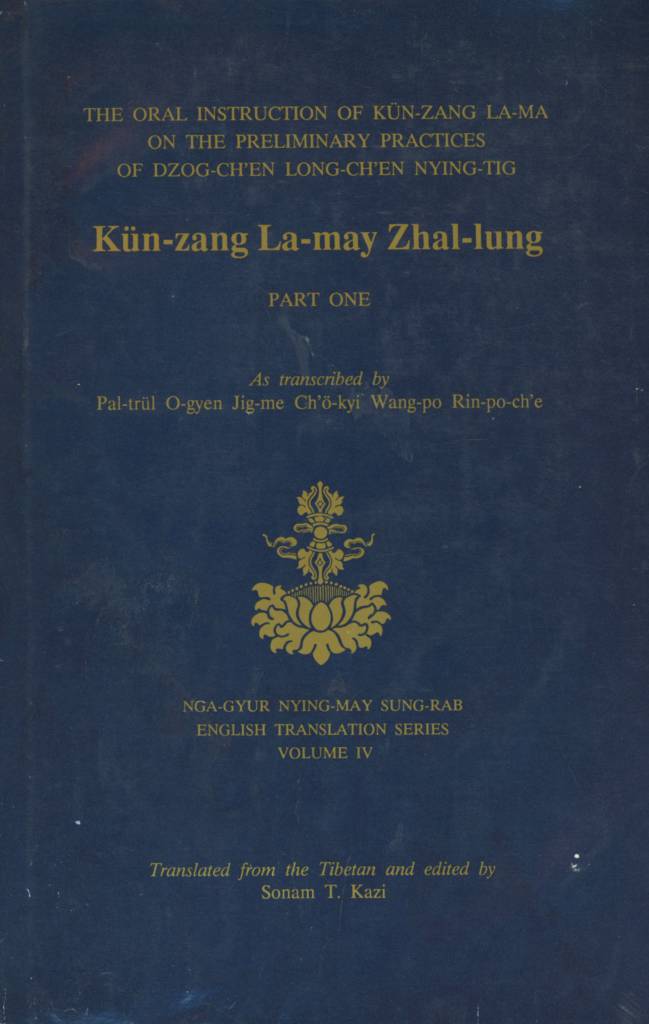
This volume, Volume VI of the Nga-gyur Nying-may Sung-rab English Translation Series, presents the common outer preliminary practices, and Volume V will present the unique inner preliminaries and the chapter on P'o-wa.
Each of the six chapters of the common outer preliminary practices consists of two sections:
- 1. the manner of listening to the teaching;
- 2. the teaching itself.
The manner of listening to the teaching consists of a set of extremely important techniques which have to be used not only as a preparation before beginning every new chapter, but also as a guiding principle in following Buddhism. Ultimate success depends on these profound secret techniques of the Pāramitāyāna and Vajrayāna. These techniques can be summed up as the development of universal compassion, called Bodhicitta, the understanding of the doctrine of Śūnyatā, and the goal of the attainment of Buddhahood by all the sentient beings.
The following are the essential teachings of the six chapters:
Chapter One explains the most valuable leisure, having eighteen endowments that are difficult to obtain, that provides us with the great opportunity to work for our freedom.
Chapter Two reminds us of the impermanence of life—the precarious nature of our existence. If we fail to take advantage of this most valuable leisure, we will be destroyed by death and miss the opportunity to liberate ourselves and others.
Chapter Three teaches us that if we fail to obtain freedom, hereafter we will again suffer in one of the six regions of saṃsāra. Knowledge of the miseries of saṃsāra should therefore prevent us from accruing the causes for reappearing in it.
Chapter Four shows us the causes for the ephemeral happines and unhappiness that shackle us forever in saṃsāra. We should stop earning such karma and earnestly look for eternal freedom.
Chapter Five explains that the only way to escape saṃsāra is to attain our innate eternal life and happiness. This will be attained the moment we realize nirvāṇa—whether it be the Hinayanic nirvāṇa or the Mahayanic nirvāṇa.
Chapter Six teaches us how ot find a real Guru, how to follow a Guru, and how to attain the ultimate goal by knowing the Guru's mind. (introduction, xxiv–xxv)
Part Two, the Unique Inner Preliminary, contains the preparatory practices that lay the foundation for the profound Vajrayana means that lead ultimately to the understanding of Dzog-ch'en. This being the highest state of the Mind, we have to be extremely careful in building the foundation for our sure success. Without this, our attempt to attain Dzog-ch'en is like jumping hopefully in the air to catch the moon.
Part Two teaches the following six profound Vajrayana techniques that instantaneously transmute one's coarse body, speech, and mind into the highest eternal body, speech, and mind of Buddhahood:
- 1. Taking Refuge
- 2. The Development of the Supreme Bodhicitta
- 3. The Visualization and Mantra of Guru Vajrasattva
- 4. The Mandala
- 5. The Simultaneous Destruction of the Four Maras: The Pauper's Method of Earning Merit
- 6. The Guru Yoga
The first chapter, “Taking Refuge,” shows how to take refuge in the never-failing Buddha, Dharma, and Sangha, which essentially refers to the realization of one's Primordial Mind. The second chapter, “The Development of the Supreme Bodhicitta,” teaches how to transcend the egoistic mind by developing the Supreme Bodhicitta—the profound, compassionate motivation to bring present happiness and the ultimate realization of Buddhahood to all sentient beings. These two chapters contain the fundamental prerequisites that have the alchemic power to change the base, ignorant mind into the most valuable Buddha Mind. The remaining four practices, contained in the four chapters that follow, are transcendent means for removing untoward obstacles towards this end.
Part Three contains instructions on p'o-wa, the method of transferring one's own or another's consciousness to a higher level. This shortcut method should only be practiced under the close guidance of a realized Guru.
As the success of the techniques taught in Kün-zang La-may Zhal-lung depends, among other things, on one's correct meditation and visualization, an appendix of line drawings containing some important letters and figures connected with the visualizations has been provided as a guide at the back of the second volume. A second appendix provides notes on a few Tibetan terms that may require careful consideration for beginners. Important notes on xylographic errors and omissions in the main text that have hitherto been overlooked and which deserve special attention by the reader are also included. (Source Accessed April 21, 2025)