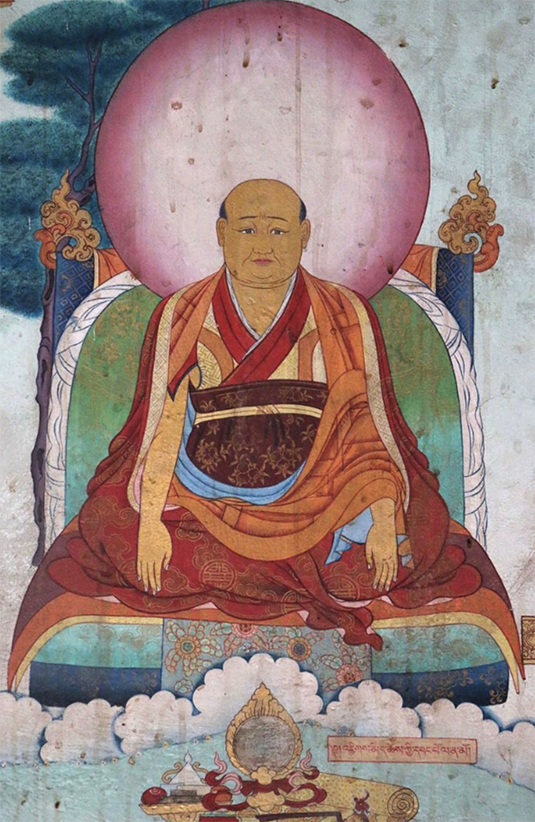
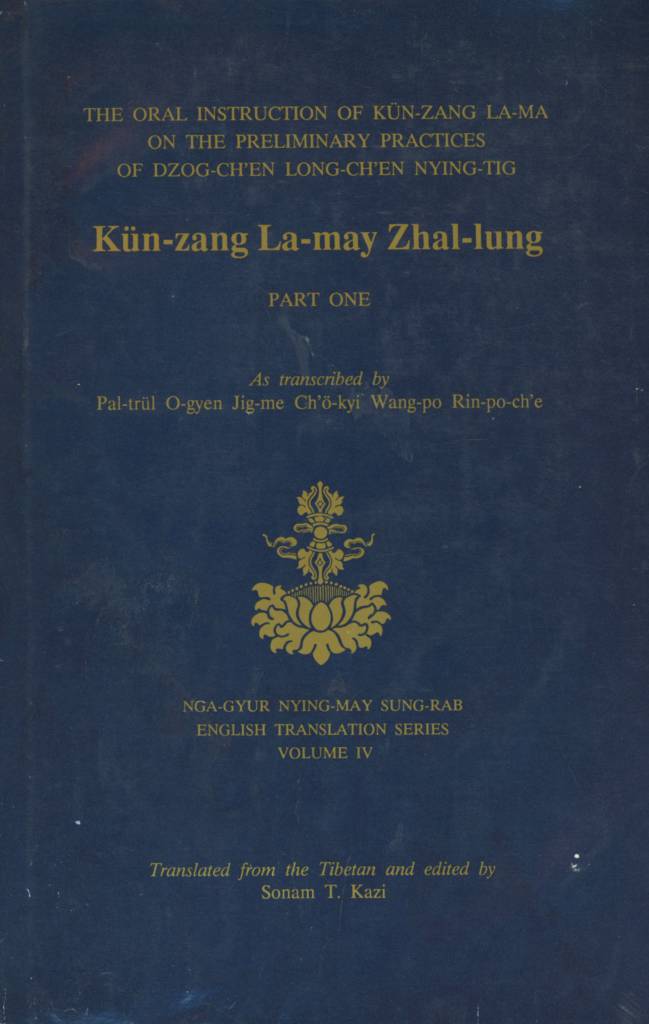
Kün-zang La-may Zhal-lung Part Two and Three
| 🤓 Admin Zone 🛠️ hidden to non-admins | |

Description
Part Two, the Unique Inner Preliminary, contains the preparatory practices that lay the foundation for the profound Vajrayana means that lead ultimately to the understanding of Dzog-ch'en. This being the highest state of the Mind, we have to be extremely careful in building the foundation for our sure success. Without this, our attempt to attain Dzog-ch'en is like jumping hopefully in the air to catch the moon.
Part Two teaches the following six profound Vajrayana techniques that instantaneously transmute one's coarse body, speech, and mind into the highest eternal body, speech, and mind of Buddhahood:
- 1. Taking Refuge
- 2. The Development of the Supreme Bodhicitta
- 3. The Visualization and Mantra of Guru Vajrasattva
- 4. The Mandala
- 5. The Simultaneous Destruction of the Four Maras: The Pauper's Method of Earning Merit
- 6. The Guru Yoga
The first chapter, “Taking Refuge,” shows how to take refuge in the never-failing Buddha, Dharma, and Sangha, which essentially refers to the realization of one's Primordial Mind. The second chapter, “The Development of the Supreme Bodhicitta,” teaches how to transcend the egoistic mind by developing the Supreme Bodhicitta—the profound, compassionate motivation to bring present happiness and the ultimate realization of Buddhahood to all sentient beings. These two chapters contain the fundamental prerequisites that have the alchemic power to change the base, ignorant mind into the most valuable Buddha Mind. The remaining four practices, contained in the four chapters that follow, are transcendent means for removing untoward obstacles towards this end.
Part Three contains instructions on p'o-wa, the method of transferring one's own or another's consciousness to a higher level. This shortcut method should only be practiced under the close guidance of a realized Guru.
As the success of the techniques taught in Kün-zang La-may Zhal-lung depends, among other things, on one's correct meditation and visualization, an appendix of line drawings containing some important letters and figures connected with the visualizations has been provided as a guide at the back of the second volume. A second appendix provides notes on a few Tibetan terms that may require careful consideration for beginners. Important notes on xylographic errors and omissions in the main text that have hitherto been overlooked and which deserve special attention by the reader are also included. (Source Accessed April 21, 2025)
- List of Color Platesxiii
- Translation and Pronunciation Notesxv
- Introductionxix
- KÜN-ZANG LA-MAY ZHAL-LUNG, PART TWO229
- One: Taking Refuge231
- 1 The Different Kinds of Taking Refuge231
- 1.1 The Three Types of Faith231
- 1.1.1 Faith Generated by Attraction232
- 1.1.2 Faith Generated by Desire232
- 1.1.3 Faith Generated out of Conviction232
- 1.2 Taking Refuge Classified by Type of Motivation238
- 1.2.1 The Small Being's Taking of Refuge238
- 1.2.2 The Mediocre Being's Taking of Refuge239
- 1.2.3 The Great Being's Taking of Refuge239
- 2 The Four Methods of Taking Refuge240
- 2.1 The Visualization241
- 2.2 The Practice of Forgiveness246
- 2.3 Concluding the Visualization248
- 3 The Advice on, and Benefits of, Taking Refuge249
- 3.1 The Three Things That Should Be Abandoned249
- 3.2 The Three Things That Should Be Adopted250
- 3.3 The Three Related Things That Should Also Be Adopted251
- 3.4 The Benefits of Taking Refuge257
- Two:The Development of the Supreme Bodhicitta265
- 1 Training the Mind in the Four Immeasurable Virtues266
- 1.1 Meditation on Impartiality266
- 1.2 Meditation on Loving-Kindness269
- 1.3 Meditation on Compassion274
- 1.4 Meditation on Empathetic Joy290
- 2 The Actual Development of Bodhicitta296
- 2.1 The Motivation296
- 2.1.1 The Motivation Classified by Mental Fortitude296
- 2.1.2 The Motivation Classified by the Stages of the Bodhisattva297
- 2.1.3 The Motivation Classified as Relative and Absolute298
- 2.1.3.1 The Relative Motivation298
- 2.1.3.2 The Absolute Motivation299
- 2.2 The Method of Developing Bodhicitta300
- 3 The Instructions on Developing Bodhicitta304
- 3.1 The Instruction on Theoretical Bodhicitta304
- 3.1.1 Meditation on How to Treat Others as Equal to Yourself304
- 3.1.2 Meditation on How to Exchange Yourself for Others306
- 3.1.3 Meditation on How to Treat Others More Affectionately than Yourself313
- 3.2 The Instruction on Practical Bodhicitta319
- 3.2.1 Transcendent Charity320
- 3.2.1.1 The Charity of Material Objects320
- 3.2.1.1.1 The Charity of Common Objects320
- 3.2.1.1.2 The Charity of Precious Objects322
- 3.2.1.1.3 The Charity of Extremely Precious Objects323
- 3.2.1.2 The Charity of Dharma323
- 3.2.1.3 The Charity of Providing Protection against Danger326
- 3.2.2 Transcendent Morality327
- 3.2.2.1 The Moral Laws for Refraining from Bad Conduct327
- 3.2.2.2 The Moral Laws for Acquiring Dharmic Merit328
- 3.2.2.3 The Moral Laws for Working for the Benefit of Sentient Beings329
- 3.2.3 Transcendent Forbearance329
- 3.2.3.1 Forbearance in Bearing Maltreatment by Others330
- 3.2.3.2 Forbearance in Enduring Hardship for the Sake of Dharma332
- 3.2.3.3 Forbearance in Hearing the Esoteric Teachings without Being Frightened335
- 3.2.4 Transcendent Perseverance337
- 3.2.4.1 Perseverance That Acts Like Armor337
- 3.2.4.2 Perseverance That Transcends Laziness338
- 3.2.4.3 Perseverance That Prevents You from Being Content339
- 3.2.5 Transcendent Mental Concentration341
- 3.2.5.1 The Concentration Practiced by Children345
- 3.2.5.2 The Concentration That Works for the Best Purpose346
- 3.2.5.3 The Meritorious Concentration of the Superior Bodhisattvas346
- 3.2.6 Transcendent Wisdom347
- 3.2.6.1 The Wisdom Obtained through Listening347
- 3.2.6.2 The Wisdom Obtained through Thinking348
- 3.2.6.3 The Wisdom Obtained through Meditation348
- Three: The Visualization and Mantra of Guru Vajrasattva367
- 1 The Four Antidotal Powers369
- 1.1 The Power of Objects Representing the Buddha's Body, Speech, and Mind369
- 1.2 The Power Attained through Repenting Past Misdeeds370
- 1.3 The Power of Vows371
- 1.4 The Power of the Practice Done as an Antidote371
- Four: The Maṇḍala395
- Five: The Simultaneous Destruction of the Four Maras: The Pauper's Method of Earning Merit415
- Six: The Guru Yoga431
- 1 The Visualization of the Paradise of the Assembly437
- 2 The Making of the Seven-Limbed Offering442
- 2.1 The First Limb: Prostrations442
- 2.2 The Second Limb: Making Votive Offerings448
- 2.3 The Third Limb: Doing Penance for the Absolution of Sin450
- 2.4 The Fourth Limb: Full Appreciation for the Good Deeds of Others, an Antidote for Jealousy451
- 2.5 The Fifth Limb: The Prayers to Preach the Dharma453
- 2.6 The Sixth Limb: Praying for Them Not to Retire in Nirvāṇa455
- 2.7 The Seventh Limb: The Dedication455
- 3 The Offering of Prayers with One-Pointed Concentration and Developing the Essence of the Four Vajra Natures460
- 4 Concluding Commentary with Reference to the Three Inner Yogas469
- 4.1 Gyal-wa Gong-pay Gyü-pa, the Buddhas' Mind-to-Mind Tradition469
- 4.2 Rig-dzin Da-yi Gyü-pa, the Rig-dzins' Gesture Tradition471
- 4.2.1 Mahāyoga472
- 4.2.2 Anuyoga472
- 4.2.3 Atiyoga473
- 4.2.4 How, after That, Atiyoga Appeared in the Human World477
- 4.3 Gang-zag Nyen-k'ung-du Gyü-pa, the Superior Beings' Ear-to-Ear Tradition: The Spreading of the Essential Doctrine in Tibet, the Land of Snow481
- KÜN-ZANG LA-MAY ZHAL-LUNG, PART THREE491
- One: Secret Instructions on Dying493
- 1 The Instruction on the Transference of Consciousness (P'o-wa), the Attainment of Buddhahood without Meditation493
- 1.1 The First Grade, Dharmakāya P'o-wa That Seals the Consciousness in the Doctrinal View494
- 1.2 The Second Grade, Sambhogakāya P'o-wa That Is Done by Means of Combining the Mahāyoga and Anuyoga Practices494
- 1.3 The Third Grade, Nirmanakāya P'o-wa of Immeasurable Mercy495
- 1.4 The Ordinary P'o-wa Performed by Means of Three Assumptions495
- 1.5 The Hooklike P'o-wa of Mercy to Help the Consciousness of the Deceased496
- 2 The Ordinary P'o-wa Performed by Means of Three Assumptions498
- 2.1 The Practice502
- 2.2 The Application502
- 2.2.1 The Sinking of the Five Senses503
- 2.2.2 The Sinking of the Four Elements504
- 2.2.3 The Sinking of the Three Visions Called Nang-ch'e T'ob-sum505
- Colophon517
- Appendix A529
- NOTE 1531
- (a)531
- (b)532
- (c)532
- (d)533
- NOTE 2533
- NOTE 3534
- NOTE 4534
- NOTE 5535
- NOTE 6535
- (a)536
- (b)536
- (c)537
- NOTE 7537
- NOTE 8538
- NOTE 1531
- Appendix B539
- Figure 1: Initial Vajrasattva visualization541
- Figure 2: Long and short Vajrasattva mantra542
- Figure 3: Vajrasattva visualization illustrating the purging of defilements544
- Figure 4: Vajrasattva visualization illustrating the four chakras545
- Figure 5: The five races of Vajrasattva546
- Figure 6: The dissolution of the syllables OṂ VAJRA SAT TVA HŪṂ547
- Figure 7: Drub-pay and Ch'ö-pay Maṇḍalas548
- Figure 8: Composition of the Drub-pay Maṇḍala549
- Figure 9: Different parts of a maṇḍala550
- Figure 10: Fully constructed Ch'ö-pay Maṇḍala551
- Figure 11: Composition of the "Thirty-Seven Point Maṇḍala"552
- Figure 12: Black Tr'o-ma554
- Figure 13: Skullcup on tripod of heads representing the Three Kāyas554
- Figure 14: Proper way of holding the palms555
- Figure 15: Proper way of positioning the palms while doing prostrations555
- Figure 16: Proper way of bringing the five principal points of the body to the ground556
.jpg)

- 1. The Difficulty of Obtaining a Well-endowed Human Body That Has Leisure
- 2. The Impermanence of Life
- 3. The Misery of Samsara
- 4. The Cause and Effect of Karma
- 5. The Benefit of Attaining Freedom from Worldly Miseries
- 6. Following a Spiritual Teacher